

You are using an out of date browser. It may not display this or other websites correctly.
You should upgrade or use an alternative browser.
You should upgrade or use an alternative browser.
How to stop “water hammer” in sprinkler system?
- Thread starter Quick01GT
- Start date
Innovate1
Well-known member
Not surprised HD can't help. Sometimes the people there have experience/knowledge beyond basics but often they don't.
You need some sort of expansion chamber. Put a small expansion chamber/tank where the water leaves the house. A small one will likely help a lot and may be sufficient. A larger one might be needed but I doubt it. I would get a sealed one with a bladder/piston rather than just a vertical section of pipe that will eventually fill up with water as the air is absorbed.
Something like this should be sufficient. If you want to test you could just do a section of vertical pipe with trapped air but you would need to drain the system occasionally to refill with air.
https://www.watts.com/products/plumbing-flow-control-solutions/plumbing-specialties/water-hammer-arrestors/lf15m2
You need some sort of expansion chamber. Put a small expansion chamber/tank where the water leaves the house. A small one will likely help a lot and may be sufficient. A larger one might be needed but I doubt it. I would get a sealed one with a bladder/piston rather than just a vertical section of pipe that will eventually fill up with water as the air is absorbed.
Something like this should be sufficient. If you want to test you could just do a section of vertical pipe with trapped air but you would need to drain the system occasionally to refill with air.
https://www.watts.com/products/plumbing-flow-control-solutions/plumbing-specialties/water-hammer-arrestors/lf15m2
vavet
Well-known member
I don't have an sprinkler system, but I was using a timer/solenoid valve with my traveling sprinkler. I experienced the same thing. I fixed it by using a short leader hose (4 foot long maybe) between the outdoor spigot and the timer module. This allowed for some expansion when the valve slammed shut.
The way I think of it is that you have this pipe full of water moving ahead steadily for some period of time. In my case, it goes from the well to the pressure tank, to the pipe, to the spigot, to the timer valve, out the hose, to the sprinkler. It's all moving along just fine and then all of a sudden the valve slams shut. Then you have this reverberation as the water that was marching ahead suddenly bounces against the valve. Because it's a solenoid, this happens very fast. With rigid pipes, the water just bounces around inside the pipes. By adding a soft hose, that water can bounce around inside the hose. The hose expands just enough to calm the water down.
When you close a spigot manually, the action is much more gradual, hence there's no water hammer.
The way I think of it is that you have this pipe full of water moving ahead steadily for some period of time. In my case, it goes from the well to the pressure tank, to the pipe, to the spigot, to the timer valve, out the hose, to the sprinkler. It's all moving along just fine and then all of a sudden the valve slams shut. Then you have this reverberation as the water that was marching ahead suddenly bounces against the valve. Because it's a solenoid, this happens very fast. With rigid pipes, the water just bounces around inside the pipes. By adding a soft hose, that water can bounce around inside the hose. The hose expands just enough to calm the water down.
When you close a spigot manually, the action is much more gradual, hence there's no water hammer.
yeltdog brings up a good point - what is your water pressure? It shouldn't be over 80 lbs
My Rachio controller specifically has a setting for water hammer. If you don't already have a 'smart controller' that uses your local weather to changer watering times, perhaps you should look into one.
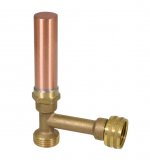
Lastly, the traditional way to stop water hammer in a house is to have an 'extension' upwards just before the fixture that basically gets filled with air and acts like a cushion. In S Cal, all of our valves are above ground and it would be pretty easy to do, but like a lot of things, the answer depends on the location and you do not show a location in your profile...
You can do the same thing with pvc - this is just an example

My Rachio controller specifically has a setting for water hammer. If you don't already have a 'smart controller' that uses your local weather to changer watering times, perhaps you should look into one.
Lastly, the traditional way to stop water hammer in a house is to have an 'extension' upwards just before the fixture that basically gets filled with air and acts like a cushion. In S Cal, all of our valves are above ground and it would be pretty easy to do, but like a lot of things, the answer depends on the location and you do not show a location in your profile...
You can do the same thing with pvc - this is just an example
Attachments
nh_yota
Well-known member
You want one of these:
https://www.supplyhouse.com/Watts-0121227-1-2-LF150A-Water-Hammer-Arrestor-Lead-Free
I put a couple in-line before my LG front loading washer and it reduced the water hammer quite a bit.
https://www.supplyhouse.com/Watts-0121227-1-2-LF150A-Water-Hammer-Arrestor-Lead-Free
I put a couple in-line before my LG front loading washer and it reduced the water hammer quite a bit.
59 wagon man
Well-known member
jmho but the water hammer must be at the solenoid valve or pump shutting off. Being that the sprinklers run out of water when the zone is shut it should have nothing to do with the hammer
engineer2
Well-known member
If you drain your system in the winter, you don't have to worry about a waterlogged air chamber.
ludakris04
Well-known member
i use a timer, and use a short piece of hose to take up the "shock"... not sure how yours is set up.
Innovate1
Well-known member
You say the hammer is when the sprinkler turns on. Usually the worse hammer is when something turns off.
Ok guys speak to me like I’m retarted in this situation. I have zero idea how to add the section of pipe to cure the water hammer.
Is it one per valve? I have 4 valves.
How do you do the water hose trick? Any pictures?
Is it one per valve? I have 4 valves.
How do you do the water hose trick? Any pictures?
larry4406
Well-known member
SoCal? Watering yards? I thought zeroscape was the new norm out there?
Sorry couldn’t resist.
Sorry couldn’t resist.
Bopbop
Well-known member
I am not sure of the plumbing codes in SoCal but the International code requires that a water hammer arrestor be installed on any fast acting (solenoid) valve. Typically the hammer occurs on the closing of the valve. The water hammer arrestor should be installed before the valve because the hammer effect is the water stopping at the valve. Typically we see water hammer when the flush valve at the toilet closes.
You may see a similar hammer at the opening of the valve. This is internal to the valve. The water hammer arrestor should help this.
What is your water pressure? if it is over 60 PSI the water hammer arrestor will need to be increased in size. The sizes are A, B, C. A size "A" would most likely control the hammer however if the pressure is over 60 PSI get a size "B". Most plumbing supply houses will have these in stock.
You may see a similar hammer at the opening of the valve. This is internal to the valve. The water hammer arrestor should help this.
What is your water pressure? if it is over 60 PSI the water hammer arrestor will need to be increased in size. The sizes are A, B, C. A size "A" would most likely control the hammer however if the pressure is over 60 PSI get a size "B". Most plumbing supply houses will have these in stock.
nadogail
Well-known member
I have made my own by simply adding a capped section of pipe filled with trapped air.
The largest was concealed as a post to support a clothes line.
If my memory is correct it was 1966, in Southern Spain.
The largest was concealed as a post to support a clothes line.
If my memory is correct it was 1966, in Southern Spain.
Innovate1
Well-known member
Ok guys speak to me like I’m retarted in this situation. I have zero idea how to add the section of pipe to cure the water hammer.
Is it one per valve? I have 4 valves.
How do you do the water hose trick? Any pictures?
Some pictures and further description of your system would help. Only one for the system. The hose only works if the hose is before the valve - not sure if that is your situation.
Is the system connected to a hose faucet, in ground, etc...
Water is not compressible.
Moving water carries energy and inertia.
So think of this moving water as a hammer head your swinging and it hits a solid stop (anvil..) You get an instant release of noise. Now hit something soft.
Water is the same as the hammer head It's flowing along in the pipe and you suddenly stop this flow with a quick acting valve. All that energy and inertia has to go some where and it does so with a bang. Water hammer.
Now with the hammer arrestors you have an air chamber that acts like a spring that will stop the water flow slower and absorb the energy preventing the band.
So somewhere in your supply line you have to install this air chamber/hammer arrestor before the valve.
Now if your truly getting a noise when the valve opens I'm not sure what you have to do.
lg
no neat sig line
Moving water carries energy and inertia.
So think of this moving water as a hammer head your swinging and it hits a solid stop (anvil..) You get an instant release of noise. Now hit something soft.
Water is the same as the hammer head It's flowing along in the pipe and you suddenly stop this flow with a quick acting valve. All that energy and inertia has to go some where and it does so with a bang. Water hammer.
Now with the hammer arrestors you have an air chamber that acts like a spring that will stop the water flow slower and absorb the energy preventing the band.
So somewhere in your supply line you have to install this air chamber/hammer arrestor before the valve.
Now if your truly getting a noise when the valve opens I'm not sure what you have to do.
lg
no neat sig line
Bopbop
Well-known member
I have made my own by simply adding a capped section of pipe filled with trapped air.
The largest was concealed as a post to support a clothes line.
If my memory is correct it was 1966, in Southern Spain.
In the plumbing industry that is called an air chamber. These were real common and are still used today. Typically they are the size of the pipe or 1 size larger and about 18" tall.
The issue with the air chamber is that over time the air is displaced with water and there is no longer a cushion. Similar to an old school well tank that gets water logged. When the air is gone the hammer comes back.
AA7483
Well-known member
Increase the pipe size or decrease the sprinklers per zone. You're flowing more gpms that the pipe is rated for. The high velocity is causing the hammer.
Innovate1
Well-known member
Increase the pipe size or decrease the sprinklers per zone. You're flowing more gpms that the pipe is rated for. The high velocity is causing the hammer.
I don't see the pipe sizes or number of sprinklers stated so I don't know how you came to that conclusion. It's a common problem and the usual way to fix it is to install a shock arrestor of some kind.
I don't see the pipe sizes or number of sprinklers stated so I don't know how you came to that conclusion. It's a common problem and the usual way to fix it is to install a shock arrestor of some kind.
Innovate1
Well-known member
Interesting video with good basic principles. Increasing the pipe size does decrease the effect but for something already in place it may be impractical. Same with reducing the number of sprinklers on a zone. Given that the OP hasn't given more detail it's hard to know what would solve the problem with the least trouble/cost.
Has this zone been quiet before and recently started hammering? If so, the likely culprit is your valve on that zone. Sprinkler valves are designed to close their valves relatively slowly in order to defeat water hammer caused by large quantities of water moving quickly and rapidly coming to a stop. Most major manufacturers of sprinkler valves have rebuild kits. Most valves can be disassembled in place so it means there is no changing of your system.
If this zone has always been hammering when shutting off, it is due to too large a volume of water having to suddenly stop when the valve closes. As stated in previous posts, the underground piping could be too small for the volume of water moving through it---very expensive fix, only a last resort.
An expansion chamber can be installed between the valve and your anti-siphon valve at the house. Its an inexpensive option and well worth a try.
You CAN change orifice sizes in your sprinkler heads so that they flow a smaller volume of water. It then makes your underground piping more sized to the zone requirements. This is a cheap fix and requires only a little effort from you. Once done, the timing on the zone would need to be increased as less water per minute is delivered after that change.
I had one zone behave like your on a previous system. It was quiet for 10 years before become a hammering situation. Rebuilding /replacing the valve "guts" was the solution that worked.
Good Luck and let us know how it turns out.
If this zone has always been hammering when shutting off, it is due to too large a volume of water having to suddenly stop when the valve closes. As stated in previous posts, the underground piping could be too small for the volume of water moving through it---very expensive fix, only a last resort.
An expansion chamber can be installed between the valve and your anti-siphon valve at the house. Its an inexpensive option and well worth a try.
You CAN change orifice sizes in your sprinkler heads so that they flow a smaller volume of water. It then makes your underground piping more sized to the zone requirements. This is a cheap fix and requires only a little effort from you. Once done, the timing on the zone would need to be increased as less water per minute is delivered after that change.
I had one zone behave like your on a previous system. It was quiet for 10 years before become a hammering situation. Rebuilding /replacing the valve "guts" was the solution that worked.
Good Luck and let us know how it turns out.
Interesting video with good basic principles. Increasing the pipe size does decrease the effect but for something already in place it may be impractical. Same with reducing the number of sprinklers on a zone. Given that the OP hasn't given more detail it's hard to know what would solve the problem with the least trouble/cost.
Yes you are right , changing the piping might be impractical, but it is one of the solutions
other than those surge devices and OP needs to take some measurement and numbers... OP can also cycle the zones to be on / off at different times.. so there for the number of sprinkler heads on at a give time is now cut in half... if he / she only turns two zone on at a time and off at different times sort of ... and see if that helps.. it is describe in that video as well as Delta T... such as zones 1 2 3 4
1 on for few minutes
then 2 on for few minutes.
after a set time
then 1 off
then 3 on
after a set time again
then 2 off
then 4 on
and the the off sequences... you get the idea..
Last edited:
AA7483
Well-known member
If it's always been an issue that is likely the cause. Exceeding recomend velocity leads to water hammer. A shock arrestor is a good bandaid. I was suggesting a different approach. I suppose more info is needed.I don't see the pipe sizes or number of sprinklers stated so I don't know how you came to that conclusion. It's a common problem and the usual way to fix it is to install a shock arrestor of some kind.
Last edited:

Has this zone been quiet before and recently started hammering? If so, the likely culprit is your valve on that zone. Sprinkler valves are designed to close their valves relatively slowly in order to defeat water hammer caused by large quantities of water moving quickly and rapidly coming to a stop. Most major manufacturers of sprinkler valves have rebuild kits. Most valves can be disassembled in place so it means there is no changing of your system.
If this zone has always been hammering when shutting off, it is due to too large a volume of water having to suddenly stop when the valve closes. As stated in previous posts, the underground piping could be too small for the volume of water moving through it---very expensive fix, only a last resort.
An expansion chamber can be installed between the valve and your anti-siphon valve at the house. Its an inexpensive option and well worth a try.
You CAN change orifice sizes in your sprinkler heads so that they flow a smaller volume of water. It then makes your underground piping more sized to the zone requirements. This is a cheap fix and requires only a little effort from you. Once done, the timing on the zone would need to be increased as less water per minute is delivered after that change.
I had one zone behave like your on a previous system. It was quiet for 10 years before become a hammering situation. Rebuilding /replacing the valve "guts" was the solution that worked.
Good Luck and let us know how it turns out.
They have always banged.
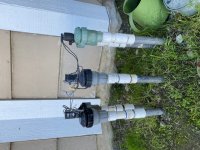
Someone PLEASE make me “water hammer arrestor for dummies diagram” I want to try and fix it this weekend.
Here’s what I’m working with
put one before the shutoff on the supply side ? Not after on the sprinkler side... It's just a T with a chamber... nothing fancy.
put one before the shutoff on the supply side ? Not after on the sprinkler side... It's just a T with a chamber... nothing fancy.
One on each valve? Is the supply side the pipe facing the house?
SALIV8
Well-known member
Im not sure if a cushion tank would work inside the house on that line. I would use something like this after the pressure regulator:
https://www.lowes.com/pd/sioux-chie...VBdvACh2Z6wAUEAQYAiABEgLs5_D_BwE&gclsrc=aw.ds
This should work too:
https://www.pppinc.net/products/wat...uplicate-of-stainless-steel-316-threaded.html
https://www.lowes.com/pd/sioux-chie...VBdvACh2Z6wAUEAQYAiABEgLs5_D_BwE&gclsrc=aw.ds
This should work too:
https://www.pppinc.net/products/wat...uplicate-of-stainless-steel-316-threaded.html
Last edited:
SALIV8
Well-known member
Or just put a vertical tube in this supply line? If so, what length?
I have had vertical air chambers that are just empty pipe slowly replace the trapped air with water, becoming useless until I drain the system and start over.
I would recommend a specifically designed arrestor.
SGKent
Banned
you can buy Sioux Chief brand water hammer arrestors and install one near the end of the line. The water sloshes back and forth in the line when it turns on and off, and that is what causes the hammer. If the line is a hundred feet or more put one at each end of the line. I cut a piece of PVC that fit over it and put a cap on it. This keeps dirt away from it. I use 3/4" pipe so I put a 3/4" threaded tee in facing up. This screws into it. The PVC pipe over it with a cap keeps dirt off.

Last edited:
SALIV8
Well-known member
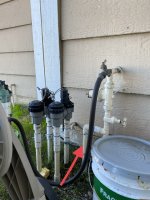
Would that arrestor still work if I install it where the red arrow is pointing on the picture posted above?
Yes I believe so. I would remove that pvc 90* and install a T to connect the arrestor in an upright position.
SALIV8
Well-known member

SGKent
Banned
yes, install the tee in place of the elbow as suggested. When the water rushes back it will go straight into the water hammer arrester. Do you have a shut off and pressure regulator below where the water comes out of the ground -that looks like the main water line. You really don't want say 90 - 120 PSI in your sprinkler system. No wonder it is hammering if that is the case.
Last edited:
yes, install the tee in place of the elbow as suggested. When the water rushes back it will go straight into the water hammer arrester. Do you have a shut off and pressure regulator below where the water comes out of the ground -that looks like the main water line. You really don't want say 90 - 120 PSI in your sprinkler system. No wonder it is hammering if that is the case.
What water regulator do you suggest? I’m mechanically inclined but don’t know squat about plumbing...or electrical