To avoid these ads, REGISTER NOW!

Why is my plumbing work all corroded and rusty???

Chevy-SS

Well-known member
Joined
Feb 11, 2010
Messages
1,492
Location
Rhode Island
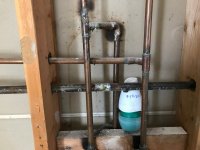
Five years ago, I plumbed in a new 3/4" copper supply line for my well water. I 'thought' I did a pretty good job, sweating in all the fittings. It looked beautiful at the time. But now it looks like **** (see pic below). There is corrosion at all my sweat joints, and it's even rusting at the hanger too, jeesh. This area of my basement is pretty dry, with my hot-air furnace very close, but the basement is big and I do have two sump pumps collecting water, so there is humidity in the air.

I have 4 questions:
1) What's causing all this corrosion?
2) Is there any danger of leakage?
3) How can I prevent this in future work?
4) Can I fix this?

Many thanks, Dave F.

plumbingcorrosion.JPG
 
To avoid these ads, REGISTER NOW!

SlappyWhite

Well-known member
Joined
Oct 3, 2012
Messages
1,819
Location
Upper Canada
My guess is it is from flux left behind after sweating the connections. It is an acid, and any residue should be removed after the work is done IMO (I just wipe down with a wet rag after making the connection). Not a big short term leakage risk IMO, but others may have more info on this.

As for the hanger, is it steel, looks like iron oxide not copper oxide in the pic? If so, no bueno with copper... If it is steel this is where leakage may be a future problem.
 
Last edited:

ericlar80

Well-known member
Joined
Nov 14, 2014
Messages
362
Location
California
My guess is it is from flux left behind after sweating the connections. It is an acid, and any residue should be removed after the work is done IMO (I just wipe down with a wet rag after making the connection). Not a big short term leakage risk IMO, but others may have more info on this.

As for the hanger, is it steel, looks like iron oxide not copper oxide in the pic? If so, no bueno with copper... If it is steel this is where leakage may be a future problem.

Yep, green corrosion is where you had flux that was not cleaned off properly, and the red oxide is the steel galvanically reacting with the copper pipe.

The flux contamination can lead to pinhole leaks, so best to get that corrected soon (just clean it off with scrub-brush, then salt & vinegar water mix, and them soapy water.

The steel part should be replaced with a copper strap that wraps around the pipe and is then nailed into the joist.
 

MJO

Well-known member
Joined
Dec 19, 2012
Messages
337
Did you use dielectrics where needed? The copper pipe touching any other than copper or brass? Wife using the pipe to hang coat hangers? Isolate the copper from dissimilar metals.
 

dogdog

Well-known member
Joined
Nov 15, 2011
Messages
12,711
white powdery stuff is either lead or aluminum I think... Green is copper, red is iron. From the trails of it, it does look like those flux paste corroding the solders..
 

PelicanPines

ALLIANCE MEMBER
Joined
Apr 30, 2014
Messages
38,112
Location
New Jersey, USA, Earth, My own reality
And yes... it is my experience... you may get pin hole leaks.

1. replace that hanger with a copper or plastic one.
2. Clean things up...

If you get a leak because you clean it... it would have leaked anyway in time.

In the future ... as mentioned. Clean off the flux...
 

stokefire7

Well-known member
Joined
Oct 5, 2011
Messages
616
The green is left over flux. The white is calcium, I think. Here's a pic from some pipe that was in my house before I ripped it out. You can see the rust on the gas line below. There's a little spot of white on that swing joint above it.
 

Attachments

  • scabby pipe .jpg
    scabby pipe .jpg
    130.4 KB · Views: 249

stokefire7

Well-known member
Joined
Oct 5, 2011
Messages
616
You'll have to show me your joint prep and the products you're using for an opinion. I've been in the pipe trades for thirty years, I can help.
 

danski0224

Well-known member
Joined
Jan 29, 2005
Messages
13,414
Location
Near Naperville, IL
The white stuff is most likely a residue from flux.

The distribution is fairly consistent. A leak would be more apt to be concentrated in one spot.

The white corrosion also follows gravity, like where condensation collects on the pipe, shown by the offset down.

The copper plated pipe hanger is rusty due to moisture. Those types of hangers are pretty common, and yours looks like it is the coated/painted type- not copper plated. Good luck finding actual copper pipe hangers at a hardware store. There shouldn't be an electrical current from the wood to the copper... dielectric corrosion should be able to be safely ruled out.

You mention well supply piping, so the pipe is condensating.

Brush off the white stuff, clean the residue, and put some Armaflex on the cold water supply to prevent condensation.
 
OP
C

Chevy-SS

Well-known member
Joined
Feb 11, 2010
Messages
1,492
Location
Rhode Island
My guess is it is from flux left behind after sweating the connections. It is an acid, and any residue should be removed after the work is done IMO (I just wipe down with a wet rag after making the connection). Not a big short term leakage risk IMO, but others may have more info on this.

As for the hanger, is it steel, looks like iron oxide not copper oxide in the pic? If so, no bueno with copper... If it is steel this is where leakage may be a future problem
.

Yep, green corrosion is where you had flux that was not cleaned off properly, and the red oxide is the steel galvanically reacting with the copper pipe.

The flux contamination can lead to pinhole leaks, so best to get that corrected soon (just clean it off with scrub-brush, then salt & vinegar water mix, and them soapy water.

The steel part should be replaced with a copper strap that wraps around the pipe and is then nailed into the joist.

Did you use dielectrics where needed? The copper pipe touching any other than copper or brass? Wife using the pipe to hang coat hangers? Isolate the copper from dissimilar metals.

white powdery stuff is either lead or aluminum I think... Green is copper, red is iron. From the trails of it, it does look like those flux paste corroding the solders..

And yes... it is my experience... you may get pin hole leaks.

1. replace that hanger with a copper or plastic one.
2. Clean things up...

If you get a leak because you clean it... it would have leaked anyway in time.

In the future ... as mentioned. Clean off the flux...

Yeah, thanks gents. :) It appeared to be flux contamination, as it mostly cleaned off and looks halfway decent now. The strap is a POS Home Depot item.


You'll have to show me your joint prep and the products you're using for an opinion. I've been in the pipe trades for thirty years, I can help.

Be aware many straps that look copper, are only copper plated steel.

Check w magnet at store.

Marc

Thanks, the cleaning helped. Plus I will get new straps, either copper or plastic. No more Home Depot POS straps!


The white stuff is most likely a residue from flux.

The distribution is fairly consistent. A leak would be more apt to be concentrated in one spot.

The white corrosion also follows gravity, like where condensation collects on the pipe, shown by the offset down.

The copper plated pipe hanger is rusty due to moisture. Those types of hangers are pretty common, and yours looks like it is the coated/painted type- not copper plated. Good luck finding actual copper pipe hangers at a hardware store. There shouldn't be an electrical current from the wood to the copper... dielectric corrosion should be able to be safely ruled out.

You mention well supply piping, so the pipe is condensating.

Brush off the white stuff, clean the residue, and put some Armaflex on the cold water supply to prevent condensation
.

Thanks, good tips. I might try some of the Armaflex. Thanks again....:thumbup:
 
Last edited:
To avoid these ads, REGISTER NOW!

ericlar80

Well-known member
Joined
Nov 14, 2014
Messages
362
Location
California
The green is left over flux. The white is calcium, I think. Here's a pic from some pipe that was in my house before I ripped it out. You can see the rust on the gas line below. There's a little spot of white on that swing joint above it.

He also didn't care to protect the wood from getting burned while sweating the lines... :shocking:
 

dogdog

Well-known member
Joined
Nov 15, 2011
Messages
12,711
What's the brown ?

LOL... Brown is the Happening :)


But seriously, brown on those thread looks like dried out sealant paste mixed with some light rust... I have that on bronze to iron joints...
 
Last edited:

stokefire7

Well-known member
Joined
Oct 5, 2011
Messages
616
LOL... Brown is the Happening :)


But seriously, brown on those thread looks like dried out sealant paste mixed with some light rust... I have that on bronze to iron joints...

The brown joke went right over my head. LOL :dunno:

I dunno bro, shouldn't be any rust as it's all stainless and copper on potable water. Dope is Megaloc. Outlet doesn't show a "leak".
 

Attachments

  • IMG_0754.jpg
    IMG_0754.jpg
    59.6 KB · Views: 22

stokefire7

Well-known member
Joined
Oct 5, 2011
Messages
616
You can get mild corrosion between stainless steel and low grade brass. So, it could be that mixed with some pipe dope.

I thought it might be from the glycol color but that doesn't work on the potable side. Our water supply is mountain runoff , cold and hard.
I'm assuming it's iron in the water. I'll check on that.

I do have a brass ****** on the recirc nozzle to a lead free B. V. with a galy plug, no leak.
 

Attachments

  • IMG_0756.jpg
    IMG_0756.jpg
    62.6 KB · Views: 25
  • IMG_0757.jpg
    IMG_0757.jpg
    61.1 KB · Views: 25
  • IMG_0758.jpg
    IMG_0758.jpg
    63.1 KB · Views: 24
  • IMG_0759.jpg
    IMG_0759.jpg
    58.6 KB · Views: 27
  • IMG_0760.jpg
    IMG_0760.jpg
    70 KB · Views: 25

stokefire7

Well-known member
Joined
Oct 5, 2011
Messages
616
...a quick pic of corrosion on a back flow preventer discharge from sulfuric acid fumes .
 

Attachments

  • IMG_0761.jpg
    IMG_0761.jpg
    63.4 KB · Views: 48

dogdog

Well-known member
Joined
Nov 15, 2011
Messages
12,711
The brown joke went right over my head. LOL :dunno:

I dunno bro, shouldn't be any rust as it's all stainless and copper on potable water. Dope is Megaloc. Outlet doesn't show a "leak".

This is the chart I remember I looked up when I used those stainless bolts for exhaust and it gal up so bad, that I had to cut it off ...

http://www.simpletwig.com/blog/galvanic-action-corrosion-prevention/


***I actually got lazy, the original chart was from bolt depot or something.

again , I don't have exp with stainless stuff too much on water stuff. was just joking about brown :)
 

metlmunchr

Well-known member
Joined
Sep 10, 2011
Messages
1,278
The OP's corrosion at the joints is a classic result of using an aggressive self cleaning flux and not thoroughly cleaning the joint afterward. Any flux that's aggressive enough to eat away the surface of the copper without cleaning with sandpaper and fitting brushes prior to soldering will give the same result. All of these fluxes have free hydrochloric acid in the mix as the self cleaning agent.

Mechanically cleaning the tubing and fittings followed by the use of a mild flux like Nokorode standard paste as marketed by Rectorseal will prevent such problems even if you don't clean the excess paste off the joint after sweating.

FWIW, the specs in the great majority of commercial plan and spec construction work specifically prohibit the use of self cleaning flux on copper piping, and the OP's pics show the reason why that's the case.
 
OP
C

Chevy-SS

Well-known member
Joined
Feb 11, 2010
Messages
1,492
Location
Rhode Island
The OP's corrosion at the joints is a classic result of using an aggressive self cleaning flux and not thoroughly cleaning the joint afterward. Any flux that's aggressive enough to eat away the surface of the copper without cleaning with sandpaper and fitting brushes prior to soldering will give the same result. All of these fluxes have free hydrochloric acid in the mix as the self cleaning agent.

Mechanically cleaning the tubing and fittings followed by the use of a mild flux like Nokorode standard paste as marketed by Rectorseal will prevent such problems even if you don't clean the excess paste off the joint after sweating.

FWIW, the specs in the great majority of commercial plan and spec construction work specifically prohibit the use of self cleaning flux on copper piping, and the OP's pics show the reason why that's the case
.

OP here.... interesting read. You could be right.

Thanks for the tips.................................
:thumbup:
 

stokefire7

Well-known member
Joined
Oct 5, 2011
Messages
616
...still haven't said what products you're using. One suspicion I have is leaded solder.
 

andyvh1959

Well-known member
Joined
Feb 15, 2020
Messages
2,598
Location
Green Bay WI
This all reminds me of the Lennox HM30 Complete Heat furnace/hot water heater I had in my house when I bought it back in 2002. When first in I thought, "Lennox, good quality product, excellent!" NOT so, what a piece of **** and trouble. 1st winter (Green Bay) the furnace AND hot water shut down, doe to a leak and pressure loss. In the HM30, hot water pumped through the A-coil is the heat source for forced air blown through the coil. Novel idea, maybe for an RV. NOT for a house. In 2002 that HM30 was already 10+ years old, and a weld failed on the stainless steel water tank. Service guy from local Lennox diagnosed it, said the tank had to be replaced, but they had a tank in stock. Wait? What? You have a S/S tank in stock for a ten year old furnace? Oh ****.

It went on like that every winter. This system was loaded with corrosion everywhere, copper, brass, aluminum, steel certainly, but everything had corrosion of some sort which I thought was largely electrolysis. At the five year point, the older technician this time, when I asked him what he'd do if it was his furnace, this guy with Lennox on his shirt, quietly said with a slight smile "I'd get rid of it NOW!"

Lennox did step up, gave me a $1500 credit for the HM30 to buy a new Lennox gas/FA system and separate hot water heater, gave me a reduced price on the system, along with the tax deduction for the system, my installed cost out of pocket was only $2500. No troubles since then almost ten years now, my faith in Lennox was restored.
 
Last edited:
To avoid these ads, REGISTER NOW!
Top Bottom