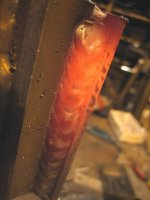
(dipping a bit away from the OP's original question)
Short-circuit transfer mode GMAW is not a prequalified technique per AWS D1.1.
Ever.
Meaning you'd have to have a completely qualified WPS. Full up, all the bells and whistles. So first there would have to be a PQR, which then determines the WPS.
And -then- , you the welder would have to test to that now-qualified WPS per the WQTR.
Can't do radiographic testing on the short-circuit transfer mode welds, as the X-rays really can't detect the possible lack of fusion.
And even when you do the 'best' that you can with that short-circuit transfer mode GMAW weld on some 'thick' steel, you'll probably STILL end up with cold lap, aka lack of fusion, aka lack of penetration.
Looks fine on the outside, but the weld energy is (almost always) insufficient to melt INTO (penetrate) the base metals when they are 'thick'.
And this video/test/example is 'just' on 3/8" steel plate.
https://www.weld.com/blog/why-you-should-not-use-short-circuiting-transfer-on-thick-materials
(complete with added laugh track at ~5 minutes into the vid

)
More example of short-circuit vs spray transfer on 3/8" plate, this time no video just words and pictures. But the pictures include a decent comparison of an etched cross-section of both welds. Lack of fusion/penetration with the short-circuit transfer weld on the 3/8" plate clearly show there.
Miller says don't use short-circuit transfer on 'thick' steel (1/2" or greater).
https://www.millerwelds.com/resources/weld-setting-calculators/mig-solid-core-welding-calculator
You really did short-circuit transfer welds on 3/4" plate? Voltage under ~22 volts, C25 gas, all that? And got fusion/penetration into those 3/4" plates, and not just the weld bead sitting on top of the plates?
I'm astonished. Hats off to you.


 ) with short-circuit transfer mode welding. And not with a 120V machine (barring some sort of high input amperage 'special' machine). For out-of-position welding, you'd have to use either pulse-spray mode with solid wire or some FCAW (self-shielding or gas-shielded) or metal-core wire.