To avoid these ads, REGISTER NOW!

Which welding rod?

kmacht

Well-known member
Joined
Apr 12, 2010
Messages
2,769
Location
Connecticut
Im getting ready to weld a thumb on my backhoe and am confused about what stick welding rod would be best to use. I have an miller thundernolt which is an AC machine. The welds will be vertical. I have had lots of experience with mig, tig, and oxy acetylene but have had very little time on a stick machine welding anything this thick. The thumb is 5/8 plate and the backhoe arm is either 3/8 ot 1/2. Whats the easiest rod to use on an ac vertical weld? I heard 6013 is easiest to run but may not be great vertical. 7018AC is supposed to be the strongest but isnt great unless you have lots of stick experience. Any other suggestions? 7014, 6011? Also, vertical up or down?

Keith
 
To avoid these ads, REGISTER NOW!

Hal

Well-known member
Joined
Mar 8, 2008
Messages
666
Location
Vermont
Unless you want to do it over, get some 7018 and practice with it first.

Also, just because it says 7018AC doesn't mean it will run easily on AC, some brands are definitely better acting than others. If you know any other welders, ask their opinion. I am sure you will here from the pros on this board, too.
 

vpd66

Well-known member
Joined
Mar 1, 2010
Messages
709
Location
Central Wisconsin
My suggestion is to find some good quality 7018AC and practice like Hal said. On that thickness plate you should do 3 pass welds. If your not comfortable stick welding it then why not weld it with wire feed? Duel shield .045 wire would be my first method I'd use but it does take a good 250 amp plus wire feed machine to run it.
 

bob15

Well-known member
Joined
Dec 8, 2011
Messages
6,863
Location
Northeasten, CT
I would use 6011 if that is all you can find as it is a good AC rod with good penetration.

You might go to your local LWS and see what they have in stock and recommend. I had to weld a stabilizer on a backhoe 20-25 years ago and my Uncle bought the rod based on what the LWS recommended and had. They also had "open cans" to buy from so he didn't need to buy a 10 or 50 pound cans. I don't remember what the number was, but I thought it was either a 90xx or 10xxx rod. I also believe it was 3/16 or 1/4 diameter rod.

No matter what rod you use, make sure the steel has a nice V-grind on it to you help get the best penetration.
 

kaymccampbell

Well-known member
Joined
Feb 27, 2015
Messages
29,506
Location
Upstate New York
My suggestion is to find some good quality 7018AC and practice like Hal said. On that thickness plate you should do 3 pass welds. If your not comfortable stick welding it then why not weld it with wire feed? Duel shield .045 wire would be my first method I'd use but it does take a good 250 amp plus wire feed machine to run it.

You beat me to it. This was going to be my suggestion. There is no reason, with good prep, that he couldn't MIG weld it together. People have seizures over MIG on thick steel. But, with proper preparation, the correct wire, and lots of raw power, MIG will do the job very nicely.
 

welder4956

Well-known member
Joined
Apr 8, 2010
Messages
3,067
Location
Birmingham, AL USA
If the only welding machine you have available is an AC stick welder, then I second the suggestion to use E6011. For the plate thicknesses you mentioned, 1/8" diameter rods would work fine or you could bump up to 5/32" rods. 1/8" rods running at 100 amps would keep the machine from tripping too often on thermal overload due to the 20% duty cycle on this machine.
 

FSrepair&fabrication

Well-known member
Joined
Jul 28, 2017
Messages
908
Location
maryland
I would do the root pass with 5/32 6011. Then cap it with 7018 stringers. You could use 6011 the whole way if you cant make a satisfactory weld with 7018. 7018 is annoying to get lit on a/c to begin with.
 

Jim greengo

Well-known member
Joined
Sep 3, 2018
Messages
7,415
Location
Behind my house
I would do the root pass with 5/32 6011. Then cap it with 7018 stringers. You could use 6011 the whole way if you cant make a satisfactory weld with 7018. 7018 is annoying to get lit on a/c to begin with.

What he said.
From what I remember of the welding tests I've taken over the years the root pass was always done with 6010 or 6011,after that it was 7018 for the rest.
 

welder4956

Well-known member
Joined
Apr 8, 2010
Messages
3,067
Location
Birmingham, AL USA
No need for a E6010 root unless welding over a gap and need full penetration. E6010 is a fast freeze rod and works well for open root welding. But for fillet welds it is not needed for the root pass.
 

RedneckWelder

Well-known member
Joined
Nov 12, 2013
Messages
5,699
Location
The Ghetto Kingdom of Methlandia
Root with 6011 cap with 7018. Clean and prep the weld and stick and thumb plate right.

We put our thumbs on excavators of all sizes with dual shield because we have the luxury of having a huge wire feeder Miller in the shop but there is no reason that a buzz box could not do this work with enough patience.
 

FSrepair&fabrication

Well-known member
Joined
Jul 28, 2017
Messages
908
Location
maryland
7018 can start just fine.
All it takes is a small file and some routine.
Run the end of the 7018 across the file about three licks and it starts just fine. It takes two or three seconds at the most.

Berry posted a 7018 downhill run that looks great. I had never tried it.

Yes, there's no reason to not use the mig.

And

Drill some holes and do some plug welds as added insurance.

And

I don't want to do the math but the pressure on a thumb isn't but half of what your bucket can curl.
Yes, edges, distance from end of ram, psi,...but it's still somewhere around half of what your bucket can curl at best. It's pretty hard to get any WEIGHT of any consequence onto a thumb.


I agree that 7018 can be done on a/c with a buzzbox, but for a non professional welder it will be hard too get lit and stay lit without getting slag inclusions. 6011 is more forgiving and slightly more brittle but will probably be strong enough for any work besides serious demolition.
 

38Chevy454

Well-known member
Joined
Dec 26, 2006
Messages
4,036
Location
Cincinnati, OH
I agree that 6011 is a good choice for the job. Especially on an AC buzzbox. 7018AC rod is nice if you can get it to work smooth. The problem with AC is the current has to reverse directions and the arc will want to go out. The 7018AC rod has arc stabilizers that help it start and restart while welding. Not an issue with 6011. Should be able to get good penetration with 6011 and the weld is still going to be stronger than the parent metal around the weld.

I built my first hot rod Must II IFS swap using 6011 and an AC buzzbox. I like 1/8 rod for the heavier stuff, and 3/32 for the thinner. 7018AC rod does make a prettier weld than 6011.

I still break out the buzzbox when I am doing thicker stuff, although I have a 240v MIG machine. Just more confident in good penetration with the SMAW stick welding on the thicker stuff since I do not weld thicker as often.
 
Last edited:

MJD1

Well-known member
Joined
Dec 28, 2014
Messages
607
Your not doing a root pass, your doing fillet welds. Use 7018ac or better yet prep everything up and tack it. Let a professional welder do the job with 7018 or dual shield wire. 6011 doesn't have the ductility to stand up to the abuses a thumb will take. Mig hard wire would be a better choice than 6011 or 6013.
 
OP
K

kmacht

Well-known member
Joined
Apr 12, 2010
Messages
2,769
Location
Connecticut
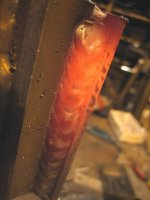
I got it done today with some 7018AC. The welds aren’t pretty but I got good penetration and I’m sure they will be plenty strong enough. The AC rod was actually pretty easy to start. Strangely I found that restarts were easier than the initial arc. Thanks for all the replies. As for MiG I only have a 110 unit so it wasn’t up to this task. It works great for sheet metal and thinner stuff but wasn’t going to work on 1/2”+ plate.

Keith
 
To avoid these ads, REGISTER NOW!

FSrepair&fabrication

Well-known member
Joined
Jul 28, 2017
Messages
908
Location
maryland
Your not doing a root pass, your doing fillet welds. Use 7018ac or better yet prep everything up and tack it. Let a professional welder do the job with 7018 or dual shield wire. 6011 doesn't have the ductility to stand up to the abuses a thumb will take. Mig hard wire would be a better choice than 6011 or 6013.

You can root a joint like that with 6011 no prob. Done all the time in the field. You cant effectively burn the paint and grime out of the joint with a 7018. Besides idk whats better than 7018 for an a/c buzzer, 8018 or 11018 require dcep and preheat and postheat to prevent cracking.
 

Gmonkee

Well-known member
Joined
May 9, 2010
Messages
2,774
7018 does the stresses any excavator sees best. Others can crack at the side of the fix.

I have done a fair share of welds on yellow machines since 2006, all 7018 stick welding on worn out junk.
A Miller plant running on 3 phase power makes good welds.
 

nadogail

Well-known member
Joined
Jan 23, 2009
Messages
31,942
Location
Coronado, CA
Considering that the Original Poster has a AC only machine IMHO the OP best avoid any DC only electrode
On a cross section as thick as 5/8", it will be important to vee out the area to be welded, and then fill in the area where you ground out the old metal.
 

sberry

Banned
Joined
Jun 18, 2005
Messages
35,747
Location
Brethren, Michigan
Wire is really good as long as it's fused. 6011 isn't bad as long as it's mild steel. But,,,, 7018 actually cleans grime better than 6011,,, 11 is simply more agressive and easier to arc but the 18 has so much more flux it cleans way better.
 

FSrepair&fabrication

Well-known member
Joined
Jul 28, 2017
Messages
908
Location
maryland
If those rods require postheat, 6010 or 6011 will require it even more...

If it was the kind of material requiring 8018 or 11018 you wouldnt use a 60xx rod at all. Those would be rooted with 8010 or better.

My point was more so that if it wasnt mild steel the OP wouldnt be able to do it with the welder hes got.
 

joe49

Well-known member
Joined
Sep 25, 2009
Messages
1,883
Location
Tonica, Il
Most real equipment buckets are not mild steel. Usually AR, T1....

OP if your going to be doing big boy welding upgrade to a better welder.
 

MoonRise

Well-known member
Joined
Nov 5, 2010
Messages
4,028
Location
NJ
Too late now, but :

- Vert up vs down? Generally, vertical down is done for thin (think sheet metal) work pieces to enable/force a faster travel speed to (help) limit penetration.

- Filler/rod to use? Depends more on what alloy(s) of steel you are welding and a bit less on the thickness.

No to 6013 in this case, that is a low/medium penetration rod.

Anything in the 60xx family might not be correct either, if the materials being welded together are anything other than mild steel.

The "stick" on a backhoe/excavator might be mild steel, or it might be something else. There may (or may not) be reinforcing plates or hardfacing beads.

And although 7018 is a 'good' electrode for a lot of welding purposes, it might not be the 'right' electrode for all welding purposes. And it MUST be properly stored and used in order to maintain the low hydrogen properties of the electrode and the welds made with that electrode (which is CRITICAL for welds made on many steels that are 'stronger' than mild steel like A36 or similar).

Next, proper prep prevents piss-poor performance.

Clean the steel of anything that is NOT actually bright shiny steel. Things like paint, or grease or oil, or dirt or rust or anything else that is NOT bright clean shiny steel.

And even though 7018 rod has a 'good' flux/slag system, you do NOT want to have not-steel mixing into the weld puddle. Because of the hydrogen that WILL result from the paint/grease/oil/rust and therefore pretty much eliminate the low-hydrogen aspect you probably wanted/needed when you used the 7018 (or 8018, or 10018, etc) low-hydrogen electrode in the first place.

With some 1/2" and 5/8" plate, you might want/need at least some level of preheat.

Wire-feed weld on 1/2" or 5/8" plate? Sure, but you are NOT going to do that (successfully anyway :lol: ) with short-circuit transfer mode welding. And not with a 120V machine (barring some sort of high input amperage 'special' machine). For out-of-position welding, you'd have to use either pulse-spray mode with solid wire or some FCAW (self-shielding or gas-shielded) or metal-core wire.

There's more to successful welding than just grabbing some electrode and and making an arc. :D

:beer:
 

Gmonkee

Well-known member
Joined
May 9, 2010
Messages
2,774
I was self taught. Boss gave me the job and said do it. I had less than an hour of practice in decades before the first job.

I had to make a pile of I beam into a press frame. A big one.

Not one weld has failed in 14 years of abuse.

MoonRise, I had no idea of the stuff you mentioned then, now I know you are correct when one can make an ideal situation possible.

I still can't weld worth a **** on vertical lines.
 

Tinner

Well-known member
Joined
Aug 31, 2013
Messages
1,101
Location
N.E. Wisconsin
Wire-feed weld on 1/2" or 5/8" plate? Sure, but you are NOT going to do that (successfully anyway :lol: ) with short-circuit transfer mode welding.

Gee, that's funny. Not only have I done it, I've passed certification tests on 3/4" plate. Not necessarily fun or efficient, but very doable.
 

Wamsutta

Well-known member
Joined
Jan 8, 2014
Messages
10,872
Location
Amarillo, Texas
You can use 7018 or 6010. The 7018 is a straight push vertical. 6010 requires a whip technique to give the puddle time to freeze.
 

FSrepair&fabrication

Well-known member
Joined
Jul 28, 2017
Messages
908
Location
maryland
You can use 7018 or 6010. The 7018 is a straight push vertical. 6010 requires a whip technique to give the puddle time to freeze.

Thank you for the most basic advice ever. The OP already got it done, all the welders (including me) are still arguing over the proper way to do it.
 

FSrepair&fabrication

Well-known member
Joined
Jul 28, 2017
Messages
908
Location
maryland
Gee, that's funny. Not only have I done it, I've passed certification tests on 3/4" plate. Not necessarily fun or efficient, but very doable.

Thats believable but not realistic in the field, the wind is gonna blow your shielding gas away. Maybe thats why all the service trucks still have an engine drive stick welder mounted on them. Stick can be done properly in the worst of conditions.
 

malibu101

Well-known member
Joined
Jul 1, 2005
Messages
3,908
Location
Walnutport PA
Too late now, but :

.......

Next, proper prep prevents piss-poor performance.

Clean the steel of anything that is NOT actually bright shiny steel. Things like paint, or grease or oil, or dirt or rust or anything else that is NOT bright clean shiny steel.

And even though 7018 rod has a 'good' flux/slag system, you do NOT want to have not-steel mixing into the weld puddle. Because of the hydrogen that WILL result from the paint/grease/oil/rust and therefore pretty much eliminate the low-hydrogen aspect you probably wanted/needed when you used the 7018 (or 8018, or 10018, etc) low-hydrogen electrode in the first place.

.......

:beer:

Agree! Just quoted this bit to reinforce that----
You can't weld rust, dirt, or paint together. PERIOD!
Yeah, some rods and flux are a bit more forgiving to a small bit of rust.

Just like a building- If the foundation is poor (poor prep for welding in this case) everything built on top of it will not be as good as it could be.
Even though it's not glorious and no one will ever see it again, it must be done right.
 
Last edited:

joe49

Well-known member
Joined
Sep 25, 2009
Messages
1,883
Location
Tonica, Il
Thats believable but not realistic in the field, the wind is gonna blow your shielding gas away. Maybe thats why all the service trucks still have an engine drive stick welder mounted on them. Stick can be done properly in the worst of conditions.
First time I saw MIG on a pipeliner truck was about 1985. Yes fitter had some wind blocks and if it was really blowing he would switch to stick. That wasn't very often. Spent about 4 months with him operating a side boom mickey mouse on Roosevelt Rd in Chicago doing NG replacement for Summerville Co. In the years since I have seen others also.
 

MoonRise

Well-known member
Joined
Nov 5, 2010
Messages
4,028
Location
NJ
Gee, that's funny. Not only have I done it, I've passed certification tests on 3/4" plate. Not necessarily fun or efficient, but very doable.

(dipping a bit away from the OP's original question)

Short-circuit transfer mode GMAW is not a prequalified technique per AWS D1.1.

Ever.

Meaning you'd have to have a completely qualified WPS. Full up, all the bells and whistles. So first there would have to be a PQR, which then determines the WPS.

And -then- , you the welder would have to test to that now-qualified WPS per the WQTR.

Can't do radiographic testing on the short-circuit transfer mode welds, as the X-rays really can't detect the possible lack of fusion.

And even when you do the 'best' that you can with that short-circuit transfer mode GMAW weld on some 'thick' steel, you'll probably STILL end up with cold lap, aka lack of fusion, aka lack of penetration.

Looks fine on the outside, but the weld energy is (almost always) insufficient to melt INTO (penetrate) the base metals when they are 'thick'.

And this video/test/example is 'just' on 3/8" steel plate.

https://www.weld.com/blog/why-you-should-not-use-short-circuiting-transfer-on-thick-materials

(complete with added laugh track at ~5 minutes into the vid :lol_hitti )

More example of short-circuit vs spray transfer on 3/8" plate, this time no video just words and pictures. But the pictures include a decent comparison of an etched cross-section of both welds. Lack of fusion/penetration with the short-circuit transfer weld on the 3/8" plate clearly show there.

Miller says don't use short-circuit transfer on 'thick' steel (1/2" or greater).

https://www.millerwelds.com/resources/weld-setting-calculators/mig-solid-core-welding-calculator

You really did short-circuit transfer welds on 3/4" plate? Voltage under ~22 volts, C25 gas, all that? And got fusion/penetration into those 3/4" plates, and not just the weld bead sitting on top of the plates?

I'm astonished. Hats off to you. :beer:
 

welder4956

Well-known member
Joined
Apr 8, 2010
Messages
3,067
Location
Birmingham, AL USA
(dipping a bit away from the OP's original question)

Short-circuit transfer mode GMAW is not a prequalified technique per AWS D1.1.

Ever.

Meaning you'd have to have a completely qualified WPS. Full up, all the bells and whistles. So first there would have to be a PQR, which then determines the WPS.

And -then- , you the welder would have to test to that now-qualified WPS per the WQTR.

Can't do radiographic testing on the short-circuit transfer mode welds, as the X-rays really can't detect the possible lack of fusion.

And even when you do the 'best' that you can with that short-circuit transfer mode GMAW weld on some 'thick' steel, you'll probably STILL end up with cold lap, aka lack of fusion, aka lack of penetration.

Looks fine on the outside, but the weld energy is (almost always) insufficient to melt INTO (penetrate) the base metals when they are 'thick'.

And this video/test/example is 'just' on 3/8" steel plate.

https://www.weld.com/blog/why-you-should-not-use-short-circuiting-transfer-on-thick-materials

(complete with added laugh track at ~5 minutes into the vid :lol_hitti )

More example of short-circuit vs spray transfer on 3/8" plate, this time no video just words and pictures. But the pictures include a decent comparison of an etched cross-section of both welds. Lack of fusion/penetration with the short-circuit transfer weld on the 3/8" plate clearly show there.

Miller says don't use short-circuit transfer on 'thick' steel (1/2" or greater).

https://www.millerwelds.com/resources/weld-setting-calculators/mig-solid-core-welding-calculator

You really did short-circuit transfer welds on 3/4" plate? Voltage under ~22 volts, C25 gas, all that? And got fusion/penetration into those 3/4" plates, and not just the weld bead sitting on top of the plates?

I'm astonished. Hats off to you. :beer:

I agree with everything you posted, but I also know it is possible to weld a 3/4" test plate with short arc and pass the side bend tests. It's not easy, and is very dependent on the welder's skill and ability to keep the wire on the leading edge of the puddle. But it can definitely be done with 0.035" wire and C25 gas. We don't allow it to be used on material over 1/4" thick on our projects due to the level of skill needed, and not many people are good at it, but I have seen it done successfully.
 

Tinner

Well-known member
Joined
Aug 31, 2013
Messages
1,101
Location
N.E. Wisconsin
Short-circuit transfer mode GMAW is not a prequalified technique per AWS D1.1.

And this video/test/example is 'just' on 3/8" steel plate.

https://www.weld.com/blog/why-you-should-not-use-short-circuiting-transfer-on-thick-materials

Miller says don't use short-circuit transfer on 'thick' steel (1/2" or greater).

https://www.millerwelds.com/resources/weld-setting-calculators/mig-solid-core-welding-calculator

You really did short-circuit transfer welds on 3/4" plate? Voltage under ~22 volts, C25 gas, all that? And got fusion/penetration into those 3/4" plates, and not just the weld bead sitting on top of the plates?

I'm astonished. Hats off to you. :beer:

First off, it was an ASME test. 21 years ago, I sure don't remember all the details. So, all your AWS drivel doesn't apply.

It was done to satisfy a customer's requirements. They paid for the test. We ran .045 wire, 80/20 gas. Voltage at the upper limit of the test parameters. Eight of us took the test, ran 1 set of practice plates, then the test. 7 passed the first time, one broke and got it the second time.

There are a lot of guys on the internet who really don't know **** from shinola about the finer points of welding. You have found a couple of them.

Miller manufactures and sells welders, that doesn't make them experts on welding. They provide decent basic information. Lincoln does a far better job with education and training.

Most of the job was 1/2 and 5/8. As I recall, all the 3/4 was fillet welds to 1/2. We ran it all short arc for about 3 weeks, until the customer fired the other shop that was working on the job. They then agreed to let us spray arc the rest of the job, as we were already certified.

I'm not saying it's a good idea to short arc heavy plate. It's slow and a general pain in the ***, but it can be done properly. Skill is the winning hand.

So Moonpie, tell us about your experience. Ever welded for a living? Ever certified? If so, what?
 
To avoid these ads, REGISTER NOW!
Top Bottom