To avoid these ads, REGISTER NOW!

Icon Torque Wrench Calibration is Remarkably Good

DugT

Well-known member
Joined
Jul 5, 2020
Messages
51
Location
Truckee, CA (6000' Sierra Nevada Mtns.)
Yesterday I bought a new HF Icon 1/2" torque wrench and it is surprisingly accurate and consistent. According to its callibration report, the worst reading out of 9 measurement was only 0.73% off from perfect. Two of the measurements were perfect to 4 decimal places. Their spec says within +/-4.00% but on average of the nine measurements, the wrench is accurate within 0.34%. I am really impressed!

For many applications, consistancy is as important as being within spec. For example, if I was torguing head bolts or wheel lugs, ideally the torque would be identical on all of them. With this wrench, for the 150 ft lb setting, all three readings were within .04% of each other. That is The worst consistency was at 50 ft lbs. Those three readings were within 0.18% of the average of the three readings. One of the measurements was perfect at 50 ft lbs and both of the other measurements were 49.8 ft lbs. I think that is amazing and maybe unnecessarily accurate.

On a side note, to adjust the calibration of this wrench you remove the cover from the bottom, loosen the nut and adjust the spring tension with an allen wrench. This is the same as my old Matco wrench but I never found a socket that was thin enough to get to that nut. I had to grind down some long nose pliers. The point is, this Icon should be easy to recalibrate.
 

Attachments

  • 202007075Ds-4601.jpg
    202007075Ds-4601.jpg
    61.4 KB · Views: 128
  • 202007075Ds-4601-2.jpg
    202007075Ds-4601-2.jpg
    38.3 KB · Views: 84
Last edited:
To avoid these ads, REGISTER NOW!

DFB

Well-known member
Joined
Sep 7, 2016
Messages
5,765
Location
Southern VT/Western Mass
If that piece of paper satisfies your needs that is good. One also could get the Quinn DIGITAL torque meter and run your own matching tests periodically just to be sure.

The Quinn is even of a tighter tolerance I believe 3%.

I just did this with my old Craftsman Micro Click torque wrench. That was also 4% in the range listed (I still have the original manual) And actually I found it slightly off about 5lbs in general to the low side but a few adjustments of the handle screw for me found the sweet spot and they are both giving the same readings now.

The Quinn does have limits lower than the top end of the new Icon though.

I am really liking that Icon wrench and I am thinking I want one for myself also. We just bought the flex head one for the farm, and for about $90 with the current 20% off the standard head one, and that looks good too. Someone had a recent thread about deciding on the old HF 3/4" drive 300 ftlbs vs the Icon 1/2" wrench. I'm still slightly undecided there as I could get the larger wrench for about $60 and as much as I need to use it may be fine too. But after having my hands on one I know that Icon is very nice wrench
 

dnschmidt

Well-known member
Joined
Oct 3, 2014
Messages
7,291
Location
Phoenix, AZ
The Quinn digital is made by Eclatorq and Eclatorq makes top of the line digital torque wrenches. All of Proto, USAG and MAC's digital torque wrenches come from Eclatorq.
 

d4dawg

Well-known member
Joined
Nov 30, 2010
Messages
131
The Quinn digital is made by Eclatorq and Eclatorq makes top of the line digital torque wrenches. All of Proto, USAG and MAC's digital torque wrenches come from Eclatorq.


How about the Kobalt digital? Are they made by Eclatorq?
 
OP
D

DugT

Well-known member
Joined
Jul 5, 2020
Messages
51
Location
Truckee, CA (6000' Sierra Nevada Mtns.)
I'm the guy who started the thread about the 3/4" Pittsburgh torque wrench. I liked that it was big and tough and cheap at $65. Also, there are diagrams and videos on how to calibrate and fix them. I decided against it for a several reasons.
1. A wrench with a liftetime warranty doesn't need to be big and tough.
2. I would always use it with 1/2" sockets so I would need a $15 3/4" to 1/2" reducer which makes the Pittsburgh almost as expensive as the Icon 1/2" which was $88.
3. The 3/4" has a 24 tooth ratchet whereas the Icon has a 92 tooth ratchet.
4. They both have lifetime warranties but HF might be more liberal with the Icon.
5. The lock mechanism of the Icon is much quicker and better than the Pittsburgh.
6. I suspect the Icon is better in almost every way except the 3/4" goes to 300ft lbs and I don't need that.
7. The Icon goes both ways. I don't need CCW but that could change.
8. The Icon has better resale value because more people need a 1/2" than 3/4".
9. The case of the Icon is much better because it has metal hinges and latches.
 
Last edited:

Mechanical Noise

Well-known member
Joined
Apr 25, 2014
Messages
2,635
Location
Southeast of O'Hare
Bolt torque doesn't directly correspond to bolt tension. Mostly you're measuring the effort to overcome friction which can vary quite a bit. There's a whole lot more variation in bolt friction than there is in torque wrench accuracy.
 

JP Chestnut

Well-known member
Joined
May 9, 2020
Messages
235
Location
Upstate NY
Hopefully the manufacture doesn’t just photocopy a nice report and stick it into every box. If you’re really worried, you should check it yourself.
 

travisn1

Well-known member
Joined
Oct 22, 2012
Messages
152
Location
Waterloo NY
Bolt torque doesn't directly correspond to bolt tension. Mostly you're measuring the effort to overcome friction which can vary quite a bit. There's a whole lot more variation in bolt friction than there is in torque wrench accuracy.

T=kdf. :rocker:

Having a tool that's reliable is an important part of that equation. My concern with lower priced (quality?) torque wrenches is their reliability over time. Spring creep, etc. I don't have a robust cal schedule, and mine are definitely due, but I always return them to zero. 3/8 flex and 1/2 snapon, both 15 years old, calibrated 6 or so years ago. I didn't pay extra for the report then. I also have a 1/4" tekton from amazon for valve covers and what not.

Even if they are off 10% it's probably more accurate then my arm.
 

Samuel D

Well-known member
Joined
Apr 9, 2019
Messages
638
Bolt torque doesn't directly correspond to bolt tension. Mostly you're measuring the effort to overcome friction which can vary quite a bit. There's a whole lot more variation in bolt friction than there is in torque wrench accuracy.
Exactly.

How you use the wrench also makes a difference, certainly far more than the difference in lab-tested accuracy of different torque wrenches. Threads should be clean, not worn, and usually lubricated (the lubricant type makes a difference too and is rarely specified). Click-type wrenches need to be exercised several times before use, ideally at target torque, if they haven’t been used very recently (e.g. just before lunch on the same day). The wrench should be held at the designated handle only. Target torque must be approached in a long and smooth final swing of ideally a quarter-turn at a speed of about 20 degrees per second. That’s four seconds for that last swing. Slow. There must be no slip-stick or the whole exercise becomes pointless.

It follows that it’s not possible to check the torque of a set fastener without undoing it and setting it again. If you set your torque wrench to, say, 30 Nm and it clicks on a bolt, that doesn’t mean the bolt was set to at least 30 Nm. It might have a tension equivalent to as little as 20 Nm but not move because of corrosion and sticking friction.

I’ve watched many mechanics work with a cavalier approach to all of this. Doesn’t stop them talking about lab-tested accuracy as if it matters a whit …

Thankfully most machinery works well without needing anywhere near 4% accuracy of fastener tension. But if you want to assemble it as the designer intended, put your effort into how you work rather than whose torque wrench you own.
 

toddmorr

Well-known member
Joined
May 4, 2017
Messages
654
Location
Prescott, Arizona
It follows that it’s not possible to check the torque of a set fastener without undoing it and setting it again. If you set your torque wrench to, say, 30 Nm and it clicks on a bolt, that doesn’t mean the bolt was set to at least 30 Nm. It might have a tension equivalent to as little as 20 Nm but not move because of corrosion and sticking friction.

interesting. Would you hazard a guess as to how much a typically dirty/rusty bolt would impact a torque reading??? I realize that's vague, but take a 10 yr old car in a tropical climate with average/low rust.....5%, 10%??? double?
 

Astro_Pneumatic_Tools

Well-known member
Joined
Oct 30, 2013
Messages
2,115
Location
South El Monte
interesting. Would you hazard a guess as to how much a typically dirty/rusty bolt would impact a torque reading??? I realize that's vague, but take a 10 yr old car in a tropical climate with average/low rust.....5%, 10%??? double?


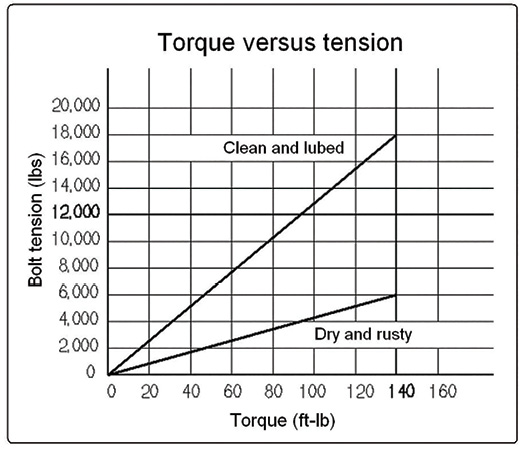
In the T=kdf (which gives you in-lbs) formula mentioned above, K is the coefficient for this bolt condition. Even on brand new bolts, the multiplier can range from around 0.12 to 0.2 depending on bolt surface treatment, plating and how dry it is. That's not 8%, let's look at an example.

This is the difference between needing 140.6lbs-ft on a bolt to 105, or as far as 84lbs-ft all to reach the same clamp load. On a rusty crust bolt, maybe you need 180lbs-ft (if the bolt survives it) for the same clamping force. Who knows.
 

noid

Well-known member
Joined
Jul 15, 2010
Messages
1,341
I'm just going to leave these here:


https://www.rtsauto.com/wp-content/uploads/2018/06/Torque-Tension-Chart-for-Metric-Fasteners.pdf

interesting. Would you hazard a guess as to how much a typically dirty/rusty bolt would impact a torque reading??? I realize that's vague, but take a 10 yr old car in a tropical climate with average/low rust.....5%, 10%??? double?

Per the example above, ~70% difference between lightly lubed and dry/rusty.

This is exactly why some auto makers use TTY bolts; because they stretch based on tension not torque.
 
Last edited:
OP
D

DugT

Well-known member
Joined
Jul 5, 2020
Messages
51
Location
Truckee, CA (6000' Sierra Nevada Mtns.)
......Threads should be clean, not worn, and usually lubricated (the lubricant type makes a difference too and is rarely specified). .....

Thanks for this and all of the other posts.

I'm curious about this lubrication because I've never heard of that before. On the other hand, "You should never lube lug nuts" is common knowledge. One of the reasons for getting bolts tight is it prevents them from vibrating loose. Lube would increase the probability that they would vibrate loose. Locktite is often recommended and I think it probably has a lubricant effect while it is still liquid. New bolts often have an oily coating. I thought it was just for rust prevention but maybe it helps to get them a little tighter too.

I totally agree that the Icon calibration is overkill and maybe more marketing than actually helpful. As far as marketing, it worked on me because I assume that the same level of detail and precision is applied to the whole Icon torque wrench manufacturing process but that could easily be wishful thinking. I doubt if they would lie about the calibration because they could easily be caught in that lie.
 
Last edited:

WinMod21

Well-known member
Joined
Jul 1, 2020
Messages
349
All this adv ^ is very interesting and informative! As I had no idea there were so many tech variables in torque wrenching!
 

toddmorr

Well-known member
Joined
May 4, 2017
Messages
654
Location
Prescott, Arizona
very interesting and helpful. I guess I've *felt* this kind of major swing in torque values when working with different bolts in different conditions, supposedly to the "same" torque. But didn't realize the quantified difference.

i guess there's still some value in consistency, but even that might vary widely, say right to left side of car due to rust.
 

M635_Guy

Well-known member
Joined
Dec 5, 2019
Messages
4,336
Location
NC
I (highly) doubt HF is faking the calibration reports. That's a lawsuit waiting to happen, not to mention a PR debacle they don't need right now.

A lot of the replies here are very interesting and informative - thanks to those guys.

On a side note, this thread for some reason it reminds me of the rabbit-hole I went down last year when I had car-buddies who are solid wrenches recommend some anti-seize on spark plugs I was installing in my old BMW. That seemed very counter-intuitive to me to the idea of torquing them for some reason. As it turned out, I was right - pretty much all modern automotive plugs these days are zinc-coated (I'd guess there might be exceptions for heavy-machinery/heavy truck/etc.) and are intended to be installed/torqued dry - the responses from Bosch and NGK both specifically said anti-seize or any other application to the threads was not recommended.

But I digress. :)
 

noid

Well-known member
Joined
Jul 15, 2010
Messages
1,341
I (highly) doubt HF is faking the calibration reports. That's a lawsuit waiting to happen, not to mention a PR debacle they don't need right now.

A lot of the replies here are very interesting and informative - thanks to those guys.

On a side note, this thread for some reason it reminds me of the rabbit-hole I went down last year when I had car-buddies who are solid wrenches recommend some anti-seize on spark plugs I was installing in my old BMW. That seemed very counter-intuitive to me to the idea of torquing them for some reason. As it turned out, I was right - pretty much all modern automotive plugs these days are zinc-coated (I'd guess there might be exceptions for heavy-machinery/heavy truck/etc.) and are intended to be installed/torqued dry - the responses from Bosch and NGK both specifically said anti-seize or any other application to the threads was not recommended.

But I digress. :)

It doesnt have to be one or the other, you can apply anti seize or lube and torque to a lower value to get the same tension.
 
To avoid these ads, REGISTER NOW!

noid

Well-known member
Joined
Jul 15, 2010
Messages
1,341
Unfortunately we have torque wrenches and are given torque specs. It sounds like we would be better off if there were tenshion wrenches and tension specs.

Not sure how you would have a tension wrench; perhaps a tension test bench.

Reference the second link I posted, it gives general guidelines for tension re: dry, lubed, and zinc plated per torque value applied.
 
OP
D

DugT

Well-known member
Joined
Jul 5, 2020
Messages
51
Location
Truckee, CA (6000' Sierra Nevada Mtns.)
It doesnt have to be one or the other, you can apply anti seize or lube and torque to a lower value to get the same tension.

I think your point is that ideal tension is the goal. I'm wondering if this matters because we have no way of knowing what the tension is because there is no way to measure it. Instead, we have to rely on torque specs and torque wrenches. Beyond that we can only hope we have at least adequate tension. On a more positive note, by using a torque wrench we are much less likely to break a bolt.

One of the several things I have learned from this thread is don't use rusty or dirty fasteners. Clean them or replace them.
 

sberry

Banned
Joined
Jun 18, 2005
Messages
35,747
Location
Brethren, Michigan
Exactly.

How you use the wrench also makes a difference, certainly far more than the difference in lab-tested accuracy of different torque wrenches. Threads should be clean, not worn, and usually lubricated (the lubricant type makes a difference too and is rarely specified). Click-type wrenches need to be exercised several times before use, ideally at target torque, if they haven’t been used very recently (e.g. just before lunch on the same day). The wrench should be held at the designated handle only. Target torque must be approached in a long and smooth final swing of ideally a quarter-turn at a speed of about 20 degrees per second. That’s four seconds for that last swing. Slow. There must be no slip-stick or the whole exercise becomes pointless.

It follows that it’s not possible to check the torque of a set fastener without undoing it and setting it again. If you set your torque wrench to, say, 30 Nm and it clicks on a bolt, that doesn’t mean the bolt was set to at least 30 Nm. It might have a tension equivalent to as little as 20 Nm but not move because of corrosion and sticking friction.

I’ve watched many mechanics work with a cavalier approach to all of this. Doesn’t stop them talking about lab-tested accuracy as if it matters a whit …

Thankfully most machinery works well without needing anywhere near 4% accuracy of fastener tension. But if you want to assemble it as the designer intended, put your effort into how you work rather than whose torque wrench you own.
this too.
 

sberry

Banned
Joined
Jun 18, 2005
Messages
35,747
Location
Brethren, Michigan
Old snap on used to say in the manual,,, all values are for clean light lubed threads. Modern penetrating type oil is about perfect for this. Keepsum from sticking.
 

JP Chestnut

Well-known member
Joined
May 9, 2020
Messages
235
Location
Upstate NY

M635_Guy

Well-known member
Joined
Dec 5, 2019
Messages
4,336
Location
NC
It doesnt have to be one or the other, you can apply anti seize or lube and torque to a lower value to get the same tension.

Given (A) they put the zinc on to obviate the need for anti-seize and (B) I don't know how to convert the tension required to a lower torque value, why would I use anti-seize?
 

M635_Guy

Well-known member
Joined
Dec 5, 2019
Messages
4,336
Location
NC
It wouldn't be HF faking anything. It would be their supplier who they have limited oversight over. Do you seriously think that a factory making a tool couldn't possibly cut corners when this happened:
https://qz.com/1323471/ten-years-af...ed-infant-milk-tragedy-deep-distrust-remains/

I s'pose. There are untrustworthy makers everywhere. Just ask anyone who lives near the Wolverine Boot factory.

Faking the torque calibration seems absurdly easy to uncover. If they're not doing routine sampling (easy enough to pull a few every few months from the store to check), they're leaving themselves open.

I dunno - it's convenient to point to things like this and say it was systemic, but I'm more data-driven than that if I'm going to make sweeping statements (what I do for a living makes me this way - lol).

What I'm inferring from what's going on is there haven't been a massive number of failures, and likely only a small number of jacks even within those product lines were actually affected. But since they don't serialize there's no way to bound for a date/manufacturing-line range, so they bring it all back. That's entirely speculation as someone who has a toe in these waters (far away from things that are cast/welded/etc.) and zero numbers to work with, but I'm just not wired to suspect fraudulent calibration by the supplier of the torque wrench because their (almost certainly different) supplier of jack stands failed on quality control (and I think it's fair to say badly in terms of how things fail on qualify even if we don't know how many were actually flawed).

It seems like some people distrust this guy, but he seems to be trying to present measured facts. I won't call it data because it's a sample of one, but the Icon clearly was in-spec.
IkbaFs.gif
 
Last edited:
OP
D

DugT

Well-known member
Joined
Jul 5, 2020
Messages
51
Location
Truckee, CA (6000' Sierra Nevada Mtns.)
I s'pose. There are untrustworthy makers everywhere. Just ask anyone who lives near the Wolverine Boot factory.

Faking the torque calibration seems absurdly easy to uncover. If they're not doing routine sampling (easy enough to pull a few every few months from the store to check), they're leaving themselves open.

I dunno - it's convenient to point to things like this and say it was systemic, but I'm more data-driven than that if I'm going to make sweeping statements (what I do for a living makes me this way - lol).

What I'm inferring from what's going on is there haven't been a massive number of failures, and likely only a small number of jacks even within those product lines were actually affected. But since they don't serialize there's no way to bound for a date/manufacturing-line range, so they bring it all back. That's entirely speculation as someone who has a toe in these waters (far away from things that are cast/welded/etc.) and zero numbers to work with, but I'm just not wired to suspect fraudulent calibration by the supplier of the torque wrench because their (almost certainly different) supplier of jack stands failed on quality control (and I think it's fair to say badly in terms of how things fail on qualify even if we don't know how many were actually flawed).

It seems like some people distrust this guy, but he seems to be trying to present measured facts. I won't call it data because it's a sample of one, but the Icon clearly was in-spec.
IkbaFs.gif

I don't think people here distrust me as much as they distrust the calibration measurements or they think they are irrelevant because there are so many other variables in adjusting Tension.

One of the reasons I posted about the calibration of this Icon is, in another thread where I said I was considering getting a Pittsburgh torque wrench, a few people argued that I should get a Husky because its tolerance spec is +/- 3% Vs. the Pittsburgh's +/- 4%. Apparently the spec isn't as relevant as the actual calibration of the tool.

There are many other factors involved in getting optimum tension but using a good tight tolerance torque wrench doesn't hurt. Getting one for only $88 hurts even less.

This reminds me of a story by Jack Handy. A guy, lets call him ****, visited an old friend who was in an "Institution" because he had developed mental issues. The friend was wearing a straight jacket and he was sitting in a white room with no windows and no pictures, everything was boring solid white. But, his friend thought he was at a fabulous beach resort island in the middle of the Pacific and life was wonderful and he was enjoying life more than ever. It took **** two hours to convince his dear friend that he was in a horrible institution wearing a straight jacket and sitting in a boring little white room with no windows.
 
Last edited:

joeswamp

Well-known member
Joined
Jul 25, 2007
Messages
2,418
Location
Massachusetts
Unfortunately we have torque wrenches and are given torque specs. It sounds like we would be better off if there were tenshion wrenches and tension specs.

Not sure how you would have a tension wrench; perhaps a tension test bench.

Reference the second link I posted, it gives general guidelines for tension re: dry, lubed, and zinc plated per torque value applied.

Nobody really cares about torque, it's just that it's very easy to measure. Bolt tension is what actually matters, but there's no way to measure it when the bolt is installed.

In factory conditions with new bolts, torque and tension do correlate pretty well, so torque wrenches make a ton of sense. When stuff gets old in the field though, the torque/tension relationship does break down.

I once worked on a helicopter engine where the field toolkit didn't contain a torque wrench. Mechanics were instructed to tighten the bolts until they were just snug and then clock them a specified number of degrees using a degree wheel. The factory did a bunch of blind tests early on and found this method to be more accurate than using a torque wrench.
 
OP
D

DugT

Well-known member
Joined
Jul 5, 2020
Messages
51
Location
Truckee, CA (6000' Sierra Nevada Mtns.)
Nobody really cares about torque, it's just that it's very easy to measure. Bolt tension is what actually matters, but there's no way to measure it when the bolt is installed.

In factory conditions with new bolts, torque and tension do correlate pretty well, so torque wrenches make a ton of sense. When stuff gets old in the field though, the torque/tension relationship does break down.

I once worked on a helicopter engine where the field toolkit didn't contain a torque wrench. Mechanics were instructed to tighten the bolts until they were just snug and then clock them a specified number of degrees using a degree wheel. The factory did a bunch of blind tests early on and found this method to be more accurate than using a torque wrench.

Thanks! While searching for the best torque wrench for me I noticed some electric ones also measured degrees or angles or both and I wondered what they were talking about. Now I know.
 

noid

Well-known member
Joined
Jul 15, 2010
Messages
1,341
I think your point is that ideal tension is the goal. I'm wondering if this matters because we have no way of knowing what the tension is because there is no way to measure it. Instead, we have to rely on torque specs and torque wrenches. Beyond that we can only hope we have at least adequate tension. On a more positive note, by using a torque wrench we are much less likely to break a bolt.

One of the several things I have learned from this thread is don't use rusty or dirty fasteners. Clean them or replace them.

Of course tension is the goal, what do you think a bolt is doing?

Torque is a means to tension.

You can very easily break a bolt with a torque wrench if you lube it and the torque spec is for a dry value.

You can use rusty fasteners just fine; just lube them to compensate.

Old snap on used to say in the manual,,, all values are for clean light lubed threads. Modern penetrating type oil is about perfect for this. Keepsum from sticking.

Kind of a silly statement considering lube or not to lube torque is dictated by the engineers of the item you're bolting on. If the equipment manual of the item you're working on says lubed torque, don't listen to snap on.

Given (A) they put the zinc on to obviate the need for anti-seize and (B) I don't know how to convert the tension required to a lower torque value, why would I use anti-seize?

Unless you're going into a fresh, clean, chased hole, you'll have to compensate for torque spec anyways.

Zinc plating doesn't stop corrosion full stop; it slow it down.

Its really a none-issue either way; it doesn't matter which way you do it... unless you ever get a Ford that use two piece plugs, then buy a nice big jug of anti seize.

Moral of the story; clean your holes boys.
 

M635_Guy

Well-known member
Joined
Dec 5, 2019
Messages
4,336
Location
NC
Of course tension is the goal, what do you think a bolt is doing?

Torque is a means to tension.

You can very easily break a bolt with a torque wrench if you lube it and the torque spec is for a dry value.

You can use rusty fasteners just fine; just lube them to compensate.


Kind of a silly statement considering lube or not to lube torque is dictated by the engineers of the item you're bolting on. If the equipment manual of the item you're working on says lubed torque, don't listen to snap on.


Unless you're going into a fresh, clean, chased hole, you'll have to compensate for torque spec anyways.

Zinc plating doesn't stop corrosion full stop; it slow it down.

Its really a none-issue either way; it doesn't matter which way you do it... unless you ever get a Ford that use two piece plugs, then buy a nice big jug of anti seize.

Moral of the story; clean your holes boys.

If I'm doing what I'm supposed to be doing and have corrosion in my spark plug holes, I've got bigger problems...
 
OP
D

DugT

Well-known member
Joined
Jul 5, 2020
Messages
51
Location
Truckee, CA (6000' Sierra Nevada Mtns.)
Of course tension is the goal, what do you think a bolt is doing?

Torque is a means to tension.

You can very easily break a bolt with a torque wrench if you lube it and the torque spec is for a dry value.

You can use rusty fasteners just fine; just lube them to compensate.


Kind of a silly statement considering lube or not to lube torque is dictated by the engineers of the item you're bolting on. If the equipment manual of the item you're working on says lubed torque, don't listen to snap on.


Unless you're going into a fresh, clean, chased hole, you'll have to compensate for torque spec anyways.

Zinc plating doesn't stop corrosion full stop; it slow it down.

Its really a none-issue either way; it doesn't matter which way you do it... unless you ever get a Ford that use two piece plugs, then buy a nice big jug of anti seize.

Moral of the story; clean your holes boys.

Now I think your point is we should evaluate the bolt and the bolt hole, do our best to solve any out of spec friction problems and then based on the amount of remaining out of spec change in friction, which we can't measure, we should guess at the appropriate torque value to achieve the ideal tension which we don't know and can't measure.

I do understand and believe what you are saying and that there are times when mechanics have to take torque specs with a grain of salt. I don't see this in my world because I just wrench bolts occasionally in my garage and I never work on anything with corrosion. For my level of experience and my easy projects, following torque specs and using perceived good wrench is good for morale.
 

travisn1

Well-known member
Joined
Oct 22, 2012
Messages
152
Location
Waterloo NY
A few people have said you can't measure bolt tension, this is wholly incorrect. If you have access to both sides of the bolt you can measure stretch with calipers, but then you have to take compression of the joint into consideration (example: a gasket). Once you have the stretch amount a simple formula gives you tension using the stiffness of the bolt.

There are also methods of measuring bolt stretch with ultrasonic devices. https://www.checkline.com/product/TI-MINIMAX# (first result from google)

Doing the torque plus rotation method is very reliable since it takes most of friction out of the equation. The initial torque is used to close up the joint, then the rotation uses the thread pitch of the bolt to give it a predetermined amount of preload via force over a distance combined with the strength of the bolt.

The k-factor in T=kdf is the slope of the torque to tension line plotted as an output of testing:
G3-Torque-versus-tension.jpg


To properly call out a torque spec in a new application there is lots of testing and validation involved. Material/joint composition, temperature, vibrations, etc all play a part in the value then tolerance you need to give. Basically high enough so the joint doesn't separate, low enough so the bolt doesn't break. You want to snap a bolt before yielding threads as you may not notice a yield but you'd know if something snapped.

Fastener design and bolt torque is a rabbit hole of engineering that I've barely dabbled in, granted more than most but I'm certainly not an expert. Search "fastener frustum" for an advanced view of bolted joint design. First result: http://faculty.mercer.edu/jenkins_he/documents/MAE322Bolts2.pdf

With DIY/automotive use, I'd rather know I'm in the ballpark by using a torque wrench and spec versus just winging it, especially with safety critical and fluid sealing parts.
 

toddmorr

Well-known member
Joined
May 4, 2017
Messages
654
Location
Prescott, Arizona
so now I'm wondering what OEMs like Toyota are thinking when they specify a torque value. Are they assuming clean/lubed or rusty/dry. Can't recall reading anything about this in any shop manual. Guaranteed Toyota has thought tons about it, maybe they just pick a middle point and call it a day.
 

DFB

Well-known member
Joined
Sep 7, 2016
Messages
5,765
Location
Southern VT/Western Mass
My shop manuals for the John Deere's have different chart values for either lubricated or dry per each grade and size.

The different OEM Harley manuals I have don't specify but the values given match up to the dry values in the JD books.
 

Lassen Forge

Well-known member
Joined
Apr 26, 2014
Messages
15,399
Location
The romantic hills of central Umbria, Italy,
Clean, dry, undamaged threads. Not rusty, not oiled. Clean and dry.

Re the "calibration" - What I'm thinking is this - the chart may look good, heck, it may actually be what that wrench pulled... but will it be as accurate after daily use in a year? I have a 15+ year old SO clicker that is still in spec. That's after some usage. I had a new manufacture Craftsman that was also in spec - until about 3 months on, then it was so bad it stripped itself out stretching the bolt with no click. Nada.

That piece of paper is what that wrench pulled IN THE FACTORY WHEN NEW... it looks good, they always do, but unless you have it checked and recalibrated regularly that paper isn't worth the cigarette you rolled from it. The only thing it does is tell you before they shipped it it worked to whatever spec they pulled.
 
OP
D

DugT

Well-known member
Joined
Jul 5, 2020
Messages
51
Location
Truckee, CA (6000' Sierra Nevada Mtns.)
Yes, after a calibrated torque wrench leaves the factory, it could explode into a million pieces. It could also stay calibrated for a long time. I've read posts from several people that said their old Pittsburgh torque wrenches have kept their calibration for years. I think an Icon will do at least as well. Icon's have been out for a couple of years and the reviews at Harbor Freight are good with an average score of 4.8.

I'm surprised how many people that do mechanical work talk about having their torque wrenches calibrated. It is easy to calibrate a torque wrench. Any mechanic that is experienced enough to use a torque wrench regularly should be able to calibrate one. The math part might stump some people but the rest of it is easy.
 

Hiball

Well-known member
Joined
Apr 30, 2009
Messages
14,032
Location
Missery
I'm surprised how many people that do mechanical work talk about having their torque wrenches calibrated. It is easy to calibrate a torque wrench. Any mechanic that is experienced enough to use a torque wrench regularly should be able to calibrate one. The math part might stump some people but the rest of it is easy.

It’s not about a one time calibration, it’s about maintaining the the internal parts that keep the TW calibrated when used on a daily basis.. The repeated stretching (clickers) over time can change the spring rate, which require adjustment and sometimes new parts, other scenarios require periodic calibration and documentation to back it up.

I’ve always been in the camp that I’m buying from a company that specializes in Torquing fasteners, especially since PI and CDi under there own branding is extremely affordable.

I don’t send many TW’s off for calibration, I’m pretty reliable in regards to keeping my clickers dialed down and have a HF strain gauge that when checked seems spot on across a variety of torque values.

Just so we are clear, I’m not bashing the Icon. It looks nice... It’s just not my cup of tea.
 
To avoid these ads, REGISTER NOW!
Top Bottom