To avoid these ads, REGISTER NOW!

Generator for 3 Ton Heat Pump

FMC1959

Well-known member
Joined
Feb 9, 2014
Messages
2,319
Location
Montreal, Canada / Upstate NY
Yup, another generator related question. (sorry!)

My biggest concern is getting big enough Kw, but as small that will do the job for budget.

There will be other small items I will add to the calculation later, but for now, my main concern is the continuous and startup amps or watts needed for my heat pump which is the AC now and does most of the heating in the winter.

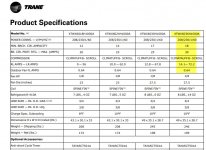
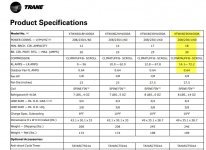
I have a 3 ton Trane XL16i (model # 4TwX6036h). I have called Trane, VM only. I filled out their online form, once 3 weeks ago and again a week ago, no response yet. I asked the contractor, he sent me the attached pic and highlighted my model and went on to say that it would run on 14.75 amps and need 18 amps at startup.
Trane Specs.jpg

When looking at the specs, does anyone understand where he is getting 14.74 and 18 amps?

My system is hooked at 240v (I believe) meaning 18 x 240 = 4320watts, so about 4500 watts should cover the heat pump, if I get a 10Kw (12Kw surge), I have about just over 6000 continuous watts for additional stuff I would like to run...does all this sound right?
 
To avoid these ads, REGISTER NOW!

metlmunchr

Well-known member
Joined
Sep 10, 2011
Messages
1,280
The contractor shouldn't be dispensing electrical advice as he's clueless about the relationship between starting and running amperage.

Starting amperage will be approximately equal to the locked rotor amperage shown on your pic as LRA.

General rule of thumb is LRA will be about 5x the full load amperage, and this is the case with your condensing unit. Since the condenser fan starts at the same time as the compressor, you'd also need to add the locked rotor amperage of that motor too, which would add another 3 amps. The indoor fan motor would need to be previously set to continuous run, else you'd also need to add the LRA for that motor too.

Accounting for just the compressor and the condenser fan motor, you'd need 75 amps for reliable
starting. 75 amps @ 240V is 18 kW.

I've got a 3.5 ton heat pump and my 4500 running /5500 starting Generac won't begin to start the condensing unit. A window unit in my detached garage pulls about 950 watts at full load, and the Generac will start that unit but you can tell it struggles to get that little unit going.

Were it not for air conditioning, most any normal size house could get by very well on a 10 kW generator even with electric hot water and electric kitchen appliances as long as you aren't trying to run everything at once. But, once you add AC into the mix, the size for a true whole house generator will double that, even with a house with gas appliances. And, with all electric appliances and water heating, you can push 25 to 30 kW unless you do some selective load shedding at certain times during the day.
 
Last edited:

theoldwizard1

Well-known member
Joined
Feb 22, 2011
Messages
43,246
Location
SE MI
A true "soft starter" (current limiter, not just a capacitor) would limit the starting current to a much lower number than the LRA.

Re "normal house generator sizing", if the home has NO 240VAC APPLIANCES, and you do careful management of loads, you could probably run it on a 2000W-3000W generator.
 
OP
F

FMC1959

Well-known member
Joined
Feb 9, 2014
Messages
2,319
Location
Montreal, Canada / Upstate NY
The contractor shouldn't be dispensing electrical advice as he's clueless about the relationship between starting and running amperage.

Starting amperage will be approximately equal to the locked rotor amperage shown on your pic as LRA.

General rule of thumb is LRA will be about 5x the full load amperage, and this is the case with your condensing unit. Since the condenser fan starts at the same time as the compressor, you'd also need to add the locked rotor amperage of that motor too, which would add another 3 amps. The indoor fan motor would need to be previously set to continuous run, else you'd also need to add the LRA for that motor too.

Accounting for just the compressor and the condenser fan motor, you'd need 75 amps for reliable
starting. 75 amps @ 240V is 18 kW.

I've got a 3.5 ton heat pump and my 4500 running /5500 starting Generac won't begin to start the condensing unit. A window unit in my detached garage pulls about 950 watts at full load, and the Generac will start that unit but you can tell it struggles to get that little unit going.

Were it not for air conditioning, most any normal size house could get by very well on a 10 kW generator even with electric hot water and electric kitchen appliances as long as you aren't trying to run everything at once. But, once you add AC into the mix, the size for a true whole house generator will double that, even with a house with gas appliances. And, with all electric appliances and water heating, you can push 25 to 30 kW unless you do some selective load shedding at certain times during the day.

I have come across "hard start capacitors" like a 5-2-1 hard kit. I don't know much about them, except what I have read in the past couple of days.

One view is that they work, reduce starting amps by a good chunk, and also save the compressors life by extending it. Trane or any other MFR of heat pumps or AC's do not add this because it is an added expense and why spend more when it isn't necessary (most home systems can handle the startup without issue and they certainly do not want the compressor to last longer)

The other view is pretty simple, another magic bullet, making to good to be true promises, ****. Actually very harmful to the Compressor.

Any thoughts on these hard start kits?
 
OP
F

FMC1959

Well-known member
Joined
Feb 9, 2014
Messages
2,319
Location
Montreal, Canada / Upstate NY
A true "soft starter" (current limiter, not just a capacitor) would limit the starting current to a much lower number than the LRA.

Re "normal house generator sizing", if the home has NO 240VAC APPLIANCES, and you do careful management of loads, you could probably run it on a 2000W-3000W generator.

I was typing as theoldwizard1 was responding. Is what I mentioned about hard start kits the same as what you are mentioning? Overall are they good to have, or they reduce startup amperage, but at a cost to....example, compressor life or other negative attributes?
 

Davefr

Well-known member
Joined
Jan 7, 2010
Messages
11,847
Location
OR
Does your HP also have backup electric elements for winter heat? Those can add lots of additional amps when the thermostat calls for additional heating.

Make sure to disable them when using a generator.
 
OP
F

FMC1959

Well-known member
Joined
Feb 9, 2014
Messages
2,319
Location
Montreal, Canada / Upstate NY
Does your HP also have backup electric elements for winter heat? Those can add lots of additional amps when the thermostat calls for additional heating.

Make sure to disable them when using a generator.

No it does not, it just works in reverse from what I understand.

The compressed Freon goes through the evaporator and/or condenser and captures the hot air. In AC mode the cool air is sent into the house and the hot air expelled outside the house. In heating mode, the cold air is expelled outside the house and the warm air is sent through the house.

That is my basic understanding and believe that it uses the same amps whether AC or heat. I am not sure how these systems vary but most systems here in Canada are always used in conjunction with a furnace as the heat pump, depending on how efficient it is, can capture heat from a low of 10 Fahrenheit to as low as -10 Fahrenheit. In Arizona or most southern states, a heat pump of this nature would be all you need but northern states or Canada, you need something else, like a furnace. To be noted, hot air coming out of the heat pump in the winter is never hot like the furnace, it is warm at best but still very effective and much more efficient to run than the furnace $$$ wise.

If they make some that have incorporated coils, I am not aware, all the heat pumps or thermo-pumps that I know of (which is definitely not absolute) are a system like I described above.
 

theoldwizard1

Well-known member
Joined
Feb 22, 2011
Messages
43,246
Location
SE MI
I was typing as theoldwizard1 was responding. Is what I mentioned about hard start kits the same as what you are mentioning? Overall are they good to have, or they reduce startup amperage, but at a cost to....example, compressor life or other negative attributes?

The problem is, just exactly what is a hard start kit ! Some people will sell you just an oversized starting capacitor which does not solve your problem.

Micro-Air got in the business by building and selling Soft Starters for RV A/C units (frequently run on generators). They now make larger ones (up to 4 ton) for residential A/C units.

Their claim is "up to 75% reduction in LRA" when starting.
 
Last edited:
OP
F

FMC1959

Well-known member
Joined
Feb 9, 2014
Messages
2,319
Location
Montreal, Canada / Upstate NY
The problem is, just exactly what is a hard start kit ! Some people will sell you just an oversized starting capacitor which does not solve your problem.

Micro-Air got in the business by building and selling Soft Starters for RV A/C units (frequently run on generators). They now make larger ones (up to 4 ton) for residential A/C units.

Their claim is "up to 75% reduction in LRA" when starting.

I don't know if you are in the HVAC business, but you or anyone else know or have experience with these soft starters? Like, yes it lowers the starting amps, but at a cost, like shorter lifespan of the AC compressor or other negative?

I doubt there would be a negative on the generator side, but if so, what would it be?

Any plus sides like the "soft start" actually prolongs compressor life because it is not being hit with full amperage...or anything similar? Where MFR's like Trane, Lennox, Rheem...etc do not add this type of item because it is an added cost but more importantly they don't want to extend compressor life by more than what they currently are? (I believe 12-15 years, just beyond the warranty for most) A system that last 30-40 years is not good for their profits!

If these are not detrimental and even if it does not reduce starting amperage by the claimed 75%, but only something like 50%, it would still be great.
 
OP
F

FMC1959

Well-known member
Joined
Feb 9, 2014
Messages
2,319
Location
Montreal, Canada / Upstate NY
Just remember that "Up to...." marketing hype always includes zero...

I know, they claim up to 75%. That why I said if they could get a 50% or even 40% reduction, that for me is a big reduction.

Especially because it would run on about 4500 watts but I would need about 18,000 watts just for it to start. Add to that 18Kw additional Kw for other items I want to run. If it would start with 10-11Kw, that is already a win.
 
To avoid these ads, REGISTER NOW!

theoldwizard1

Well-known member
Joined
Feb 22, 2011
Messages
43,246
Location
SE MI
I don't know if you are in the HVAC business, but you or anyone else know or have experience with these soft starters? Like, yes it lowers the starting amps, but at a cost, like shorter lifespan of the AC compressor or other negative?
No first hand experience, but at one time I was a EE ! (Most of my brain cells are still connected.)

The problem is the large starting capacitor. When a capacitor is discharged and starts to charge up, it looks like a short circuit, so obviously it will draw a lot of power. Once the voltage in the capacitor build up sufficiently, the motor will start to spin. Once the motor is at full speed the centrifugal switch will take the start capacitor out of the circuit as its job is done.

The trick is to slow the charge rate of the capacitor by placing a current limiting resistor (or some fancy electronic current limiter) inline with the starting capacitor. (Video showing similar problem on an inverter.)

As I said, no experience, but I don't see why this would negatively affect the motor because it will not start to turn until the start capacitor is sufficiently charged. Even with the current limiting resistor, the charging time of the capacitor (about <1 second) is much lower than the spin up time for the motor (2-5 seconds) so I can not imagine any negative affects.

I am sure there is a way to wire it so that it is only in play when the generator is trying to start the A/C.

Any plus sides like the "soft start" actually prolongs compressor life because it is not being hit with full amperage...or anything similar?
No. The high current is caused by the starting capacitor not the windings of the motor.

If these are not detrimental and even if it does not reduce starting amperage by the claimed 75%, but only something like 50%, it would still be great.
50% sounds realistic.


Note, inverter compressors SHOULD NOT NEED SUCH A DEVICE ! Inverter motors/compressor first convert the incoming AC to high voltage DC. The high voltage DC is feed into a 3 phase inverter. 3 phase because the power is more evenly distributed across different windings as the motor spins (single phase motor are "coasting down" and "spinning up" once each cycle). The inverter is capable of generating variable frequency output. The motor speed is directly proportional to the frequency, so they can control the speed of the motor.
 

theoldwizard1

Well-known member
Joined
Feb 22, 2011
Messages
43,246
Location
SE MI

You may need to install a "hard start" kit, which is quite cheap. It is basically a large capacitor in series with a disconnect part ... Such a device usually has a solid-state relay. It is basically a PTC material that rapidly increases in resistance as it is heated when an electric current passes through it. As the result, it disconnects the start capacitor from the circuit soon after power is applied. The PTC material then remains hot from the "trickle current" that continues to flow through it as long as there is voltage. Note that when the power is removed from the motor, the solid state material begins to cool down, which takes a few minutes.
Correct concept.
 
OP
F

FMC1959

Well-known member
Joined
Feb 9, 2014
Messages
2,319
Location
Montreal, Canada / Upstate NY
No first hand experience, but at one time I was a EE ! (Most of my brain cells are still connected.)

The problem is the large starting capacitor. When a capacitor is discharged and starts to charge up, it looks like a short circuit, so obviously it will draw a lot of power. Once the voltage in the capacitor build up sufficiently, the motor will start to spin. Once the motor is at full speed the centrifugal switch will take the start capacitor out of the circuit as its job is done.

The trick is to slow the charge rate of the capacitor by placing a current limiting resistor (or some fancy electronic current limiter) inline with the starting capacitor. (Video showing similar problem on an inverter.)

As I said, no experience, but I don't see why this would negatively affect the motor because it will not start to turn until the start capacitor is sufficiently charged. Even with the current limiting resistor, the charging time of the capacitor (about <1 second) is much lower than the spin up time for the motor (2-5 seconds) so I can not imagine any negative affects.

I am sure there is a way to wire it so that it is only in play when the generator is trying to start the A/C.


No. The high current is caused by the starting capacitor not the windings of the motor.


50% sounds realistic.


Note, inverter compressors SHOULD NOT NEED SUCH A DEVICE ! Inverter motors/compressor first convert the incoming AC to high voltage DC. The high voltage DC is feed into a 3 phase inverter. 3 phase because the power is more evenly distributed across different windings as the motor spins (single phase motor are "coasting down" and "spinning up" once each cycle). The inverter is capable of generating variable frequency output. The motor speed is directly proportional to the frequency, so they can control the speed of the motor.

Correct concept.

Thanks Wizard lots of helpful feedback.

If you read (or anyone else read) https://generators.smps.us/start.html this guy mentions the following

"The LRA is typically 3 to 8 times continuous operating current (called full load amps, or FLA). Note, this does not equate to 3 to 8 times real (active) power because the power factor of a starting motor is low (<0.5)."

then goes on to say

"The case is that nameplate LRA is given for full voltage starting. In reality, when you start a motor from a generator, the current surge causes voltage dip. When voltage drops, the current is reduced proportionally. Most residential appliances can start with 30% voltage sag, that is at 30% lower currents. As the result, starting volt-amps could be 0.7*0.7=0.49 of nominal. For example, a typical 5-ton (5HP) a/c has 145 LR amps at 240VAC. At 30% voltage dip it would require (145*0.7)*(240*0.7)=17,052 VA to start. Note that commercial applications normally allow only 15% drop, in which case you would need to deal with 0.85*0.85=.72 of nominal starting kVA."

Trane Specs.jpg

If what he is saying is true, then my unit which has an LRA of 72.2 + fan and other minor draw say 75 amps, using his formula of 75 x .7 = 52.2. This would allow me to get away with less Kw. But then in his formula, he says to multiply amps (amps x .7) a volts (volts x .7) = required VA to start. The initial draw actually required goes down even more. My LRA of 75 amps would look something like....(75 x.7) x (240 x .7) which would equal 8820 starting VA.

I have never understood the difference between VA (volt amps) vs Kw or watts (volts x amps) and why some generator companies express their genset VA and others their Kw. I know that most often when both numbers are show, they are very close to each other. And I believe (not definite but IIRC) this guy in the link above mentions that when Kw exceeds VA, go with the VA number.

In another section he mentions generator surge or peak is often understated by as much as 50%...if I interpreted what he was saying correctly.

All this to say if this guy is right, I can get away with about 9000 watts or my heat pump startup instead of 18,000? :bounce:

* BTW, is EE = Electrical Engineer?
 

theoldwizard1

Well-known member
Joined
Feb 22, 2011
Messages
43,246
Location
SE MI
I have never understood the difference between VA (volt amps) vs Kw or watts (volts x amps) and why some generator companies express their genset VA and others their Kw.
Most "industrial" transformers use VA. It has to do with "power factor" (I have forgotten everything I ever knew about "power factor" but you have to believe in imaginary numbers and don't want to relearn it. That and Smith Charts.)

In another section he mentions generator surge or peak is often understated by as much as 50%...if I interpreted what he was saying correctly.
Same with "starting current" for motors. Too many variables to come up with a way to test and have "real world" meaning.

Personally, I would go with Micro Air. This is their business.

* BTW, is EE = Electrical Engineer?
Shhh ! Don't tell anybody !
 

theoldwizard1

Well-known member
Joined
Feb 22, 2011
Messages
43,246
Location
SE MI
"The case is that nameplate LRA is given for full voltage starting. In reality, when you start a motor from a generator, the current surge causes voltage dip. When voltage drops, the current is reduced proportionally. Most residential appliances can start with 30% voltage sag, that is at 30% lower currents. As the result, starting volt-amps could be 0.7*0.7=0.49 of nominal. For example, a typical 5-ton (5HP) a/c has 145 LR amps at 240VAC. At 30% voltage dip it would require (145*0.7)*(240*0.7)=17,052 VA to start. Note that commercial applications normally allow only 15% drop, in which case you would need to deal with 0.85*0.85=.72 of nominal starting kVA."
Retired. Lots of dead brain cells. Don't really give a **** about anything ...

But, this statement does not seem logical. (EDIT : But re-reading it, it is a "hand waving exercise" to "guestimate" starting current from LRA.)

Power from a generator is (more or less) constant. If you are operating a close to max power (either VA or KW) and there is a high current demand (starting capacitors "look" like a short circuit) the voltage will drop. (Part of Ohm's Law, power = voltage X current with some power factor.) The momentary "short circuit" may not be long enough to trip the generator output breaker.

On the motor/compressor side, the starting capacitor wants to charge up quickly (which looks like a "short circuit"). With lower voltage and still inadequate current the thermal overload/breaker should (hopefully) trip (or you will melt something the motor) because it reacts faster than the breaker on the generator. If this happens, you will hear a "Hmmmm ... Click" at the motor. At the generator you will hear the RPM drop and then it will rev back up.

All this to say if this guy is right, I can get away with about 9000 watts or my heat pump startup instead of 18,000?
Don't bet on it ! Get a backup heat source. Besides a 10KW generator will **** a lot of fuel, gasoline, diesel, natural gas or LP.

LRA (locked rotor amps) is REAL and somewhat common in compressors. Prove it to yourself. Wait for your refrigerator to start up. Quickly unplug it. Wait a second or two and plug it in again. It probably will not start (Hmmmmm ... Click !). Wait about 60 seconds and it will start. Don't ask me to explain it. Don't care anymore. Get off my lawn.
 
Last edited:
OP
F

FMC1959

Well-known member
Joined
Feb 9, 2014
Messages
2,319
Location
Montreal, Canada / Upstate NY
Retired. Lots of dead brain cells. Don't really give a **** about anything ...

But, this statement does not seem logical. (EDIT : But re-reading it, it is a "hand waving exercise" to "guestimate" starting current from LRA.)

Power from a generator is (more or less) constant. If you are operating a close to max power (either VA or KW) and there is a high current demand (starting capacitors "look" like a short circuit) the voltage will drop. (Part of Ohm's Law, power = voltage X current with some power factor.) The momentary "short circuit" may not be long enough to trip the generator output breaker.

On the motor/compressor side, the starting capacitor wants to charge up quickly (which looks like a "short circuit"). With lower voltage and still inadequate current the thermal overload/breaker should (hopefully) trip (or you will melt something the motor) because it reacts faster than the breaker on the generator. If this happens, you will hear a "Hmmmm ... Click" at the motor. At the generator you will hear the RPM drop and then it will rev back up.


Don't bet on it ! Get a backup heat source. Besides a 10KW generator will **** a lot of fuel, gasoline, diesel, natural gas or LP.

LRA (locked rotor amps) is REAL and somewhat common in compressors. Prove it to yourself. Wait for your refrigerator to start up. Quickly unplug it. Wait a second or two and plug it in again. It probably will not start (Hmmmmm ... Click !). Wait about 60 seconds and it will start. Don't ask me to explain it. Don't care anymore. Get off my lawn.

I am no engineer or much of anything else, but I always thought this thing about the fridge (also window AC) was simply that when it normally starts, the compressor has been at off long enough that there is no up built PSI in the line, and it starts quite easily, as it is designed to do.

Turn it off or unplug while it is operating, the compressor, and the plug it back in right away, there is probably too much pressure build up for the compressor to overcome, so you either get the hmmmm click (which I am guessing is a safety switch preventing something from burning up), or it blows your fuse breaker because it is pulling so many amps in trying to overcome the deficit in power to overcome the pressure Waiting 60 seconds usually relieves any built up pressure ad it starts as it should...nothing technical, just what I thought made sense when this happened.

Similar phenomena as a circular saw, cutting into a 2x6 or 2x8, and having a good size, unsupported cut. When the cut is close to completion and the unsupported cut starts hanging and binding into the blade, you get; an el-cheapo saw will smoke or eat the gears. A strong premium saw will pull big amps and pop your breaker. (Supposedly 30 amps or more for a 15 amp motor)

****

Babbling on has finished...I intend to look for the Micro Air soft start, and although I was in the USA 1-2 times per month, since COVID, that ain't happening. So I took a quick look online for places that have that unit, just a few small places not near me.

If they ship, I could be OK, if not, I would need to find another brand other than Micro Air that I can find in Canada; do you know of other reputable soft start systems?
 

theoldwizard1

Well-known member
Joined
Feb 22, 2011
Messages
43,246
Location
SE MI
If they ship, I could be OK, if not, I would need to find another brand other than Micro Air that I can find in Canada; do you know of other reputable soft start systems?

Sorry, no. Did you know to get to Canada from Detroit you drive SOUTH east through the tunnel ?

Bring back the original 6 !
 

theoldwizard1

Well-known member
Joined
Feb 22, 2011
Messages
43,246
Location
SE MI
Trucks can not use the Tunnel so they use the bridge. Traffic volume is high. Work has already begun on the new Gordie Howe bridge (down river a ways). Canada is paying for it, but they get most (all ?) of the revenue.

You folks are smart not letting any of us Yanks in until this virus is under control !
 
OP
F

FMC1959

Well-known member
Joined
Feb 9, 2014
Messages
2,319
Location
Montreal, Canada / Upstate NY
Trucks can not use the Tunnel so they use the bridge. Traffic volume is high. Work has already begun on the new Gordie Howe bridge (down river a ways). Canada is paying for it, but they get most (all ?) of the revenue.

You folks are smart not letting any of us Yanks in until this virus is under control !

I thought you were going to say Canada is paying for it because Trump said so, like the wall he said Mexico was paying for :) (my lousy attempt at humor :dunno:)
 

theoldwizard1

Well-known member
Joined
Feb 22, 2011
Messages
43,246
Location
SE MI
I thought you were going to say Canada is paying for it because Trump said so, like the wall he said Mexico was paying for :) (my lousy attempt at humor :dunno:)

The current bridge is privately owned and the family did their best legal moves to prevent the Gordie Howe bridge from happening.

I am not sure how Canadians feel about their native son moving to the US and playing his entire career over here, but he is one of the few athletes in Detroit that was truly loved by all !
 
To avoid these ads, REGISTER NOW!
Top Bottom