To avoid these ads, REGISTER NOW!

Infrared heaters on porch

AntonLargiader

Well-known member
Joined
Nov 20, 2016
Messages
1,372
Location
Charlottesville, VA
We're going to add some IR/radiant heat to our porch, to extend the usefulness as winter comes along. One can spend a lot of money on this, but Global Industrial has 3kW heaters for about $400 each with the controller. The holy grail is to get "no glow" heat strips but that's double the money. The porch is about 28' x 13' and I think we want three of these heaters. At 240V they are 12.5A each. Three of them are 37.5A, that means I need #8 cable, right? I'd be pulling that cable from the panel to the bank of controllers, and then running 12-2 to each of the heaters.

Is there a limit to how high on the wall I can install the controls? I don't want to go super high but I think I'd want them above typical switch height.

Anything else I should keep in mind?

Not 100% sold on these particular ones but this is what we are considering:

Heaters: https://www.globalindustrial.com/p/...er-och-57-240v-sse-240v-3000w-stainless-steel

Controls: https://www.globalindustrial.com/p/...-control-for-quartz-electric-infrared-heaters
 
To avoid these ads, REGISTER NOW!

Terry D

Well-known member
Joined
Mar 25, 2015
Messages
2,202
Location
St. Louis, MO.
You are going to need a 20 amp circuit, from the panel( 12-2 )for each heater. Height for a thermostat is 5' off of floor. Unless you want it zoned, ideally, it would be better to have it work off of one thermostat. But that would involve contactors.

I don't know why you couldn't build a control panel with (3) 2-pole contactors with 24 volt coils and a 24 volt transformer with a 24 volt thermostat, and not buy those controllers @ 111.00 each.

Is this porch enclosed
 
Last edited:
OP
A

AntonLargiader

Well-known member
Joined
Nov 20, 2016
Messages
1,372
Location
Charlottesville, VA
Right, can I see that... but that eats up six slots in my panel. That's a lot. I think I'd have to add a sub for that, which isn't THAT big a deal but I'd rather not.

IR heat isn't so much a thermostat thing; it's more of a power level thing. The air doesn't get warm so you can't control to it. The controller I linked to is just a proportional output, like PWM.
 

Dan C

Active member
Joined
May 23, 2012
Messages
32
I put in 4 of these on a 26x22 porch i just finished and they are awesome.

https://www.infratechheatersusa.com...att-Electric-Patio-Heater---C-Series-CD60.htm

I ran them on 30 amp 220 fed from the box to the switch on 10/2 then from the switch on 10/3 per the wiring schematic to run each element individually. So you end up with 2-3000 watt heaters per switch. I used quad breakers for 2- 30amp breakers per pair of panel slots (4 total consumed)

For the switches I used these, which Infratech likes to charge $185 per pair for: https://www.amazon.com/gp/product/B000U3DUZO/?tag=atomicindus08-20
 

Dan C

Active member
Joined
May 23, 2012
Messages
32
I put in 4 of these on a 26x22 porch i just finished and they are awesome.

https://www.infratechheatersusa.com...att-Electric-Patio-Heater---C-Series-CD60.htm

I ran them on 30 amp 220 fed from the box to the switch on 10/2 then from the switch on 10/3 per the wiring schematic to run each element individually. So you end up with 2-3000 watt heaters per switch. I used quad breakers for 2- 30amp breakers per pair of panel slots (4 total consumed)

For the switches I used these, which Infratech likes to charge $185 per pair for: https://www.amazon.com/gp/product/B000U3DUZO/?tag=atomicindus08-20


IMG_5207.jpgIMG_5206.jpg


Sent from my iPhone using Garage Journal
 

u2slow

Well-known member
Joined
Nov 20, 2011
Messages
3,647
Location
BC
Some of my friends have the umbrella/lightstand type propane patio heaters. I like them enough I bought by own for $150.

Not going electric. I'm an electrician and know all too well how much it costs to install and run.
 
OP
A

AntonLargiader

Well-known member
Joined
Nov 20, 2016
Messages
1,372
Location
Charlottesville, VA
I know gas heaters are quick and easy, but we have been free of propane bottles for a few years now and I have no real desire to go back, plus they take up floor space. Dan's approach is exactly what I'm after. The issue is that it's difficult to get power into the porch without exposed conduit, due to the layout and the solid brick wall.

There is a path for going over the brick wall (up the unfinished basement stairwell, up through an interior 2nd floor sill, turning inside a wall and then going through the porch roof header) that could bring power into the porch roof. The best variation of this for me would be to pull 8-3 for that run and put a sub on the header between the rafters but I don't think I could meet working space requirements. That leaves me with either pulling two or three larger cables or having the least ugly subpanel I can find mounted in plain view.

Infratech sells an industrial-style controller that seems to take one power feed and distributes it to several heaters, and indicates that it can be installed in restricted spaces like crawls. What are my options for that? What does and doesn't count as a subpanel that requires the full amount of working space?

Nice setup, Dan. Our space being more rectangular I have been envisioning three 3kW heaters down the long side, as they typically cover a 10x10-ish space. I looked at Infratech, too, the thing is that their 3kW heaters aren't much cheaper than the 6kW ones, so it doesn't work out well on $/kW. What's your climate, and do you know yet if the 4x6kW is right or overkill for that space? We're not looking to make it balmy out there.
 

rlitman

Well-known member
Joined
Oct 18, 2010
Messages
24,778
Location
Long Island
Some of my friends have the umbrella/lightstand type propane patio heaters. I like them enough I bought by own for $150.

Not going electric. I'm an electrician and know all too well how much it costs to install and run.

Tell me again how much it costs to run? With the cost of BBQ tank propane refills, and my well above average electric costs here, electric still provides a BTU for less money than propane, and I don't have any tanks to store or replace when they expire.

Yeah, electric heat is outrageously expensive, but propane in small quantities is even more outrageous. Anyway, electric only costs money when you run it. If you're warming yourself for the hours that you use it, and don't try to heat your house with it, the cost is negligible.

Due to the current pandemic, I've been seeing family in my "den with high ceilings" (patio) more often, and I went a similar route to the previous posts to get another season out of this room. However, rather than installing 240V heaters at very high cost, I bought three 1500W 120V quartz tube radiant heaters. One cost me $40 (this one came out of a cabinet shop and was made to dry paint on car panels, so it came with an awesome stand too), and the other two are cheap wall mount models I got on Amazon for $50 and $57. It works for me, because I happen to have three outdoor outlets facing my back yard that come from three different 20A circuits, and a 4th circuit easily reached from a 14-gauge cord reel in my garage. Rather than use the awful included wall mounts, I bought three identical $10 articulating TV mounts. These not only allow me to aim the heater where I want it, but they also have a removable plate that attaches to the TV, so I can easily take the heaters off and store them out of the weather when not in use. I hung one wall mount over the patio table, and one by the outdoor ping pong table. The third I can clamp to a pole.
 

Dan C

Active member
Joined
May 23, 2012
Messages
32
I know gas heaters are quick and easy, but we have been free of propane bottles for a few years now and I have no real desire to go back, plus they take up floor space. Dan's approach is exactly what I'm after. The issue is that it's difficult to get power into the porch without exposed conduit, due to the layout and the solid brick wall.

There is a path for going over the brick wall (up the unfinished basement stairwell, up through an interior 2nd floor sill, turning inside a wall and then going through the porch roof header) that could bring power into the porch roof. The best variation of this for me would be to pull 8-3 for that run and put a sub on the header between the rafters but I don't think I could meet working space requirements. That leaves me with either pulling two or three larger cables or having the least ugly subpanel I can find mounted in plain view.

Infratech sells an industrial-style controller that seems to take one power feed and distributes it to several heaters, and indicates that it can be installed in restricted spaces like crawls. What are my options for that? What does and doesn't count as a subpanel that requires the full amount of working space?

Nice setup, Dan. Our space being more rectangular I have been envisioning three 3kW heaters down the long side, as they typically cover a 10x10-ish space. I looked at Infratech, too, the thing is that their 3kW heaters aren't much cheaper than the 6kW ones, so it doesn't work out well on $/kW. What's your climate, and do you know yet if the 4x6kW is right or overkill for that space? We're not looking to make it balmy out there.

I looked at the Infratech controls and you have to buy their subpanel/controller setup and then you can use the variable heat controllers. That was going to cost over $3k and I wasn't going to do that.

Its this: https://www.infratechheatersusa.com...h_Accessory---Main-Control-Box-Custom-MCB.htm

Plus this: https://www.infratechheatersusa.com...---Remote-Analog-Control-(Custom)-30-4035.htm

I spent $75 on the 4 double switches and got what I wanted pretty cheaply. I didn't have to work too hard to run it as the whole corner of the house was under renovation and ran in the feeds at that time. The smart home integrated controller was even more.

I live outside Dayton, OH so its get a bit colder here than there. That said, they have only been up a few weeks and on evenings in the 40s, we have run 2 units with 3 elements on and they were perfect. My wife who's always cold sits closer to the unit with 2 on and I under the single element. I know they are not the cheapest units, but at 60" long they space out perfectly to cover the sides and into the middle.

I have a gas line proximal (5' away) to the heaters and was thinking about a couple 20' long gas heaters but by the time the costs were added up it was significantly cheaper to buy the infratech and wire them in than it was to install the gas ones.
 

alfredeneuman

Well-known member
Joined
Mar 3, 2011
Messages
4,596
Location
Fullerton, CA
6000-Watt-Electric-Patio-Heater

I ran them on 30 amp 220 fed from the box to the switch on 10/2 then from the switch on 10/3 per the wiring schematic to run each element individually. So you end up with 2-3000 watt heaters per switch. I used quad breakers for 2- 30amp breakers per pair of panel slots (4 total consumed)

Fixed electrical space heating requires that the circuit be treated as a continuous load and computed at 125% of the actual load.
6000/240= 25Amps ---------25X1.25=31.25A
A 30A breaker isn't large enough to meet NEC code
EDIT: #10 is rated at 30amps and isn't large enough either
 
Last edited:

Dan C

Active member
Joined
May 23, 2012
Messages
32
Fixed electrical space heating requires that the circuit be treated as a continuous load and computed at 125% of the actual load.
6000/240= 25Amps ---------25X1.25=31.25A
A 30A breaker isn't large enough to meet NEC code
EDIT: #10 is rated at 30amps and isn't large enough either

Sounds like I need to go back to the electrician that specd the job. Thanks
 

u2slow

Well-known member
Joined
Nov 20, 2011
Messages
3,647
Location
BC
To each their own. Just a general warning on total cost involved if you hadn't worked out your options.

I'm at 14 cents/kWh. Already need propane tanks for camping and BBQ. Cheap tank fills at Costco.
 

rlitman

Well-known member
Joined
Oct 18, 2010
Messages
24,778
Location
Long Island
To each their own. Just a general warning on total cost involved if you hadn't worked out your options.

I'm at 14 cents/kWh. Already need propane tanks for camping and BBQ. Cheap tank fills at Costco.

Ok, so if you can get a BBQ tank filled for $13.50, then you're breaking even on energy with your electric, and if you can get it filled for less, then you're winning with LP. Except that the BBQ tanks expire, and you need to store them and get them filled. Plus, around here, BBQ tank refills run almost twice that much.

If I could do this effectively with natural gas, it wouldn't even be comparable, but I can't.

Oh, except for one problem. LP burners may throw a lot of radiant heat, but they also lose a LOT more heat to convection. That means that you cannot use one of these LP patio heaters under a covered porch, because they'd set the roof on fire. And also, ALL of that heat lost to convection (which may be as much as half of the heat given off by these things) is lost to the outdoors. So now that I think about it, you'd have to get your BBQ tank refilled for $6.75 to be warmed outdoors as much by LP as you would by the equivalent cost of electricity.
 
OP
A

AntonLargiader

Well-known member
Joined
Nov 20, 2016
Messages
1,372
Location
Charlottesville, VA
NatGas would certainly be cheaper for us. We pay about $9/1000scf so 2.7 cents for the equivalent of 3kW? Do I have my decimal points in the right place in my brain? Whereas the 3kW would be about 33 cents electric, or about a dollar an hour if we have three 3kW strips going. Now, I don't know how much lower the efficiency of gas is in this application. Anyone know? Certainly there is heat lost through the exhaust.
 

Stuart in MN

Well-known member
Joined
Sep 8, 2005
Messages
23,477
Location
Minneapolis
Electrical power is almost always more expensive than gas, BUT...for an application like this I assume the heaters will only be turned on for a few hours now and then, and won't be used 24/7. As a result, the cost to run is less of an issue.
 
OP
A

AntonLargiader

Well-known member
Joined
Nov 20, 2016
Messages
1,372
Location
Charlottesville, VA
I missed a factor in the conversion.

$9/1000scf * scf/1034 BTU * 3.4 BTU/W-h => 3 cents per kW-h equivalent, or just over 1/4 the cost of electricity. If we used it for 100 hours per winter, that's a $75 savings which I don't think is enough to make a combustion-based heater attractive.

I looked at options for bringing power onto the porch in a way that wasn't ****-ugly:

1) Subpanel. Can't be in the ceiling, could be high and in a corner. Power from the bottom coming up a conduit in the corner between a pos and the wall. Paint it white. This would really simplify other wiring.

2) Remote subpanel. In the same spot, I could just have a 2" conduit from the enclosed crawl space under the porch. Yeah, I can't put the subpanel there so I would be pulling from the basement at which point I might as well come from my existing sub. That makes for some long-ish runs and crowded panels.

So it looks like I'm on the hunt for the shallowest and least ugly 8~10 slot subpanel available. Tentative plan would be to feed it with a 50A breaker and 6-3 from the bottom through the smallest conduit practical, and have a larger section of conduit going out the top to carry cables for three 3kW heaters and the porch lights and fans. What do you think?
porch_panel.jpg
 

rlitman

Well-known member
Joined
Oct 18, 2010
Messages
24,778
Location
Long Island
Outside, you're stuck with a large surface mount panel. Inside, flush mount might be an option, and that's relatively easy to conceal. What's on the back of that wall?
 
OP
A

AntonLargiader

Well-known member
Joined
Nov 20, 2016
Messages
1,372
Location
Charlottesville, VA
Outside, you're stuck with a large surface mount panel. Inside, flush mount might be an option, and that's relatively easy to conceal. What's on the back of that wall?

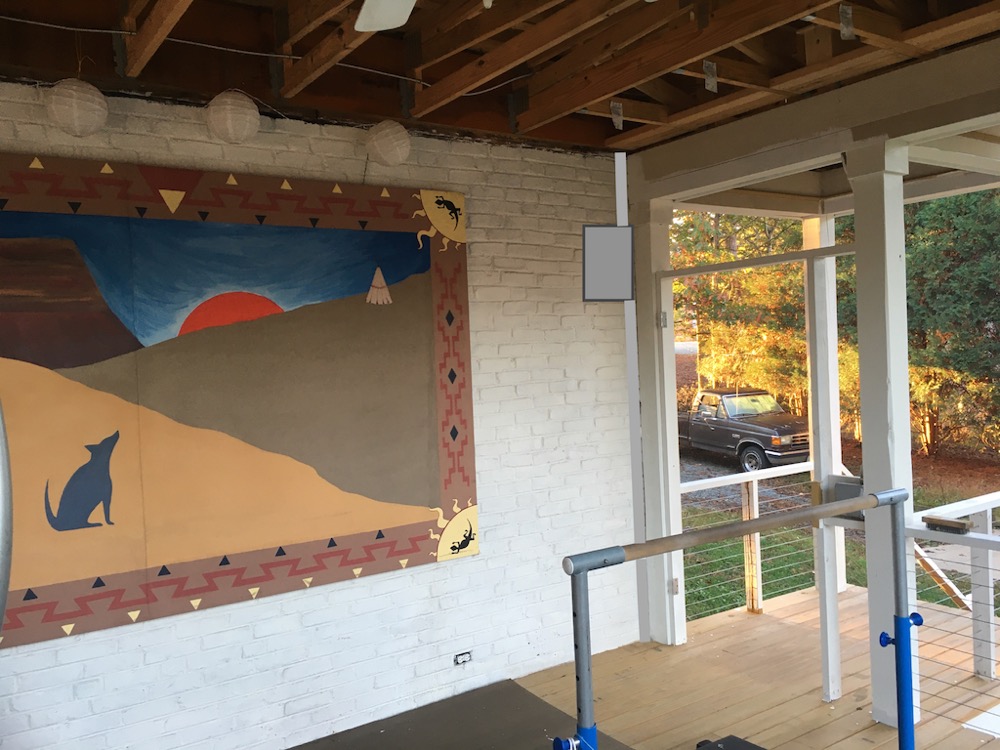
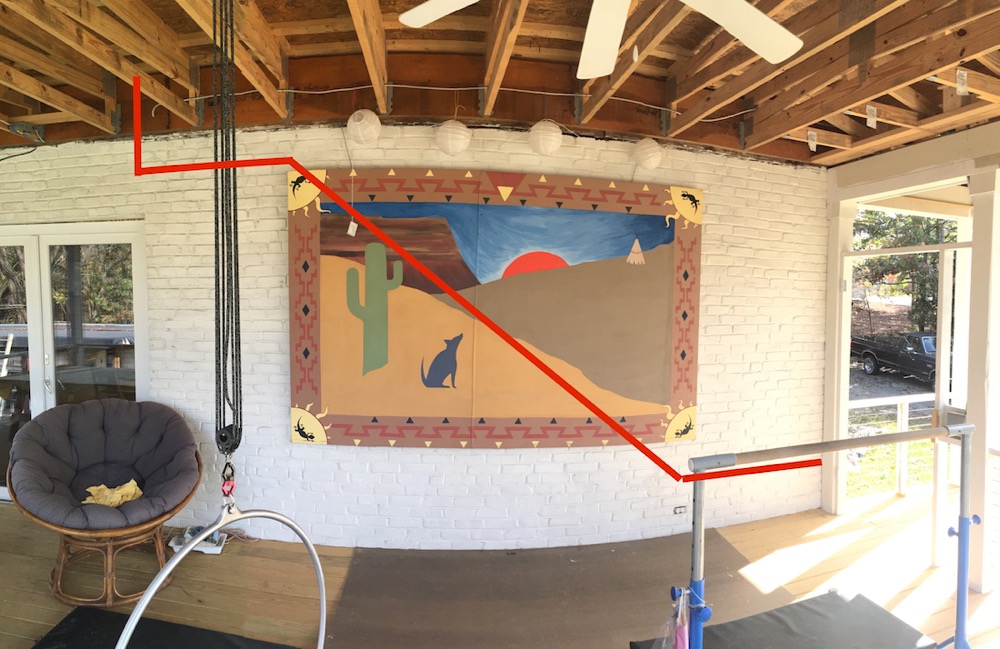
The living room and the stairs, two step landing at the top and bottom. Solid 1930 brick; no stud bays. Looks like this. Below the line is the stairs down, above the line is the stairs up. 9' ceilings with the 2nd floor joists sitting on top of the brick. You can see a run of MC coming out at the top; it goes from the ceiling of the basement stairs up through the wall into what is probably floor joist space and then turns out through the header. I could probably pull a heavier cable (or additional cables) through there if I removed the baseboard in the upper landing, which would give me power from above albeit with a longer run. The basement subpanel is about five feet behind the lower landing, so it would be simple and short (but a bit ugly) to do the exposed subpanel plan from the bottom.

EDIT: at the other end of the porch it's just interior space. I could do the panel there, maybe even a bit easier since the main panel is right underneath, but the inside corner of the porch is less protected from the weather. The end in the pics has a roof extension over the exit stairs which shelters that whole section of wall, but the other end doesn't.

porch_panel2.jpg
 
Last edited:
To avoid these ads, REGISTER NOW!
OP
A

AntonLargiader

Well-known member
Joined
Nov 20, 2016
Messages
1,372
Location
Charlottesville, VA
The first heater came in today. I might get around to installing it this coming weekend.

At this point I am leaning toward pulling three cables from the main panel below the other end of the porch. I have five empty slots in the main panel and as long as I can combine two of the circuits (bathroom fan and bathroom receps, any reason they need to be separate?) I can get six slots for three 240V breakers. It's a 30 slot QO panel; I could probably replace it with a larger one if needed.

I will post a pic but it looks pretty much like the mirror image of the doorway on the pics I posted, with a 6x6 up against the brick wall. I would either run a conduit in that corner or build a chase and pull some NM-b or MC through it from below.
 

Terry D

Well-known member
Joined
Mar 25, 2015
Messages
2,202
Location
St. Louis, MO.
The first heater came in today. I might get around to installing it this coming weekend.

At this point I am leaning toward pulling three cables from the main panel below the other end of the porch. I have five empty slots in the main panel and as long as I can combine two of the circuits (bathroom fan and bathroom receps, any reason they need to be separate?) I can get six slots for three 240V breakers. It's a 30 slot QO panel; I could probably replace it with a larger one if needed.

I will post a pic but it looks pretty much like the mirror image of the doorway on the pics I posted, with a 6x6 up against the brick wall. I would either run a conduit in that corner or build a chase and pull some NM-b or MC through it from below.

If the bathroom was a new wire or remodel, you can put the whole bath on a 20 amp circuit, or the GFCI would need to be on its own 20 amp circuit and any other bathroom GFCI's could also be on this circuit. In your case, it sounds like the fan is on its own circuit, which is overkill. It should not be a problem to combine the two. If they are only 15 amp circuits, its not right per todays codes, but since it is already wired, it all depends what gets plugged into that receptacle. Curling irons, hairdryers etc.
 
OP
A

AntonLargiader

Well-known member
Joined
Nov 20, 2016
Messages
1,372
Location
Charlottesville, VA
Thanks. The bathroom was built during a remodel about six years ago, and VA is pretty slow to adopt code so they were maybe on 2008. As far as I can tell from the chart I made (I didn't wire it), the lights and probably shower fan are on a breaker with the adjacent laundry lights, the single GFCI recep is solo, and the toilet fan is solo. Since the toilet fan wire is in the ceiling crawl with the other lights and fan, I could just tie the fan into them up there. I will be adding a second recep down low for a bidet so I will tie that into the circuit for the existing recep which I'm pretty sure .goes down into the basement crawl.

That would free up one space. I need to free up another because I forgot that I have a single recep under the panel on its own circuit. I have some tandem breakers so if worst comes to worst I can use them.
 
OP
A

AntonLargiader

Well-known member
Joined
Nov 20, 2016
Messages
1,372
Location
Charlottesville, VA
I got the first one installed. Pulled cable up along the other porch post to a box (for the controller) and then up and over to the fixture. Works well, but there are some things I would like to improve.

1) The dimmer-style control fits into a single-gang box but it's crowded with the wire nuts and the pigtails from the controller. The controller itself fills a lot of the box. I will probably switch to using square boxes with 1-gang covers.

2) There is no indicator light on the controllers. I don't know if they are variable-voltage or PWM but that may be easy enough to determine with a DVM. I suppose it depends on the duty cycle length.
 

rlitman

Well-known member
Joined
Oct 18, 2010
Messages
24,778
Location
Long Island
That has to be a triac dimmer. It's not exactly PWM, but more of an AC form of it. You'll need a scope to see what I mean.
 
OP
A

AntonLargiader

Well-known member
Joined
Nov 20, 2016
Messages
1,372
Location
Charlottesville, VA
I see. So sort of PWM but acting on every 60Hz cycle.

Bottom line is, how can I get an indicator lamp to be on regardless what the controller is set to? And without a neutral... maybe just not worth it.
 

rlitman

Well-known member
Joined
Oct 18, 2010
Messages
24,778
Location
Long Island
I see. So sort of PWM but acting on every 60Hz cycle.

Bottom line is, how can I get an indicator lamp to be on regardless what the controller is set to? And without a neutral... maybe just not worth it.

I can think of a few options. How about this weird one:
Find a cheap 12V power supply that accepts 90-265VAC 50/60hz input (it's a pretty common style). It should work just fine on the "dimmed" power so long as you derate the output power by say half. Feed it off the controller power, and it should put out plenty of 12V power to run an indicator lamp.
 

rlitman

Well-known member
Joined
Oct 18, 2010
Messages
24,778
Location
Long Island
OP
A

AntonLargiader

Well-known member
Joined
Nov 20, 2016
Messages
1,372
Location
Charlottesville, VA
So this is pretty much finished. Three heaters are installed, looking like this:

62706480799__A0E69571-FB67-4C0B-9213-07D54AB944E0.jpg

I stacked three 4x4 boxes together for the controls, connecting them as shown to give them the needed 4.5" spacing.

IMG_1422.jpg

The controls went into a corner along a post. It will be boxed in and painted to blend into the post after I buy a few more staples. :)

IMG_1423.jpg

There are a few issues, though. One is that the triac controls make the 120V LED lights in the kitchen range hood flicker. It doesn't happen when the heaters are on full, but when I turn them down and the waveform gets chopped up the lights flicker. Think this could be resolved with some sort of noise filter in the hood? It originally had halogen lights but I switched them to LEDs several years ago.

Second, I need to upsize the breakers. The heaters draw 12.5A so the 15A breakers that I had don't quite make 125%. And last night, after a while they did trip, although the heaters weren't even at full blast so it doesn't fully make sense to me why they tripped. But they did, and they should be 20s, so I will go with 20s.

But... the main house panel is a mess. I cleaned it up a lot as shown in a previous thread of mine, but the six slots I needed for the heaters put me over the full point. I can go with tandems but I'm wondering if it's time to replace this panel. Many of the breakers don't seem to grip the buss very tightly, and the bottom-neutral layout means things are really cluttered. The neutral feeder that you can see on the right keeps me from putting wider GFCI breakers in most of those right-side positions. Having installed a plug-on-neutral subpanel for the garage, I know how much better things can be and I will probably be adding a few more circuits to this. I suppose an alternative would be to add a subpanel off to the side but I need to buy some breakers either way and panels themselves are pretty cheap.

IMG_1425.jpg
 

Bert_

Well-known member
Joined
Dec 24, 2016
Messages
9,918
Location
NW Iowa
So this is pretty much finished. Three heaters are installed, looking like this:

62706480799__A0E69571-FB67-4C0B-9213-07D54AB944E0.jpg

I stacked three 4x4 boxes together for the controls, connecting them as shown to give them the needed 4.5" spacing.

IMG_1422.jpg

The controls went into a corner along a post. It will be boxed in and painted to blend into the post after I buy a few more staples. :)

IMG_1423.jpg

There are a few issues, though. One is that the triac controls make the 120V LED lights in the kitchen range hood flicker. It doesn't happen when the heaters are on full, but when I turn them down and the waveform gets chopped up the lights flicker. Think this could be resolved with some sort of noise filter in the hood? It originally had halogen lights but I switched them to LEDs several years ago.

Second, I need to upsize the breakers. The heaters draw 12.5A so the 15A breakers that I had don't quite make 125%. And last night, after a while they did trip, although the heaters weren't even at full blast so it doesn't fully make sense to me why they tripped. But they did, and they should be 20s, so I will go with 20s.

But... the main house panel is a mess. I cleaned it up a lot as shown in a previous thread of mine, but the six slots I needed for the heaters put me over the full point. I can go with tandems but I'm wondering if it's time to replace this panel. Many of the breakers don't seem to grip the buss very tightly, and the bottom-neutral layout means things are really cluttered. The neutral feeder that you can see on the right keeps me from putting wider GFCI breakers in most of those right-side positions. Having installed a plug-on-neutral subpanel for the garage, I know how much better things can be and I will probably be adding a few more circuits to this. I suppose an alternative would be to add a subpanel off to the side but I need to buy some breakers either way and panels themselves are pretty cheap.

IMG_1425.jpg

Maybe I missed it but is this an open porch or enclosed?

None of those 4sq boxes or MC cable are allowed to be outside.
 
OP
A

AntonLargiader

Well-known member
Joined
Nov 20, 2016
Messages
1,372
Location
Charlottesville, VA
Looking at panels, I know a lot of you like the Eaton CH stuff. The breakers are a bit more expensive but nothing crazy. If I'm going to swap, I'd be looking for 40-ish spaces with plug-on-neutral and preferably main lug since it is fed by a disconnect. However some brands (Homeline?) don't seem to have main lug 200A panels and the MB panels still aren't expensive.

With Eaton I'd need all new breakers. With Homeline I have a few lying around but not enough to really matter. And if I stay with QO then of course I'd get to re-use some of the more expensive ones. Need to spend some time looking at costs. Cheapest and easiest would probably be to just add a 60A subpanel for the porch stuff and leave the old panel as it was, but I'm not against updating the rest of it.
 

rlitman

Well-known member
Joined
Oct 18, 2010
Messages
24,778
Location
Long Island
...There are a few issues, though. One is that the triac controls make the 120V LED lights in the kitchen range hood flicker. It doesn't happen when the heaters are on full, but when I turn them down and the waveform gets chopped up the lights flicker. Think this could be resolved with some sort of noise filter in the hood? It originally had halogen lights but I switched them to LEDs several years ago...

The triac dimmers create a very harmonic current through your heaters, which puts back harmonic voltage noise throughout your house.

I would suggest looking for an LED bulb that is dimmable. Those are designed to accept inputs directly from a triac dimmer, so they are supposed to not flicker in response to harmonic voltage.
 

Bert_

Well-known member
Joined
Dec 24, 2016
Messages
9,918
Location
NW Iowa
I wouldn't replace it. Add a 60-100 amp sub right next to it or in some other convenience space.

Your panels in great shape. Replacing a panel takes a bunch of time.

This is in my house. I cleaned it up a bit and actually eliminated some circuits when some walls were open. I don't plan on replacing it anytime soon.
 

Attachments

  • KIMG0781.jpg
    KIMG0781.jpg
    68.1 KB · Views: 34
OP
A

AntonLargiader

Well-known member
Joined
Nov 20, 2016
Messages
1,372
Location
Charlottesville, VA
That *****. I guess I need to look for where else in the house we might have issues. I'm bummed that I didn't discover this when I only had the first "test" one installed. If the three of them are going to be messing things up all over the house then I need a different solution, like PWM. 9kW of triac noise could cause all kinds of issues.

We have dimmable LED bulbs in the main room ceiling and a scattering of LED fixtures and lamps throughout the house. LED outdoor floods, which are probably not dimmable. And of course appliances that should get decently clean power.

The bulbs in question, though, are dimmable and the range hood has three light levels. They are these or something very similar: https://www.1000bulbs.com/product/173810/LED-02509.html


The triac dimmers create a very harmonic current through your heaters, which puts back harmonic voltage noise throughout your house.

I would suggest looking for an LED bulb that is dimmable. Those are designed to accept inputs directly from a triac dimmer, so they are supposed to not flicker in response to harmonic voltage.
 

Terry D

Well-known member
Joined
Mar 25, 2015
Messages
2,202
Location
St. Louis, MO.
I wouldn't replace it. Add a 60-100 amp sub right next to it or in some other convenience space.

Your panels in great shape. Replacing a panel takes a bunch of time.

This is in my house. I cleaned it up a bit and actually eliminated some circuits when some walls were open. I don't plan on replacing it anytime soon.
If that floor is concrete, that should be a GFCI under that panel

Sent from my SM-G960U using The Garage Journal mobile app
 

Bert_

Well-known member
Joined
Dec 24, 2016
Messages
9,918
Location
NW Iowa
If that floor is concrete, that should be a GFCI under that panel

Sent from my SM-G960U using The Garage Journal mobile app

That outlet was probably installed in the '70s. Before gfci requirements for basements. Code is not retroactive.

Besides I have a chest freezer plugged into it. I will not plug a freezer into a gfci.
 
Last edited:
OP
A

AntonLargiader

Well-known member
Joined
Nov 20, 2016
Messages
1,372
Location
Charlottesville, VA
I spent a bit more time on the flickering range hood lights. They only flicker when they are dimmed. If they are on full, the porch heater controls never affect them. And if the porch heaters are more than about 1/3 power, the range hood isn't affected at all. It's only when the range hood is dimmed and the porch heaters are turned way down that they flicker, so clearly there is some interaction between the two dimming effects.

Thinking it might have something to with the position in the panel, I swapped the hood position with the breaker above it so it was on a different stab and a different leg. This made the problem far worse, as the light flickered with much less dimming than before. I don't know about percent output, but OFF is about 8:00 on the dial, turning CW clicks to full and then dims after that. Originally the flickering started when the dial got to about 3:30, and in the new position it started before the dial got to 2:00 and there was a single flicker when I turned them on. I swapped back and the problem zone returned to 3:30 with no initial flicker. So clearly one leg is "dirtier" than the other.

The heaters are 240V and two of the controllers are on one leg and one is on the other (not through and intent, just the way the wires are in the panel). So two of them go Leg 1 to controller to heater to leg 2, and one goes the other way. However, any of the heaters cause the problem the same way, so this doesn't seem significant. And the wires on the back of the controllers are not identified so I can't choose which side of the circuit I connect to what.

I can work around this but I'm concerned about a possible unseen effect on other appliances. Wondering about some sort of isolation transformer. Should probably put an oscilloscope on the circuits before I get too worried, though. How can one clean up dirty power in one's house? Looks like an isolation transformer would be a $1000+ proposition.
 
To avoid these ads, REGISTER NOW!
Top Bottom