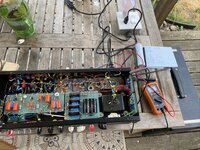
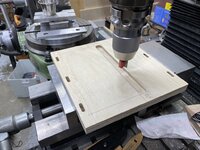
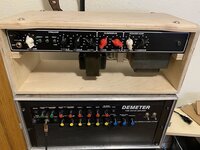
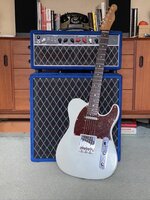
About a year ago I bought an amplifier chassis with the idea that I'd make a copy of a Dumble amplifier. Only I knew practically nothing about electronics at the time and quickly got overwhelmed when sorting through the different known circuits of the OverDrive Special so it sat in a box. Then last December, for reasons I can't explain, I decided to make an entirely different copy of a Dumble amp, called the Steel String Singer, but would also need to fold up and drill my own chassis to make it work. My buddy Gregor (
Sakurama) kindly agreed to let me use his brake to make the chassis, but Covid struck and I thought it was best to not pursue that any further. By then though, I had cut some G10, drilled it, stake the eyelets and populated it with components.
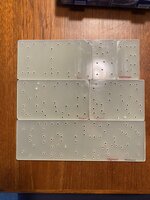
The cut and drilled G10. It drills easily enough, but my arms were itchy for several days.
 F330880D-563C-4242-A58A-A1465592F7C9_1_105_c
 by
Sean Chaney, on Flickr
All holes staked with eyelets
 0B047C8E-6ACD-4A6F-886F-5A94F50D46B1_1_105_c
 by
Sean Chaney, on Flickr
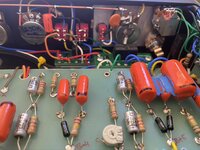
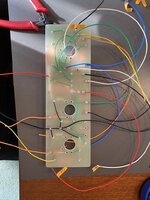
This is the preamp board. You can just make out all the film capacitors and resistors on the other side. This side of the board is just to make connections between components. My automatic stripper does not like teflon wire and each of these wires was stripped using the junky coax stripper in the next photo.
 F414A3A5-B12C-44B0-BE3B-4BC8B2DCBB90_1_105_c
 by
Sean Chaney, on Flickr
The power filter board. These capacitors help smooth out the ripple current after the incoming AC power is rectified to DC
 07F4267E-572E-4117-8BF4-B31BF0E1ED6E_1_105_c
 by
Sean Chaney, on Flickr
I got stuck at this stage for a few months but eventually someone decided to pick up the project and had a batch of chassis and printed circuit boards made. The downside was that I didn't get to make the chassis exactly how I wanted it, but the upside was that I didn't have to spend my time (and Gregors) learning how to use the brake well enough to get a satisfactory chassis...and I didn't have to do all the cutouts, which would have taken ages.
I went ahead and bought the PCB's along with the chassis because they're a hell of a lot neater and it's a bit easier to replace components if needed because you don't have to worry as much about the under-board leads slipping (they're bent over the top of the eyelets to prevent it from happening though.)
The chassis wasn't printed, so I took some measurements, made an Illustrator file and cut some paint masks on my vinyl plotter.
 BE19E70D-832C-44A4-B628-6B68A4439B7E_1_105_c
 by
Sean Chaney, on Flickr
Which needed to be weeded. If you have kids with perfect eyesight and decent hand eye coordination, this is a good thing to keep them busy for an hour or so until they go cross-eyed
 5F80F7FF-C353-41FB-BA53-1C9B74DF3956_1_105_c
 by
Sean Chaney, on Flickr
Use some Testors enamel
 0C41A468-AE51-40B6-ABFF-1BD3153688AF_1_105_c
 by
Sean Chaney, on Flickr
Peel off the mask
 7ABC81F5-4A50-4371-AB8C-494D5D7173B7_1_105_c
 by
Sean Chaney, on Flickr
Worked out pretty OK
 44148460-2F13-485C-908C-42FC099F910B_1_105_c
 by
Sean Chaney, on Flickr
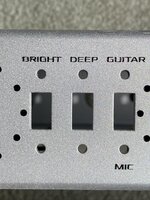
These letters are about 0.040" tall and I lost a little detail, but still OK with me
 6C74454A-25DE-4426-949C-892A2909EC91_1_105_c
 by
Sean Chaney, on Flickr
I should also note that Gregor was very kind to let me use his blasting cabinet a few months back. I had bought some of that canned 2K urethane and painted the chassis black at first. It didn't go well and after four or five hours of sanding, I'd had enough and called the guy with all the cool tools, who bailed me out. I got to unload some fresh media on him too which I hope was a win/win.
Laying down heater wires. These carry about 5V AC and they're twisted to the fields cancel out as much as possible.
 55F95F0E-1FA6-43DE-9466-4D0007A8B6DF_1_105_c
 by
Sean Chaney, on Flickr
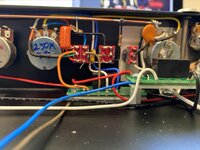
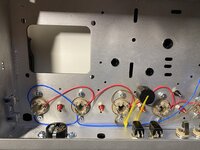
These are the output tube sockets. The red wire carries ~440VDC to the screen grids and the blue and brown wires go to the output transformer
 B92BE151-5553-4055-9EC6-3A7F4E0DB42F_1_105_c
 by
Sean Chaney, on Flickr
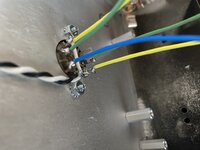
This is one of the 9-pin sockets. This particular amp has 7 of them. I tacked the wire in place with the chassis horizontal. You want the entire eye to be filled with solder. If I try to fill it with the chassis horizontal, I risk running solder down into the pin socket, so I tack them in place while I'm in a comfortable position, then set it up vertically to fill the eyes.
 FD22AF73-081A-41E1-862E-D4CC5BA9AEFB_1_105_c
 by
Sean Chaney, on Flickr
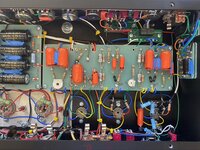
With the pre-amp board in place. I guessed on the lead length and will likely trim and strip all of these before setting them in place.
 13A6F4E2-BC85-4BB9-AD85-BFC87CA39EB9_1_105_c
 by
Sean Chaney, on Flickr
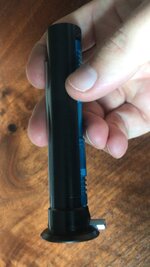
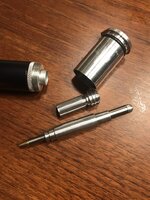
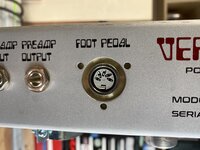
It's been in this state for the past couple of weeks. There's a FET circuit that I want on a foot switch. It isn't in the schematic so I have to add a transformer, make a power supply board, add a relay and figure out where I'm going to put it all in a pretty busy amp. In the mean time, the chassis has a punch out for an XLR jack, which I do not want, so I took some measurements to make something to convert the space to use a DIN plug (like I used in another amp)
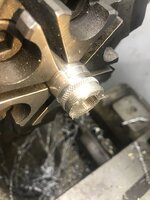
A buddy of mine wants to learn to use a lathe, so he came over today and we went through all the processes required to make something relatively simple.
 9B64438A-3BB9-4985-A888-77E6379FDE65_1_105_c
 by
Sean Chaney, on Flickr
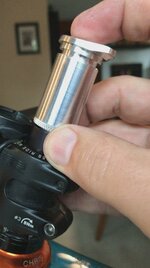
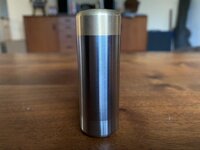
This is where we landed. I still need to buy a #6 tap to drill and tap holes to fix it to the panel. When I took the measurements, I averaged the diameter but didn't compensate for the burr left by the water jet that did the cutout. It'll press fit into place when I'm ready, but I need to tap the holes first, so this photo doesn't show it flush with the outside of the panel.
 2C115FE9-A4FC-4A9C-B438-5D643C93CA93_1_105_c
 by
Sean Chaney, on Flickr
I hope to have enough time this weekend to finish planning the FET switching and get the chassis drilled for everything that's needed for it...and maybe get the transformers installed and hooked up as well.