To avoid these ads, REGISTER NOW!

Shut the power off - Surge?

ollie76

Well-known member
Joined
Apr 22, 2012
Messages
694
Location
Nova Scotia
A few days ago I shut the main breaker to my house off to have a look at something. When I turned the power back on, my refrigerator stopped working. It appears the control board is damaged. I don't understand what happened here, anyone have any thoughts? Did I induce a surge of some kind?

Now to elaborate a bit, I was checking out how my doorbell transformer was wired as I was looking to replace it for a better one that can power a video doorbell. I shut the power off, pulled the front off the breaker panel, had a quick look and put it back on. I didn't touch a thing, just looked.

The refrigerator is actually wired to a generator sub panel anyway, which I did not touch, so no wiring of the circuit was disturbed.
 
To avoid these ads, REGISTER NOW!

wyliesdiesels

Well-known member
Joined
Aug 14, 2012
Messages
20,020
Location
Modesto, CA
Closing a main breaker would actually cause a voltage sag since all the loads that were on before the breaker was opened are now demanding current and this an in-rush of current which causes very brief voltage sag.
 

malibu101

Well-known member
Joined
Jul 1, 2005
Messages
3,908
Location
Walnutport PA
Closing a main breaker would actually cause a voltage sag since all the loads that were on before the breaker was opened are now demanding current and this an in-rush of current which causes very brief voltage sag.

Yeah, never thought of that. Not sure what happened here

I ain't not claiming to be no Tesla here, but....
Some electrical law tells us if voltage goes down, amperage goes up.

Could the voltage sag cause a current rise that maybe a component could not handle?
Just like if a component maybe could not handle a voltage rise?
:dunno:
 
OP
O

ollie76

Well-known member
Joined
Apr 22, 2012
Messages
694
Location
Nova Scotia
The power goes out around here fairly regularly. I'd like to avoid another 400 dollar control board replacement. Would some kind of surge protector be a good idea?
 

malibu101

Well-known member
Joined
Jul 1, 2005
Messages
3,908
Location
Walnutport PA
The power goes out around here fairly regularly. I'd like to avoid another 400 dollar control board replacement. Would some kind of surge protector be a good idea?

Maybe I'm off track, but...
Maybe it's not a voltage surge (like a surge protector may help for), but instead a current "surge"?

I don't see how a surge protector could do any harm though. Other than malfunctioning to off and ruining the food inside. (my pessimistic side :) )

Any opinions?

:dunno:
 

TractorJeff

Well-known member
Joined
Dec 8, 2013
Messages
3,309
Location
Elkhorn, WI
Well?
Technically the Load Center Breakers should have been opened one at a time to reduce the Load on the Main Breaker to minimize arcing across its contacts.
I was always taught to try not to open a loaded Breaker. (Especially over 600 volts)
 
OP
O

ollie76

Well-known member
Joined
Apr 22, 2012
Messages
694
Location
Nova Scotia
I really should have exercised more care I know, next time I will be more careful. Like I said though, we lose power pretty regularly around here and nothing like that ever happened before.
 

Innovate1

Well-known member
Joined
Jul 28, 2014
Messages
4,289
Location
Illinois near St. Louis, Missouri
How old is the refrigerator? Sounds like it may just be coincidence. Like when I shut my mower off one day and it was working fine. The next day when I started it I got lots of oil smoke and found I had a blown head gasket. The engine has a weakness for that and it has happened several times. Some times things just wear out.

It certainly should be able to take the main being shut off and turned back on. As for turning all the individual breakers off/on instead of the main - I doubt this has any basis in fact. The main is made to take a lot more current and should be able to take being switched. And the snap action makes it happen very quickly, reducing arcing.

"Current surge"? Again, sounds like a made up issue. A voltage surge can cause a current surge. A short could cause a current surge. If you have a lot of current that suddenly gets switched off the inductance in the distribution wiring could cause a voltage surge but it would be on the upstream side of the switch. If it is a current surge what causes it and where does the current go?

A surge protector would be a good idea. Electronics is in practically everything now. I recently added a whole house surge protector.
 

Innovate1

Well-known member
Joined
Jul 28, 2014
Messages
4,289
Location
Illinois near St. Louis, Missouri
I ain't not claiming to be no Tesla here, but....
Some electrical law tells us if voltage goes down, amperage goes up.

Could the voltage sag cause a current rise that maybe a component could not handle?
Just like if a component maybe could not handle a voltage rise?
:dunno:

There is no law that if voltage goes down current goes up. At least not a general law. There may be a few specific cases that happens but not generally.

To get the same power at lower voltage the current must be higher as power is voltage times current. But that requires something to change in the load.
 
OP
O

ollie76

Well-known member
Joined
Apr 22, 2012
Messages
694
Location
Nova Scotia
How old is the refrigerator? Sounds like it may just be coincidence. Like when I shut my mower off one day and it was working fine. The next day when I started it I got lots of oil smoke and found I had a blown head gasket. The engine has a weakness for that and it has happened several times. Some times things just wear out.

It certainly should be able to take the main being shut off and turned back on. As for turning all the individual breakers off/on instead of the main - I doubt this has any basis in fact. The main is made to take a lot more current and should be able to take being switched. And the snap action makes it happen very quickly, reducing arcing.

"Current surge"? Again, sounds like a made up issue. A voltage surge can cause a current surge. A short could cause a current surge. If you have a lot of current that suddenly gets switched off the inductance in the distribution wiring could cause a voltage surge but it would be on the upstream side of the switch. If it is a current surge what causes it and where does the current go?

A surge protector would be a good idea. Electronics is in practically everything now. I recently added a whole house surge protector.

It certainly isn't new. It was here when we bought the house. Maytag, stainless french door style with freezer on the bottom.

It certainly could be a co-incidence. I did notice after I turned the power back on that one of my smart lamps had come on uncommanded. Something weird happened with the power for sure.
 

westom

Well-known member
Joined
Aug 16, 2009
Messages
221
The power goes out around here fairly regularly. I'd like to avoid another 400 dollar control board replacement. Would some kind of surge protector be a good idea?
Nobody can provide an informed answer without information from the best source - a dead body. What on that board failed?

The most common reason for failures are manufacturing defects. For example, many years after manufactured, counterfeit electrolyte in capacitors were causing failures of all type of electronics. Manufacturing defects even cause failures many years later.

Too many want to use word association to make a conclusion. All appliances suffer what is being called a surge with every power on. That normal current surge is often destructive after damage had occurred long before. Actual power on is gentle tap that pushes a defective part over the edge - into failure.

They once brought me a failed coputer claiming power on had damaged it. I traced failure to a pullup resistor for the bootstrap circuit. That resistor has only one function. To provide power during a power on. It was probably damaged months previously. But only caused a failure when they finally power cycled that computer.

Those are examples of why things fail long after damage happened. Damage and failure need not coincide.

What is that surge? A voltage slowly rising on power on. What does a surge protector do? Its let-through voltage is typically 330 volts. That means it does absolutely nothing (remains inert) until 120 volts rises well above 330 volts. Obviously a power on never creates a voltage approaching or exceeding 1000 volts. Obviously a surge protector does nothing (remains inert) during all power cycling.

That is a common problem. Too many want to suspect using wild speculation. Since a power on surge sounds like a surge protector, then that protector must do something useful. Word association proves it. Reality: that plug-in protector does nothing on any power on or power off. And can sometimes make surge damage easier from voltages approachnig or exceeding 1000 volts. A reality that contradicts conclusions from word association.

Again, to know what caused that failure means identifying a defective part on that dead body.

As for freaky electricity, well, connect an incandescent bulb to any suspect electric receptacle. Does that bulb change intensity at any time (ie when some other appliance power cycles). If yes, then a fact now exists to locate something defective. In most causes, intensity changes are only due to poor workmanship in wiring. In rare cases, it can be reporting a serious wiring defect. It is a best tool for reporting failures without diagnostic tools that cost many $thousands.

Most all failures are due to manufacturing defects. Failure rates on white appliances have increased substantially in American appliances since business school graduates merged so many brands into one. Trying to increase profits at the expense of quality. As I recall, Hotpoint and Maytag appliances are now manufactured on the same assembly line. Maytag once being a high end (more reliable) appliance. Hotpoint being a low end.

Just another reason why that one failed internal part must be identified long before making any conclusions.
 
OP
O

ollie76

Well-known member
Joined
Apr 22, 2012
Messages
694
Location
Nova Scotia
When I replace the board, I'll give it a good visual inspection. I'll take a few pics and post for you guys as well. I know some things won't show actual damage but you never know.
 

Innovate1

Well-known member
Joined
Jul 28, 2014
Messages
4,289
Location
Illinois near St. Louis, Missouri
A surge protector will do nothing for normal on/off power switching. It may prevent damage from lightening and other extreme transients on the line which may cause damage. The damage may not fail the unit but cause weakening that may fail later.

If the OP has the skills to find the failed individual component that may provide some insight. Without service info that can be difficult even for someone skilled in electrical/electronics.
 

rlitman

Well-known member
Joined
Oct 18, 2010
Messages
24,609
Location
Long Island
Closing a main breaker would actually cause a voltage sag since all the loads that were on before the breaker was opened are now demanding current and this an in-rush of current which causes very brief voltage sag.

True, but opening the breaker will likely cause a surge if you have any inductive loads running (the fridge compressor motor is certainly inductive). Still, it shouldn't be the cause of a failed circuit board.
 

CoogarXR

Well-known member
Joined
Jan 11, 2016
Messages
6,856
Location
Ohio
You say that the control board "appears" to be damaged- is that a figure of speech, or does it literally have visible damage?

Decades of fixing electronics has told me that equipment that runs all the time (computers, commercial video displays, appliances, etc), tend to fail once they finally receive a cooling cycle (during a power outage, move, etc). Many times it's bad capacitors that have swollen and failed, but continue to work because they are warm. Once the board cools off they are too shot to work again.

Sounds like BS, but I have seen it a zillion times.
 
To avoid these ads, REGISTER NOW!
OP
O

ollie76

Well-known member
Joined
Apr 22, 2012
Messages
694
Location
Nova Scotia
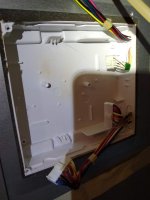
Well the control board looks fine physically when you open the back panel. However, I found a YouTube clip of the exact same fridge with the identical problem and the control board replacement was the solution. It behaved exactly like mine.....not cooling, every light on the front panel coming on when you push any button. Loud beep when you push the water dispenser. It's kinda all I got to go on really.

This is the clip.... identical problem to mine. Same refrigerator as well.
 
Last edited:

Done That

Well-known member
Joined
Aug 18, 2017
Messages
601
Location
MO
I can only speak to first hand observation of hvac controls. Many returns we get have visible browning areas, usually caused by power resistors aging the conformal coating over time... but while it appears damaged there is nothing wrong, its just what happens over time.
Probably the number 1 failure is moisture damage, followed by failed relays welding closed or stuck open so they can't switch loads on or off.
ESD damage of sensitive circuits and micros is also common from mishandling during a replacement, so take care during handling.
 

westom

Well-known member
Joined
Aug 16, 2009
Messages
221
True, but opening the breaker will likely cause a surge if you have any inductive loads running (the fridge compressor motor is certainly inductive).
If an opening breaker creates a surge, then AC electricity that is constantly going on and off 120 times a second also creates surges.

Opening a breaker may create as much as tens of volts of noise. 120 volt electronics (even long before the IBM PC existed) were required to withstand 600 volt transients.

If opening a breaker causes a surge, then GFCI are routinely destroyed by that surge.

In electronics, most all failures have no visual indication. Most failures are traceable to manufacturing defects.

To say more requires some facts. Apparently all we have is an error indicator. That is only a symptom. It says where to start looking for facts. (And what most repairmen will replace.) Without facts, nobody can say why it failed. Only can speculate.

Defective parts can cause failure much later.

Heat is another diagnostic tool. A part that is completely defective can still work at room temperature. Then fail when that room or that part gets hotter. Defective constantly. Fails only intermittently.
 
OP
O

ollie76

Well-known member
Joined
Apr 22, 2012
Messages
694
Location
Nova Scotia
My new board should arrive tomorrow. I'll take the old one out and post a bunch of pics for you guys.....probably nothing obvious. Thanks for all the advice and help!
 

wyliesdiesels

Well-known member
Joined
Aug 14, 2012
Messages
20,020
Location
Modesto, CA
If an opening breaker creates a surge, then AC electricity that is constantly going on and off 120 times a second also creates surges.

Opening a breaker may create as much as tens of volts of noise. 120 volt electronics (even long before the IBM PC existed) were required to withstand 600 volt transients.

If opening a breaker causes a surge, then GFCI are routinely destroyed by that surge.

In electronics, most all failures have no visual indication. Most failures are traceable to manufacturing defects.

To say more requires some facts. Apparently all we have is an error indicator. That is only a symptom. It says where to start looking for facts. (And what most repairmen will replace.) Without facts, nobody can say why it failed. Only can speculate.

Defective parts can cause failure much later.

Heat is another diagnostic tool. A part that is completely defective can still work at room temperature. Then fail when that room or that part gets hotter. Defective constantly. Fails only intermittently.

In the US, its 60 cycles per second not 120....
 
OP
O

ollie76

Well-known member
Joined
Apr 22, 2012
Messages
694
Location
Nova Scotia
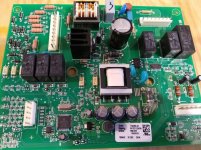
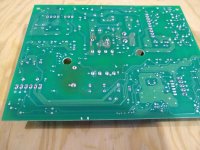
Control board came a day early. Plugged it in and the fridge fired right up, everything seems to be working perfectly. I took the old board out and took a bunch of pics.

The only thing I see is somewhere around the Schottky diode (D9 - SB5H100) in the middle of the board there is some heat discoloration.
 

Attachments

  • IMG_20201115_150348222.jpg
    IMG_20201115_150348222.jpg
    61.7 KB · Views: 18
  • IMG_20201115_152450261.jpg
    IMG_20201115_152450261.jpg
    163.9 KB · Views: 32
  • IMG_20201115_152455580.jpg
    IMG_20201115_152455580.jpg
    155.6 KB · Views: 26
  • IMG_20201115_152511363.jpg
    IMG_20201115_152511363.jpg
    95.1 KB · Views: 22
  • IMG_20201115_152516350.jpg
    IMG_20201115_152516350.jpg
    124.8 KB · Views: 22
  • IMG_20201115_152522382.jpg
    IMG_20201115_152522382.jpg
    121.3 KB · Views: 16
  • IMG_20201115_152531526.jpg
    IMG_20201115_152531526.jpg
    143.9 KB · Views: 18

wyliesdiesels

Well-known member
Joined
Aug 14, 2012
Messages
20,020
Location
Modesto, CA
Control board came a day early. Plugged it in and the fridge fired right up, everything seems to be working perfectly. I took the old board out and took a bunch of pics.

The only thing I see is somewhere around the Schottky diode (D9 - SB5H100) in the middle of the board there is some heat discoloration.

i bet you could remove the bad diode and solder in a new one and the board will work.
 

Innovate1

Well-known member
Joined
Jul 28, 2014
Messages
4,289
Location
Illinois near St. Louis, Missouri
That darkening of the board is pretty minor. That looks typical for a part that gets warm and has run for years. I have seen worse on functional circuits. I wouldn't assume the part is bad just from that. If it's bad they fail shorted so would be an easy check with a meter. (they may open if there is a lot of current but they short first).

You could also compare measurements on the failed and new boards.
 
OP
O

ollie76

Well-known member
Joined
Apr 22, 2012
Messages
694
Location
Nova Scotia
I came across a different YouTube clip where the guy was having the same problem. Turns out this is a common problem with these fridges and it is an issue with the capacitors failing. Someone on eBay sells these repair kits for them and it's just a capacitor kit to solder in. I might just try replacing all the caps and trying the thing out. At least then I might have a backup board.
 

PFSard

Well-known member
Joined
Sep 12, 2013
Messages
2,423
Location
Mesa, AZ
ollie76 : Glad you're up and running again. Good luck with repairing the board that was replaced.

I had a power failure in my neighborhood a few weeks ago. Less than a half-hour. My very old CRT TV would not fire up afterwards. A few days later my computer monitor died.

I consider the deaths victims of old age. (1) I would guess that the monitor was close to 15 years old; and had had a electrolytic capacitor issue many years back (I had replaced them myself). I already had a spare monitor. (2) The CRT TV; well .... I just replaced it with a basic LED TV.
 

BigGarage

Well-known member
Joined
Jun 5, 2019
Messages
2,346
Location
Just south of Detroit, MI.
At least 15 years ago I was doing an electrical project in a house that had poorly labeled circuits at the breaker panel so I just killed the main power while I installed some new circuits and outlets. I had never installed a surge protector for my computer and when I was done with the project and turned the power back on the computer never worked again.

A person who knows a lot more than I do about electrical told me that there is a surge created when you power off the circuit. I don't know but it gave me a reason to update to a newer computer and I didn't mind that.

Dennis
 

westom

Well-known member
Joined
Aug 16, 2009
Messages
221
A person who knows a lot more than I do about electrical told me that there is a surge created when you power off the circuit.
What kind of surge? In campgrounds, a surge is called a low voltage. So protector for that surge never connects appliances. In Asus motherboards, a surge is called a voltage that varies by some tenths of volts. In destructive transients, a surge is maybe 20,000 amps that create a near zero voltage - unless something foolishly tries to block it.

A power on surge is a large current demanded by all appliances. Resulting in a low and slowly rising voltage.

Word 'surge' is subjective. Vague. Disinformation. Apparently he did not even say what kind of surge. So nothing was learned. Honest answers always include perspective. That means numbers must exist. Otherwise, it is best assumed to be, at best, wild speculation.

Most all electronic failures have no visual indication. That diode may normally run so hot as to brown tint the PC board. That is why power diodes are sometimes mounted a quarter inch off the board. Being hot is normal.

In one TV that failed after about 14 months, I partially removed suspect parts to test each separately. Discovered an HER304 diode had failed. Since other parts of that diode bridge were fine, that part probably failed open due to a manufacturing defect. A most common reason for failures.
 
To avoid these ads, REGISTER NOW!
Top Bottom