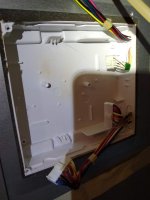
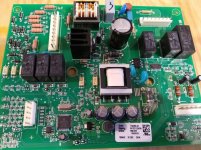
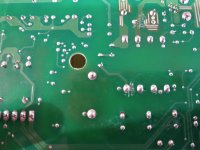
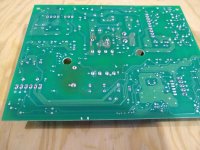
The power goes out around here fairly regularly. I'd like to avoid another 400 dollar control board replacement. Would some kind of surge protector be a good idea?
Nobody can provide an informed answer without information from the best source - a dead body. What on that board failed?
The most common reason for failures are manufacturing defects. For example, many years after manufactured, counterfeit electrolyte in capacitors were causing failures of all type of electronics. Manufacturing defects even cause failures many years later.
Too many want to use word association to make a conclusion. All appliances suffer what is being called a surge with every power on. That normal current surge is often destructive after damage had occurred long before. Actual power on is gentle tap that pushes a defective part over the edge - into failure.
They once brought me a failed coputer claiming power on had damaged it. I traced failure to a pullup resistor for the bootstrap circuit. That resistor has only one function. To provide power during a power on. It was probably damaged months previously. But only caused a failure when they finally power cycled that computer.
Those are examples of why things fail long after damage happened. Damage and failure need not coincide.
What is that surge? A voltage slowly rising on power on. What does a surge protector do? Its let-through voltage is typically 330 volts. That means it does absolutely nothing (remains inert) until 120 volts rises well above 330 volts. Obviously a power on never creates a voltage approaching or exceeding 1000 volts. Obviously a surge protector does nothing (remains inert) during all power cycling.
That is a common problem. Too many want to suspect using wild speculation. Since a power on surge sounds like a surge protector, then that protector must do something useful. Word association proves it. Reality: that plug-in protector does nothing on any power on or power off. And can sometimes make surge damage easier from voltages approachnig or exceeding 1000 volts. A reality that contradicts conclusions from word association.
Again, to know what caused that failure means identifying a defective part on that dead body.
As for freaky electricity, well, connect an incandescent bulb to any suspect electric receptacle. Does that bulb change intensity at any time (ie when some other appliance power cycles). If yes, then a fact now exists to locate something defective. In most causes, intensity changes are only due to poor workmanship in wiring. In rare cases, it can be reporting a serious wiring defect. It is a best tool for reporting failures without diagnostic tools that cost many $thousands.
Most all failures are due to manufacturing defects. Failure rates on white appliances have increased substantially in American appliances since business school graduates merged so many brands into one. Trying to increase profits at the expense of quality. As I recall, Hotpoint and Maytag appliances are now manufactured on the same assembly line. Maytag once being a high end (more reliable) appliance. Hotpoint being a low end.
Just another reason why that one failed internal part must be identified long before making any conclusions.


 )
)