To avoid these ads, REGISTER NOW!

Need help with my boiler!

Jberger93

Well-known member
Joined
Oct 2, 2019
Messages
184
Location
Pittsburgh
So I'm about to give up and call in a pro. My house baseboard heater(only the one in my bedroom ) won't stop making noise like the ocean. It gurgles every time I turn the heat on . I tried bleeding it and a straight stream of water comes out ... so where is the air ? Am I missing something
 
To avoid these ads, REGISTER NOW!

rlitman

Well-known member
Joined
Oct 18, 2010
Messages
24,652
Location
Long Island
Hummm, ok. What sort of expansion tank do you have? Is it a big cylinder with two valves, or something that looks a little like a propane tank with domed ends, and only one pipe connection on one end and a small schrader valve under a plastic cover on the opposite end?
 
OP
J

Jberger93

Well-known member
Joined
Oct 2, 2019
Messages
184
Location
Pittsburgh
Hummm, ok. What sort of expansion tank do you have? Is it a big cylinder with two valves, or something that looks a little like a propane tank with domed ends, and only one pipe connection on one end and a small schrader valve under a plastic cover on the opposite end?


It's a big cylinder with two valves. One valve opens and closes expansion tank. The other is used to drain the water out of the expansion tank
 

yeldogt

Well-known member
Joined
Jan 2, 2012
Messages
18,184
You may need to check the tank -- it sounds like an old school tank that needs to have air above.

Often -- need to power flush the zones.

Has something changed ? leak ... typically something must change for the air to get in
 
OP
J

Jberger93

Well-known member
Joined
Oct 2, 2019
Messages
184
Location
Pittsburgh
You may need to check the tank -- it sounds like an old school tank that needs to have air above.

Often -- need to power flush the zones.

Has something changed ? leak ... typically something must change for the air to get in

How do I power flush ?
Also , I'm not really sure what changed with the heating system. I bought by the house last March and used the heat a few times . It did the same thing last year . I can't stand it anymore
 
OP
J

Jberger93

Well-known member
Joined
Oct 2, 2019
Messages
184
Location
Pittsburgh
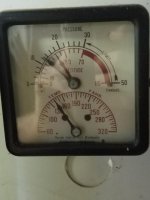
PpI was just checking my pressure and it's at about 11. Boiler is in basement and there's only one store it goes up. so a single story house. Should I try to increase pressure ? How do I do that ? And how high should I go
 

Attachments

  • 20201207_161030.jpg
    20201207_161030.jpg
    135.6 KB · Views: 73
  • 20201207_161013.jpg
    20201207_161013.jpg
    58.8 KB · Views: 59
  • 20201207_161036.jpg
    20201207_161036.jpg
    84.3 KB · Views: 64
Last edited:

rlitman

Well-known member
Joined
Oct 18, 2010
Messages
24,652
Location
Long Island
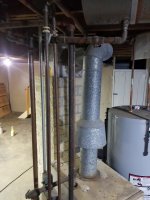
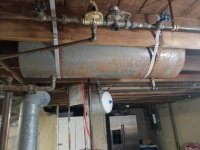
Just to confirm, that grey tank in the very center of the first picture, with the blue cap on the right, that's connected to your water heater, right? Because that's also an expansion tank.
 
OP
J

Jberger93

Well-known member
Joined
Oct 2, 2019
Messages
184
Location
Pittsburgh
Just to confirm, that grey tank in the very center of the first picture, with the blue cap on the right, that's connected to your water heater, right? Because that's also an expansion tank.

Correct. Sorry . The big tank is the expansion tank for the boiler. The little one is for water heater
 

danski0224

Well-known member
Joined
Jan 29, 2005
Messages
13,517
Location
Near Naperville, IL
Probably another boiler system that isn't piped correctly near the boiler, with no air removal device.

Definitely not piped correctly. The compression tank is fed from the tap for the pressure relief valve.

Good luck.
 
OP
J

Jberger93

Well-known member
Joined
Oct 2, 2019
Messages
184
Location
Pittsburgh
Probably another boiler system that isn't piped correctly near the boiler, with no air removal device.

Definitely not piped correctly. The compression tank is fed from the tap for the pressure relief valve.

Good luck.

How do I fix that ? Lol. Or am I better off calling a professional
 

danski0224

Well-known member
Joined
Jan 29, 2005
Messages
13,517
Location
Near Naperville, IL
You can look up any cast iron boiler then look at the instruction manual. The manual has near boiler piping instructions.

B&G has piping instructions for compression tanks on their site. There are a few relatively specialized parts that are needed to do it properly. I would suggest going to an expansion tank system instead.

I would suggest reviewing those BEFORE calling a professional so you understand what is going on.

Also keep in mind that the return temperature to a cast iron boiler needs to be 145*F or higher.

It will not be inexpensive to fix PROPERLY.
 

LS6 Tommy

Well-known member
Joined
Dec 27, 2013
Messages
26,162
Location
Northern NJ
X2 on the tank being incorrectly piped. Pressure's fine for a two story house with baseboard. I'm surprised it's not a little higher. You can try draining the tank to reestablish an air cushion. Close the valve on the pipe going to the tank (on the left in your pic). Open the drain (on the right) and let all the water out until there's nothing left. Close the drain, slowly open the inlet valve.

Bond the inlet and outlet of your water heater, too.


Tommy
 
Last edited:
To avoid these ads, REGISTER NOW!

yeldogt

Well-known member
Joined
Jan 2, 2012
Messages
18,184
How do I fix that ? Lol. Or am I better off calling a professional

Power flushing is using the pressure in the domestic water feed to flush out the zone. You isolate the zone and open the water feed --- flush water through the zone until clear. The ease of doing this depends on the piping layout and service valves included.

You have an old style pressure tank .... google around and you will see people explaining how to for lack of a better word ... reset them. This type of tank has been replaced by the smaller bladder tank.

There are many heating systems out there with minimal service considerations -- service valves and purge ports add labor and parts cost -- so they are omitted. The installer purges all the air after install and the systems can run for 20 years without being touched. Once they are opened up and air gets in -- they have to be fully purged by someone who knows how to do it.

Most older systems don's have micro bubble air eliminators like a Spirovent that will do a better job of getting any air out .. also ...some systems just trap air.

It's a simple process if there is a way to isolate each zone loop -- you fill the system and then purge any air through each zone and out through the boiler to a drain.
 

rlitman

Well-known member
Joined
Oct 18, 2010
Messages
24,652
Location
Long Island
...Definitely not piped correctly. The compression tank is fed from the tap for the pressure relief valve...

What of it? The tank needs to be at the PONPC. If the pump(s) pulls away from the boiler (as it should), ANY connection to the boiler will work equally well to connect the tank (except perhaps a tiny tap made just for a tridicator). And the pressure relief valve needs to be at the same hydraulic location in the piping, so it is just fine there too.

If it were my system, I'd find a convenient horizontal section in the basement in the main loop close to where it returns to the boiler, cut it, install an air scoop in the middle with a Taco air vent on top and an Extrol bladder expansion tank underneath, and shut the valve to your compression tank permanently (those things ****!).

Like this (not my picture), except in this picture the pump is pushing water through the scoop, which is technically backwards:
Air_Scoop.jpg


In my own home, I have a microbubble resorber. Such a device wouldn't hurt, but truth be told, in a typical baseboard system, it's a waste of money. Microbubble resorbers really only come into play when you have 1/2" PEX distributing water through long radiant loops.
 

johnnyradiant

Well-known member
Joined
Mar 27, 2017
Messages
833
Location
Vancouver, BC
'Round my area 12-15 psi is common. 11 would work too. The only problem with 11 is what did it start out as? If it started out at 11-12 I wouldn't focus on that, accept to say that the picture looks like is somewhere between the mid point of the first tic and the second tic past 10 which would read closer to 13 psi. From the cool temp of the boiler to the hot temp of the boiler does the pressure gauge change? If it starts climbing it is a good indicator of a problem on the expansion side. I have one of those expansion tanks in my apartment building, it's somewhere around a 55 gal drum size, it's mounted up at rooftop height. In 40 years the only problem I get is the occasional issue with the seals of the sight glass tube. On smaller systems I prefer the bladder style like your DHW tank.
 

danski0224

Well-known member
Joined
Jan 29, 2005
Messages
13,517
Location
Near Naperville, IL
What of it? The tank needs to be at the PONPC. If the pump(s) pulls away from the boiler (as it should), ANY connection to the boiler will work equally well to connect the tank (except perhaps a tiny tap made just for a tridicator). And the pressure relief valve needs to be at the same hydraulic location in the piping, so it is just fine there too.

It's just not supposed to be done that way.

If you go to the B&G (Xylem) website, there are diagrams that show the proper piping of a compression tank, and the devices that are required.
 
OP
J

Jberger93

Well-known member
Joined
Oct 2, 2019
Messages
184
Location
Pittsburgh
So I just tried to redo the expansion tank. I completely drained lt. Then I closed drain valve and reopened the fill valve. Then I drained each baseboard heater from the closest to the boiler to the furthest. I'm still hearing the gurgling in the same spot
 

rlitman

Well-known member
Joined
Oct 18, 2010
Messages
24,652
Location
Long Island
So I just tried to redo the expansion tank. I completely drained lt. Then I closed drain valve and reopened the fill valve. Then I drained each baseboard heater from the closest to the boiler to the furthest. I'm still hearing the gurgling in the same spot

An air over water tank is one way that air gets into a system, but it is not the source of the gurgling. Replacing it with a bladder tank and bleeders will stop your need for repeating the bleeding ritual at least annually, but right now you just need to get the air out, and that's where power flushing comes into play.

It sounds like there's a spot in your system that's higher than where you're bleeding. The bleeder will let out air from behind it, but it won't pull out air from higher spots.

Power flushing works, if the system is valved correctly (if someone skipped some parts when installing it, then it may be difficult or even impossible), so bear with me.

Each loop (zone), should have a drain valve. There should also be a shutoff between that drain and the boiler. Close that one shutoff just past the drain, and leave the automatic fill valve working. Then drain water into a large bucket (or, if you have a hose rated for hot water, that can work too). Water will circulate through the zone to the drain, and makeup water will fill the system. The shut valve will prevent the makeup water from going directly to the drain bypassing the zone. That should blow any pockets of air out the drain. Then after shutting the drain, you can open up that valve.

A word of caution here. Drain valves are not all that reliable. Half the time I open one, I find it no longer shuts. I'd have a spare on hand (with a little pipe dope) just in case that happens. They're cheap, and easy to replace (the water will stop flowing if you turn off the supply).
 
OP
J

Jberger93

Well-known member
Joined
Oct 2, 2019
Messages
184
Location
Pittsburgh
An air over water tank is one way that air gets into a system, but it is not the source of the gurgling. Replacing it with a bladder tank and bleeders will stop your need for repeating the bleeding ritual at least annually, but right now you just need to get the air out, and that's where power flushing comes into play.

It sounds like there's a spot in your system that's higher than where you're bleeding. The bleeder will let out air from behind it, but it won't pull out air from higher spots.

Power flushing works, if the system is valved correctly (if someone skipped some parts when installing it, then it may be difficult or even impossible), so bear with me.

Each loop (zone), should have a drain valve. There should also be a shutoff between that drain and the boiler. Close that one shutoff just past the drain, and leave the automatic fill valve working. Then drain water into a large bucket (or, if you have a hose rated for hot water, that can work too). Water will circulate through the zone to the drain, and makeup water will fill the system. The shut valve will prevent the makeup water from going directly to the drain bypassing the zone. That should blow any pockets of air out the drain. Then after shutting the drain, you can open up that valve.

A word of caution here. Drain valves are not all that reliable. Half the time I open one, I find it no longer shuts. I'd have a spare on hand (with a little pipe dope) just in case that happens. They're cheap, and easy to replace (the water will stop flowing if you turn off the supply).

There Is only 1 pipe that comes up from the boiler. This then splits into 2, but there isn't a shut off valve for either pipe. The first pipe it splits to feeds the basement heater , the second pipe it splits to feeds the living room then comes down, then feeds the kitchen then comes back down, then into the mud room and back down , then the bathroom and back down, then spare room and down, then bedroom and down .. bedroom is the last one one the pipe and is where noise is
 

rlitman

Well-known member
Joined
Oct 18, 2010
Messages
24,652
Location
Long Island
Did you bleed that last corner? The one in the basement ceiling before the pipe drops to the baseboard in the basement? Basement radiators loops usually end up collecting air when they're run by the ceiling and dive down to the baseboards. Each high section should have a way to bleed it.

Anyway, the supply is coming out the top rear of the boiler (it goes up that large copper pipe), and the return is going in the left side (what you ended up following, after following the cold water supply). Unfortunately, I don't see a way to disconnect it in a way that will force water through the loops (you have two, separated by check valves, and perhaps a monoflo tee) and out the drain. So that option is out (without spending a lot of money)
 
Last edited:

yeldogt

Well-known member
Joined
Jan 2, 2012
Messages
18,184
You need to try and flush the system ---- some systems trap air. The pipe size and pitch or turn .. traps a bubble. The flow through the pipe is not enough to push it on it's way ... can you wiggle the pipe where you hear it making noise ? Sometimes any turbulence can move it along.

My friend had one of these old systems .. we had trouble after fixing a leaking valve on one of his radiators. It took many attempts ... we finally got it working and he had no more issues for 7-8 years ... he moved.

I would keep at it .. try some flushing. You will reinvent the wheel with that system when you start to repipe.

Those old boilers really like simple piping --- pumping away is a book from the early 90's that explains this .... but doing this to yours would require moving lots of items
 
OP
J

Jberger93

Well-known member
Joined
Oct 2, 2019
Messages
184
Location
Pittsburgh
Did you bleed that last corner? The one in the basement ceiling before the pipe drops to the baseboard in the basement? Basement radiators loops usually end up collecting air when they're run by the ceiling and dive down to the baseboards. Each high section should have a way to bleed it.

Anyway, the supply is coming out the top rear of the boiler (it goes up that large copper pipe), and the return is going in the left side (what you ended up following, after following the cold water supply). Unfortunately, I don't see a way to disconnect it in a way that will force water through the loops (you have two, separated by check valves, and perhaps a monoflo tee) and out the drain. So that option is out (without spending a lot of money)
I did bleed that top pipe. That's on a different loop than the bedroom anyways. Would that affect it still ?
 
OP
J

Jberger93

Well-known member
Joined
Oct 2, 2019
Messages
184
Location
Pittsburgh
Maybe I should try and get the end with the bleeder screw up higher. Is that what you mean? That way all the air goes to the highest point ?
 
To avoid these ads, REGISTER NOW!
Top Bottom