To avoid these ads, REGISTER NOW!

Between 485 & 705 SQ/FT Mid-Century Moto Mecca Makeover

Workspaces between 485 and 705 squarefeet.

E12-535iTurbo

Well-known member
Joined
Feb 27, 2014
Messages
492
Location
The Netherlands
Can we please dig a bit in the lighting rabbit hole? I'm currently rebuilding parts of my shop and am at the verge of installing lights. I would really love input on this. What should I order?
-LED? What warmth? How much? What are the specs to look for. Should it be dimmable, should the colors/warmth be changeable?

I've two work stations to redesign. A common work bench where I do general purpose building. Engines, wood, soldering etc. and a welding table.
 
To avoid these ads, REGISTER NOW!

slik560

Well-known member
Joined
Oct 5, 2009
Messages
787
Location
Kansas, USA
There are some threads on this very thing in other Garage Journal forums. Lots. Almost any configuration you can think of. Try a search and we'll let Mr. H continue to present his excellent skills. :)
 

elvee

Well-known member
Joined
Nov 1, 2006
Messages
309
Location
Atlanta, GA
One of the big things to look at with lighting is the CRI - Color Rendering Index. The higher the number, the more accurately the light will allow you to perceive colors. Anything above 90 is considered very good. Most of the stuff you find in general home stores is going to be somewhere in the 80s if they even list it. The other issue I find with LED is flicker - the cheaper driver hardware can cause this quite often.

LED's can be great, but there are issues in the manufacturing process that can show up in usage. LED's produced in different batches will not have the same output, in both color temp and light quality. Doing a piece by piece upgrade can exacerbate this. Same for mixing products from different manufacturers.

Hope this helps. I can go on for hours, and point you to some professional pieces talking about it. Most of what I have learned comes from the theater / entertainment side but carries through to general usage.
 

rk_tek

Well-known member
Joined
Apr 12, 2015
Messages
153
Location
Bella Vista, AR
On the lighting front, I saw a video Adam Savage did using an LED panel light with adjustable color temps designed for photography and attached it to some Loc Line. I would say it's a bit of a budget version of what Gregor has as the light panels were from amazon and not exactly pro photographer gear. I've still considered making something similar for up close detail work at the bench.

I was fortunate to grab a 2x4 LED panel that was a leftover project sample and use it over my bench. It is very bright and provides very even lighting over the whole area.
 

bdking

Well-known member
Joined
May 16, 2013
Messages
94
Location
PDX
On the lighting front, I saw a video Adam Savage did using an LED panel light with adjustable color temps designed for photography and attached it to some Loc Line. I would say it's a bit of a budget version of what Gregor has as the light panels were from amazon and not exactly pro photographer gear.

I made a pair of these Adam Savage work lights for my drafting table and they’re great. Easily dimmable with a dial for color temprtaure and very flexible. They’re great for detail work or general illumination.

Parts were about $100 each. Video here.
 
OP
S

sakurama

Well-known member
Joined
Oct 10, 2010
Messages
1,458
Location
Portland - the cool one.
Can we please dig a bit in the lighting rabbit hole? I'm currently rebuilding parts of my shop and am at the verge of installing lights. I would really love input on this. What should I order?
-LED? What warmth? How much? What are the specs to look for. Should it be dimmable, should the colors/warmth be changeable?

I've two work stations to redesign. A common work bench where I do general purpose building. Engines, wood, soldering etc. and a welding table.

I will give you a bit of my perspective as a person who uses and shapes light and how and why I make the decisions about certain lights. So I won't really answer your question but I'll give you a bunch of information you didn't ask for but may help in your decisions. Quality of light is more important that warm or cool which is more preference since your eyes adjust to color temperature but can't adjust to quality. The only time you'll notice a lights color temperature is if it's contrasted against another color temperature light. Light color is beyond our discussion right now and CRI is another can of worms.

My perspective as a photographer is a bit different - I shape light to manipulate the viewer not the object. Now, psychology aside there are a few principles to light that even most photographers don't understand.

Light can be described as either "soft" or "hard" and many people make the mistake of misinterpreting that too simplistically - a "soft box" is soft and a smaller light, say a flashlight, is "hard". We make this assumption because we assume a static situation in our minds - a person in a chair or say an object on a table.

Let's back up.

Light describes an object not through it's illumination but through it's absence. Shadow is how we understand something's shape. A way to imagine this is say in a whiteout. Light is so diffused that it is very difficult to make things out and you can actually lose your depth perception.

Now the opposite.

A glaring sun in the desert say - the shadows are so dark you can't see in them and they appear black voids. Shape is very defined but information about both light and dark is limited.

So we need shadows to understand shape.

When you're trying to see if a wall is flat you'll put a light at the opposite end and shine it across letting tiny imperfections be magnified by the low angle of the light. If you're examining something you'll shine a light at different angles to see the textures and shapes.

This is why work stations have a "task" light on an arm but there are larger, softer lights that are serving to light up the whole room.

This is called key and fill. Key is the main light that is describing something and fill is the amount of light that is "filling" in the shadows.

Some examples:

i-qbrDhrh-X2.jpg

This is my Wilton on the bench with all the lights shut off only illuminated by the single window. The window is large - 2-1/2 x 10' and it's overcast today so this is a soft source but it's low angle, lack of fill and the fact that we can't move it means it's not helpful but it is fairly attractive. In this case I could turn the vise (since I can't move the window) and then I'd be able to control the light via changing my subject or my perspective.

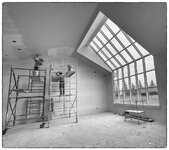
In the time before lights artists built studios with giant north facing skylight/windows.
i-9HTGv3j-X2.jpg

This has been considered the "best light" forever. It is a large source, essentially as large as the room, it is not direct in that the sun, being in the southern hemisphere, will never directly shine into the space yet it is directional by virtue of it being a single window. The other benefit is that the light will bounce off the white walls of the space and naturally fill in the shadows at about a 1-1/2 to 2 stop ratio - considered ideal. A "stop" or "f-stop" is a measure of light and 1 stop represents a halving or doubling of the amount of light.

The artist who used this light so much they named it after him was Rembrandt:

i-LnwF45B.jpg

Sit your subject at a right angle to a large north facing window and you're suddenly a lighting genius.

This quality of light was not lost those who had work to do:

i-9TvW29M-X2.jpg

Every factory from the 1800's into the 1900's had row after row of angled dormers with north facing skylights. You notice there's no lights at all in this photo. This light gives a balance of direction, shadow and fill that is pretty unmatched. Also, unmovable and useless at night.

i-qbrDhrh-X2.jpg

Back to our vise. If my window was larger, about the size of the footprint of the floor, faced north and the room was white I'd have no need for lights during the day.

i-9Z4XChR-X2.jpg

So I brought a studio light into the shop and put it opposite the window. It's only the modeling light so it's just a bit brighter than the window but now we have control over positioning our light so the text is readable and the bare bulb is also reflecting off the ceiling creating it's own fill.

Next we'll put the reflector that's sitting on the table on this light. It will focus the light and therefore make it brighter but light will no longer be bouncing off the ceiling.

i-g4bWchT-X2.jpg

Now we have a brighter, directional light, with less fill. Because the reflector is about 6" this would be considered a "hard" light in this situation but don't think of hard and soft as "things" but relationships between the size of the source and the distance from the subject. Many photographers don't understand this and think a soft box is a "soft" source. It is if it's two feet away but if it's 50' away it is now a hard source. 200' away and it's almost a point source. It's a relationship not a thing.

i-gJFXjQf-X2.jpg

So this is a 2x2' soft box and it's not as bright because it's diffusing the light so much but you can see it's doing a very nice job of showing shape, light and shadow. Softboxes were invented to act like portable north facing windows and like many tools are abused by people who don't know how to use them. Many a photographer has made a career with a single giant soft box... cough, Annie Leibowitz, cough...

i-D2R9sF6-X2.jpg

This is now the shop lights back on and my round LED on above the bench at full power. It's about as bright as 150w (equivalent) LED lights I'm using hanging from the big metal reflectors but because it's pretty close to the workbench it's pretty bright and nicely directional.

So, all this is to say your ideal light to work should be directional but not too small. You should ideally be able to move your task light to focus it where you need to work. All my machines have task lights that are slightly brighter than the other lights. I use large hanging lamps with frosted bulbs because I like the look of "pools" of light that draw your eye. There is enough bounce, diffusion and overlap that the shop has sufficient fill for the numerous task lights.

i-PGD6hw2-X2.jpg

If I had unlimited resources I'd have a north light factory ceiling situation. Next option would just be giant north facing windows. After that would be high ceilings with lights bouncing into them to create a very diffused light accented with task lights. After that and we're where I am - a compromise on the look of the lights and the illumination that they provide. The bench is the only place with an "ideal" light set up - soft, directional, bright and movable. Interestingly I looked up this light and the price is way down from where it used to be. It's now only $310 where it was more than double. FotodioX C-700RSV

Every shop is different and there is no "ideal solution" but hopefully you understand a bit more about light and will look at it a bit differently. I tell students to pay attention to the light around you and when you see beautiful light try to understand why.

I hope that this helps but a discussion of lighting is hardly something that can be tackled in a single post or even a single class. To this day I'm still learning about light and how to manipulate it.

Gregor
 

rk_tek

Well-known member
Joined
Apr 12, 2015
Messages
153
Location
Bella Vista, AR
And ^ this is why we come here. The knowledge drop. The terms between photographer and architect are different, but the goals are the same. I was working on a lighting plan this morning for a church lobby. I have glass overhead doors on the north side that give excellent overall illumination but different light styles and mounting heights separate and define the circulation and congregating spaces and inform people of how I intend the building to be used. The lights also provide 'task lights' over a grouping of tables so reading is easier.

Some of the biggest takeaways are providing enough light throughout the space to make navigation easy and then brighter task lighting at the areas where work is done. A task light putting out 15 foot candles is almost useless if you have the ceiling covered in high output lights that illuminate the entire space in 50 foot candles.

Contrast and glare are also big factors in being able to see well in a space. Gregor's single window illuminating the vice is an excellent example of contrast. The window may provide a ton of light where it hits, but your eyes are compensating for that bright light and you can't see anything in the shadows. An evenly lit space at 30 foot candles may be easier to work in that one that has several extremely bright lights that create hot spots. The average lighting may be 30 foot candles, but under the light is 100 foot candles and between the lights is only 10.
 

mfg0772

Well-known member
Joined
Aug 8, 2018
Messages
146
Location
Northeast CT
Gregor - you always find a way to make a subject interesting and approachable. I would have thought that lighting wouldn’t interest me. BUT you present so much information and a good story, it’s hard not to find it interesting. Like a teacher who is sneakily teaching students who don’t want to learn. Although I think most of us here want to learn, you make us absorb even more.
 

56vette461

Well-known member
Joined
Jan 13, 2013
Messages
491
Location
Northern California
Gregor, I appreciate your insights on lighting. My career was in law enforcement with a lot of time spent photographing crime scenes and evidence. I learned very early that the positioning of a light source in the field would always be a challenge. Flash lights and flash positioning were sometimes our only source. While I never could be classified an expert, the experience has been a lesson in patience.
 

jonshonda

Well-known member
Joined
Jul 17, 2017
Messages
4,731
Location
Wisconsin
I love the different perspectives on lighting. Prior to covid I was an engineer at an industrial lighting manufacturer. Our products were in the inspection tunnels for GM, Ford, Chrysler, Honda, Toyota, etc.

CRI in the 80's is just fine, and jumping into the 90's (not claimed, but actual 90's) get very expensive fast. It can easily double the cost of the led board.

But what we found very interesting is the binning (quality matching) of the led's is also very important. The quality of the led chip itself can have a very large effect on the output of the light.
 
Last edited:

dchasins

Well-known member
Joined
Apr 2, 2014
Messages
58
Location
Western NC
Now that was a really interesting and informative post on lighting...like so many interesting topics here. I'd just like to say thank you, Gregor, for devoting so much time to this forum and sharing your knowledge. I'm sure that I'm like many others, finding this a very friendly, thoughtful and ultimately useful source of information. I don't post much--but MCMMM is so unusual, varied, and interesting that I felt the need to speak up. If I could only read one thread on GJ, this would be it.
 

Stopwatch

New member
Joined
Feb 15, 2011
Messages
3
...The terms between photographer and architect are different, but the goals are the same. I was working on a lighting plan this morning for a church lobby....

I, too, am working on a lighting plan this week, although for a residential remodel. There's a difference between how an architect uses light and how a photographer uses light, although the end result is usually the same; good lighting of just the right quality, color and quantity.

We, the architects, need to consider the use of the space, materials, colors, the desired mood, and daylighting starting with the tried and true 2.5xH rule of thumb, which is that daylighting will, roughly, be effective into the space 2.5 times the head height of the window. See Gregor's photo of the giant window space above. If you're interested in industrial spaces using sawtooth roof daylighting, search for some work by architect Albert Kahn; he was a master at this.

I like spaces with large amounts of dark surface finishes paired with lighter surfaces; blue black walls and a maple floor, or soapstone counters with bright white cabinets. Each of these conditions requires the right lighting to make the most of the space - and comply with (appropriately) ever-increasingly strict energy codes. Well-designed "pools" of light in a space with dark finishes can be amazingly appealing. We humans like cozy inglenooks, window seats and dark wood-paneled reading rooms for a reason; I think it's a leftover trait from our evolution. Caves and small, crude shelters were our first homes and we've never really lost the desire for spaces with these qualities.

But evolution has allowed us to understand and appreciate the contrast between grand and cozy, and how to manipulate light to our benefit.
 
OP
S

sakurama

Well-known member
Joined
Oct 10, 2010
Messages
1,458
Location
Portland - the cool one.
Ruger 10/22

Okay, I need to finish this Ruger up and get it off the bench.

The stock that I'm using is a Klinsky and it's made in the Czech Republic. It's the right basic shape but a bit clunky and the fit of the action is pretty sloppy.

i-LN87wBP-X2.jpg


I used my radius gauges to check to see what size end mill I'll need to open the stock up. 5mm radius isn't a good fit but 7/16 is close enough.

i-hBNZNjk-X2.jpg


It feels like my test stock went well while this one has been trouble. I can't believe I tore a chunk out of the back of the stock. I was going slow and with a fast speed on the end mill but no matter.

i-3XQ2Jhx-X2.jpg


The receiver sits really low in the stock so when I milled the back out for the tang I luckily had a bit of extra material so I may be able to sand out that missing chunk.

i-XqDj8FP-X2.jpg


Cleaned and prepped to bed the receiver.

i-LZg29Ft-X2.jpg


i-vSZhhgx-X2.jpg


i-jqHZR9m-X2.jpg


The clamp is just to make sure that the receiver is bottomed out on the milled opening. You can clean up Devcon with Acetone and since I planned to sand the back down I didn't bother to tape it out. I had a better sense of the epoxy now so I wasn't as worried.

i-pdGRNLq-X2.jpg


12 hours later I pulled them apart. It worked great except for a couple of small voids on those corners. There's nothing functionally wrong with it so I'm not going to bother trying to fix it. You'll never see them unless the gun is apart.

i-hTHMcgr-X2.jpg


I mill out the epoxy where it's in the way of the action - it mills much like Delrin.

i-pPvTmzF-X2.jpg


The tail of this stock was just really ugly so I've already sanded the end down a fair bit but now I'm taking more off to get the stock even with the action.

i-7RD23kT-X2.jpg


Since the tang has a strange intersection I just smooth the stock to match the gentle curve in the back with the tang a bit proud on the front but flush on the back.

i-qw6kLwQ-X2.jpg


While the grip is asymmetrical I want the top of the back to be equal so I copy measurements across and make a line to shape to.

i-wWKBV2g-X2.jpg


The tapers here are a nicer way to bring the back of the gun to a close. I also put a small chamfer on the edges.

i-QpK3Tmm-X2.jpg


I saved that chunk that got torn out thinking I may try to glue it back but now realize that it's just barely enough that I could use it to fix the corner nick.

i-f4TTBZ5-X2.jpg


I used superglue for a change because I didn't want to try to clamp wood glue or worry about it slipping under tape. No idea if it will hold.

i-zBnD9rm-X2.jpg


Last opportunity to ruin it is with finishing. My plan is to do it with the same finish as the walls - poly over shellac. I like the color, I have experience with shellac and it's also a traditional finish on old guns. What could go wrong...

Gregor
 

slik560

Well-known member
Joined
Oct 5, 2009
Messages
787
Location
Kansas, USA
What I envy even more than the craftsmanship in all things: wood, metal, trailer repair, motorcycle resuscitation, etc., is Gregor's time-management skills. You must operate on a 48 hour day. Not just doing the work, but photographing each step and phase - each worthy of magazine publication. It's impressive. Thanks....again...for sharing it all with us.
 
To avoid these ads, REGISTER NOW!

Cypress

Well-known member
Joined
May 2, 2020
Messages
141
Location
Colorado
What I envy even more than the craftsmanship in all things: wood, metal, trailer repair, motorcycle resuscitation, etc., is Gregor's time-management skills. You must operate on a 48 hour day. Not just doing the work, but photographing each step and phase - each worthy of magazine publication. It's impressive. Thanks....again...for sharing it all with us.

I concur.
 

bdking

Well-known member
Joined
May 16, 2013
Messages
94
Location
PDX
I’ll be interested to see what you think of the bedding.

Next you can do our 10/22 take-downs!
 
OP
S

sakurama

Well-known member
Joined
Oct 10, 2010
Messages
1,458
Location
Portland - the cool one.
I’ve got my popcorn ready. Just waiting for dramatic photos of a beautifully finished stock.

Don't get too excited.

You must operate on a 48 hour day. Not just doing the work, but photographing each step and phase - each worthy of magazine publication. It's impressive. Thanks....again...for sharing it all with us.

It's just small bits of time here and there. Because my shop is in the house I can go out for 10-15 minutes and sneak a little time in but only on something small like this. Bigger things like stairs or the van's roof rack are mothballed while I'm working on shoots.

I used to write in a journal but stopped sadly, when we had kids. This takes the place of that for me so it's something I enjoy doing and it has the added benefit of giving me a chance to share bits of knowledge I've picked up on the way. So win win.

I’ll be interested to see what you think of the bedding.

Next you can do our 10/22 take-downs!

I think your take-down is much more accurate than mine. Not sure if that's a barrel thing or just the nature of the take-down. I hadn't thought of bedding it for that reason but maybe I should.

i-tGx83rQ-X2.jpg


Ben convinced me to get "take-down" a few years back. It's a 10/22 that breaks apart in the middle and with this Magpul Backpacker stock can be packed into a very small bag which makes it nice for camping.

We also got suppressors which require a very long permitting process as they're Class III devices. On a 22 the suppressor quiets the shot so much that the only sound you hear is the bolt cycling and the bullet hitting the target - it's as quiet or quieter than an air rifle and is great for preserving your hearing and not disturbing other people if you're out camping. In Oregon it is legal to shoot on public lands provided you follow all common sense safety measures.

i-ZXCqt8W-X2.jpg


So with all the bedding complete I brushed on a coat of shellac.

i-TJVF4dt-X2.jpg


I wanted something that looked more like the warm tones of Walnut or the walls in the house - a reddish brown - but the golden tones of the amber shellac were quite handsome and I should have stopped there.

i-qfbwdHH-X2.jpg


But I didn't. I used the dyed shellac that I've had such good luck with on the paneling and it turns out that a gun stock is much more complicated than a flat board. My attempts to back brush areas pulled the finish up and once it starts to go bad it doesn't ever come back.

i-DtLbLSL-X2.jpg


Luckily shellac can be removed with alcohol and a scrubbing pad although it's a pain in the ****.

i-pC4gsNz-X2.jpg


Because I'm more stubborn than smart I tried it a second time. Color is perfect but finish is not.

i-4rjxZsK-X2.jpg


After stripping and sanding the stock a second time it is looking a bit tired. I decide to give gel stain a try. I've had luck with it before and I'm worried a normal stain will be irrevocable if it goes wrong. I'm trying to get back to the warmth I had with the shellac.

i-LMcSrSG-X2.jpg


I do my testing on the bottom of the cheek pad. While not perfect it's not bad. The gel stain is applied with a foam brush (or in my case a cut up foam pad) and then wiped off. It's very forgiving.

i-9HZCVfW-X2.jpg


And forgiving is what I need at this point.

i-LVfG4Gb-X2.jpg


Two coats looks pretty good. I'd like it to be darker but they recommend only two coats and, honestly, it didn't get much darker with the second coat. It might be the shellac sealed the grain enough that the stain isn't soaking in.

i-gvFhxqV-X2.jpg


I put a third on it and I'm satisfied. It's got warmth now and the multiple disasters of finish and removal combine to give the stock and antiqued look that I'm not unhappy with. I'm almost tempted to leave the dimpling natural but the plan has always been to paint that black like the Anschutz and Walther. I have to see my plan through!

I'll let this dry and then decide on what top coat. I was leaning towards spar varnish so it would be weather proof but I'm absolutely not going to brush anything on at this point. A wipe on poly might be a good solution or a spray on could work. Not sure if Danish Oil or Tung Oil qualify as finishes that would work. Easy is the key here.

Gregor
 

ayer

Well-known member
Joined
Dec 31, 2011
Messages
102
Location
Adirondacks Northeastern NY
I do not comment very much but have read your entire thread with much interest. Great job on the 10/22 ( and other projects ). I have worked for "professional" gun smiths that did not do work this nice. Thank you for all the topics you go into here.

Ted
 

chriseben

Member
Joined
Sep 9, 2019
Messages
5
Location
Upper Austria, Austria
Well hello there, this is gonna be my first post on GJ. And I must admit your thread is worth it. Just read everything from start to finish and I really enjoy your journey thus far.

Greetings from Austria

-Chris
 

Brian_P

Well-known member
Joined
Jan 27, 2017
Messages
47
Location
Georgia
If you're considering spar varnish or tung oil, may I recommend Waterlox? It's essentially tung oil, but polymerizes. It's excellent stuff, probably the most waterproof finish I know of, with good durability, good appearance, and easy application. The only downside is that you need 24 hours between coats, so a finishing project is a bit of a commitment compared to some alternative products. Still an excellent choice if you're intending to use this rifle on a camping trip where it might get wet. Not that it ever rains in the PNW.

More importantly, excellent craftsmanship! And I applaud you for discussing guns on the page. I think we all realize that the Venn diagram containing gearheads, machinists, welders, watch enthusiasts, and artists has substantial overlap with gun owners/gunsmiths. All over the political spectrum. And many of us learned personal responsibility as children and young adults through handling firearms. Using and respecting potentially dangerous tools while understanding and taking responsibility for potential consequences is an important life lesson, particularly as guns are but a few of the many such tools in our world. But the subject is difficult to address in 2020 without partisan overtones, which is unfortunate. I've been reluctant to include gun content in my public social media presence, which is probably a mistake, as making any topic a taboo only serves to deepen the rift. I appreciate your thoughtful approach, and should probably follow your lead.
 
Last edited:

jdp993

Member
Joined
Aug 30, 2006
Messages
21
I have been using a product called Tru-oil gun stock finish (so it should be fit for purpose) on all of my cabinet projects recently. The Tru-oil gives a warm finish and has great clarity. It is very easy to work with, the key being the thinner the coat the better.
 

Choirboy

Well-known member
Joined
Apr 18, 2013
Messages
178
Location
SE Iowa
I have my great-grandfathers squirrel gun, a single shot Remington he used with .22 shorts. He had a suppressor on it and my Grandfather always said it was the best squirrel gun because it was so silent you could shoot a whole bag full of squirrel without the noise spooking any off. When suppressors became regulated great grandpa destroyed the suppressor, but obviously the barrel is still threaded. I think I have his squirrel call, too, come to think about it.
 

rk_tek

Well-known member
Joined
Apr 12, 2015
Messages
153
Location
Bella Vista, AR
I have been using a product called Tru-oil gun stock finish (so it should be fit for purpose) on all of my cabinet projects recently. The Tru-oil gives a warm finish and has great clarity. It is very easy to work with, the key being the thinner the coat the better.

Have you ever tried the Tru Oil/ArmorAll combo? I have not, but my understanding is the ArmorAll contains a chemical that polymerizes with the Tru Oil. Maybe it’s just a backyard version of Waterlox.
 
OP
S

sakurama

Well-known member
Joined
Oct 10, 2010
Messages
1,458
Location
Portland - the cool one.
Well hello there, this is gonna be my first post on GJ. And I must admit your thread is worth it. Just read everything from start to finish and I really enjoy your journey thus far.

Greetings from Austria

-Chris

Hello Chris! Thanks for taking the time to read the musings here. I appreciate it. Having sort of come to the realization that this thread has become a journal of sorts I feel like I should somehow make an effort to preserve it. I have no copy of it besides what exists here - at least outside of the photos.

And the journey will certainly continue. Who knows how much longer but the house certainly isn't finished...

I do not comment very much but have read your entire thread with much interest. Great job on the 10/22 ( and other projects ). I have worked for "professional" gun smiths that did not do work this nice. Thank you for all the topics you go into here.

Ted

Thanks Ted. I'm always sort of borrowing from one discipline to inform another and I think that helps. Judiaann got me a book early in the pandemic: Range by David Epstein and I think it offers some interesting insight into success I've had trying to do many things: Each discipline teaches you something that you can then take to another thing.

To your point I have been surprised how many gunsmiths aren't really machinists (not that I am one) and that they approach the task strictly from the historical aspect of this is how it's done. The mechanical structure of a gun and a motorcycle are pretty similar really (aside from they'll both kill you and you really need to be careful where you point them) but just that accuracy depends on both precision, repeatability and close tolerances.

Have you ever tried the Tru Oil/ArmorAll combo? I have not, but my understanding is the ArmorAll contains a chemical that polymerizes with the Tru Oil. Maybe it’s just a backyard version of Waterlox.

Okay, this is just plain weird. I looked this up and it's one of my favorite things - a bonkers solution that seems to have spontaneously appeared and work incredibly well but has no explanation.

If you're considering spar varnish or tung oil, may I recommend Waterlox? It's essentially tung oil, but polymerizes. It's excellent stuff, probably the most waterproof finish I know of, with good durability, good appearance, and easy application. The only downside is that you need 24 hours between coats, so a finishing project is a bit of a commitment compared to some alternative products. Still an excellent choice if you're intending to use this rifle on a camping trip where it might get wet. Not that it ever rains in the PNW.

I've been reluctant to include gun content in my public social media presence, which is probably a mistake, as making any topic a taboo only serves to deepen the rift. I appreciate your thoughtful approach, and should probably follow your lead.

I think some of my "east coast liberal" friends are surprised to know I love shooting and own guns and after the "you didn't seem like that sort of person" surprise they're usually curious. That's completely a prejudice of a different kind. I've taught a few people how to shoot and there's not been one who didn't find it pretty exciting.

And of course the more we appreciate what we have in common the more likely we are to accept without prejudice the differences.

i-zcLTWTV-X2.jpg


You made a pretty good case for it and Tru-Oil isn't something I could find locally. I think they're essentially the same thing - some kind of natural oil with a kind of polymer. This seems to encompass a large range of products that try to bridge the gap between a linseed type oil and a polyurethane. And that's essentially what I wanted to try.

It goes on like water, which I wasn't expecting, and seems to dry pretty hard but they only shop that had this only had "medium sheen" which I was hoping was not too shiny. It's a bit too shiny. I may try to knock it back with the grey scotchbrite but overall it seems pretty workable. Mostly, I want to get this off the bench so I can do other stuff.

i-qTSgmgd-X2.jpg


Like this! The broken brake lever of the Dakar Boxer.

While it hasn't "failed" yet it was clearly a failure. When I built it I wanted to use an open tube to serve as the hub between the two smaller tubes and the longer arm - a normal sort of frame building technique I like. The problem is that I forgot one very basic thing - the tube would have no strength if it didn't have an end component - sort of like a cup. It's like the difference between a flat bar and angle iron - except in a circle.

Also, it was too thin.

i-7mcvd5M-X2.jpg


I used a 1" anular cutter after hacksawing the tube apart to prep for a better version of the same solution.

i-pg7Sr4b-X2.jpg


I finally find one use for the milling vise and now, suddenly, I find another.

i-hhw6Q77-X2.jpg


So this time I made the walls of the tube thicker (obvious solution) but also I left the back with a "side" with a smaller hole in it. This basically makes it like a round angle iron and it's much stronger. Now I'll look forward to seeing what fails next. My guess would be the weld of the long arm. I was considering making a gusset but decided against it as I think this should be strong enough for a brake arm. I'm not standing on it - well, hopefully not.

That was the goal of this bike of course - to explore ideas and try solutions.

Gregor
 

Mavawreck

Well-known member
Joined
Jan 30, 2011
Messages
1,835
Location
Durham NC
I use Waterlox on everything but agree it’s too shiny. I knock it back with a gray 3M pad like you mentioned and then use a satin finishing wax like offered by General Finishes to give a deep luster. I used to use Valoil and then a 50/50 mix of linseed oil and turpentine to the same effect. Valoil is no longer available and waterlox seems to keep the Linseed oil from penetrating and properly drying.
 

Brian_P

Well-known member
Joined
Jan 27, 2017
Messages
47
Location
Georgia
You made a pretty good case for it and Tru-Oil isn't something I could find locally. I think they're essentially the same thing - some kind of natural oil with a kind of polymer. This seems to encompass a large range of products that try to bridge the gap between a linseed type oil and a polyurethane. And that's essentially what I wanted to try.

It goes on like water, which I wasn't expecting, and seems to dry pretty hard but they only shop that had this only had "medium sheen" which I was hoping was not too shiny. It's a bit too shiny. I may try to knock it back with the grey scotchbrite but overall it seems pretty workable. Mostly, I want to get this off the bench so I can do other stuff.

Try adding some satin over that. When applying the satin, you generally use 2-3 coats of the regular Waterlox (hardwood vs. softwood), then 1-2 coats of satin over them. I'll sand in between some but not all coats, depending on how much I've raised the grain or how many dust nibs are present. The end result is a great, low gloss finish. I'm afraid this picture is the best one I have easily available (and I apologize for adding pictures to your thread), but it hopefully demonstrates the sheen on a set of shelves I just finished.
 

Attachments

  • Sep20 - 1.jpg
    Sep20 - 1.jpg
    38.4 KB · Views: 248

kjdhawkhill

Well-known member
Joined
Jan 19, 2015
Messages
822
Location
Flyover state #4
Gregor, its amazing what differences people can accept easily, if its not their first impression. I'm an "east coast liberal" in a lot of people's minds based on my education, but a "jack-booted thug" in other people's minds based on my employment.

I'll leave the politics out, as I don't have your measured journaling skill, I just want your 48-hours-per-day productivity.

I think the next side-project is a wood stock for the breakdown 22. Just throwing it out there, I'd love to see that conversion.
 
OP
S

sakurama

Well-known member
Joined
Oct 10, 2010
Messages
1,458
Location
Portland - the cool one.
Gregor, its amazing what differences people can accept easily, if its not their first impression. I'm an "east coast liberal" in a lot of people's minds based on my education, but a "jack-booted thug" in other people's minds based on my employment.

I'll leave the politics out, as I don't have your measured journaling skill, I just want your 48-hours-per-day productivity.

I think the next side-project is a wood stock for the breakdown 22. Just throwing it out there, I'd love to see that conversion.

Ha, I can see the dichotomy and honestly it's my favorite place to be. If people can't pigeonhole you immediately then they're forced to take a bit more time to figure you out and that's always a good thing.

And I don't know about the 48 hour days but lately I have been on a tear to get stuff done. Ironically it's been the lack of time that's letting me be productive as I'm trying to find ways to use all the waiting between shots. Lots of it is knocking off little things that can be done in an hour or two.

i-swNMHrw-X2.jpg

I had to go down to Woodcrafters (not the chain but our local store) and low and behold they had all the Waterlox and they had Tru-Oil too. Since I'm down the Waterlox path and have switched horses a few times I decided to stay with it but I got a tinted tung-oil and then the standard satin. I'm finally happy with the color. I'm a little disappointed that I've ignored the grip because the areas where it's been stained are actually really nice and dark. But, I'm sticking with the plan. Anyway, this is one coat of the tint and then I did a satin. It's exactly right but needs a few more coats.

i-fWdcZQJ-X2.jpg

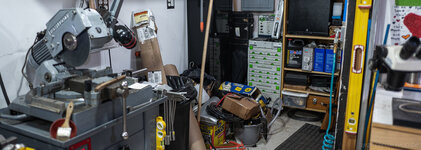
So while you guys are seeing the shop improving there's always a corner where chaos reigns. Things that are being sold on ebay, things that don't fit or have a home, cleaning buckets, inner tubes, rags... As my grandfather was fond of saying, "A place for everything and everything in it's place." These are the things without places. In a pile. Makes me crazy.

i-F887xH2-X2.jpg

So one of the shots that I'm doing for Garrett Wade is a cover for a catalog featuring toolboxes. The Art Director sent some inspirations shots for ideas and one of them was a wall of french cleats - something we'd normally hire a stylist to build. I said that I thought I could probably build that and they said they would be happy to pay me to do it. Get paid to build a wall of french cleat shelves? Why, yes I would.

i-BHm82pd-X2.jpg

I was considering building the set in the shop but the size of all the stuff made that impossible. Whatever size of thing your photographing you'll need about 5 times that space for all the photo gear, lights, stands etc.

But at least the shop can be where I make everything. So I lowered the Festool table and rolled the bikes outside.

i-Mdpxwdm-X2.jpg

While I had a lot of prefinished baltic birch already on hand one of the pieces I'd been holding onto was intended to be a small desk. Right where the pile of junk was. I wanted to make a small place to do detail work: soldering, wiring, watches, sketching. A clean spot so my sketchbook isn't always gritty.

i-dkrLn9t-X2.jpg

I didn't want to make it complicated, although I did consider making a small drawer underneath, but I did want to just get it done because at least the microscope would have a home. And I'd be forced to deal with the junk.

i-S7pmLdX-X2.jpg

Space cleared and now I'm using some empty Festool boxes to set the height for the chair. I'm just going to drill it right into the studs.

i-gDMhwH5-X2.jpg

It's tiny. Only 1000mm long but it's a good height, out of the way and I've managed to impart just a few more feet of order in the shop. Plus, this set building exercise gave me the excuse to warm up and get this off the list. Next up for this desk is to make a wire rack and move the soldering station over. Maybe another little shelf...

i-hM6DwfL-X2.jpg

Speaking of inconsequential projects that improve your life - I zip tied the power cord to the vacuum hose. I think I tried this once before but since this hose and cord are tethered in the ceiling over the table it seemed like it would help - it did. I like it.

i-XK9VsxT-X2.jpg

I use this little Kreg measure a lot. Can't recall what it's called... Oh, right, the Kreg KMA2900 and it's the best $15 I've spent considering how often I've used it to make off set marks and such. Anyway, I am measuring off and cutting a few strips of french cleats.

i-8PtGHWQ-X2.jpg

I feel a little like Milton just without the red stapler but I like my little desk. I didn't draw an elaborate sketch. I liked the 1000mm dimension and i knew there was a chance I'd repurpose the shelves so I checked dimensions of things I might want to put on them against the size of the toolboxes and found a good compromise.

i-K9vzfSP-X2.jpg

The shelves are very simple: a board with a french cleat screwed to the back and then some triangular braces that extend past the cleat to rest on the mating french cleat on the wall. Simple as can be. I made the triangles 30 degrees because my Kapex has a nice stop there and then used a stop to make sure they're all the same size.

i-bsQcQGS-X2.jpg

The less I use a tape measure the more accurate I get.

i-j5hrVPV-X2.jpg

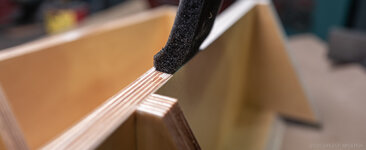
I lopped off the thin ends so I'd have enough meat for a screw to grab. My first test, with a perfectly flush triangle, split from the screw. I like the detail.

i-rTTqHSM-X2.jpg

THere's only enough time for a single coat of poly to make the edges nice and contrasting.

i-LrxNsfF-X2.jpg

The dining room is the only one large enough to shoot in. J is not happy about my shoots in the house - I have no idea why...

i-FWDLXrd-X2.jpg

I didn't want to start drilling cleats into the perfectly finished sheet of baltic birch so I hot glued and clamped the cleats in place. It's surprisingly sufficient for the job.

i-t749vZf-X2.jpg

And that's what it looks like with lights on it. I always hate seeing fake photos - you know the ones where it's obvious whomever was taking the photo had zero knowledge of the thing - so I wanted to at least make sure that the "workshop wall" looked legit. The propping is a bit weird but it has to use only GW products and they only sent a limited amount. Nonetheless it's a decent shot and I'm happy with how the wall and shelves turned out.

I'm sure I'll find some sort of use for those shelves after this is over. :dunno:

Gregor
 

Cypress

Well-known member
Joined
May 2, 2020
Messages
141
Location
Colorado
Looks great Gregor. Maybe I missed it in the post but what thickness of material are you using for the cleats?

Thx
 

The J

Well-known member
Joined
Mar 4, 2010
Messages
152
Gregor, wishing you and the family a Merry Christmas Eve.

Thank you for all your contributions and lessons. We’re looking forward to many more projects in 2021!
 

Brian_P

Well-known member
Joined
Jan 27, 2017
Messages
47
Location
Georgia
Glad to hear you like the satin sheen. It looks great - and I think you'll like it even more when you have it out camping in the rain and water just beads right off of it.

Shelves look great!
 
To avoid these ads, REGISTER NOW!
Top Bottom