Can we please dig a bit in the lighting rabbit hole? I'm currently rebuilding parts of my shop and am at the verge of installing lights. I would really love input on this. What should I order?
-LED? What warmth? How much? What are the specs to look for. Should it be dimmable, should the colors/warmth be changeable?
I've two work stations to redesign. A common work bench where I do general purpose building. Engines, wood, soldering etc. and a welding table.
I will give you a bit of my perspective as a person who uses and shapes light and how and why I make the decisions about certain lights. So I won't really answer your question but I'll give you a bunch of information you didn't ask for but may help in your decisions. Quality of light is more important that warm or cool which is more preference since your eyes adjust to color temperature but can't adjust to quality. The only time you'll notice a lights color temperature is if it's contrasted against another color temperature light. Light color is beyond our discussion right now and CRI is another can of worms.
My perspective as a photographer is a bit different - I shape light to manipulate the viewer not the object. Now, psychology aside there are a few principles to light that even most photographers don't understand.
Light can be described as either "soft" or "hard" and many people make the mistake of misinterpreting that too simplistically - a "soft box" is soft and a smaller light, say a flashlight, is "hard". We make this assumption because we assume a static situation in our minds - a person in a chair or say an object on a table.
Let's back up.
Light describes an object not through it's illumination but through it's absence. Shadow is how we understand something's shape. A way to imagine this is say in a whiteout. Light is so diffused that it is very difficult to make things out and you can actually lose your depth perception.
Now the opposite.
A glaring sun in the desert say - the shadows are so dark you can't see in them and they appear black voids. Shape is very defined but information about both light and dark is limited.
So we need shadows to understand shape.
When you're trying to see if a wall is flat you'll put a light at the opposite end and shine it across letting tiny imperfections be magnified by the low angle of the light. If you're examining something you'll shine a light at different angles to see the textures and shapes.
This is why work stations have a "task" light on an arm but there are larger, softer lights that are serving to light up the whole room.
This is called key and fill. Key is the main light that is describing something and fill is the amount of light that is "filling" in the shadows.
Some examples:

This is my Wilton on the bench with all the lights shut off only illuminated by the single window. The window is large - 2-1/2 x 10' and it's overcast today so this is a soft source but it's low angle, lack of fill and the fact that we can't move it means it's not helpful but it is fairly attractive. In this case I could turn the vise (since I can't move the window) and then I'd be able to control the light via changing my subject or my perspective.
In the time before lights artists built studios with giant north facing skylight/windows.
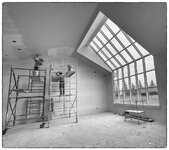
This has been considered the "best light" forever. It is a large source, essentially as large as the room, it is not direct in that the sun, being in the southern hemisphere, will never directly shine into the space yet it is directional by virtue of it being a single window. The other benefit is that the light will bounce off the white walls of the space and naturally fill in the shadows at about a 1-1/2 to 2 stop ratio - considered ideal. A "stop" or "f-stop" is a measure of light and 1 stop represents a halving or doubling of the amount of light.
The artist who used this light so much they named it after him was Rembrandt:

Sit your subject at a right angle to a large north facing window and you're suddenly a lighting genius.
This quality of light was not lost those who had work to do:

Every factory from the 1800's into the 1900's had row after row of angled dormers with north facing skylights. You notice there's no lights at all in this photo. This light gives a balance of direction, shadow and fill that is pretty unmatched. Also, unmovable and useless at night.

Back to our vise. If my window was larger, about the size of the footprint of the floor, faced north and the room was white I'd have no need for lights during the day.

So I brought a studio light into the shop and put it opposite the window. It's only the modeling light so it's just a bit brighter than the window but now we have control over positioning our light so the text is readable and the bare bulb is also reflecting off the ceiling creating it's own fill.
Next we'll put the reflector that's sitting on the table on this light. It will focus the light and therefore make it brighter but light will no longer be bouncing off the ceiling.

Now we have a brighter, directional light, with less fill. Because the reflector is about 6" this would be considered a "hard" light in this situation but don't think of hard and soft as "things" but relationships between the size of the source and the distance from the subject. Many photographers don't understand this and think a soft box is a "soft" source. It is if it's two feet away but if it's 50' away it is now a hard source. 200' away and it's almost a point source. It's a
relationship not a thing.

So this is a 2x2' soft box and it's not as bright because it's diffusing the light so much but you can see it's doing a very nice job of showing shape, light and shadow. Softboxes were invented to act like portable north facing windows and like many tools are abused by people who don't know how to use them. Many a photographer has made a career with a single giant soft box... cough, Annie Leibowitz, cough...

This is now the shop lights back on and my round LED on above the bench at full power. It's about as bright as 150w (equivalent) LED lights I'm using hanging from the big metal reflectors but because it's pretty close to the workbench it's pretty bright and nicely directional.
So, all this is to say your ideal light to work should be directional but not too small. You should ideally be able to move your task light to focus it where you need to work. All my machines have task lights that are slightly brighter than the other lights. I use large hanging lamps with frosted bulbs because I like the look of "pools" of light that draw your eye. There is enough bounce, diffusion and overlap that the shop has sufficient fill for the numerous task lights.

If I had unlimited resources I'd have a north light factory ceiling situation. Next option would just be giant north facing windows. After that would be high ceilings with lights bouncing into them to create a very diffused light accented with task lights. After that and we're where I am - a compromise on the look of the lights and the illumination that they provide. The bench is the only place with an "ideal" light set up - soft, directional, bright and movable. Interestingly I looked up this light and the price is way down from where it used to be. It's now only $310 where it was more than double.
FotodioX C-700RSV
Every shop is different and there is no "ideal solution" but hopefully you understand a bit more about light and will look at it a bit differently. I tell students to pay attention to the light around you and when you see beautiful light try to understand why.
I hope that this helps but a discussion of lighting is hardly something that can be tackled in a single post or even a single class. To this day I'm still learning about light and how to manipulate it.
Gregor










 What he said