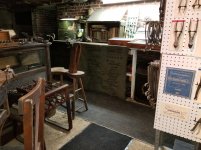
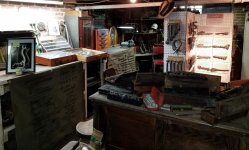
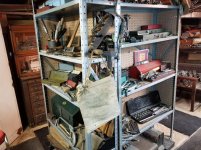
I really like the tiered shelving/pegboard approach Lugz. You're really getting a lot of storage/display space out of a small space.
Thanks. I didn't buy the shelving for this purpose. Actually, I didn't buy them at all. I am re-purposing them from other parts of the basement and garage, they were here when I moved in back in 1989, and I did at one point lament that they weren't about 6 inches wider.
You may have noticed that no one shelf has two toolboxes or attache style socket set boxes on it side by side. That's because they wouldn't fit. I had to go with toolboxes on one side, loose tools on the other. And in hindsight, that's probably better for mixing things up. The very top shelves are actually at eye level, but that's actually too high for proper display, because you have no look-down angle, and if it was a toolbox, for example, you couldn't actually see into it if the lid was up.
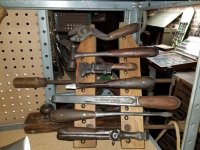
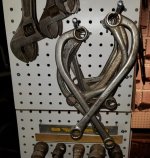
I've got my little collection of flaring tools, along with some tube cutters and benders, on one top shelf.
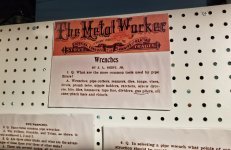
See Pic 1. It may seem to most people like an odd thing to collect as a collectible, but as soon as I became aware of more than one design approach, I was fascinated by the different approaches that various OEM's took to achieving the same result. For example, that's a Walden-Worcester, an Edlemann, a Reed, a Parker, and an Imperial Brass, no two alike.
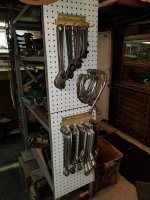
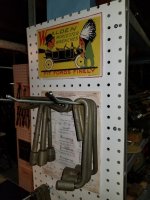
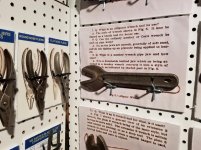
On the other top shelf, I have my Precision-Bilt Master Wrench Set and some Hinsdale sets, including my recreation of Todd's WWI Bacon Can set.
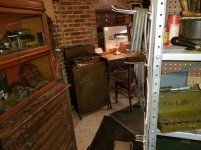
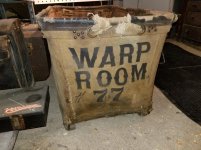
See Pic 2. Even if you were 6'2", you'd have to duck because of the joists overhead, and you really can't see them well. But I can see enough of them to know they're there and they're visible enough and easy enough to get down to please the inquiring mind of a curious guest.
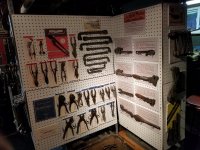
At the bottom of the L-shaped shelving unit island, you may have noticed I left the pegboard short.
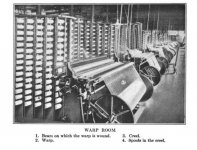
Those shelves, just inches off the ground, are way too low for proper display purposes, but I can put many boxes and kits and cases and things lengthwise, side by side, than I could if the pegboard went all the way to the bottom. So, sort of pseudo storage / pseudo display.
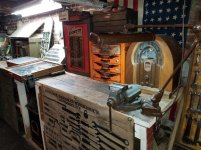
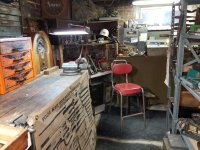
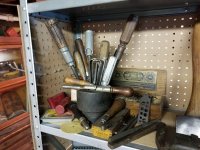
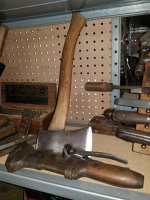
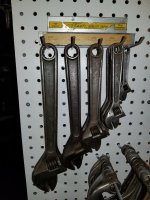
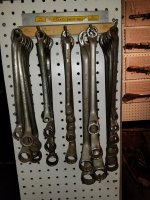
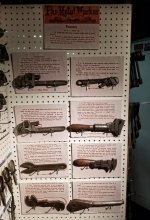
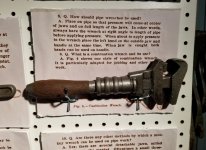
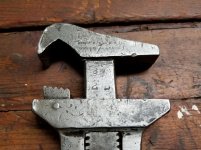
See Pics 3 & 4.
If I want to move that Williams 3/8-inch drive socket box and set up and open the lid, I can swap it out with something else, such as the Fairmount tools, for example. When I sell off my Plomb collection, I can move that black leather Knickerbocker repairman's tool box (for vintage Made in England Gestetner Cyclographs or "copy machines") up to one of those shelves!

I am using the other bottom shelf for tap and die stuff right now.
Believe me when I say that loading the shelves, deciding what would stay, and what would go back in their cubbards, and where things would be located on which shelves, was very much a day of trial and error, involving dimensions, fit, aesthetics and my own sense of priorities. Even though I know I can move them, change them out, and rotate them - from a low shelf to a better shelf, from behind cabinet doors and out from under workbenches to shelves, and vice versa, it really tested my personal "1 to n" list.






 :
:






 ) can have their own threads. I am looking forward to all of them!