To avoid these ads, REGISTER NOW!

How to seal a garage door better?

Bradbilt

Well-known member
Joined
Mar 8, 2018
Messages
162
Location
Gilbert PA
Does anyone have any suggestion as to how to seal a garage door better than the rubber seal at the floor and the weatherstrips at the top and sides?
 
To avoid these ads, REGISTER NOW!

stainlessyyc

Member
Joined
May 17, 2019
Messages
19
Location
Calgary, AB
The weatherstripping on the outside needs to be refreshed periodically and I found mine really sealed well after taking the time to reposition the strips on the outside and have a bit of tension pushing in. The new strips were also a lot more pliable as well which helped I’m sure but it seals good enough now I don’t have any drafts in winter
 

Fluxion

Well-known member
Joined
Apr 9, 2013
Messages
171
Location
Topeka. Kansas
Matt Risinger just did a video about Thermo Traks on his Youtube channel. Looks like an interesting garage door seal.

<iframe width="560" height="315" src="https://www.youtube.com/embed/h7pEGEyVBLI" frameborder="0" allow="accelerometer; autoplay; clipboard-write; encrypted-media; gyroscope; picture-in-picture" allowfullscreen></iframe>
 

PassnThru

Well-known member
Joined
Jan 5, 2010
Messages
6,512
Location
Bowling Green KY
Actually - if the concrete is flat and the bottom seal isn't 20 years old - and if the outer side seals were installed properly - and the door was installed properly - then the seal should be good honestly.
What's your particular complaint?
 

Zmann

Well-known member
Joined
Feb 24, 2019
Messages
302
Location
Arizona
I love the video
" I am not affiliated or paid in any way " but they gave me every product you see here for free lol

that being mentioned . def some cool ideas
 

Citation

Well-known member
Joined
Jan 20, 2016
Messages
3,223
Location
Indy
I love the video
" I am not affiliated or paid in any way " but they gave me every product you see here for free lol

that being mentioned . def some cool ideas

I was thinking the same thing. Still, I do like Matt's videos. They are useful in terms of helping me think about what is important in terms of how a house should function.
 

cgall

Well-known member
Joined
Jun 6, 2012
Messages
569
Location
Cincinnati, OH
Take a look at how much gap you have between the door and the inside wall. You can replace the hinges to tighten up a gap, they are numbered. I sealed up a gap by replacing a couple of #2's with #3's. Also check your downward travel on the door opener, you don't want it cramming the door into the floor.
 

slowtwitch73

Well-known member
Joined
Apr 18, 2019
Messages
5,876
Location
Hellgate
Most doors if they are used develop a bow in the middle where the lift motor yanks on it and pulls it back. If you aren't using your door much, a couple well placed screws through the door edge and into the wood will pull it tight. Ir you run some of that sticky foam strip along the top, and then screw it down tight, you get a good seal. Then unplug the opener and throw some towels along top and bottom.
Need to use door? plug in, undo two or three screws, put them back when done.
 

NUTTSGT

Super Moderator
Staff member
Joined
Sep 14, 2009
Messages
51,080
Location
Northern Central Ohio
On my garage, as the doors don't get opened all the time, I put in small wood wedges behind the sliding latches. They push the door tight against the seal. Simple, cheap, effective.
 

tarmy

Well-known member
Joined
May 28, 2014
Messages
4,706
Location
Nor Cal
Buy those expensive green hinge sets with springs. I thought they were a joke...until I got tired of the leaks. They work friggin’ awesome. Put them on all my roll up doors...
 

ColoMid

Member
Joined
Nov 5, 2013
Messages
22
Location
Canton, Ga
I bought the Green Hinges as well after a previous GJ discussion. $65 and 30 min
work and it couldn't better. Keeps a light tension against the side seal flaps perfectly.
Takes the slack out of the rollers in the track.
 
Last edited:
OP
B

Bradbilt

Well-known member
Joined
Mar 8, 2018
Messages
162
Location
Gilbert PA
Brand new building.

Just trying to make a better seal all the way around.

I was thinking of using outside seals on the inside edge of the door to have double seal(Similar to thermo tracks) that would seal along the inner edge of the door
 
To avoid these ads, REGISTER NOW!

MeentSS02

Well-known member
Joined
Aug 12, 2010
Messages
325
Location
Dayton, OH
Motivation/Disclaimer

I ran across this thread a few weeks ago - the "how do I seal a garage door better" question seems to come up from time to time, and I feel like there's a lot of good info out there, but it just isn't consolidated all that well. The search function on this site isn't great, mainly because there are so many damn threads/posts that it is hard to sift through all the information (some better than others).

I've researched different types of garage door seals for years; in that time, I've also tried a few different products for my own doors. I'm going to attempt to consolidate what I've learned over the years into the next few posts; I hope that it helps the next person that has this same question a few months/years from now. It also helps get the information out of my head so I don't have to think about it anymore.

Disclaimers:

  1. I'm not a professional - I'm just your run of the mill DIY-er that can't leave well enough alone. If you see something wrong with what I've posted, please call me on it and add your own expertise/experience so that we can all learn.
  2. Some of the pictures you see are my own - others are taken from websites like North Shore Commercial Door and GarageDoorWeatherSeal.com, and are watermarked appropriately. I did that out of convenience - they carry many different types of products, so it was easier to just take a few screen caps that I merged together to make everything easier to see. I'm not affiliated in any way with either of these companies, although I've done business with both (and I can assure you I've never received a discount from either).
  3. Most of what I'm going to list below applies to your standard residential sectional doors. You can apply the same basic ideas to commercial/industrial roll-up style doors as well.

I am only providing basic info; you will have to decide what works best for your garage door and overall situation.
 

MeentSS02

Well-known member
Joined
Aug 12, 2010
Messages
325
Location
Dayton, OH
Does anyone have any suggestion as to how to seal a garage door better than the rubber seal at the floor and the weatherstrips at the top and sides?

First, to directly answer this question: there really isn't a better way to seal your garage door besides the rubber seal at the floor and weather strips at the top and sides.

There are, however, many different types of seals available, some of which are better than others.

The top priority is that you want the door to fit tightly against the jamb when the door is down. There are a couple of ways to address this:

  1. Adjust your garage door tracks
  2. Use something like the Green Hinge System (https://www.greenhingesystem.com/) to help take up any remaining gaps

You really don't want anything between the jamb and the garage door - the door must be able to move freely up and down; anything that impedes that could cause issues with your opener. The garage door doesn't really fit snuggly against the jamb until the door is pretty much all the way down, but you still don't want any type of weather seal like you'd use on a hinged man door unless your garage door/jamb was specifically made to accept that style of seal. I can't think of a situation where you'd want to use a solution designed for a hinged door - how the garage door opens/closes is fundamentally different, so it is reasonable to expect that it would require a different kind of seal.
 

MeentSS02

Well-known member
Joined
Aug 12, 2010
Messages
325
Location
Dayton, OH
Bottom/Threshold Seals

In my experience, sealing the bottom of the garage door to the concrete has been my biggest challenge. There are two different types of products to address this:


  1. Bottom seals that attach to the door itself
  2. Threshold seals that you glue to the floor

Bottom Seals

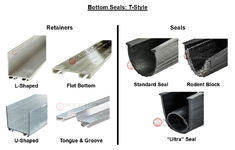
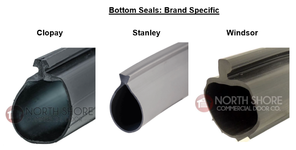
There are a few different types of bottom seals. Some are universal, and others are garage door manufacturer specific. The pics below show most of the options available:

Bottom-Seals-1.png
Bottom-Seals-2.png
Bottom-Seals-3.png

My door was originally equipped with a retainer/track that accepted the bulb-style of seal. It worked okay, but I felt like the T-style was a better design, and had way more available seal options. I have a tongue and groove door, so I purchased the aluminum retainers that were made specifically for that application.

In the T-style, I've personally tried both the standard and "ultra" seals. For my application, the "ultra" seal, although thicker (which means the garage door won't go down as far in the closed position), made the best seal. You can also put a rubber stopper in each end of the tube to help the seal keep its shape.

Also note that there are multiple sizes available in the standard T-style seal, allowing you to take up as much (or as little) of the gap you have.

Threshold Seals

I've also seen these referred to as Tsunami seals. It doesn't matter what they are called - the basic idea is that you attach it to your floor, creating a lip for the bottom seal to rest on. This helps keep out driving rain and snow. I have south-facing garage doors, and one would always let water seep in underneath the door during heavier rains. The threshold seal stopped that.

Threshold-Seals.png

Threshold seal pros:

  1. Keeps out driving rain
  2. Creates a better surface for the garage door bottom seal to sit on

Threshold seal cons:

  1. Cost
  2. Labor intensive install - I bought the kind that required construction adhesive to bond it to the floor. The adhesive backed stuff would probably have been a better choice, but wasn't available when I bought the threshold seal years ago.
  3. PITA to remove (if needed)
  4. Keeps water in - think runoff from your vehicles (rain, snow, A/C condensation). You'll end up needing to sweep the water out over the threshold seal every once in a while unless you just want to let it sit there and evaporate.

Whether or not you need a threshold seal depends on your situation, and also how the concrete was laid. I've seen channels cut into the slab to give the seal something to sit in, and I've also seen them with small lips that would keep driving rain from being able to get any farther than that part of the concrete slab.
 

MeentSS02

Well-known member
Joined
Aug 12, 2010
Messages
325
Location
Dayton, OH
Interior Top Seals

I stumbled across these things a few years ago - before that, I didn't even know they existed:
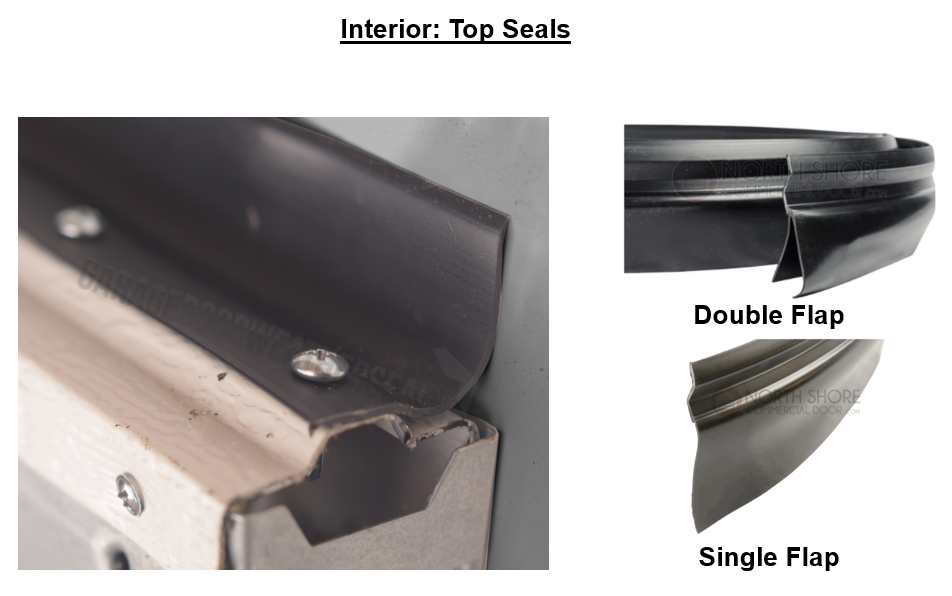
Interior-Top-Seals.png

There are different styles available. Again, I have tongue and groove door garage door panels, so the pictures shown are specifically for that application. They also make ones for flat top/bottom door panels. I went with the double flap variety since the cost wasn't that much more.

These seals work pretty well at sealing the top of the door from the inside. It's especially nice since they attach directly to the door panels, so there's no worries about pinching them like you would if they were attached to the wall.

That said, you do have to watch where they come close to your torsion springs. The first couple times I used it, the end of the torsion springs that stick out were getting caught on them. If that happens, you'll see it, and probably hear the racket as it catches and lets go. All you have to do to prevent that is make a couple well placed slits where it makes contact with the springs - problem solved. I'd highly recommend running the door up and down manually after installing these to watch for interference before you re-engage the door opener.
 

MeentSS02

Well-known member
Joined
Aug 12, 2010
Messages
325
Location
Dayton, OH
Exterior Side and Top Seals

The first, and in my experience the most common type of exterior side and top seals are the standard nail-on vinyl stop molding style. At this point, I can count on one hand the number of homes I've seen that haven't had this style of garage door seal:

Exterior-Seals-1.png

I think everyone is pretty familiar with these. If you need a door sealed quick, this is probably what you are going to go grab. The install is quick (which is why contractors prefer them), and you can find them at pretty much any home improvement store. There are many different color options available, and I've also seen ones that come ready-to-paint. They are also by far the cheapest option.

Vinyl, as you'd expect, contracts and expands with the outside temperature, which means you are also likely to see something like this:

Vinyl-Stop-Molding.jpg

That doesn't exactly make a good seal. Most of the ones I've seen installed have looked like that. I'm sure with a careful install (as in, don't nail the top and bottom first, and then put all the rest of the nails in), you can help prevent this to an extent, but it's really to be expected. They'll also eventually tear, which means you'll have to rip them off and install new ones every so many years. Not a huge deal, but something to keep in mind.

Again, these are cheap and easy, and will work for 99% of people out there that really don't care how well their garage door seals.
 

MeentSS02

Well-known member
Joined
Aug 12, 2010
Messages
325
Location
Dayton, OH
Exterior Side and Top Seals Continued

So what if you don't want the vinyl stop molding style of seal? That'll push you towards a two-part solution that consists of some sort of retainer/track and a seal that slides into said track.

Something like this:

Exterior-Seals-2.png

Pretty much all of the retainers/tracks I've seen have all been aluminum, and come in many different sizes and configurations. These tracks accept many different styles of seals, giving you a lot of flexibility to fit your needs perfectly.

The drawback is that these are expensive, and it's a fairly labor intensive install if you want it to look neat. It took me about 8 hours to do my 16x7 and 9x7 doors, most of which was cutting and fitting the aluminum tracks to get it just the way I wanted.

Keep in mind that there are three different sizes of retainers/tracks:


  1. Slim Line
  2. Standard
  3. Oversized

The Standard option gives you the most flexibility in choosing different types of materials and sizes to fit your needs. Once you pick a size, you are locked into that unless you want to buy and fit all new retainers, which is what I did this past year (I went from slim line to standard).
 

MeentSS02

Well-known member
Joined
Aug 12, 2010
Messages
325
Location
Dayton, OH
Seal Recommendations

I installed some 3/4" slim line brush seals many years ago. Overall, these performed pretty well, but after a few years, the brushes started to fan out a bit. They still sealed, but not quite like they did when new.

Slim-Line-Brush-Seal-2.jpg
Slim-Line-Brush-Seal-1.jpg

If you want to go the retainer + seal route, keep in mind that the aluminum retainers/tracks and any metal backed brush seals are subject to shipping restrictions. Usually, you can only order a maximum length of 4-5 feet, which means you'll need to use multiple pieces to cover an entire side/top. This becomes expensive and wasteful if you want the pieces to be relatively the same size, depending on the size of your door. Again, just something to keep in mind.

For brush seals, they now offer a flexible version that can be rolled up and shipped as one piece, like they do for rubber or vinyl seals. This material is substantially cheaper than the aluminum backed brush seals. I'm unsure if it works any better/worse than the aluminum backed variety.
 

MeentSS02

Well-known member
Joined
Aug 12, 2010
Messages
325
Location
Dayton, OH
Seal Recommendations Part 2

As stated in a previous post in this thread, I switched from the slim line style of retainer to the standard size this past year. I also opted to use EPDM rubber vs. the brush seals. It came out pretty nice (at least from a distance):

Finished-Weather-Seal.jpg

The shortfalls, however, become pretty apparent when you get up close:

Wavy-Rubber-Seals.jpg

Everywhere you see a gap is very apparent from the inside as you see light leaking in through each of those gaps when the sun is shining on the doors. That's no bueno, especially for the price.

What's more, the rubber seals expand and contract a lot. It was around 70° when I installed them. This picture was taken on a 35° day:

Expansion-Contraction-Issues.jpg

That *****, especially since those side pieces were actually cut about 1/8" long (and it's that way on both of my doors). You can try to capture the expansion and contraction by pinching the tracks, but that comes at the expense of making it harder to replace the seals when needed (and yes, that's when, not if).

The expansion/contraction issue isn't a huge deal, but combined with the wavy seals, that makes it a no-go for me. I'll be replacing them shortly with aluminum backed brush seals of approximately the same size (~1"). The brush seals conform to irregular surfaces much better than any EPDM rubber or vinyl ever will. The drawback is their more industrial look - that doesn't bother me much obviously.
 

MeentSS02

Well-known member
Joined
Aug 12, 2010
Messages
325
Location
Dayton, OH
Bottom Line

That's an awful lot of typing for what essentially amounts to mental diarrhea (or a dump of all the **** in my head if that makes more sense). So what is the point?

It's this: if you want to effectively seal a garage door, you need to take a layered approach.

Step 1: Get the garage door to fit as snug against the jambs as possible. Adjust the tracks, and use Green Hinges (I'm probably going to try these as well since they look like a nice product) if necessary.
Step 2: Double up on seals when/where possible if you can.

That means combining a bottom seal with a threshold seal (if needed; depends on your slab), an interior top seal with an exterior top seal, and then the side seals.

Step 2 is going to depend on your requirements. If you heat/cool your garage, this is probably going to be pretty important. If not, you don't really need to double up on seals unless you have money burning a hole in your pocket (or just enjoy the challenge like in my case).

In my experience, the brush seals on the exterior side and top do the best job of conforming to the gaps, and get my recommendation. Go for the standard sized retainer/track, and aluminum backed brushes for the best results.

As has already been stated by another forum member, you can also use the brush seals on the sides of the door from the inside. That's about the only way you can effectively double up on the seals without interfering with the operation of the door. You'll have to pay close attention to any obstructions (like the cable), but it's definitely possible, and would give you the best chance of actually sealing the door.
 
Last edited:

38Chevy454

Well-known member
Joined
Dec 26, 2006
Messages
4,036
Location
Cincinnati, OH
Re: Interior Top Seals

I stumbled across these things a few years ago - before that, I didn't even know they existed:

Interior-Top-Seals.png


There are different styles available. Again, I have tongue and groove door garage door panels, so the pictures shown are specifically for that application. They also make ones for flat top/bottom door panels. I went with the double flap variety since the cost wasn't that much more.

These seals work pretty well at sealing the top of the door from the inside. It's especially nice since they attach directly to the door panels, so there's no worries about pinching them like you would if they were attached to the wall.

That said, you do have to watch where they come close to your torsion springs. The first couple times I used it, the end of the torsion springs that stick out were getting caught on them. If that happens, you'll see it, and probably hear the racket as it catches and lets go. All you have to do to prevent that is make a couple well placed slits where it makes contact with the springs - problem solved. I'd highly recommend running the door up and down manually after installing these to watch for interference before you re-engage the door opener.

I just installed this top inside single flap seal on my 16ft wide doors. They were bowing out slightly in the center away from the frame and outside seal. I could feel the cold wind blowing in before these seals blocked that. Has to be helpful on the heating bill :eyecrazy:
https://www.garagedoorstuff.com/product/garage-door-top-seal/
 

MeentSS02

Well-known member
Joined
Aug 12, 2010
Messages
325
Location
Dayton, OH
I'm installing new garage doors soon and would like to go with these. Will ask the installer if he's willing to use them; otherwise, might just order them, pull his stuff and install them myself. They're pretty inexpensive.

I looked into these heavily...they are by far the most robust design I've seen when it comes to garage door seals. The only things I didn't like about them were:


  1. Hard to find - none of the online retailers I've worked with in the past carried them (at least that I saw)
  2. The aluminum retainers would really only work with that kind of seal

Basically, I was worried that if I needed to replace them and couldn't find them (or they were no longer being made), I'd end up having to do everything all over again, which is what I just got done doing last year because of my lack of foresight.

That said, replacement might not be a big deal - they look like they'll last a long time. The double flap design is also really nice, and should seal well on most standard sectional doors.
 
Last edited:

TeamTruett

Well-known member
Joined
Jun 12, 2011
Messages
213
Location
Mid Hudson Valley NY
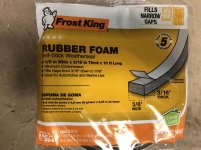
I applied window weather strip insulation to the backside of the seal after cleaning it. A 10' package was $2.68 at Home Depot. While not perfect, it made a worthwhile improvement.
 

Attachments

  • IMG_4350.jpg
    IMG_4350.jpg
    75.7 KB · Views: 181
  • IMG_4349.jpg
    IMG_4349.jpg
    151.4 KB · Views: 164
  • IMG_4347.jpg
    IMG_4347.jpg
    78.5 KB · Views: 181
Last edited:

MFortie

Well-known member
Joined
Aug 9, 2010
Messages
903
Location
San Diego County
Any suggestions for rollups? We get pretty strong winds here that scour the property; I’ll get a half inch or better layer of sand/DG a couple feet into my shop after a windstorm. These are 10’x14’ doors...
 

i4ni

Well-known member
Joined
Jan 23, 2010
Messages
1,015
If you have windows in your garage door it's a good idea to add a 8 foot piece of 1 1/2" aluminum angle screwed to the inside top of the door to tie the 3 center hinge points together. Doing this will effectively stiffen and create an 8 foot wide reinforced center pulling point for the garage door opener arm to pull on rather than always pulling on that same 6 inch anchor point. It's a good practice on any garage door whether it has windows or not especially 16 foot doors. Any door will fatigue in the center over time. Ask me how I know? My 16 foot door was used several times a day and over a period of years the door fatigued enough that it buckled in the center and at that point I was pretty well screwed. Rather than going garage door shopping that day I removed the bent top section laid it face down on 4x4 blocks at each end and bent it back straight. Then I added the angle as described above and it's been working fine ever since. I got lucky that mine was repairable but you may not be that lucky. :beer:
 

MeentSS02

Well-known member
Joined
Aug 12, 2010
Messages
325
Location
Dayton, OH
Any suggestions for rollups? We get pretty strong winds here that scour the property; I’ll get a half inch or better layer of sand/DG a couple feet into my shop after a windstorm. These are 10’x14’ doors...

Where do you see gaps when you look from the inside out when the sun is shining? It should be pretty obvious with the doors closed and the shop lights off.

Regardless, I'd be looking at brush seals for the sides and top. How long you need depends on how big of a gap you are trying to fill.

Brush seals that fit a "standard" size retainer/track come in 1", 1.5", 2", and 3" lengths.

Brush seals that fit an "oversize" retainer/track come in 4", 5", and 6" lengths.

It won't be cheap, but you need something that can conform to the door, and roll up doors have evenly spaced, but not uniform (flat) gaps to fill.

The bottom seal will depend on the concrete surface you are sealing against.
 

ripperd

Well-known member
Joined
Jul 2, 2014
Messages
2,048
Location
Twin Cities, MN
My doors are pretty new and seal quite well when the air is calm. But my house faces northwest into the wind. And on cold windy days, I can hear the doors move back and forth away from the seals and I can see the daylight come and go, and feel the breeze as air slips by the gap created by the wind pushing the doors inward off the seals. Those spring loaded hinges look to be the perfect ticket for mine. Going to be a bit of an investment though with 3 doors!
 

MeentSS02

Well-known member
Joined
Aug 12, 2010
Messages
325
Location
Dayton, OH
My doors are pretty new and seal quite well when the air is calm. But my house faces northwest into the wind. And on cold windy days, I can hear the doors move back and forth away from the seals and I can see the daylight come and go, and feel the breeze as air slips by the gap created by the wind pushing the doors inward off the seals. Those spring loaded hinges look to be the perfect ticket for mine. Going to be a bit of an investment though with 3 doors!

Sounds like you have a solid plan.

I'm on the fence on doing the hinges for mine...they seal well enough, but I'd like the doors to be a little more quiet when rolling up and down which the Green Hinges are supposed to help fix.
 
To avoid these ads, REGISTER NOW!
Top Bottom