To avoid these ads, REGISTER NOW!

DIY Install - Heat only Mod/Con Boiler for Slab Radiant

George-in-NH

Member
Joined
Oct 27, 2016
Messages
23
Hello,

I am planning a DIY installation of Slab Radiant in my garage. I've gleaned a ton of useful information from this forum and I thought I'd document it for feedback and to show the process incase it can be of help to anyone, someday.

Project Stats:

Detached Garage - New Construction.
28x32x12 Wood framed garage, with Attic Trussed room above.
No domestic or any water at all to the garage from the house.
Insulation is R19 walls and Spray foam against roof and gable ends. It's tight.
(2) 10 x 9 Overhead Doors (R14 Insulated).
(1) Man Door.
(5) Windows Down & 2 Window Upstairs.
Slab (5" Thick) already has 4 loops of 1/2" PEX (O2 barrier) about 200' ea.
Slab Insulated on inside of 4' frost wall (down to footer, 2" XPS Dow Blue).
Slab Insulated with CreteHeat EPS panels under - These also positioned the PEX.
I installed Electric Baseboard upstairs that will be used when room is used.
I have pulled permits for all of my work including this heat install - We are allowed to do our own work on a primary residence here in Seacoast NH.

Usage: Car Parking and Hobby workshop for cars, bikes, anything else I want to! I plan to run one temperature all the time maybe 50-55 depending on how it feels.

Boiler Selection :

I decided to do Slab Radiant but I've never been in a garage with it so I hope its worth the extra $ (at least 4X a Modine).
LP fuel but maybe going to NG in the future, my house has it but hard to get access for garage.
A Mod/Con was chosen so I can run low temp and stay in the efficient range of boiler.

During my research, I have found that there are not many small sized boilers available. I tried to get a Navien NHB-055, the specs look great - However Navien does not allow them to be sold to non licensed individuals. Then I placed orders for a Triangle Tube CC50S, then later a ZBR 16-3 Greenstar 57 45,000 BTU. After ordering I was informed that both are discontinued. That cost me a month of time and brought me into the cold part of the year, oh well. What I have come to realize is that the smallest sizes seem to be limited at the high end output but otherwise seem the same.

I have only been considering purpose built boilers and am staying away from Tagaki etc on demand water heaters. Hopefully this will increase reliability, because it sure increases cost.

My current design uses a Weil-McLain AquaBalance Series 2 WMB 80-H. This is a heat only boiler with a 10:1 Turn Down Ratio for a min burn of 8kBtu/Hr.

I am ready to place orders for the equipment - I'm buying online from supplyhouse and ecomfort to avoid the attitude I get at the supply store counters when I say I'm installing my own system.

Design:

I'm using Primary/Secondary per WM Manual. To make things easier, I'm using the WM pre-fabricated Primary Manifold. Antifreeze will be used and there is no source for make-up water. I intend to pump neutralized condensate thru the wall our onto the ground. If I have condensate freeze up issues, I'll add heat tape.

See attached schematic of my system design (and the WM piping diagram from the manual). Any comments are welcome and appreciated.

George


Edited 210111 - Diagram now includes Spirovent and 3 Zone Taco Relay
 

Attachments
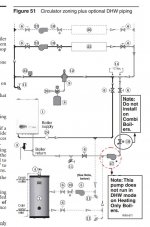
  • WM Piping Diagram from Manual.JPG
    WM Piping Diagram from Manual.JPG
    72.9 KB · Views: 160
  • WM AB80H Piping Digram 1.jpg
    WM AB80H Piping Digram 1.jpg
    96.9 KB · Views: 99
Last edited:
To avoid these ads, REGISTER NOW!

V8BoatBuilder

New member
Joined
May 10, 2015
Messages
4
Good on you for making it happen yourself and not being bullied by towns/contractors/supply houses to hire someone.
 

brewchief

Well-known member
Joined
Sep 20, 2008
Messages
2,370
Location
Michigan
I would swap the air scoop and vent for a microbubble air eliminator, there are multiple brands to choose from, I normally use califi but the spirovent is very good as well, just depends on what my suppliers are carrying.

I will get a system up and running and make sure it is 100% for a week or so before adding antifreeze.

Sent from my SM-T510 using Tapatalk
 
OP
G

George-in-NH

Member
Joined
Oct 27, 2016
Messages
23
Re V8 -Thanks for the encouragement.

Re brewchief - I had originally specified a spirovent. I don’t have any past experience with them but they do seem better tech. I think I’ll take your advice.


Sent from my iPhone using Garage Journal
 

jlv03

Well-known member
Joined
Jan 19, 2020
Messages
346
Location
SE IA
If you haven't experienced floor heat before, you are in for a treat.

With excess capacity of the boiler, any thoughts of running a baseboard or water-to-air exchanger off of it for the upstairs?
 
OP
G

George-in-NH

Member
Joined
Oct 27, 2016
Messages
23
Re jlv03

Thanks, I hope its worth it - I think it will be.

I wish I had run the plumbing for upstairs, but I wasn't sure what my plan was by the time I wanted to have it sheet rocked. I had a plumber start to help me, then not return my calls. Bad planning I guess, but I was having a very hard time getting people to even call me back. Contractors were really busy last summer!

I'll see how the the Electric baseboard works out...
I can always add a zone and run the tubing for up there on the wall. Its a garage after all! This makes me think that I should use a zone circulator control with more than one relay.

I've learned a lot in this project, but I sure wish I knew then what I know now!

This Hydronics stuff is pretty interesting, I'd not thought much about it before.

George
 

Tduby

Well-known member
Joined
Apr 5, 2016
Messages
496
Location
Da U.P.
Nice set up I agree on changing out the air separator for a better design. I would also rethink putting antifreeze in honestly you don’t need it the slab will not freeze if you have good side and wing insulation. Only other suggestion is consider at some point putting on a fan coil and run it off the DHM setting then you get a nice hot air if you want to quickly heat up your upstairs
 
OP
G

George-in-NH

Member
Joined
Oct 27, 2016
Messages
23
Re Tduby -

Thanks, I have been questioning weather I need antifreeze. I'm definitely going to get it going with just water for a while to make sure its leak free etc. We'll see after that. I don't leave the property for extended times, so for now antifreeze isn't really necessary.

I have updated my design to use a spirovent, its not much more $.

Adding a hydronic zone for the upstairs is certainly something I may do at some point, but I'm going to live with the electric for a while and see if a change is a good idea. The room will only be used once in a while.

George
 

yeldogt

Well-known member
Joined
Jan 2, 2012
Messages
18,184
What are the electric rates ? My memory is very high.

I agree on the glycol .... or at least only what you would need not 50%

Is the ceiling open ? you state you may want hydronicts in the future?

How big is the room upstairs ..SF? Could have been a couple of panel radiators piped with PEX
 
OP
G

George-in-NH

Member
Joined
Oct 27, 2016
Messages
23
Re yeldogt

Rates are $0.15 per KWh, not sure if that's high. In Dec I used 294Kw keeping the upstairs room thermostat at 50F according to the smart thermostat (Mysa). So $44, kind of alot but not overwhelming. The downstairs bay area never dropped below 45ish. My kids turned the heat up to 70 a few days. This is not representative of what will happen when I do have the slab heated of course.

I'll probably do light glycol mix once its all up and running just for peace of mind.

The room above is 14'Wx30'Lx8'H, with open stairway access - no door separating the up/down spaces. The ceiling and all the rest of the inside of garage and room is sheetrocked.

Yes I should/could have run pex and a panel radiator. I didn't because I needed to get the sheetrock people in there and hadn't figured out what I needed to do for heat. The one plumber that called me back stopped returning my calls. Bad decision on my part.

I had the electric baseboard and was doing the electric myself so I put it in.

I can still do it but I'll either have to run the tubing on the wall or open the wall to keep it out of sight.

I should post some pictures of my project.

Thanks,
George
 

Chris705

Well-known member
Joined
Nov 1, 2012
Messages
834
Location
The Finger Lakes of NY
I just added some fin-tube baseboard to my second floor and tied it into my system after 3 years of running only slab heat downstairs.... all the tubing is fed from the floor joists so you can always add down the road without tearing things apart.....
You will be very happy with your flor heat!
 

yeldogt

Well-known member
Joined
Jan 2, 2012
Messages
18,184
The cost of getting that NG to the garage -- I would do the math. It's so much cheaper to operate. It sounds like you have the ceiling in the space ..so no way to do radiant for the second floor.

You could do baseboard up stairs ..... I think you would find that a couple panel radiators would also work and they are easy to retrofit with PEX ..... can be done with bypass fitting on them and that way you just need a loop of PEX ...each have a thermo head for control. They work great .. each taking what they need from the loop.

You would have to think ahead and make sure you get the temps and BTU's needed -- you can actual make a big primary loop ..giving the panels high temp water and still pull the low temp water for the floor ..
 
OP
G

George-in-NH

Member
Joined
Oct 27, 2016
Messages
23
Re Chris705 - Good to hear, thanks for the reply!

Re yeldogt -

I am planning to initially use LP and convert to NG in the future. However the trench path I'd like to take goes where there is currently an above ground pool. I was set to remove it and make a patio until my 83 year old Mom moved nearby and started swimming daily in the summer. Can't do that to her.

As far as cost goes I priced out the parts for burying a NG line to my existing meter and came up with $700ish. Plus I'd have to rent a backhoe, I dug my last trench putting that pool in! LP tank rental is $75/year. An additional meter and line from street could have been be put in for free but it costs $25/month to rent the meter.

Fuel prices per nh.gov, $/millionBTU
LG - 43
Electrical Resistance - 48
NG - 13

It will be interesting to see how many btus/yr I use, and what my break even on a NG switch over will be.

About the heat upstairs - I will go the panel rad route someday if it seems like a good idea once I've lived with it for a while. I can route the tubing upstairs and then once up there I have access to run the tubing behind the knee wall.

I appreciate the input!

George
 
OP
G

George-in-NH

Member
Joined
Oct 27, 2016
Messages
23
Hi All,

Question - If I were to add upstairs hydronic heat (replacing electric baseboard) - Unless low temperature high mass or panel radiators are used - Does the benefits to efficiency of a condensing boiler go away with a high temperature loop?

Part of the reason I went with Electric Baseboard upstairs was to be able to set and forget the slab using low temperature water. Then the boiler will be operating with a low return temp for max condensing and hopefully long run times at min burner output modulation.

George

George
 

yeldogt

Well-known member
Joined
Jan 2, 2012
Messages
18,184
This is where you have some math to do -- you can oversize the panel radiators so they require lower water temp. Buderus gives outputs at different temp water -- you match this to the design temps of the space. The tall upright double units work well in many spaces.

The main loop is still going to be tempered by the other lower temps of the floor before it returns to the boiler. .... still low. Remember -- you only run at those max temps on the coldest days

Fin tube is normaly at 180 -- have seen track houses at 200. Builders/ installer save money with less feet of radiation ... homeowner pays for a lifetime. Condensing never happens at those temps.
 

Chris705

Well-known member
Joined
Nov 1, 2012
Messages
834
Location
The Finger Lakes of NY
I have my fin tube set to work with my high temp set at 165, I installed it cause I thought eventually I would want warmer temps in my upstairs wood shop, downstairs my in floor I keep at a set point of 53... so far I like the ability to quickly raise the temp to 65 in about 40 min or so....I adjust the thermostat each time I go up there to work, otherwise my spray foam insulation keeps the entire shop at at the 53 floor heat temp. I think even 120 degree water would give you okay heat output if well insulated. For my 1600 sf second level I installed 60lf of fin tube.
 
OP
G

George-in-NH

Member
Joined
Oct 27, 2016
Messages
23
Re Chris705 & yeldogt -

I think I'm getting a pretty good understanding of how I could add upstairs H2O heat. I'm going to stick with the electric baseboard for now, but lay out the piping so I can add a secondary loop for upstairs some day. I've also been toying with the idea that I could add a hydronic unit heater to quickly warm up the bay areas instead of waiting for the long thermal mass of the slab to heat up the air. This would be used if I'm in there for only a few hours in the evening.

I could size the additional emitters to use 120deg water so I'm condensing more often.

But as I said that is going to be backburned as I am pushing my budget as it is. This decision is also driven by the fact that I'm going to be using LP for a few years which isn't much less per BTU than resistance electric.

I really appreciate the discussion of the options!

George
 

yeldogt

Well-known member
Joined
Jan 2, 2012
Messages
18,184
factor getting the NG ... with NG you maintain higher temps and all the other troubles go away.
 

shepner

Active member
Joined
Aug 11, 2018
Messages
37
Location
SE Wisconsin
Just now discovered this thread so here is a bit of an info dump:


I went through something very similar with my new garage which is slightly smaller and I have a mezzanine for a 2nd floor. I have 2 insulated roll-up doors

There is R40 worth of foam under the roof and R21 of mineral wool in the walls (except in a few areas that I need to finish yet). Concrete has 2" worth of foam sheet on sides and underneath. The boiler is in the house and I pump 128F glycol out to the garage through an insulated pex line.

The garage's thermostat is limiting the floor temp to 80F (dont forget to run a pex line for the temp probe before you pour the concrete!) and the air temp to 55F-60F. This is my first winter with it running.

I used some hydronic design software from (I think) Mr Pex. This is very useful for determining the pump sizes, flow rates, etc. There are also some efficient (but expensive) circulation pumps that can do things like provide constant pressure or even adjust flow rates based on the temp differential. The cheap pumps also tend to consume lots of power.


Things Ive learned:

Because it takes *forever* (hours) for that slab to change temps, I needed to set the thermostat schedule so it would start heating in the evening. This way I wouldnt get such wide air temp swings between morning and evening. "Forever" translates to around 9hrs/day (give or take depending on how cold it is outside)

I wish I had like 2x the insulation around the concrete. On the plus side, I have less snow to move.

Go with glycol. Include a micron filter. This will be the safest and longest lasting solution. Id also go with distilled water in there. Since you dont have a water supply, you will likely want some form of reservoir and pump for makeup.

The garage takes ~1/3 of my boiler's capacity. The impact on my gas bill was noticeable but not alarming. Try to have more capacity in your boiler then what your garage needs. Helps the boiler last longer.

Air temps on the first and second floors are typically less then a half a degree apart. There are no cold spots. Even by the garage doors.

60F with hydronic heat feels about the same as the house at 68F with gas forced air. The floor at 80F is wonderful to work on.

In addition to a concrete temp probe, I also recommend an outside temp sensor so it wont call for heat when its warmer outside.

Take a look at the Tekmar 561 thermostat. I bought it from here: https://www.supplyhouse.com/Tekmar-Thermostats-TekmarNet-Thermostats-1445000 Id have to go look to see which specific model I have but I think it was the 562 as as I wanted it to control my exhaust fans in the summer.
 
OP
G

George-in-NH

Member
Joined
Oct 27, 2016
Messages
23
Re shepner -

Thanks for the reply! Makes me feel good to read of a similar setup that is working well.

I've already purchased the bulk of the the parts including the pumps. I had started to investigate ECM pumps that could vary speed, but decided to just go with 3 speed settable Gundofos pumps. Hopefully I'm not leaving much on the table, but I wasn't sure what was needed to control the speed to take advantage.

I too wish I had installed more slab/frost wall insulation - I put 2" eps under and 2" XPS on the inside perimeter of the frost wall. What I think may have helped was a thermal break at the overhead doors and more insulation on the outside perimeter. However I think it will be fine and I won't have to clear the openings to the overhead doors if it ever starts snowing here again. That insulation is quite expensive though.

I did plan ahead and install a slab probe and have a wisbro thermostat. The T-Stat doesn't have scheduling so once its up and running I may switch it out for one with more features. Ability to change temp over the internet would be great!

I will be using a light mix of glycol eventually once its fully tested. Since I don't have makeup water, I'm going to try filling and closing the system to see how long it holds pressure without needing to re-pressurize. If I can't get away with no makeup water, I'll add a reservoir pump assembly like the Axiom DFM150.

Can't wait to get going on this and finally have heat!
 
To avoid these ads, REGISTER NOW!

shepner

Active member
Joined
Aug 11, 2018
Messages
37
Location
SE Wisconsin
>decided to just go with 3 speed settable Gundofos pumps

heh. Yeah, that likely the exact same as what was originally installed on my boiler. It got tossed when the garage got hooked up. :)

...6mo later Im wishing I didnt toss the old pump because Im thinking Id like to use an old dishwasher as a parts washer and just feed it from a bucket since I dont have water out there. :p

>[...] I won't have to clear the openings to the overhead doors if it ever starts snowing here again.

With mine, there is a gap of ~1.5' from the edge of the slab to the tubes. The exposed portion of the slab in front of the doors is gold and does not get snow. The side door is the same way. No more problems of doors frozen in place. On a related note, when I sealed the slab, I also sealed the apron and part of the ally as well. The snow/ice doesnt stick quite as well and so its easier to scrape off. I also suspect the apron is also slightly warmer too as it seems to stay fairly clear (compared to the one on the old garage)

>I will be using a light mix of glycol eventually once its fully tested. Since I don't have makeup water [...]

Since my boiler is in the house, I do have makeup water (and also have to worry about mineral deposits) but the valve is normally left off. The system only operates at ~18 PSI so its not terribly likely to leak.

Just make sure you dont leave plain water in there over the winter. Pex-AL-Pex is tough stuff but why take chances. My system is actually >50% glycol but I dont recall exactly what. It was also ~10gal that went in.

>Can't wait to get going on this and finally have heat!

It is a truly wonderful thing to have :)
 
OP
G

George-in-NH

Member
Joined
Oct 27, 2016
Messages
23
Thanks for the comments -

I'm reconsidering the selection of fixed speed (3 speed selectable) Grundfos pumps. My initial not-in-depth reading about smart circulators led me to think that they are beneficial to systems with constantly changing head pressures due to valves opening and closing to meet heat demand. My thought was with my system, comprised of one radiant slab zone, the flow speed could be set at whatever speed setting matches flow requirements. Plus the Weil-McLain manual recommends the 15-58 pump I purchased (for the Primary/Boiler Piping Circuit)

I think that is mainly still the case, but just read reference to the greater efficiency of the Alpha smart pump. I presume this is because its a brushless DC motor and is inherently more efficient at a given flow in comparison to the 15-58.

So this leads me to two questions -

Do I replace both the primary and secondary pumps with smart pumps (Grundfos Alphas)?

How do I select the settings on the pumps? I can estimate the system head (haven't really done that yet) but how do I know the flow rate thru the boiler loop to make sure it meets the boiler requirements? The manifolds have flow meters so I can double check the flow of the radiant secondary loop with those.

Thanks,
George
 
OP
G

George-in-NH

Member
Joined
Oct 27, 2016
Messages
23
Answering my own questions -

It looks like the Grundfos Alpha pumps display the flow and the wattage used. This is great!

I'm going to return the 2 pumps I bought and buy some smart pumps.

I think I am going to go with Alpha1 pumps since the additional features of the Alpha2 pumps don't seem applicable to my system.

Any opinions about the choice between the 2 Alpha pumps?

George
 

yeldogt

Well-known member
Joined
Jan 2, 2012
Messages
18,184
Just now discovered this thread so here is a bit of an info dump:


I went through something very similar with my new garage which is slightly smaller and I have a mezzanine for a 2nd floor. I have 2 insulated roll-up doors

There is R40 worth of foam under the roof and R21 of mineral wool in the walls (except in a few areas that I need to finish yet). Concrete has 2" worth of foam sheet on sides and underneath. The boiler is in the house and I pump 128F glycol out to the garage through an insulated pex line.

The garage's thermostat is limiting the floor temp to 80F (dont forget to run a pex line for the temp probe before you pour the concrete!) and the air temp to 55F-60F. This is my first winter with it running.

I used some hydronic design software from (I think) Mr Pex. This is very useful for determining the pump sizes, flow rates, etc. There are also some efficient (but expensive) circulation pumps that can do things like provide constant pressure or even adjust flow rates based on the temp differential. The cheap pumps also tend to consume lots of power.


Things Ive learned:

Because it takes *forever* (hours) for that slab to change temps, I needed to set the thermostat schedule so it would start heating in the evening. This way I wouldnt get such wide air temp swings between morning and evening. "Forever" translates to around 9hrs/day (give or take depending on how cold it is outside)

I wish I had like 2x the insulation around the concrete. On the plus side, I have less snow to move.

Go with glycol. Include a micron filter. This will be the safest and longest lasting solution. Id also go with distilled water in there. Since you dont have a water supply, you will likely want some form of reservoir and pump for makeup.

The garage takes ~1/3 of my boiler's capacity. The impact on my gas bill was noticeable but not alarming. Try to have more capacity in your boiler then what your garage needs. Helps the boiler last longer.

Air temps on the first and second floors are typically less then a half a degree apart. There are no cold spots. Even by the garage doors.

60F with hydronic heat feels about the same as the house at 68F with gas forced air. The floor at 80F is wonderful to work on.

In addition to a concrete temp probe, I also recommend an outside temp sensor so it wont call for heat when its warmer outside.

Take a look at the Tekmar 561 thermostat. I bought it from here: https://www.supplyhouse.com/Tekmar-Thermostats-TekmarNet-Thermostats-1445000 Id have to go look to see which specific model I have but I think it was the 562 as as I wanted it to control my exhaust fans in the summer.

Where are you measuring the temp ? With floor temps at 80 and you insulation .. you should be getting higher temps ?

How far spaced is the tubing ..and size. Did you heat the second floor or are you just using the heat from lower?
 

yeldogt

Well-known member
Joined
Jan 2, 2012
Messages
18,184
Re shepner -

Thanks for the reply! Makes me feel good to read of a similar setup that is working well.

I've already purchased the bulk of the the parts including the pumps. I had started to investigate ECM pumps that could vary speed, but decided to just go with 3 speed settable Gundofos pumps. Hopefully I'm not leaving much on the table, but I wasn't sure what was needed to control the speed to take advantage.

I too wish I had installed more slab/frost wall insulation - I put 2" eps under and 2" XPS on the inside perimeter of the frost wall. What I think may have helped was a thermal break at the overhead doors and more insulation on the outside perimeter. However I think it will be fine and I won't have to clear the openings to the overhead doors if it ever starts snowing here again. That insulation is quite expensive though.

I did plan ahead and install a slab probe and have a wisbro thermostat. The T-Stat doesn't have scheduling so once its up and running I may switch it out for one with more features. Ability to change temp over the internet would be great!

I will be using a light mix of glycol eventually once its fully tested. Since I don't have makeup water, I'm going to try filling and closing the system to see how long it holds pressure without needing to re-pressurize. If I can't get away with no makeup water, I'll add a reservoir pump assembly like the Axiom DFM150.

Can't wait to get going on this and finally have heat!

Please remember ... your first line: It's just heat in and heat out. What is working well?

Put enough heat into a slab and you will warm the space. The key is to design a system to do what you want ... at the lowest cost ...both install and running
 
OP
G

George-in-NH

Member
Joined
Oct 27, 2016
Messages
23
Re yeldogt

The cost difference (suplyhouse.com) is 175 (A2) - 155 (A1) = $20 bucks.

Maybe I should just get the later Alpha2 version even if the Smart Apdapt feature isn't going to do anything for me.

George
 

yeldogt

Well-known member
Joined
Jan 2, 2012
Messages
18,184
The primary pump .... for the boiler. That's a static flow based on the overall system and the boilers need... Mine is on medium. The $100 three speed pump while much better energy wise from the old fixed single speed it is still not going to match the alpha. My Alpha on medium is around 15 watts

The system side --- have been playing around with it -- once my house is all together and there is more zoning on and off my guess is "AUTO" will be the ticket. I have it set to high ... even on the other settings the pump modulates ... the "high" just lets it go all the way

I just forget what the earlier Alpha does not have ... may not be worth for the boiler.

Depending on what and how you do the second floor the "auto" may be worth having.
 

shepner

Active member
Joined
Aug 11, 2018
Messages
37
Location
SE Wisconsin
>Any opinions about the choice between the 2 Alpha pumps?

Im looking at the website. I think the Alpha1 is intended for use with an external controller. The Alpha2 sounds like it has the controller built-in but appears to have a much lower max head.

I checked, and I now have the Alpha2 on my system. Considering its the sole pump for my boiler which is currently heating 2 (of a planned 3) things, Im guessing you will be ok. Still wouldnt hurt to do the calculations tho
 
Last edited:

shepner

Active member
Joined
Aug 11, 2018
Messages
37
Location
SE Wisconsin
Here is my build thread which might help with some of the questions: https://www.garagejournal.com/forum/showthread.php?t=405825

>Where are you measuring the temp ? With floor temps at 80 and you insulation .. you should be getting higher temps ?

I have the thermostat set so the floor wont exceed 80F and the air wont exceed 55F or 60F depending on time of day. The floor sensor is ~10' in from the wall and between the pipes. The outdoor sensor is ~9' up on the middle of the North wall. The thermostat's internal PID just figures out how to deal with all of that. :)

Yeah, I could have a warmer air temp but 1) Id likely have to raise the floor temp, 2) that costs more, and 3) I find it as comfortable as the house (which is technically warmer) so I dont bother. :)

On raising the floor temp: You need a pretty large temp differential to keep the system efficient and Im guessing my current 20F delta isnt really enough. I recently learned that lesson with the water heater which is also heated by the boiler. I might try raising it slightly for next winter.

>How far spaced is the tubing ..and size.

In-floor, its 3 circuits of 1/2" pex-al-pex. Couple hundred feed worth but I dont recall exactly. I just remember it worked out slightly less then I had calculated due to a different pattern being used. Everything is pretty evenly spaces but I also dont recall what it was. 12"-16"? Im pretty sure I had posted some pictures of it tho. The garage manifold is being fed by 1" pex.

>Did you heat the second floor or are you just using the heat from lower?

No heating upstairs. Note that my 2nd floor is a mezzanine so its not sealed off. There is a large hole for where the car lift is. Temps are quite even everywhere on both floors. No fans to circulate the air (the exhaust fans are a different matter)
 

FarmerSid

Well-known member
Joined
Dec 12, 2005
Messages
145
Location
Ontario, Canada
Wow! Great knowledge and system designs. Talk about information overload! I have a question though. I see some copying a premade wall mount system with components from Menards. Those have two pumps with one zone. Then I see nice systems with only one pump and one zone. Why the two two pumps vs one pump?
 

shepner

Active member
Joined
Aug 11, 2018
Messages
37
Location
SE Wisconsin
>Why the two two pumps vs one pump?

In my case, I designed my system and paid an expert to review the design, adjust as needed*, and then install. I had 2 circuit diagrams of how the hydronic system would work. One had a single pump and the other had several. After all was said and done, I have 1 pump because it operates nearly as well as the other design (but at considerably less expense)

*this was rather important. Really helps to find an independent contractor who knows/enjoys working on hydronic systems and is willing to work with you. The big places would barely talk to me.
 

yeldogt

Well-known member
Joined
Jan 2, 2012
Messages
18,184
Here is my build thread which might help with some of the questions: https://www.garagejournal.com/forum/showthread.php?t=405825

>Where are you measuring the temp ? With floor temps at 80 and you insulation .. you should be getting higher temps ?

I have the thermostat set so the floor wont exceed 80F and the air wont exceed 55F or 60F depending on time of day. The floor sensor is ~10' in from the wall and between the pipes. The outdoor sensor is ~9' up on the middle of the North wall. The thermostat's internal PID just figures out how to deal with all of that. :)

Yeah, I could have a warmer air temp but 1) Id likely have to raise the floor temp, 2) that costs more, and 3) I find it as comfortable as the house (which is technically warmer) so I dont bother. :)

On raising the floor temp: You need a pretty large temp differential to keep the system efficient and Im guessing my current 20F delta isnt really enough. I recently learned that lesson with the water heater which is also heated by the boiler. I might try raising it slightly for next winter.

>How far spaced is the tubing ..and size.

In-floor, its 3 circuits of 1/2" pex-al-pex. Couple hundred feed worth but I dont recall exactly. I just remember it worked out slightly less then I had calculated due to a different pattern being used. Everything is pretty evenly spaces but I also dont recall what it was. 12"-16"? Im pretty sure I had posted some pictures of it tho. The garage manifold is being fed by 1" pex.

>Did you heat the second floor or are you just using the heat from lower?

No heating upstairs. Note that my 2nd floor is a mezzanine so its not sealed off. There is a large hole for where the car lift is. Temps are quite even everywhere on both floors. No fans to circulate the air (the exhaust fans are a different matter)

Don't fixate on the delta .... the overall return temp is important to make sure the boiler will condense. With close tubing and very tight well insulated buildings the delta drops.

With a 80 degree floor temp ... you should be getting much higher internal building temps. I'm thinking the way you are measuring is off and the thermostat should be at 5' for the room temp
 

yeldogt

Well-known member
Joined
Jan 2, 2012
Messages
18,184
Wow! Great knowledge and system designs. Talk about information overload! I have a question though. I see some copying a premade wall mount system with components from Menards. Those have two pumps with one zone. Then I see nice systems with only one pump and one zone. Why the two two pumps vs one pump?


Some wall boilers come with an internal pump .... that can be one reason you only "see" one pump.

Wall hung boilers are small ... the heat exchanger inside has resistance to the water going through it. Something must "push" that water through the heat exchanger. Also -- think about Pex ... lots of small tubes running around.

It may not seem logical ... but a big house with large cast iron radiators and a big CI boiler in the basement often needs less "pumping power" or "head" vs a Pex system.

On small systems where you may only have 3 loop of PEX I have seen systems where there is only one pump with a wall boiler. -- the pump circulates water to the manifold and into the boiler. This will only work if the overall head of the system is low. You look at your neighbors system and he says it works great .... you copy his .... But, your system has another loop or uses a different boiler and you find the boiler will not start or shuts off on high limit. The pump can't do the flow. This is a common problem. Often people get bigger pumps ... may work ..but now more $$ in power.

So the proper way is to used two pumps. One pump is called the primary -- it's job is just to keep sending water around a short loop to keep the boiler happy. The other pump ... secondary .... its job is to provide the power to send the heated water the boiler is making out to the radiation you have picked. This second pump is sized and picked based on the radiation system you have.

PEX piping is restrictive and has more "head" vs other types of radiation -- it almost always needs two pumps. You will see "close spaced T" used on small systems .... when you get a bit bigger it requires a "Low loss header" . If you look these up there will be diagrams ... you will understand what is going on.

The above is why people have problems using wall hung on-demand water heaters. A water heater is designed to be connected to a house water supply -- it has 40 or 60 PSI pushing through the heat exchanger. Way more than any small circulator .. with low flow the unit will run hot or not even start
 

yeldogt

Well-known member
Joined
Jan 2, 2012
Messages
18,184
>Why the two two pumps vs one pump?

In my case, I designed my system and paid an expert to review the design, adjust as needed*, and then install. I had 2 circuit diagrams of how the hydronic system would work. One had a single pump and the other had several. After all was said and done, I have 1 pump because it operates nearly as well as the other design (but at considerably less expense)

*this was rather important. Really helps to find an independent contractor who knows/enjoys working on hydronic systems and is willing to work with you. The big places would barely talk to me.

I like how you ran the PEX ... have you measured the loss in the ground ? I did that once with about 15'. The house was being spray foamed .... they foamed the bottom of a trench with about 8" of foam -- the trench was about 10" wide. I put the PEX in and the foam guys hit the trench again with another 8 on top. Worked great and I had really no loss that I cold tell ...
 
OP
G

George-in-NH

Member
Joined
Oct 27, 2016
Messages
23
>Why the two two pumps vs one pump?

In my case, I designed my system and paid an expert to review the design, adjust as needed*, and then install. I had 2 circuit diagrams of how the hydronic system would work. One had a single pump and the other had several. After all was said and done, I have 1 pump because it operates nearly as well as the other design (but at considerably less expense)

*this was rather important. Really helps to find an independent contractor who knows/enjoys working on hydronic systems and is willing to work with you. The big places would barely talk to me.

Re Shepner -

*I'm in this without an expert plumber to help. Originally, I started to work with a guy who seemed eager to help. He came and was responsive to my questions etc even offered to set me up to buy off his account if I wanted to do it myself. Then... stopped picking up the phone. I imagine he had more profitable things to do. I'm not cheap I would have paid him well for consultation - actually my last message to him was please quote the job I don't have time right now.

Then, I contacted 5 (at least) plumbers and did not get one call back. This was pre-covid boom time here in seacoast NH.

I though F-it I'm doing this on my own. Now, I find it pretty interesting but I've certainly spent a ton of time trying to figure it all out!

Re FarmerSid -

I see there's been answers already to your question about 1 vs 2 pumps. I'll simply say (I'm no expert actually this is my first mod/con install in my own garage) - The primary/boiler pump assures that the boiler always has enough flow to keep it safe. The boiler is a high head device and the manual calls out primary/secondary piping. Maybe I could have gotten away without a secondary pump but I may be adding more zones someday for upstairs and a unit heater for quickly warming garage air. Then the additional head might cause the boiler to see flow issues with one pump. Also, I plan to use variable speed Grundfos Alpha2 pump on the secondary which will slow down the flow as needed and save energy.

One of the best things I did in this project so far was to buy a book called "Modern Hydronic Heating" by John Siegenthaler (Amazon). It covers all of this very concisely with alot of detail but not so much so that you feel like your taking a fluid mechanics course.

George
 

shepner

Active member
Joined
Aug 11, 2018
Messages
37
Location
SE Wisconsin
Im guessing someone reading this thread will find LoopCAD useful: https://mrpexsystems.com/design-services/

>I like how you ran the PEX ... have you measured the loss in the ground ?

My manifold had little thermometers on both sides. I havnt tried calibrating them but I seem to be loosing ~8F (128F at the boiler, 120F at the manifold). Output on the manifold generally reads 80F. I dont have a thermometer for that on the house side but the pipe feels about the same temp. Im not sure how much loss I have outside of the trench. Still need to get around to insulating those pipes.

I *really* wish I could have gotten the trench foamed like that. It crossed my mind but never seriously considered it. I was focusing on getting my yard put back together to make the dogs (and my wife) happy(er). The snow does not melt over the trench so its not leaking too much heat.
 

shepner

Active member
Joined
Aug 11, 2018
Messages
37
Location
SE Wisconsin
>[...]Then, I contacted 5 (at least) plumbers and did not get one call back. [...]

yeah, I originally got an absurd quote from one place (who obviously didnt want to do the work), not much better luck with the others, and decided to strike out on my own. I went through a worse mess just to get the garage built in the first place. Fortunately ended up with a crew of independent carpenters who actually know what they are doing. They have been a great resource because they know all the *other* independents as well. Thats how I got my roof foamed and had the hydronic system hooked up.


>One of the best things I did in this project so far was to buy a book called "Modern Hydronic Heating" by John Siegenthaler (Amazon). It covers all of this very concisely with alot of detail but not so much so that you feel like your taking a fluid mechanics course.

That would have been very helpful. Does it give much info on how to tune the system after it is in place? I like to tinker....
 

shepner

Active member
Joined
Aug 11, 2018
Messages
37
Location
SE Wisconsin
>With a 80 degree floor temp ... you should be getting much higher internal building temps. I'm thinking the way you are measuring is off and the thermostat should be at 5' for the room temp

Yep, the thermostat is ~5' up and even isnt on an outside wall. Not too far from the side door tho but it was otherwise the best place for it. Fortunately that thermostat seems to be thermally buffered so it isnt bothered by me going in and out.

That is just the slab's max temp. It isnt maintained at that temp. The system charges the slab to no more than 80F and then lets it cool to a min of 60F. So the actual maintained temp is somewhere in between.
- I found allowing the slab to go less then my set air temp (ie down to 45F) would cause major temp swings and excessively long run times for the boiler. So now I have the min slab temp, the air temp, and the warm weather cut off all set (I believe) to the same value (would have to brave the snow to go validate that statement) which seems to work well.

Unfortunately that thermostat doesnt report the actual slab temp and has near useless data logging. I should setup a temperature data logger on the floor to see what its actually doing

My insulation is *mostly* in place. Theres a few spots in the that havnt been completed because I still need to do stuff there (or move some really large/heavy stuff out of the way in that one spot). Ive been going around with spray foam looking for drafts so the building is fairly airtight. The notable exception are the exhaust fans. They have shutters but I still need to make insulating covers. It isnt noticeably colder by them but I really do need to get that finished. More stuff for the list :p
 
To avoid these ads, REGISTER NOW!
Top Bottom