To avoid these ads, REGISTER NOW!

Resurrecting a Vintage Racer

theoldwizard1

Well-known member
Joined
Feb 22, 2011
Messages
43,145
Location
SE MI
In 1967, I was working at the Ford Scientific and Research building doing engine build-up just off the Research Garage.
I spent most of my years a few doors down in EEE/POEE (now back to the name HF1 gave it, Ford Engineering Laboratory).

I worked with **** Ronzi building a 300 six engine that was stroked to 332 cid and had a SOHC aluminum head with an overmounted camshaft using rocker arms and hydraulic adjusters.
Ford of Australia did a SOHC (?) aluminum head for the 250. Made great torque.
 
To avoid these ads, REGISTER NOW!

dkmc

Well-known member
Joined
Jan 20, 2008
Messages
949
Location
NYS--Upstate in the corn fields
Wow, Ford Research using a Q-Jet?? That's interesting.


In 1967, I was working at the Ford Scientific and Research building doing engine build-up just off the Research Garage. I worked with **** Ronzi building a 300 six engine that was stroked to 332 cid and had a SOHC aluminum head with an overmounted camshaft using rocker arms and hydraulic adjusters. The valves, combustion chambers, and ports were close copies of the 427 SOHC V8. It had dual plugs and two distributors and had a Rochester Quadrajet 4V carb. It made decent power on the dyno.
 

4 FN 27

ALLIANCE MEMBER
Joined
Oct 19, 2015
Messages
4,635
Location
Minnesnowta
A little more about the header build...

The nice part about working on an open wheel car is there isn't a lot to get in the way of the headers. This gives you a lot of leeway on the routing to get them equal length and looking good...they're exposed for the world to see!

The first pipe took the longest. I was shooting for a 36" primary length, with adequate clearance to the ground and the drag link. I'm also trying to give myself the best chance of getting all the pipes the same length.

I'm using a piece of rectangular tube clamped to the bottom of the car and a square from Certiflat to hold the collector in place. I'm trying to get everything on this pipe as plumb and level as I can because it affects the other two pipes that are joined together in this 6 into 2 setup. The nice part about the inline six is the firing order is such that the front three pipes and rear three pipes can be run into their own collectors, which makes the routing a lot simpler.

I ended up having this pipe tacked together twice...the first time I didn't set myself up very well for getting the next one the same length.

This is in the process of fitting the pipe on #6 cylinder. You can see one of my IC Engineworks tack welding clamps holding the pipes together. I have a couple sizes of these and they're a tremendous time saver when working by yourself.


Something that I've picked up on is that using different centerline radius bends in a set of headers greatly improves the appearance of them. All the tubes are 1-5/8" diameter, and the rear set is done with 2-1/2" and 4" centerline radius bends. I ended up getting a 6" centerline radius bend for the front set because I wasn't happy with how the smaller radius looked.

Here is the rear set finished up:

Lather, rinse, and repeat to build the front set:


Here you can see the big 6" radius bend on the bottom of the leading pipe.

Another view:


Something I started doing a few sets of headers ago was using silicon bronze filler to braze the outside joint between the pipes and the flange.


I had read about this in Ron Fournier's Metal Fabricator's Handbook. He recommended the braze joint to prevent cracking. It seems to work...we had a testing incident with my sprint car that resulted in the left header getting crunched. It bent the flange across the mounting bolts but the silicon bronze was intact.

I run the silicon bronze on AC with about 90% arc balance to DC...just barely a little AC arc to clean the puddle. It does a great job of making a nice, shiny joint and helps prevent overheating the parent metal and mixing it with the bronze.

:beer:

Impressive work Graham!!!
 
OP
G

Graham08

Well-known member
Joined
Dec 10, 2007
Messages
713
Location
Iron Station, NC
I've been busy and haven't had a chance to update this thread for a while.

Another thing that was missing was the brake pedal. Sprint car brake pedals are funny...you want it long to have a high ratio for good mechanical advantage, because the seating position is awkward. But, at the same time, you want to minimize travel because the seating position is awkward and it's tough to move your foot real far. So it's a bit of a compromise.

I went a little different route than most sprint car pedals, which are just two pieces of 1" round tube at right angles. Instead, I made this out of 12 gauge sheet and 1/8" flat stock. Starting with a little cardboard aided design:


Next I formed the outer skin using my Hossfeld bender from 1/8" x 3/4" flat. I ended up doing it in two pieces because I got to a point where the bending dog wouldn't grab on the radiused part at the bottom.


All of the sheet metal pieces ready to weld together.


Tacked.


And welded up. I borrowed the streamline tube idea from Matt Walrath, who is an amazing off road fabricator in California. It's just a good shape for the bottom of your foot.


And installed in the car. I added a return spring in addition to the internal one in the master cylinder. Riding the brakes can be a problem in these cars because it's in an awkward spot...


The pivot is a 1/2" OD shoulder bolt. It's just the right length that the pedal swings freely without needing extra shims or spacers.

I also took a bit of time to mount the master cylinder. The side mount holes work really well in this application.


Thanks for reading! I almost have this thread caught up to real time...
 

zmotorsports

ALLIANCE MEMBER
Joined
Oct 20, 2009
Messages
21,381
Location
Northern Utah
Fantastic work as usual Graham.

That brake pedal turned out great and the mounting of the master cylinder was very clean and tidy.
:bowdown::bowdown:
 
OP
G

Graham08

Well-known member
Joined
Dec 10, 2007
Messages
713
Location
Iron Station, NC
Nice work! I also wanted to ask, are you using your heal when you apply the brakes?
Thanks for sharing!

It's more the ball of your foot. The pushrod is adjustable to let the pedal down closer to the motor plate so it's in a little better spot. There's only two calipers on the car (left front and inboard on the rear axle), so it's not like you're able to do a panic stop. The brakes are mostly used to set the car going into corners.
 

BORING HOP YARD

Well-known member
Joined
Jan 13, 2007
Messages
1,101
Location
Boring Oregon
Interesting Graham, I cant envision a panic stop with a set up like that but I understand how it would kick the *** end around to get set for the corner....I think.
On the straight your on the gas as you enter the corner you turn in and your on the brake to get the rear to swing and your riding the on and off switch until you come off the corner then is wide open. Dirt is one of the best shows going!
 

Robert Haas

Well-known member
Joined
Sep 30, 2010
Messages
1,749
Interesting Graham, I cant envision a panic stop with a set up like that but I understand how it would kick the *** end around to get set for the corner....I think.
On the straight your on the gas as you enter the corner you turn in and your on the brake to get the rear to swing and your riding the on and off switch until you come off the corner then is wide open. Dirt is one of the best shows going!

I don't think you have driven a dirt car yet.
 

txvwnut

Well-known member
Joined
Jan 1, 2015
Messages
7,619
Location
Bedford, Texas
Brakes on a dirt car are to stop it in the staging lanes and set the chassis on corner entry, never to swing the rear around that just comes through on physics. There's not enough grip on dirt to worry about a panic stop plus by the time you see it your in it.

Graham that thing is looking good. Just let me know when I need to suit up.
 

Robert Haas

Well-known member
Joined
Sep 30, 2010
Messages
1,749
First time I drove a dirt car it was a super modified that belonged to my uncle. Weird car. Powered by a fuel injected all aluminum small block running on methanol. It had to be pushed off and had no actual transmission. Just an in and out box with a clutch. It used three wheeled brakes and if you pushed the brake peddle the car would lurch to the left as it only had brakes on the left front tire and a large single rotor mounted to the front of the quick change between the drive shaft and the yoke.

I turned less then 50 laps in that car never in anger. Just practiced and never got fast enough for anyone to even think about letting me try to qualify it. I never hurt it, spun it a few times but never hit anything harder then the inside berm so it was obvious I was not skilled enough to actually push the thing.

My Uncle wanted me to get off the motorcycles I raced at the time and transition to dirt. I just needed a less violent class to figure it out.

By the way, did I mention I was 16 years old at the time?
 
To avoid these ads, REGISTER NOW!

LXCam

ALLIANCE MEMBER
Joined
Apr 23, 2013
Messages
19,119
Location
AZ
I hadn’t seen this thread g, so I’m getting in line to check it out thoroughly when I got a little more time.
 

LXCam

ALLIANCE MEMBER
Joined
Apr 23, 2013
Messages
19,119
Location
AZ
And man am I glad I took a bit of a break this morning to read all that. Very impressive work! That mandrel you made and how you machined it is a work of art :bowdown:

I made a D shape one for hemi heads but did it caveman style with a porta band and my belt grinder. Maybe I should have paid better attention in school :sad:
 
OP
G

Graham08

Well-known member
Joined
Dec 10, 2007
Messages
713
Location
Iron Station, NC
It's been quite a while since I had a chance to update this thread. We've been busy with kids' dirt bikes and fall baseball, so time to work on the coupe has been limited, too. I have managed to get the loud pedal made and functional...here are a few photos.

First the pedal and some little brackets. The pedal is 1/2" 4130 tube with some small streamline thrown in. The loop on the top is to allow the driver to pull up on it if there should happen to be a stuck throttle.


This is what it looks like after being attached to the floor pan.


I used some #10-32 aircraft nut plates to secure it to prevent fumbling around with nuts on the bottom of the floor. These things are pretty cool. Cheap and self locking...they attach with 3/32" solid rivets.


Next up was the throttle linkage. I messed around with an Excel spreadsheet to figure out the linkage kinematics so I could have slow, medium, and fast settings. After determining the layout, I blued a piece of 1/4" aluminum plate and got out my scriber. This is after drilling all the holes while I still had parallel edges to clamp in the vise.


I used an aircraft bellcrank bearing for the pivot. They work really well for this appication...smooth motion with zero slop. Here it is Cleco'd to my aluminum part during the riveting process.


Setting a rivet with my TATCO squeezer. This is way easier to do in a tight spot than a riveting hammer and bucking bar.


Finished bellcrank.


Here is the upper half of the linkage that transmits motion from the right to the left side of the car. I also made the arm on the throttle shaft. The link itself is 3/8" tube and uses #10 rod ends. The "S" bend in the tube is to keep from using up all the misalignment in the rod ends to do the offset from the bellcrank forward to the engine. There's a return spring between the throttle arm and the chassis to ensure the butterflies close.


And the bottom half in the linkage at the pedal, with another return spring.


I'm working on an air box with a K&N filter element to go on the injector stacks now. Unlike the old days, George would like to keep the engine from swallowing dirt clods and rocks.

:beer:
 

Billy Jack

Well-known member
Joined
Jan 12, 2017
Messages
302
Location
Pittsburgh Suburbs
That's some fine work there, Sir!
I hadn't seen this thread for so long that I nearly forgot about it.
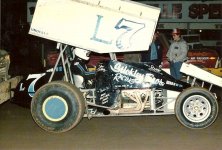
As one who did a lot of head-scratching trying to make late 70's-early 80's Sprint Cars safe, somewhat competitive and reasonably light in this millennium, I can appreciate your impeccable attention to detail.
It does look strange, however, to see a vintage-looking Super without an in-and-out box and tapered rear axle.
Keep posting whenever you can: It's certainly a very entertaining thread to those who've "been there-done that".
The old P.O.S. we started with back in 1986 wasn't much better that what you started with. Manual steering, in/out box, iron small block, 1500 lbs., used tires, steel wheels, but we were out there rather than sitting in the grandstands dreaming.

Bill
 

Attachments

  • L7 Lernerville 1986.jpg
    L7 Lernerville 1986.jpg
    98.5 KB · Views: 83
Last edited:

Bodj Built

Well-known member
Joined
Feb 3, 2016
Messages
1,165
Location
Moorpark, CA
Your work looks great! And YES. I've been following Matt Walrath's work for the past ten years. The guy is a metal genius.
 
OP
G

Graham08

Well-known member
Joined
Dec 10, 2007
Messages
713
Location
Iron Station, NC
That's some fine work there, Sir!
I hadn't seen this thread for so long that I nearly forgot about it.
As one who did a lot of head-scratching trying to make late 70's-early 80's Sprint Cars safe, somewhat competitive and reasonably light in this millennium, I can appreciate your impeccable attention to detail.
It does look strange, however, to see a vintage-looking Super without an in-and-out box and tapered rear axle.
Keep posting whenever you can: It's certainly a very entertaining thread to those who've "been there-done that".
The old P.O.S. we started with back in 1986 wasn't much better that what you started with. Manual steering, in/out box, iron small block, 1500 lbs., used tires, steel wheels, but we were out there rather than sitting in the grandstands dreaming.

Bill

Thank you! I like the pic from Lernerville. That is a super cool racetrack! When I lived in Ohio we were about a two hour ride from there, so I made the trek a few different times to see USAC, the Outlaws, or Super DIRT modifieds.

You're right about the in-out box and rear end. George still has the Halibrand rear that was last run in the car, but he wanted to run the newer Winters piece because he has a starter setup that bolts onto a Winters rear. You can't race the car that way, but it's much handier (and safer) than push starting the car on the street.

This thread is going to run a little longer than planned. I just got a box from George in the UPS that has the water pump, fuel pump, and power steering pump to get the front drive set up. I don't think they ever ran this combination of parts, so there will for sure be some head scratching involved.

Your work looks great! And YES. I've been following Matt Walrath's work for the past ten years. The guy is a metal genius.

Thanks! Yes, he is. I wish he would post more often on Instagram, I learn something every time.

Very nice work sir. Paul

Thank you!
 

dglennon

Member
Joined
Feb 22, 2009
Messages
13
Great thread and excellent work on the restore Graham! I'm definitely subscribed.

Reading through the posts and seeing names like Wolfgang, Haud, Doty is music to my ears. Doug is a great guy and ran a chassis fab business in Sioux Falls area until just recently. He was always good for a story or two whenever we would stop. His boy, Robby, raced some sprint cars for 8-10 years around Husets and Knoxville.

Keep up the good fab work and posting pictures. It is fun to see how it was done back in the day before all parts became store (catalog/internet) purchased!
 

Sierra977

Active member
Joined
Apr 19, 2020
Messages
31
If interested, you might enjoy a similar project by Tom and Davin from Barn Find Hunter resurrecting a 1937 Ford race car. Engine they use is a Chrysler poly from Petty Enterprises.

 
OP
G

Graham08

Well-known member
Joined
Dec 10, 2007
Messages
713
Location
Iron Station, NC
An update, with some work from a couple months ago...

The next thing on the list was an air box and filter setup to keep the newest 6 from swallowing as much dirt as the old one. K&N Filters has a nice website that allows you to search their filter designs by shape...which allowed me to find the element I'm using. The original application is a Porsche 944.

I started by adding some mounting flanges to the injector stacks. As some point in the past another filter setup had been brazed onto them, so there was leftover brass. I ended up using silicon bronze filler and very low heat to add the TIG braze the flanges on.


After some careful layout, I bent up the main body of the air box out of 0.063" aluminum sheet. I was able to incorporate the flange for the air filter as part of this by hemming the top edge back on itself.


Here it is mocked up on the stacks. I punched the holes for the injectors and everything before forming it, so it was a relief when it all worked out!


The next step was to form the ends on the slip roll, make some caps for the top, and weld it all together:


I'm using aircraft nut plates to hold the air box on the stacks. This prevents fiddling with loose nuts, and hopefully will prevent one from working loose and making its way into the engine. I've seen what a butterfly screw will do to a piston and valve and it's not pretty...


Things were a little tight on the roll cage so I had to make some clearance...


Done! Well...almost...nothing holding the filter in yet.


I added these clips out of 16 gauge steel to hold the filter in (top and bottom). There are more nut plates on the inside to secure them.


Next up is updating the oil pan to something that's a bit more efficient, and getting the pumps set up on the front of the engine.

:beer:
 

zmotorsports

ALLIANCE MEMBER
Joined
Oct 20, 2009
Messages
21,381
Location
Northern Utah
Awesome work as usual Graham.

I'm not familiar with the aircraft nut plates, do they rivet in like a Dzus receiver plate and then have the machine screw threads in the middle?
 
OP
G

Graham08

Well-known member
Joined
Dec 10, 2007
Messages
713
Location
Iron Station, NC
Awesome work as usual Graham.

I'm not familiar with the aircraft nut plates, do they rivet in like a Dzus receiver plate and then have the machine screw threads in the middle?

Thanks!

Yep, that's pretty much it. They're all metal and self locking. These are the standard configuration with a rivet on either side. There are some others like 90 degree (to fit into corners) and both rivets on one side for a tight spot. These are really cheap (like $0.20 or so a piece) from Aircraft Spruce. They also sell drill jigs that greatly speed up the process of installing them.

I use the #10 and 1/4" sizes quite a bit. There are several others available.
 

zmotorsports

ALLIANCE MEMBER
Joined
Oct 20, 2009
Messages
21,381
Location
Northern Utah
Thanks!

Yep, that's pretty much it. They're all metal and self locking. These are the standard configuration with a rivet on either side. There are some others like 90 degree (to fit into corners) and both rivets on one side for a tight spot. These are really cheap (like $0.20 or so a piece) from Aircraft Spruce. They also sell drill jigs that greatly speed up the process of installing them.

I use the #10 and 1/4" sizes quite a bit. There are several others available.

Awesome. Thanks Graham, I appreciate the information. I'll definitely have to get some of those for various projects.
 

Monza Harry

Well-known member
Joined
Dec 29, 2018
Messages
1,433
Location
Windsor ON
Thanx for the read Graham! My Dad had and raced [with a driver] an older Curtis Craft Midget [transvers spring front with parallel bar rear] with AMRA in 1979 and 1980 mostly [maybe a few in 1981...?], did well in 1980 5th in the points that year. Yes things have changed a little haven't they? We raced in Ohio, Michigan, Indian, and New York as well as two tracks here in Ontario [Canada]. The US exchange rate went from our favour to way not around that time so our racing adventure on a shoestring budget was mostly over! However we were invited to the Heroes vs The Outlaws race at the Pontiac Silverdome in 1983 with the car my Dad and the driver partnered in The Sidewinder Chevy, The Chevy II was laid over to the right and the drivetrain was shifted to the left, that was working ok until someone got crossed up and eliminated about 10 cars ours included. Thanx Again for including "Us" on your adventure, and keep up the beautiful work! Harry
I'll post up a pic of the sidewinder in a while/tomorrow. TransferringSidewinder Midget,R.jpg from my phone to the computer.
 
To avoid these ads, REGISTER NOW!
Top Bottom