A little more about the header build...
The nice part about working on an open wheel car is there isn't a lot to get in the way of the headers. This gives you a lot of leeway on the routing to get them equal length and looking good...they're exposed for the world to see!
The first pipe took the longest. I was shooting for a 36" primary length, with adequate clearance to the ground and the drag link. I'm also trying to give myself the best chance of getting all the pipes the same length.
I'm using a piece of rectangular tube clamped to the bottom of the car and a square from Certiflat to hold the collector in place. I'm trying to get everything on this pipe as plumb and level as I can because it affects the other two pipes that are joined together in this 6 into 2 setup. The nice part about the inline six is the firing order is such that the front three pipes and rear three pipes can be run into their own collectors, which makes the routing a lot simpler.
I ended up having this pipe tacked together twice...the first time I didn't set myself up very well for getting the next one the same length.
This is in the process of fitting the pipe on #6 cylinder. You can see one of my IC Engineworks tack welding clamps holding the pipes together. I have a couple sizes of these and they're a tremendous time saver when working by yourself.
Something that I've picked up on is that using different centerline radius bends in a set of headers greatly improves the appearance of them. All the tubes are 1-5/8" diameter, and the rear set is done with 2-1/2" and 4" centerline radius bends. I ended up getting a 6" centerline radius bend for the front set because I wasn't happy with how the smaller radius looked.
Here is the rear set finished up:
Lather, rinse, and repeat to build the front set:
Here you can see the big 6" radius bend on the bottom of the leading pipe.
Another view:
Something I started doing a few sets of headers ago was using silicon bronze filler to braze the outside joint between the pipes and the flange.
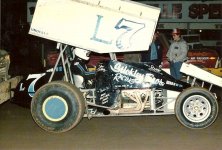
I had read about this in Ron Fournier's Metal Fabricator's Handbook. He recommended the braze joint to prevent cracking. It seems to work...we had a testing incident with my sprint car that resulted in the left header getting crunched. It bent the flange across the mounting bolts but the silicon bronze was intact.
I run the silicon bronze on AC with about 90% arc balance to DC...just barely a little AC arc to clean the puddle. It does a great job of making a nice, shiny joint and helps prevent overheating the parent metal and mixing it with the bronze.