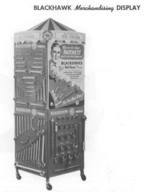
DaveWhat a stylish display. Totally typical of Blackhawk I have to say. I would absolutely love one as well, but I’d struggle to find the tools as the 7/16“ drive are very rare in the U.K.
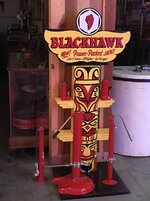
The ad refers to “new” Nuggets 7/16” drive, which suggests it dates to around 1938, or not long after. This might suggest a wooden display, but you never know with Blackhawk. The spinner handle shown looks like the one with the white resin handle, which was very innovative for the time, and Blackhawk were not afraid to spend decent money on displays - remember the “totem pole” one?
DuPont introduced all manner of plastics in the 1920’s (including cellulose acetate in 1927 - which would be my choice for making a display like that today) so it could easily have been one if these.
Monitoring the responses for any more info. With one good picture we could scale everything off the tools!

Sadly, I did not. I've been kicking myself in the *** over it ever since.Horse
I hope that you grabbed that display when you saw it!!!
I do now! Wow…!
Hi Dave. The ad is dated March 1939 on the top of the Automotive Digest page from which it was excerpted. Nuggets were introduced in early 1938, although they appear in print in late 1937 catalogs. The reference in the ad to them being "redesigned" confirms the page date. The first generation (1937-1938) Nuggets sockets were bulkier because they didn't have the last Lock-On patent (2,190,081), filed in 1938, issued in 1940, created exclusively for getting the push-button release into the smaller Nuggets. Blackhawk never made 3/8-drive Lock-On because of the same issue, which not even the patent (a sleeve insert) could overcome.The ad refers to “new” Nuggets 7/16” drive, which suggests it dates to around 1938, or not long after.
Nuggets were made from 1937 through 1941, and then again after the war through the 1950's. They were restricted by the WPB during WWII because they were considered redundant (and therefore steel wasteful) to 3/8- and 1/2-inch drive, ironically. (This has always interested me from the academic perspective. Theoretically, if Blackhawk had been truly successful in convincing industry that 7/16-inch drive could replace junior and standard drives, the "50% savings" principle that Blackhawk extolled in their marketing would have saved that much in steel as well as costs in hand tools during WWII.) They seem to have been popular, but I don't think anyone has attempted to quantify that. It is a fait accompli that it did not endure.If that round display was from 1938 (or maybe 39) they might not have made many before having to concentrate on ”lend - lease” orders or even U.S. war orders, which might explain why there are not many around?
Ahh, we were about right on the dates then. Looks like war orders could definitely account for so few of those displays being produced!Hi Dave. The ad is dated March 1939 on the top of the Automotive Digest page from which it was excerpted. Nuggets were introduced in early 1938, although they appear in print in late 1937 catalogs. The reference in the ad to them being "redesigned" confirms the page date. The first generation (1937-1938) Nuggets sockets were bulkier because they didn't have the last Lock-On patent (2,190,081), filed in 1938, issued in 1940, created exclusively for getting the push-button release into the smaller Nuggets. Blackhawk never made 3/8-drive Lock-On because of the same issue, which not even the patent (a sleeve insert) could overcome.
I have heard of the WPB restrictions. I seem to remember hearing that only one length of breaker bar was deemed essential, so only one was produced.Nuggets were made from 1937 through 1941, and then again after the war through the 1950's. They were restricted by the WPB during WWII because they were considered redundant (and therefore steel wasteful) to 3/8- and 1/2-inch drive, ironically. (This has always interested me from the academic perspective. Theoretically, if Blackhawk had been truly successful in convincing industry that 7/16-inch drive could replace junior and standard drives, the "50% savings" principle that Blackhawk extolled in their marketing would have saved that much in steel as well as costs in hand tools during WWII.) They seem to have been popular, but I don't think anyone has attempted to quantify that. It is a fait accompli that it did not endure.
As for the round store display, I don't think any have ever been seen in the real world, only on that page. But I'm struggling to picture any other Nuggets displays, in any shape or form, either.
In all my reading on WPB Limitation Orders I have never seen anything about restrictions on hardware store display materials, Dave, and I have never noticed a particular shortage in wartime era hardware store displays of other OEMs, or even of other Blackhawk displays, which continued to also be featured in catalogs. While WPB Limitation Order L-190 had some effects on commercial production, that wasn't even established until 1943, and it was much less than people realize. Longer or shorter handles on the same size drive tool. 'Tweener socket sizes that overlapped drive sizes. Etc. They were mainly trying to eliminate redundancy. Even the vaunted 'steel drives' - rounding up old unused tools were voluntary and came late in the war, ironically, just before we started to realize we were probably going to win. I'm not trying to dissuade you from your conclusions on this. While this round Nuggets display is clearly something that hasn't popped up like other displays, and that may be because they just didn't make too many of them in 1939-ish, I don't think the eventual war or our meager pre-war efforts had anything to do with it.Looks like war orders could definitely account for so few of those displays being produced!
I wasn’t thinking so much of legal restrictions, but rather the practicalities! If you have one customer (the United Kingdom) that will take everything you can make from 1939 onwards, what priority do you attach to having advertising materials made? Obviously they continued to advertise to a fair degree, which says much for their capabilities, but maybe this particular display was a bit of a speciality even then?In all my reading on WPB Limitation Orders I have never seen anything about restrictions on hardware store display materials, Dave, and I have never noticed a particular shortage in wartime era hardware store displays of other OEMs, or even of other Blackhawk displays, which continued to also be featured in catalogs. While WPB Limitation Order L-190 had some effects on commercial production, that wasn't even established until 1943, and it was much less than people realize. Longer or shorter handles on the same size drive tool. 'Tweener socket sizes that overlapped drive sizes. Etc. They were mainly trying to eliminate redundancy. Even the vaunted 'steel drives' - rounding up old unused tools were voluntary and came late in the war, ironically, just before we started to realize we were probably going to win. I'm not trying to dissuade you from your conclusions on this. While this round Nuggets display is clearly something that hasn't popped up like other displays, and that may be because they just didn't make too many of them in 1939-ish, I don't think the eventual war or our meager pre-war efforts had anything to do with it.
Indeed they were!They were selling commercial sets in the UK, I have colleagues over there who have them. Including sets only available in the UK, called "OK" sets, that had economy line finishes. And they had early 1940 contracts with Treasury, which administered Lend-Lease. But we're talking about the hardware store Nuggets display itself. They would've had those made for their distributors. I don't see how anything happening in 1939 would've limited their orders of those displays.