My stuff knows when I’m in a weakened state. Two car batteries die. TV system takes a dump. Kitchen microwave dies. Sprinkler system pops a fitting. Pool filter motor overheats and dies. Fence gate latch breaks and hinge pops its pin.
Parts for a 33 year old pool pump are getting harder to find and places that claim to have them wait a few days to tell you they don’t actually have the part you want. Eventually, when the motor burns itself out the cost to repair the old pump gets close to the cost of a new one. If my problem can be fixed with money, it isn’t a real problem (it's $650). Manufacturers like to tweak the design of their products and backward compatibility isn't on the top of the list. With a few days to go before my lifting limit goes above 8lbs, I have the guys at the pool store load 10 gallons of liquid chlorine and two pool pumps (I brought the old one to give them something to measure). Without lifting anything, I slid each 2.5 gallon chlorine bucket out of the Cruiser's cargo area into a wagon of the same height. Lifted one end of the new pump's box and slid the box gently to the hand truck and into the garage for unpacking and disassembly. There's no way I can screw on the new strainer assembly with the 1hp motor attached so it has to come apart.
The scene of the action is ready to receive the new pump but I know in advance that the new pump is lower than the one it replaces. Bring on the concrete and Travertine pavers.

The new pump comes with two unions that thread onto the male threads on the inlet and outlet. The inside of the inlet and outlet are also threaded to accept 1.5 inch pipe thread. I could cut off the threaded portion of the inlet pipe from the pool but that makes the pump outlet several inches out of alignment with the existing PVC.

Both inlet and outlet connections are about 1.5 inches too low to make the connection as well. First attempt to raise the pump with a concrete paver is better but still too low.
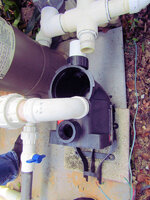
Adding a Travertine paver to the concrete one overshoots and is too high. Third try, with two Travertine pavers stacked is too low but not by a whole lot. Looks like I can stack two, gluing each one down and using a piece of pressure treated fence board as the final shim is just about perfect. Before I do any gluing, I need to remove the union and try to screw the strainer basket housing directly to the 1.5 inch stub from the pool. I luck out and it clears everything, not by a lot but it clears. I can paint some PVC-friendly pipe joint compound on the stub and make the connection.

Once the inlet pipe connection is as tight as I can make it, the outlet connection actually lines up almost perfectly. More pipe joint compound and a few turns on the union and the outlet is connected.

Three wires run through the waterproof conduit and a dedicated ground to the motor case and I have power connected (well, as soon as I turn the breaker on).

I was feeling pretty confident and put the plastic cover on the electrical end of the motor and filled the strainer basket with water. With the cover tightened down I flipped the breaker on, came back out to the power switch and timer and powered the new system up. The pump is still sucking air so I start feeling around for a loose fitting. There are two black knobs on the Jandy valves and one of them fell off in my hand when I gave it a tiny turn. They are meant to squeeze silicone grease into the valve so it moves freely. As soon as the one fell off, the strainer basket filled with air and the pump cavitated. The part that screws into the valve is a very fine PVC thread and I don't have a spare valve or grease injector. It is going to take 3 or 4 days to get here and the pool is looking a little swampy so I scrounged through my vast collection of oddball bolts and found one with the same fine threads and used it to plug the hole.

Turned the pump back on and within 30 seconds the strainer basket (with clear top) has perfectly clear, bubble-free water swirling in it.

That stupid grease injector is almost $30 but I don't really want to go without it. Those valves are not easy to turn and without any grease will become impossible.