To avoid these ads, REGISTER NOW!

220V to 110V adapter cord?

MacMcMacmac

Well-known member
Joined
Oct 21, 2014
Messages
1,591
Location
canada
Is there any safe and legal method for getting 110v service from a 3 prong 220v plug? I have several in a convenient location to power tools. I was thinking an adapter cable might exist, but it seems the only way to make it work would be running the 110v neutral to the 220v ground, which doesn't seem acceptable.
 
To avoid these ads, REGISTER NOW!

SlappyWhite

Well-known member
Joined
Oct 3, 2012
Messages
1,819
Location
Upper Canada
Assuming two hots and a ground in the outlets (black, red and ground wires), no neutral. If so there is no safe way to get 120v via a plug or adapter. Technically there will be 120v between each hot and the ground but that is not "safe".

What were these outlets originally for?
What are they used for today?
Some sort of plug in heating?
What current (fuse/breaker)?
What gauge wire?
Is this old K&T or more modern?

If you do not need the 240v circuit at all and these are 15 or 20 amps circuits (14 or 12 gauge wiring). You can possibly change the connections at the panel by moving the red wire from the fuse/breaker to the neutral bus (it really depends on some of the questions above). I would wrap the entire red wire inside the panel with white electrical tape to denote it is neutral to the next guy. Replace all the receptacles with 120v and again in each box wrap the red wire with white tape....
 

ptgarcia

Well-known member
Joined
Nov 15, 2016
Messages
1,202
Location
Alta Loma, CA
I'm not an electrical guy, but I asked this same question a few years back. I have an unused 240v 3-prong outlet in my garage that was intended for an electric clothes dryer. I was told to make it a 20-amp 120v outlet would require moving (1) hot leg to the neutral bus, being certain to mark that wire neutral at both the outlet and load center.
 
OP
M

MacMcMacmac

Well-known member
Joined
Oct 21, 2014
Messages
1,591
Location
canada
These are 20A, 240V Hubbell Twist Lock 3 prong outlets which were installed a few years ago to power pressure washers for a contractor that comes in during our annual shut down to clean out our cooling tower. The 220V washers are far quieter to use, require no fuel storage, and produce no poisonous fumes which might migrate into the sump when they are working down there. The cacophony of the old gas units was a real PITA for the week they were here. I guess I'll stick with the extension cords.
 

Terry D

Well-known member
Joined
Mar 25, 2015
Messages
2,202
Location
St. Louis, MO.
If your wanting to get 120 volt from them temporary, but still have the capability of plugging your 240 volt pressure washer in it, there is no right or safe way to do it with adaptors. You might be able to convert one to 120 volt depending on what wiring they used. If it is a cable with a black, white and green, Simply change the 240 volt twist lock to a 120 duplex and remove the 2-pole breaker and install a single pole, move the white wire to the neutral buss. The ground shouldn't have to be moved
 
Last edited:

wyliesdiesels

Well-known member
Joined
Aug 14, 2012
Messages
20,067
Location
Modesto, CA
Is there any safe and legal method for getting 110v service from a 3 prong 220v plug? I have several in a convenient location to power tools. I was thinking an adapter cable might exist, but it seems the only way to make it work would be running the 110v neutral to the 220v ground, which doesn't seem acceptable.

first off its 120/240 in the US

and the answer is no. you would need a 4-wire 240v receptacle to be able to derive 120v from it.

there is no adapter that will add a wire that is not there....

you need 1 hot, 1 neutral and 1 ground. you only have 2 of those in a 240v 3-wire receptacle...

run a separate circuit...
 

Norcal

Well-known member
Joined
Mar 16, 2008
Messages
13,769
Want a 120V from a 240V source? There are only two choices that would be code compliant, either add a neutral or run a new circuit, or use a transformer to get 120V from 240V. 3rd option is get a UK “site transformer” to step down 240V to 110V each leg is 55V but they are 50 HZ and NA is 60 HZ.
 

theoldwizard1

Well-known member
Joined
Feb 22, 2011
Messages
43,238
Location
SE MI
first off its 120/240 in the US

and the answer is no. you would need a 4-wire 240v receptacle to be able to derive 120v from it.

there is no adapter that will add a wire that is not there....
I am NOT dis-agreeing ... I find it interesting that up until the 80s (?), it was common for electric dryer to have a 3 prong cord and a 120V timer and light bulb. Same with electric stoves. 120V light bulbs, timers and convience outlets.

I have read the discussion and watched several video about this and I still don't understand it well enough that I could explain it to another person.
 

Norcal

Well-known member
Joined
Mar 16, 2008
Messages
13,769
I am NOT dis-agreeing ... I find it interesting that up until the 80s (?), it was common for electric dryer to have a 3 prong cord and a 120V timer and light bulb. Same with electric stoves. 120V light bulbs, timers and convience outlets.

I have read the discussion and watched several video about this and I still don't understand it well enough that I could explain it to another person.
Up until the adoption of the 1996 NEC it was permitted to ground the frame of clothes dryers, & cooking equipment, to the neutral of that equipment, it is still permitted in existing installations, thankfully that went away, but should have happened 40 years prior.
 

theoldwizard1

Well-known member
Joined
Feb 22, 2011
Messages
43,238
Location
SE MI
Up until the adoption of the 1996 NEC it was permitted to ground the frame of clothes dryers, & cooking equipment, to the neutral of that equipment, it is still permitted in existing installations, ...
Good luck with that ! Old dryer, new outlet ... New cord !
 
To avoid these ads, REGISTER NOW!

Lassen Forge

Well-known member
Joined
Apr 26, 2014
Messages
15,374
Location
The romantic hills of central Umbria, Italy,
Some 220 equipment was designed with 110 components (think timers and lights on dryers, etc.) where they internally pulled one leg off the 234 circuit and supplied 117... we had a GE with a 120 timer on it where it was plugged into 240 (had to replace it), this was back in the 1970's and if you miswired it it would throw 230 into that 115 timer and let all the smoke out of the wiring... Don't ask how I know, but it was pretty, um, interesting...
 

Norcal

Well-known member
Joined
Mar 16, 2008
Messages
13,769
Some 220 equipment was designed with 110 components (think timers and lights on dryers, etc.) where they internally pulled one leg off the 234 circuit and supplied 117... we had a GE with a 120 timer on it where it was plugged into 240 (had to replace it), this was back in the 1970's and if you miswired it it would throw 230 into that 115 timer and let all the smoke out of the wiring... Don't ask how I know, but it was pretty, um, interesting...
Most common way to screw things up is when someone brings the high leg off a 240V 3 phase service, which on a straight 240V load is fine, but a appliance where a neutral is required it will cause nothing but grief since the high leg is a nominal 208V, sending 120V into the neutral will cause similar problems, there used to be a lot of people asking how to use American dryers in the 50 HZ world where 220/230/240 volts (depending on the country) is a line to neutral voltage & the only way it could be run is with a transformer, by center tapping it to get 120/240V which makes the low price paid for the dryer evaporate real quick & still does not take care of the frequency issues. Things are easy to screw up everywhere.
 

Lassen Forge

Well-known member
Joined
Apr 26, 2014
Messages
15,374
Location
The romantic hills of central Umbria, Italy,
...there used to be a lot of people asking how to use American dryers in the 50 HZ world where 220/230/240 volts (depending on the country) is a line to neutral voltage & the only way it could be run is with a transformer, by center tapping it to get 120/240V which makes the low price paid for the dryer evaporate real quick & still does not take care of the frequency issues. Things are easy to screw up everywhere.

The one thing people don't realize is that "their" 240 is NOT the same as "our" 240... there are some (few & rare) companies that will sell conversion kits for some appliances (the one that I can think of off hand is a commercial Kitchenaid Mixer) but it involves both a motor AND circuit board transplant... at about 2/3 the cost of the appliance. Equally difficult is taking something like a teakettle from the UK (which compared to ours here are night and day) and thinking they'll pull 240 from their stove and install a socket... because "it's just a heating element" until that 60hz hits their 50hz electronics and oops...
 

wyliesdiesels

Well-known member
Joined
Aug 14, 2012
Messages
20,067
Location
Modesto, CA
I am NOT dis-agreeing ... I find it interesting that up until the 80s (?), it was common for electric dryer to have a 3 prong cord and a 120V timer and light bulb. Same with electric stoves. 120V light bulbs, timers and convience outlets.

I have read the discussion and watched several video about this and I still don't understand it well enough that I could explain it to another person.
its pretty simple actually. the appliance frame was grounded through the neutral. there was no ground wire. which can be potentially dangerous....
 

u3b3rg33k

Well-known member
Joined
Dec 18, 2017
Messages
4,048
its pretty simple actually. the appliance frame was grounded through the neutral. there was no ground wire. which can be potentially dangerous....
you can feel the capacitance when you run your hand along the paint while it's running, too. can feel this on a lot of old things, actually.

NEMA 10-30, good riddance.
 

bugnut

ALLIANCE MEMBER
Joined
Jul 14, 2012
Messages
3,979
Location
Central Ohio
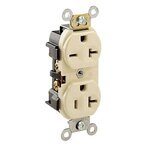
I'll just leave this here. I have a couple of these in my outbuilding only rated for 20amp.
Leviton, model number 5844
 

Attachments

  • leviton.jpg
    leviton.jpg
    9.3 KB · Views: 6

Norcal

Well-known member
Joined
Mar 16, 2008
Messages
13,769
I'll just leave this here. I have a couple of these in my outbuilding only rated for 20amp.
Leviton, model number 5844
GFCI protection is required, and 2 pole GCFI circuit breakers are not cheap, The 2020 NEC as it is adopted more & more will make the use of 2 pole GFCI's more common, though.
 

wyliesdiesels

Well-known member
Joined
Aug 14, 2012
Messages
20,067
Location
Modesto, CA
I'll just leave this here. I have a couple of these in my outbuilding only rated for 20amp.
Leviton, model number 5844
Not sure what the point was in leaving this here. Did you wire it with a 4-wire circuit? If not, then you wired it incorrectly.
 
To avoid these ads, REGISTER NOW!
Top Bottom