To avoid these ads, REGISTER NOW!

soow vs. romex (240v outlet)

jengland

Member
Joined
Jul 30, 2018
Messages
14
Location
Side of the house
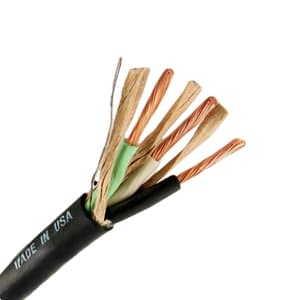
i'm installing a 240v receptacle in the garage. i made the mistake of using #6 gauge soow cable and a friend pointed out that i needed to use #6 gauge romex wiring. i had thought that "wiring is wiring...as long as it's the same gauge." i'm in the process of replacing the soow wiring with romex. i'm assuming that the objection to soow wiring is fire hazard? if that is the case, two questions: 1) why would soow wiring represent a greater fire hazard? is it something to do with individual strands of wiring as opposed to the one solid romex wire? 2) has anyone had experiences with soow wiring (assuming the correct gauge is being used) actually causing a fire?

the intended use is running a welding machine (which draws 34 amps) through the circuit, using #6 gauge wiring with a 50 amp circuit breaker.

and if i used soow wiring to make a 240v extension cord, is there a fire hazard with that?

thanks you for your time, everyone.
240 OUTLET.jpg
 
To avoid these ads, REGISTER NOW!

American Locomotive

Well-known member
Joined
Jan 8, 2017
Messages
11,153
Location
Rhode Island
The main concern is that SO cord could become more easily damaged than NM-B (Romex) or conduit because of the soft rubber. Granted, SO cord can be extremely tough, but no SO cord manufacturer wants to go through the hassle of testing and certifying SO cord to be used as branch circuit cabling.
 

HamAndEggs

Well-known member
Joined
Nov 16, 2020
Messages
932
Location
Houston, TX
SOOW Wire is about a zillion times stronger than Romex

Its not to code, but I see literally no reason this wouldn't be anything but an improvement on Romex

If you look at the specs for SOOW, all the manufacturers I have seen actually rate it higher then the usual standards we see. For example 12AWG SOOW is rated for 25a, not 20a that 12/2 Romex is


HamAndEggs

Well-known member
Joined
Nov 16, 2020
Messages
932
Location
Houston, TX
The main concern is that SO cord could become more easily damaged than NM-B (Romex) or conduit because of the soft rubber

Have you ever used SO Cord, and Romex? The jacket on Romex can get damaged just pulling it through a hole in a stud

SO is used all day, every day, outside on the floor and is fine. SO is tough.
 

pattenp

Well-known member
Joined
Jun 4, 2008
Messages
10,175
Location
Virginia - USA
SOOW cord is manufactured for portable flexible use and is not listed to be used as permanent building wire, so all the "I believe or I think" comments about SO cord being better than NM-b doesn't amount to a hill of beans. NM-b is listed for permanent building wire use. SO cord is tough because of its intended use of being flexed repeatedly. Bottom line, use the correct wire approved by the NEC.
 

Walkers

Well-known member
Joined
May 17, 2021
Messages
3,912
Location
Cave Creek Az
Well lets look at it analytically. SOOW is good for the same temp, is good in harsher environments, is good for twice the voltage of Romex, is good for use in unprotected space. I wouldn't be too worried over it. YMMV.
 

wyliesdiesels

Well-known member
Joined
Aug 14, 2012
Messages
20,252
Location
Modesto, CA
If the SO cord is ran inside the wall then it needs to be removed and swapped with either NM-B or THWN in pipe.

SO cord is not permitted for you inside the wall.

The problem with SO cord is the really fine strand conductors. When you terminate them under a breaker lug, you will not get good contact as they splay out.

For 50a u need #6 nm-b or #8 THWN. However if this is only going to be used for a welder then you can use smaller wire
 

wyliesdiesels

Well-known member
Joined
Aug 14, 2012
Messages
20,252
Location
Modesto, CA
Well lets look at it analytically. SOOW is good for the same temp, is good in harsher environments, is good for twice the voltage of Romex, is good for use in unprotected space. I wouldn't be too worried over it. YMMV.
What voltage are you referring to? NM – B is rated for 600V
 
Last edited:

SlappyWhite

Well-known member
Joined
Oct 3, 2012
Messages
1,819
Location
Upper Canada
There is the right way and not the right way.... personally I would go with the correct wire/cable. Even if SOOW meets all the electrical considerations on a spec sheet it is not right or rated for the application. Also when you sell a home inspector will see it and flag your electrical as suspect/hack.... Heaven forbid if it does cause a fire, what do you think your insurance company will say? The wire is not suited to make a good connection under the breaker lugs, likely just come loose over time, another hazard. Fire migration... Just do it right, not that expensive.

As an example, Romex is also FT1 rated, I do not see any FT rating on SOOW.... it is about more than gauge, voltage rating, etc.

In other news, I can buy garden hose rated at a much higher PSI than my regualtor, it is also really flexible and tough, I am going to use it for my airline...fed from PVC. /s
 
Last edited:

Walkers

Well-known member
Joined
May 17, 2021
Messages
3,912
Location
Cave Creek Az
What voltage are you referring to? NM – B is rated for 600 V
This was the spec I found for Romex. It was on the internet, so, ya know, it gotta be true and accurate.

"The minimum recommended installation temperature is -25°C for two-conductor cables and -10°C for three-conductor cables (with suitable handling procedures). Material should be properly stored above 0°C for 24 hours prior to installation. The maximum voltage rating for all intended applications is 300 volts."
 

Terry D

Well-known member
Joined
Mar 25, 2015
Messages
2,202
Location
St. Louis, MO.
Rubber cord can become brittle over time. If its inside of walls, you would never know and it could become a problem. I understand that the rubbers these days are much better than when this code article was first witten, but that does not matter. It is a violation of the NEC to install it as building wiring
 

Showkey

"MEMBER EMERITUS"
Joined
Aug 9, 2014
Messages
8,638
Location
Wausau WI
This is comical…….. SOOW is basically heavy duty extension cord, the most novice “home inspector” ( at time of sale) will see it and write it up as a fail when used as permanent wiring.

Many use SOOW when they want to temporarily run the welder outside.
 

rlitman

Well-known member
Joined
Oct 18, 2010
Messages
24,772
Location
Long Island
SO cable is not rated to be run in
... For example 12AWG SOOW is rated for 25a, not 20a that 12/2 Romex is[/URL]
The current rating has everything to do with the usage, and nothing to do with SOOW being special. In your example, the manufacturer can make the assumption that SOOW is unrolled and exposed to the air on all sides, whereas the Romex is assumed to be buried in a layer of insulation.
 

FMB4

Well-known member
Joined
Jan 19, 2017
Messages
2,926
Again, use Romex. Soow would be a huge liability if anything ever went wrong with that circuit.
 
To avoid these ads, REGISTER NOW!
OP
J

jengland

Member
Joined
Jul 30, 2018
Messages
14
Location
Side of the house
The NEC does not allow flexible cord to be used in place of permenent wiring, NM cable "Romex®" or other wiring method must be used, the breaker also needs to be replaced with a 2 pole model.
it's a 2-pole breaker. i had to order the bridge for it, though.
 
OP
J

jengland

Member
Joined
Jul 30, 2018
Messages
14
Location
Side of the house
If the SO cord is ran inside the wall then it needs to be removed and swapped with either NM-B or THWN in pipe.

SO cord is not permitted for you inside the wall.

The problem with SO cord is the really fine strand conductors. When you terminate them under a breaker lug, you will not get good contact as they splay out.

For 50a u need #6 nm-b or #8 THWN. However if this is only going to be used for a welder then you can use smaller wire
"you will not get good contact as they splay out..." - i did notice this when i was making the connections. interesting point. thank you.
 
OP
J

jengland

Member
Joined
Jul 30, 2018
Messages
14
Location
Side of the house
There is the right way and not the right way.... personally I would go with the correct wire/cable. Even if SOOW meets all the electrical considerations on a spec sheet it is not right or rated for the application. Also when you sell a home inspector will see it and flag your electrical as suspect/hack.... Heaven forbid if it does cause a fire, what do you think your insurance company will say? The wire is not suited to make a good connection under the breaker lugs, likely just come loose over time, another hazard. Fire migration... Just do it right, not that expensive.

As an example, Romex is also FT1 rated, I do not see any FT rating on SOOW.... it is about more than gauge, voltage rating, etc.

In other news, I can buy garden hose rated at a much higher PSI than my regualtor, it is also really flexible and tough, I am going to use it for my airline...fed from PVC. /s
"The wire is not suited to make a good connection under the breaker lugs, likely just come loose over time, another hazard."

I did notice that the connection to the breaker lug was not very clean. Thank you for your observations!
 
OP
J

jengland

Member
Joined
Jul 30, 2018
Messages
14
Location
Side of the house
Rubber cord can become brittle over time. If its inside of walls, you would never know and it could become a problem. I understand that the rubbers these days are much better than when this code article was first witten, but that does not matter. It is a violation of the NEC to install it as building wiring
"Rubber cord can become brittle over time. If its inside of walls, you would never know and it could become a problem."

This is a good point. Thank you for your insights!
 
OP
J

jengland

Member
Joined
Jul 30, 2018
Messages
14
Location
Side of the house
This is comical…….. SOOW is basically heavy duty extension cord, the most novice “home inspector” ( at time of sale) will see it and write it up as a fail when used as permanent wiring.

Many use SOOW when they want to temporarily run the welder outside.
I did use the extra SOOW wiring I had left over to make a 240v extension cord.

EXTENSION CORD.jpg
 

Walkers

Well-known member
Joined
May 17, 2021
Messages
3,912
Location
Cave Creek Az
If you are interested, I have a large piece of SO in use in a working environment since 1984. The outer jacket started splitting in the last few years. This is on the floor in a welding shop
 

Cruzan80

Well-known member
Joined
Jul 22, 2015
Messages
4,486
Location
Denver, CO
If the SO cord is ran inside the wall then it needs to be removed and swapped with either NM-B or THWN in pipe.

SO cord is not permitted for you inside the wall.

The problem with SO cord is the really fine strand conductors. When you terminate them under a breaker lug, you will not get good contact as they splay out.

For 50a u need #6 nm-b or #8 THWN. However if this is only going to be used for a welder then you can use smaller wire
So just as a devil's advocate kind of point...
My sub panel is in my garage, with unfinished walls. Could I then run SOOW to an outlet or direct-wire a tool since it will be visible and exposed the whole time? Or not due to poor breaker connections?

The reason I am asking is back a few months ago, Lowes had SOOW cheaper by the foot than NM/B. Was considering it, but ended up finding a deal on NM somewhere else.
 

Terry D

Well-known member
Joined
Mar 25, 2015
Messages
2,202
Location
St. Louis, MO.
So just as a devil's advocate kind of point...
My sub panel is in my garage, with unfinished walls. Could I then run SOOW to an outlet or direct-wire a tool since it will be visible and exposed the whole time? Or not due to poor breaker connections?

The reason I am asking is back a few months ago, Lowes had SOOW cheaper by the foot than NM/B. Was considering it, but ended up finding a deal on NM somewhere else.
Seriously, have you not been reading the posts. Rubber cord can not be installed as building wiring. It is for connecting utilization equipment to building wring via a plug. It can only be hardwired on one end. Examples a dishwasher or disposal. Also for extension cords
 
Last edited:

u2slow

Well-known member
Joined
Nov 20, 2011
Messages
3,642
Location
BC
I have witnessed sow/soow being used for legit hardwired receptacles on ceiling drops (with grips). Also for hardwiring freestanding or semi-portable equipment.

Just don't bury/fasten it inside a wall.
 

Cruzan80

Well-known member
Joined
Jul 22, 2015
Messages
4,486
Location
Denver, CO
@ TerryD, I was following along. And the main point being made above for the rubber not being used is that it is behind walls and subject to deterioration and not easy visual inspection. Try re-reading my question before attacking.

My point is asking when a power cord becomes building wiring. Or is direct-wiring a power tool in full view the entire time, to the subpanel, building wiring? The wiring in question was going to go to a 5hp RAS (Rockwell 16/18"), via exposed studs and joists.

Or if I need to achor it to something is when it becomes "building wiring", and if it is just draped across the floor, it is ok?

Not trying to play semantics, actually curious about how it is determined.


Btw, as U2Slow says, I work in a school, and we have drops from the ceiling to outlet boxes, ran with SOOW. Twist locks in the ceiling, regular duplex plastic boxes hanging.
 
Last edited:

Terry D

Well-known member
Joined
Mar 25, 2015
Messages
2,202
Location
St. Louis, MO.
I have witnessed sow/soow being used for legit hardwired receptacles on ceiling drops (with grips). Also for hardwiring freestanding or semi-portable equipment.

Just don't bury/fasten it inside a wall.
And also that. Only hardwired on one end
 
Last edited:

nadogail

Well-known member
Joined
Jan 23, 2009
Messages
32,319
Location
Coronado, CA
The real "take away" is that SO, SJO & SOOW are not "Approved for the purpose".

You may see them used as "Drops" from ceiling boxes; but be assured that those ceiling boxes are fed by a wiring system composed of materials approved for the purpose they are intended; the Drop Cables are suspended with Strain Reliefs.
 
OP
J

jengland

Member
Joined
Jul 30, 2018
Messages
14
Location
Side of the house
thank you everyone for taking the time to post your thoughts on the subject. i am more educated about the types of electrical wiring available. i ordered #6 gauge romex and will replace the soow cord i had used initially. much appreciation and please have a good day, everyone!

p.s. i understand that white pvc pipe is not supposed to be used for conduit but i had some extra and didn't want to buy MORE stuff that i did not need. if we ever move from this house i plan on taking down the 240v outlet and wiring, therefore it won't be an inspection problem.
240V PROJECT.jpg
 

Bad Habit

Well-known member
Joined
Mar 19, 2014
Messages
2,089
Location
Chumstick WA
Actually a little impressed you got that cord through the 90. You could have just put the receptacle next to the panel and used all that as an extension cord.
 

Terry D

Well-known member
Joined
Mar 25, 2015
Messages
2,202
Location
St. Louis, MO.
@ TerryD, I was following along. And the main point being made above for the rubber not being used is that it is behind walls and subject to deterioration and not easy visual inspection. Try re-reading my question before attacking.

My point is asking when a power cord becomes building wiring. Or is direct-wiring a power tool in full view the entire time, to the subpanel, building wiring? The wiring in question was going to go to a 5hp RAS (Rockwell 16/18"), via exposed studs and joists.

Or if I need to achor it to something is when it becomes "building wiring", and if it is just draped across the floor, it is ok?

Not trying to play semantics, actually curious about how it is determined.


Btw, as U2Slow says, I work in a school, and we have drops from the ceiling to outlet boxes, ran with SOOW. Twist locks in the ceiling, regular duplex plastic boxes hanging.
Sorry if I came off like i was attacking you. You can not hardwire that saw on both ends of a flexible cord, since that saw is considered a mobile or portable piece of equipment. It must have a plug on one end. There are some cases where a cord can be hardwired on both ends, one being a permanently installed luminaire. Some outside commercial light fixtures that are adjustable will have a cord whip coming out of it, it is ok to hardwire it into a j-box. The reason is that light is permanently install, if it was portable, it would have to have a plug. But that whip is not building wiring, it is where the utilization equipment is attached to building wiring. The wiring up to that j-box, must be approved for building wiring

Cords can never be a substitute of fixed wiring of a structure. It can not run through holes in walls and ceilings. It is not allowed above a drop ceiling and it can not be attached to a building surface. It doesn't mater if it is visible or concealed.

I also have installed cord drops from a ceiling in a commercial kitchen. None of the cord can be above the ceiling.

As far as hardwiring a cord into a panel, I can not come up with a code article off the top of my head, but I would say defiantly no.
 
Last edited:

Cruzan80

Well-known member
Joined
Jul 22, 2015
Messages
4,486
Location
Denver, CO
Thanks Terry. Sorry if I read it wrong. Given that this thing is a beast (5hp, 1ph, over 800lbs), would it officially need a plug rated for 5hp, since I can't direct wire to a J-box? Same for the 1k# 12/14 cabinet saw next to it?

Wondering what the definition of "portable" is, as both of these weigh more than the big-box store comrpessors people always suggest direct wiring in. These are not little 10" Emerson saws...

Again, this is a home, personal shop that only I am in, but curious what "official" code says about these behemoths.
 
To avoid these ads, REGISTER NOW!
Top Bottom