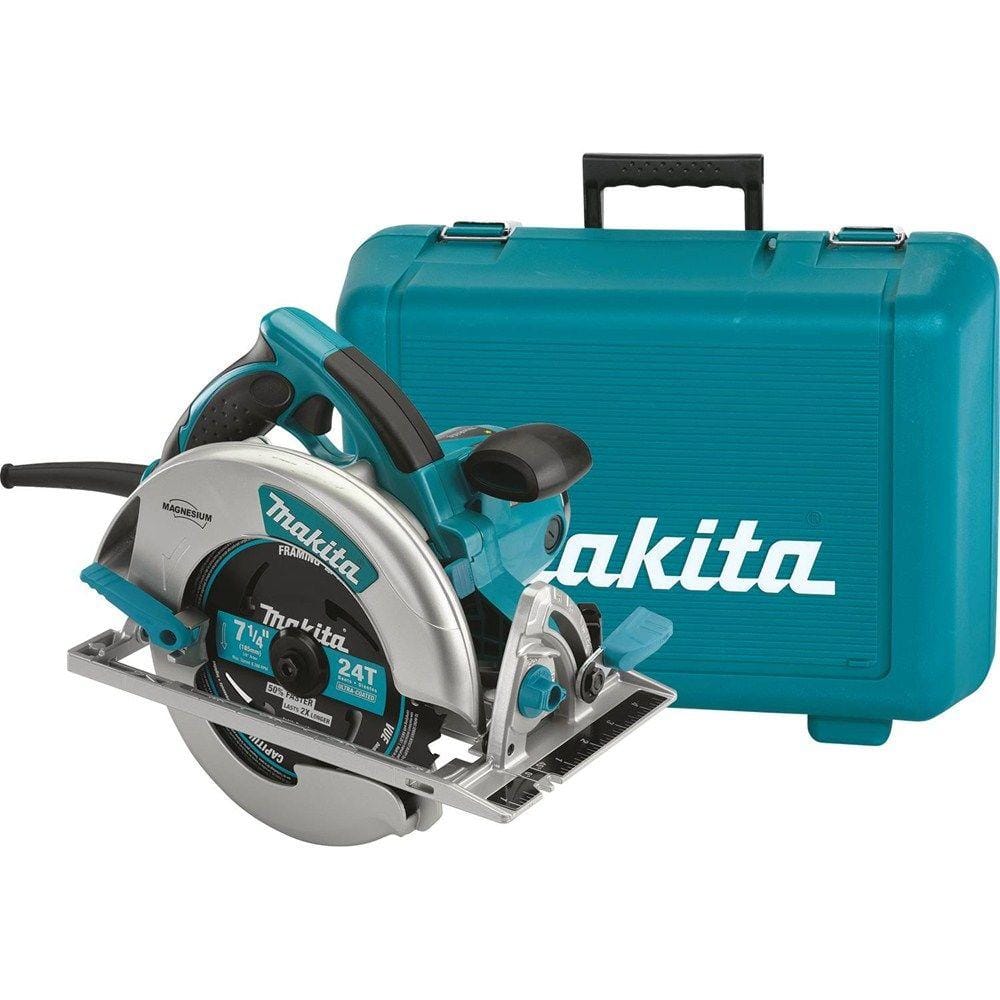
I'm left-handed, so I prefer a sidwainder. In my left hand, the blade of the sidewinder is on the right side of the saw, it's easy for me to see the cut line. There's no doubt that when cutting downhill, the weight of a 77 can help the saw guide itself along the cut line. I've used both. For production framing or roof cutting, I'd take the 77. For basic daily DIY, I'd take a sidewinder.
Way back in the day when I built my house, I was recently out of the military. With numerous household military moves, for power tools all I owned was a cheap-*** circular saw and a power drill. That got me started. But they sucked. After a few days I bought a good quality sidewinder, and a few days later after I figured out a work flow, I bought a Dewalt chop saw. The chop saw was my cutting station. The corded circ saw got dragged around as needed. You do what you do with what you have, and you make it work.
I didn't own air tools back then so I hand nailed. Fairly large house, 4200sqft. Burned out the crappy drill on literally the LAST hole for the central vac tubing. Bought a Milwaukee drill as a replacement. Still have that MKE drill to this day.
Do you need a lot of tools to frame? Heck no. But the tools you have, you won't want them to slow you down. You want them to cut efficiently. You want a saw that will run. Blades that will cut. Dull blades burn wood, put undue stress on the saw's motor, and because you force the cut, they open up the door for an accidental injury. On a remote site you want your tools to last and you don't want to spill blood. A broken tool on a remote building site can wreck your productivity. And maybe the next day's productivity as well.
Fast forward many years...
Maybe 5 years ago I bought a Dewalt brushless drill and impact driver set. Small batteries, maybe 2aH. But man oh man, what a revelation brushless motors were to me with regards to battery life. So much better than my 12v brushed cordless.
About a year ago I invested in more Dewalt brushless. Track saw, circ saws, drills, drivers, grinder, oscillating multi-tool, plus a few others. I do have some larger batteries. I think my largest are 9aH. During the black friday sales there were all sorts of battery/tool combination packages. I have a mix or 2, 4, 5, 8, and 9aH batteries. They each have their place.
If you'll have a cutting station set up, corded would be a fine choice. You can drag a coded saw all over a structure with a few extension cords. It obviously gets easier once you get a couple of circuits live within the structure.
Today's cordless tools with brushless motors and a reasonably sized battery? They do really work well. And with a few 2aH batteries or with larger batteries, they can cut all day. I have a cordless Dewalt DCS574, a 7-1/4" brushless. I typically have a 5aH battery in it. It'll cut all day.
With regards to the circular saw itself, definitely go with the larger 7-1/4" saw. For thicker materials, have a hand saw to finish the cut. Easy solution. Sensible solution. An economical solution. If it's in your budget, have a corded or cordless at your cutting station and perhaps a cordless saw that you can easily carry around the site. If the corded goes down, it can be your back-up.
I've dragged corded tools up ladders, on scaffolding, and across roofs. Cordless is easier, lol. My first cordles circular saw was a 12v. It was good for what it was, which was convenience. But with the battery limitations and a brushed motor, it was by no means an all-day tool. Today's stuff is pretty remarkable.
Just buy quality.
For metal, I'd recommend starting with an angle grinder for versatility.
Stone? I use my oldest, worst-shape circular saw for stone cutting with a diamond blade. Or a diamond blade in an angle grinder.
Think of your building site. The frame you are building. How you think you'll work at the site. Certain tools may make sense once you think through how you'll build. When I was starting out, I bought tools well after I needed them. My work dictated the tool purchases.
Good luck!
Mongo