nathan_anthony
Member
- Joined
- Oct 10, 2021
- Messages
- 13

why not?Looks European to me. If you want to preserve collector value, I wouldn't use acid or Evaporust on it.


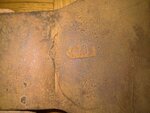
that kind of looks like a good guessI'm seeing what looks like the letters DL followed by the arrow looking marks on the logo.
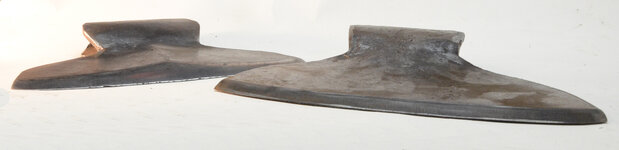
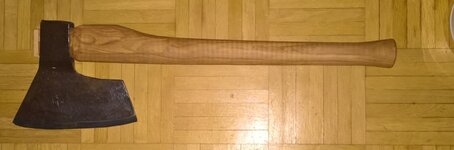
Sorry, I didn't know any better49 years in logging country says this thread is mis-titled. That's some kind of goose-wing something or other. It's cool, but it ain't a broadaxe.
I believe that “Goosewing” is the shape of the axe. A shape that was very common in Germany and thus in Pennsylvania amongst the Deutsche(Germans). I believe that Goosewings were also made in Austria.Isn't a goosewing ax just a German style broad ax, or more likely around here, Pennsylvania Deutsche? That has always been my understanding of it.
Me too. For final hewing of logs that were already hewn with a more typical broadaxe. Shorter, more frequent strokes. Removing kerfs.That has always been my understanding of it.
You could try mixing beeswax with the BLO. That's what my old man would do for some body. But I don't think there's anything that will make it last if you're going to use it. If you were going to hang it on a wall I would recommend FluidFilm. I am a huge proponent. But it is too wet for using.I used boiled linseed oil in the past and it seems to work well, but it isn't very wear resistant.
Me neither.I don't share the Evaporust is bad mindset.
Evaporust and Metal Rescue will definitely strip any and all trace of oxidation (rust, and any other oxide-based "patina" that has accrued on the naked steel). But it is chemically impossible for it to affect the color or the integrity of the naked steel. It is not an acid. As for the desirability, I wonder about that. Stripping the axe will return it to the condition it was in after it was originally quenched in oil and water and then tempered and finished, probably with nothing more than linseed oil and bees wax. In that condition one could see the line between the steel of the head and the forge-welded cutting edge. Isn't that line very evident on axes made today by guildsmen and craftsmen using traditional techniques? As far as I know, it wasn't traditional to conceal that line with some kind of finish, so I'm not sure why it would be considered undesirable to uncover it, regardless of the method used. But as I said, I'd be curious to hear more.Acid and Evaporust can both discolor the metal, and on some tools it leaves a very distinct line where the two grades of metal meet. BIG turnoff for collectors.
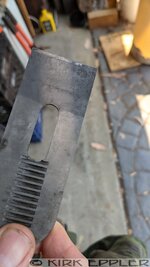
Then how do we explain the two shades of gray, or colors in the plane iron I included a picture of? Attached here again. This was a simple Throw it in Evaporust. No acid, no Simple Green, nothing.Evaporust and Metal Rescue will definitely strip any and all trace of oxidation (rust, and any other oxide-based "patina" that has accrued on the naked steel). But it is chemically impossible for it to affect the color or the integrity of the naked steel.

Serious collectors all hate Evaporust cleaned tools. You can spot them from across the room.Huh? I'm confused. Didn't you already explain that the entire plane iron was fully submerged in the Evaporust? And that the plane iron was made with two pieces of steel forged together? The Evaporust didn't create the line between them. It just revealed that it was made with two pieces of steel of two different grades with slightly different shades. Make no mistake, it is very powerful. But it has no ability to impugn naked steel. It will absolutely strip anything that is oxidebased (rust, paint, etc) on the steel's surface. It will even promote flash rust. But it can have no molecular interaction with the steel. The funny thing about Evaporust and Metal Rescue is that it won't even remove grease, grime, or dirt. Has no effect on it.
Did you take an exhaustive national poll I don't know about? Or are you just deigning to consider those who you are familiar with to be either representative of the entire hobby or the definition of serious? One would have to be oblivious to not recognize and acknowledge that it certainly has its detractors, especially among the crusty old boys clubs (e.g., EAIA, etc), but the days of their draconian stranglehold on the hobby are long gone, and since I know, associate, and regularly deal with serious collectors who now swear by it, including members of several different clubs, it certainly can't be all.Serious collectors all hate Evaporust cleaned tools.
Not really. Most people here are very respectful of preferences. I'm actually fairly conservative, and prefer to preserve as is whenever possible. I will never put a tool on a power wheel, or put a power wheel to a tool, for example, where some guys prefer the bright polished look. But rust is not patina, in my opinion, and it will continue to corrode if left unretarded. So, I definitely de-rust. The only thing more benign than Evaporust and Metal Rescue is an e-tank, in my opinion, but I disassembled mine when those magical solutions appeared.apperantly the "restore or not" is a sensitive topic
It should go without saying, but well said.but I think it's just like religeon, it's fine to have your own oppinion about it, but you should't make any claims as to what is right or wrong for the collective.
Alot of guys swear by it. I think it might have some salts in it, which I am wary of, but as you say, it sure as heck has a long and venerable following. And let's be real, we're not talking about Tiffany's objects! That coolass axe will be just fine.there are entire musiems full of ballistol coated medival stuff, so it oughta be good for something^^
I certainly fit in the "crusty old boys" group of collectors, and can tell you I've Never encountered a high end tool collector that uses Evaporust on valuable collectible tools. It's a common mistake with low end and beginning collectors, but as they move up they quickly learn better. The color that Evaporust leaves on something like a cast iron plane is not removed by reoiling and rewaxing, period.Did you take an exhaustive national poll I don't know about? Or are you just deigning to consider those who you are familiar with to be either representative of the entire hobby or the definition of serious? One would have to be oblivious to not recognize and acknowledge that it certainly has its detractors, especially among the crusty old boys clubs (e.g., EAIA, etc), but the days of their draconian stranglehold on the hobby are long gone, and since I know, associate, and regularly deal with serious collectors who now swear by it, including members of several different clubs, it certainly can't be all.
Evaporust and Metal Rescue will sometimes leave a chalky black carbon residue on steel's surface. That is a perfectly natural residue from the last layer of rust removal and easily removed with a soft abrasive and oil. What is left is original steel. It is definitely denuded. It needs reoiling and rewaxing.
But, to each his or her own.
That's purely anecdotal. Unless you're again supposing that your experience is representative of all collectors.I've Never encountered a high end tool collector that uses Evaporust on valuable collectible tools.
That's your opinion.It's a common mistake with low end and beginning collectors, but as they move up they quickly learn better.
I don't collect planes and I have never cleaned one. Or anything made of cast iron, for that matter. But it has had no deleterious effect on any carbon or alloy steel tools I do collect and have cleaned. Other than the aforementioned oxide stripping and residue.The color that Evaporust leaves on something like a cast iron plane is not removed by reoiling and rewaxing, period.
no bignathan,
Good luck with your axe. And sorry for harshing your buzz on this thread with an unnecessary distraction. My bad. I should know better.
That's what the Ignore button is for.
I'm out.