To avoid these ads, REGISTER NOW!

Radiant Heat Cold Climate Boiler Size - Need math gurus

gdrum

Well-known member
Joined
Sep 19, 2011
Messages
69
Many threads on this but did not want to hijack someone else thread.

Building a 25x42 garage condo in midwest climate where it will have cold swings as well as normal summer. Ceiling is 23' I am NOT trying to heat this thing or set records trying to heat this with a radiant boiler setup. Main source of heat will be with multi head mini split. I really want to go for the minimum for
maximizing efficiency and expenses. Simply trying to setup the lines that come with the unit and get that dialed in.

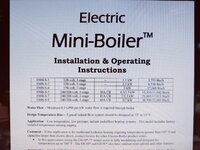
Looking at the Electro Industries EMB-S-2 2.5KW 9k BTU Hot water boiler. 120v 1 phase. Also figure it would maximize my 125amp panel for more necessary adds. Anyone good at the math of this. Gas is not an option. Why would or wouldnt this work fine or should I step up a few notches on the list of their mini boilers that they sell? I figure this would keep it at 50-55 or so degrees effortlessly in extreme temps while the splits do majority of work but both are operating on least energy burn.

Thanks in advance.
IMG_20211019_110852.jpg IMG_20211019_110925.jpg IMG_20211016_115118.jpgIMG_20211016_115031.jpg
 
To avoid these ads, REGISTER NOW!

msharley

Well-known member
Joined
Sep 20, 2021
Messages
14,061
Location
Central Pennsylvania
Hey G,

Figure you are trying to heat 3,000 sq. ft. (average ceiling being 8ft).... https://welovefire.com/btu-calculator/

3,000 X 30 = 90,000 btus.

If possible? Use a 220V element. Costs about 35% less to heat than with a 110V element..

Install several ceiling fans. This will move the warm air down from the ceiling.

If you are anywhere near that blamed IO (froze stiff)WA? (two winters I worked there? average "high of the day?" was NINE! NINE BELOW ZERO!!)

I would suggest going for a 125,000 to 150,000 TOTAL BTU .....(possibly 200,000BTU in combination)

Forget any heat generation from those "mini split" things once it is in the teens.... All they do is run the meter up...

They make an out door wood/pellet/coal burner that does EXCELLENT with a hot water system. (you need to use glycol, to prevent freeze up)....With this, you will want to have a generator to run the pump(s)/burner/auger in the event of an extended power outage... Acquaintance of mine heats his home, garage & shop with one....

Hope this helps....

Later, Mark
 

PoorUB

Well-known member
Joined
Mar 29, 2021
Messages
11,632
Location
Fargo, ND
30 BTU per square foot?! We use 15 to 20 here in North Dakota!
Basically 1000 square feet = 20K BTU ,plus the extra ceiling height, maybe 30K BTU, assuming a relatively tight building. I would bump it up a bit to be sure, maybe 50K BTU.
I have heated 3,500 square foot houses on 80K BTU.
 

msharley

Well-known member
Joined
Sep 20, 2021
Messages
14,061
Location
Central Pennsylvania
30 BTU per square foot?! We use 15 to 20 here in North Dakota!
Basically 1000 square feet = 20K BTU ,plus the extra ceiling height, maybe 30K BTU, assuming a relatively tight building. I would bump it up a bit to be sure, maybe 50K BTU.
I have heated 3,500 square foot houses on 80K BTU.
Hey Poor,

That is what the "industry standard" is...(did you look at the link?)

GDrum was asking...what to figure on...

I was figuring for the frequent opening/closing of the doors....real hard to paint a car in the winter....

If you think you can do it in 15, and maintain temp....go for it!

I'm thinking having "multiple" elements...when it is 40 degrees, heat with one. When it is 20 to 25 degrees, the second one comes on...etc..

If he were to use several, with a "rotation" timer....it should serve him well....

Later, Mark
 

PoorUB

Well-known member
Joined
Mar 29, 2021
Messages
11,632
Location
Fargo, ND
Hey Poor,

That is what the "industry standard" is...(did you look at the link?)

I really don't care what the article says. I have real life experience in North Dakota. I sold 30K BTU hanging heaters for 1,000 foot square shops all the time and no complaints. I also helped design and sold boilers and tubing for floor heat. In the OP's situation a 50K boiler will be more than enough. The 9KW he mentions will probably do it just fine.
Also keep in mind you can only put so many BTU's into the floor with tubing. Some where between 15 and 35 BTU per square foot, so 15,000 to 35,000 BTU. Pretty much inline with my recommendation.

Do you have any HVAC experience?
 

haveissues

Well-known member
Joined
Feb 9, 2011
Messages
379
Location
Hudson Valley NY
I think that heater is sized pretty well for that floor, you could maybe go a step larger like poorUB said. The most you are going to get out of that floor is 35k btu or so depending on tube spacing and input water temp. It doesn't matter much if it is 120 or 240, except that the wire and breaker will have to be twice as large to handle the 120v unit. A 9kw heater at 120v is 75 amps, plus you are supposed to rate the wire at 125% since it is a continuous load so you will need a wire that can handle 93 amps.

I am in the same boat as you-deciding on how to heat my new radiant floor. Electricity is expensive here and we have no natural gas. I don't want oil so that leaves either propane or electric. I think I am going to go with an air to water heat pump despite their expense. With an hydronic air handler it will give me AC also.
 

yeldogt

Well-known member
Joined
Jan 2, 2012
Messages
18,184
I think that heater is sized pretty well for that floor, you could maybe go a step larger like poorUB said. The most you are going to get out of that floor is 35k btu or so depending on tube spacing and input water temp. It doesn't matter much if it is 120 or 240, except that the wire and breaker will have to be twice as large to handle the 120v unit. A 9kw heater at 120v is 75 amps, plus you are supposed to rate the wire at 125% since it is a continuous load so you will need a wire that can handle 93 amps.

I am in the same boat as you-deciding on how to heat my new radiant floor. Electricity is expensive here and we have no natural gas. I don't want oil so that leaves either propane or electric. I think I am going to go with an air to water heat pump despite their expense. With an hydronic air handler it will give me AC also.
Finding the air to water is the problem ....
 

yeldogt

Well-known member
Joined
Jan 2, 2012
Messages
18,184
30 BTU per square foot?! We use 15 to 20 here in North Dakota!
Basically 1000 square feet = 20K BTU ,plus the extra ceiling height, maybe 30K BTU, assuming a relatively tight building. I would bump it up a bit to be sure, maybe 50K BTU.
I have heated 3,500 square foot houses on 80K BTU.
My new house in PA is well over 4k and the boiler is 60k

My studio used to have 4k electric while waiting for propane to get connected .... it's + 1600 sf
 

yeldogt

Well-known member
Joined
Jan 2, 2012
Messages
18,184
Many threads on this but did not want to hijack someone else thread.

Building a 25x42 garage condo in midwest climate where it will have cold swings as well as normal summer. Ceiling is 23' I am NOT trying to heat this thing or set records trying to heat this with a radiant boiler setup. Main source of heat will be with multi head mini split. I really want to go for the minimum for
maximizing efficiency and expenses. Simply trying to setup the lines that come with the unit and get that dialed in.

Looking at the Electro Industries EMB-S-2 2.5KW 9k BTU Hot water boiler. 120v 1 phase. Also figure it would maximize my 125amp panel for more necessary adds. Anyone good at the math of this. Gas is not an option. Why would or wouldnt this work fine or should I step up a few notches on the list of their mini boilers that they sell? I figure this would keep it at 50-55 or so degrees effortlessly in extreme temps while the splits do majority of work but both are operating on least energy burn.

Thanks in advance.

IMG_20211019_110852.jpg IMG_20211019_110925.jpg IMG_20211016_115118.jpgIMG_20211016_115031.jpg
How are you going to heat the second floor?

IMO -- with good tight building and insulation the 9k is more than enough. What are the coldest temps?

Is a mini head going up and down? Will you be using the second floor all the time?
 

kj_mustang

Well-known member
Joined
Feb 9, 2011
Messages
1,213
Location
Harrisonburg, VA
I did not heat my second floor on my build but it is very well insulated. When we lived in it for almost two years, the second floor was about 3 degrees cooler than the first.
 

yeldogt

Well-known member
Joined
Jan 2, 2012
Messages
18,184
Some models of the spacepak solstice are available as well as Enertech.
In some pictures -- they look the same. Would not surprise me if they did come from same company ... but, I have no idea.

The nerd in me wants to order one .....

When I went looking last spring .... I could find little information on them and no one who had ever installed. When I finally get around to redoing my old outbuilding next year .... I may risk ordering one vs doing a propane boiler.
 
OP
G

gdrum

Well-known member
Joined
Sep 19, 2011
Messages
69
How are you going to heat the second floor?

IMO -- with good tight building and insulation the 9k is more than enough. What are the coldest temps?

Is a mini head going up and down? Will you be using the second floor all the time?
Mini Split dual head 1 up, 1 down. Likely 3-4 ton unit. Coldest month is January average 25-35 degrees. There will be swings. I just have a hunch that less is more with the boiler yet everyone's telling me to go big. I see it being expensive and wasted way to make heat given the height and layout.
 

haveissues

Well-known member
Joined
Feb 9, 2011
Messages
379
Location
Hudson Valley NY
In some pictures -- they look the same. Would not surprise me if they did come from same company ... but, I have no idea.

The nerd in me wants to order one .....

When I went looking last spring .... I could find little information on them and no one who had ever installed. When I finally get around to redoing my old outbuilding next year .... I may risk ordering one vs doing a propane boiler.
The spacepak is a self contained unit while the enertech is a split.
 

yeldogt

Well-known member
Joined
Jan 2, 2012
Messages
18,184
Mini Split dual head 1 up, 1 down. Likely 3-4 ton unit. Coldest month is January average 25-35 degrees. There will be swings. I just have a hunch that less is more with the boiler yet everyone's telling me to go big. I see it being expensive and wasted way to make heat given the height and layout.
That's only 1000sf ..... I can heat my very well insulated 1600sf + studio with 4k of electric when it 5 degrees out in PA. Part conventional and SIP

My 4k house -- also new and very well insulated (foam) -- except the exposed stone. Can be cooled with 3T -- again in PA w/ 95 degree heat.
 

yeldogt

Well-known member
Joined
Jan 2, 2012
Messages
18,184
The spacepak is a self contained unit while the enertech is a split.
They both make the hot water outside the last I looked -- on the site enertech talks about only transferring water.

Spacepac and Unico are both second tier solutions .... Would never do one unless nothing else would work. It's interesting they are moving into the air to water. I have no idea how well the head units work ... Pumping cold water all over a house. Need to be careful. It's all in the install I guess. I owned a vacation property way back when with a high velocity -- not the greatest with heat. They can't really take advantage of the new modulating equipment ... Guess to stay alive they have to do something.

With natural gas ... I still think the boiler is better. My current rural project is propane ... as have all the rest. The air to water heat pump is interesting when it's up against propane.
 

haveissues

Well-known member
Joined
Feb 9, 2011
Messages
379
Location
Hudson Valley NY
They both make the hot water outside the last I looked -- on the site enertech talks about only transferring water.

Spacepac and Unico are both second tier solutions .... Would never do one unless nothing else would work. It's interesting they are moving into the air to water. I have no idea how well the head units work ... Pumping cold water all over a house. Need to be careful. It's all in the install I guess. I owned a vacation property way back when with a high velocity -- not the greatest with heat. They can't really take advantage of the new modulating equipment ... Guess to stay alive they have to do something.

With natural gas ... I still think the boiler is better. My current rural project is propane ... as have all the rest. The air to water heat pump is interesting when it's up against propane.
The enertech advantage I have literature on is a split system.

I would do a wall hung boiler unit if I had natural gas but we don't here and propane companies are so slimy that I'm willing to go pretty far to avoid them. Plus by my calculations my shop will need ~100 degree water to meet demand so that would be perfect for air sourced hydronic heat pump. The enertech also as a 7kw (I think) built in heater for backup and when ambient temperatures are sub zero.
 

yeldogt

Well-known member
Joined
Jan 2, 2012
Messages
18,184
The enertech advantage I have literature on is a split system.

I would do a wall hung boiler unit if I had natural gas but we don't here and propane companies are so slimy that I'm willing to go pretty far to avoid them. Plus by my calculations my shop will need ~100 degree water to meet demand so that would be perfect for air sourced hydronic heat pump. The enertech also as a 7kw (I think) built in heater for backup and when ambient temperatures are sub zero.
How is it split ..... they send refrigeration inside to a heat exchanger ?

What I find interesting -- they are like a package unit where all the refrigeration is factory w/ nothing to do when it arrives
 

haveissues

Well-known member
Joined
Feb 9, 2011
Messages
379
Location
Hudson Valley NY
How is it split ..... they send refrigeration inside to a heat exchanger ?

What I find interesting -- they are like a package unit where all the refrigeration is factory w/ nothing to do when it arrives
It still makes hot water on the outside and transfers hot water to the interior unit but the interior unit houses a pump, zoning valves for domestic hot water and the electric backup heater. Similar concept to the spacepak but different enough that I don't think they are made by the same company.

The fact that the refrigerant does not need to be messed with is appealing for me. I can do all of the hydronic stuff very easily on my own, without needing to buy more tools.
 
To avoid these ads, REGISTER NOW!

yeldogt

Well-known member
Joined
Jan 2, 2012
Messages
18,184
It still makes hot water on the outside and transfers hot water to the interior unit but the interior unit houses a pump, zoning valves for domestic hot water and the electric backup heater. Similar concept to the spacepak but different enough that I don't think they are made by the same company.

The fact that the refrigerant does not need to be messed with is appealing for me. I can do all of the hydronic stuff very easily on my own, without needing to buy more tools.

It is interesting .... I have not done a deep dive into either. So I don't know where it sits on the overall efficiency. The air units are hurting Geo now more than before. The efficiencies just don't pan out ....

My fear would be if it needed any service. I did not look at the warranty .... but, getting any factory service would be hard.
 

PoorUB

Well-known member
Joined
Mar 29, 2021
Messages
11,632
Location
Fargo, ND
Mini Split dual head 1 up, 1 down. Likely 3-4 ton unit. Coldest month is January average 25-35 degrees. There will be swings. I just have a hunch that less is more with the boiler yet everyone's telling me to go big. I see it being expensive and wasted way to make heat given the height and layout.
Now knowing your outdoor temps in January are that warm the 9K boiler will definitely be enough! With the secondary heat source I would bet the 5K boiler will be enough, 17K BTU.

I could heat the shop in North Dakota at -30 with the 9K boiler assuming the construction was decent.

Go with the 5K. You have the minisplit to "catch up" if needed. Insulate under the slab and around the outside edge.
 
OP
G

gdrum

Well-known member
Joined
Sep 19, 2011
Messages
69
Now knowing your outdoor temps in January are that warm the 9K boiler will definitely be enough! With the secondary heat source I would bet the 5K boiler will be enough, 17K BTU.

I could heat the shop in North Dakota at -30 with the 9K boiler assuming the construction was decent.

Go with the 5K. You have the minisplit to "catch up" if needed. Insulate under the slab and around the outside edge.
I appreciate this. This is what I was leaning towards. The local installers want to use this unit instead of the one I picked. Any clue on the differences or if the more spend is worth it? https://www.ecomfort.com/Electro-Industries-EZB-T1-05-240-1/p110249.html

Here is what I or we have narrowed it down to I think. https://www.ecomfort.com/Electro-In...gntXpZ96aKTRLvowsdzhrpiQ4toP5U6BoCLCkQAvD_BwE
 

yeldogt

Well-known member
Joined
Jan 2, 2012
Messages
18,184
I appreciate this. This is what I was leaning towards. The local installers want to use this unit instead of the one I picked. Any clue on the differences or if the more spend is worth it? https://www.ecomfort.com/Electro-Industries-EZB-T1-05-240-1/p110249.html

Here is what I or we have narrowed it down to I think. https://www.ecomfort.com/Electro-In...gntXpZ96aKTRLvowsdzhrpiQ4toP5U6BoCLCkQAvD_BwE
The better electric units modulate --- even the ones that are on and off work well as long as you don't get surges.

It's not the same as a gas unit in that regard
 

PoorUB

Well-known member
Joined
Mar 29, 2021
Messages
11,632
Location
Fargo, ND
Modulating versus single stage.

Something to be said about simplicity too. Where I worked we installed quite a few of the mini boilers and had no issues. The modulating boiler is new enough that I never worked on one, but they are a bit more complex, more electronics, solid state relays, more to go wrong. I doubt you will know the difference when it comes down to operation and cost. Some will say the modulating is more efficient, but I don't see how. All the heat produced goes into the water with both boilers.

I would go with the EMB.
 

yeldogt

Well-known member
Joined
Jan 2, 2012
Messages
18,184
Modulating versus single stage.

Something to be said about simplicity too. Where I worked we installed quite a few of the mini boilers and had no issues. The modulating boiler is new enough that I never worked on one, but they are a bit more complex, more electronics, solid state relays, more to go wrong. I doubt you will know the difference when it comes down to operation and cost. Some will say the modulating is more efficient, but I don't see how. All the heat produced goes into the water with both boilers.

I would go with the EMB.
They are not very complex ... but I agree not a big deal. On a large one you don't want the big load on and off.
 

PoorUB

Well-known member
Joined
Mar 29, 2021
Messages
11,632
Location
Fargo, ND
I sold the Thermolec brand of electric boilers, but the modulating Electromates came out after I got out of the field. Very aware of how they work.

The EMB's are pretty simple, circuit board, contactor and a heating element, not much more than that!
 
OP
G

gdrum

Well-known member
Joined
Sep 19, 2011
Messages
69
IMG_20211113_183933.jpg
This is what I whipped up. Now onto wiring. Question for the gurus. I got a taco 501 single zone relay. I planned to use the relay as the power source for the boiler and then run the pump/thermostat through the boilers board. There are options and ways to do either or all through the relay. Not sure which is best.
 

jlv03

Well-known member
Joined
Jan 19, 2020
Messages
346
Location
SE IA
Not sure what you mean by run the boiler through the relay? You can run the pump off the relay, with the Taco's 2nd set of dry contacts used as the "TT" for the boiler. That's how my 6kW boiler is setup. Or you can skip the Taco altogether and run everything through the boiler.

The advantage of the Taco is that the pump is likely off a separate 120VAC source, by running the boiler thermostat connections through the Taco - if you lose the 120VAC for the pump, the boiler will not turn on.
 

PoorUB

Well-known member
Joined
Mar 29, 2021
Messages
11,632
Location
Fargo, ND
I might be missing something, but you wire the boiler right to 240 volt. There should be thermostat terminals in the boiler to connect to your thermostat, plus outputs to run a pump. You don't need the Taco 501 relay.
 
OP
G

gdrum

Well-known member
Joined
Sep 19, 2011
Messages
69
I might be missing something, but you wire the boiler right to 240 volt. There should be thermostat terminals in the boiler to connect to your thermostat, plus outputs to run a pump. You don't need the Taco 501 relay.
I am not finding the power source for the pump. I assumed it needed a second source.

IMG_20211118_131752.jpgIMG_20211114_175712.jpg
 

PoorUB

Well-known member
Joined
Mar 29, 2021
Messages
11,632
Location
Fargo, ND
Use a 240 volt pump. Connect to the incoming power to the boiler, run through the relay on the board. The wiring to the pump should be used, or run a 120 volt pump on a separate circuit. Still no use for the Taco relay.
 

jlv03

Well-known member
Joined
Jan 19, 2020
Messages
346
Location
SE IA
If using the Taco - run a 240VAC to the boiler. Run 120VAC into the Taco, leaving a jumper on the incoming to the first set of relay contacts. This first set of relay contacts goes to the circulating pumps. The second set of Taco contacts goes into the boiler's thermostat connection.

If skipping the Taco, run 240VAC to the boiler. Run 120VAC into the pump circulating contacts in the boiler and out to the circulating pump. Land thermostat contacts directly on the boiler thermostat connections.
 
OP
G

gdrum

Well-known member
Joined
Sep 19, 2011
Messages
69
If using the Taco - run a 240VAC to the boiler. Run 120VAC into the Taco, leaving a jumper on the incoming to the first set of relay contacts. This first set of relay contacts goes to the circulating pumps. The second set of Taco contacts goes into the boiler's thermostat connection.

If skipping the Taco, run 240VAC to the boiler. Run 120VAC into the pump circulating contacts in the boiler and out to the circulating pump. Land thermostat contacts directly on the boiler thermostat connections.
Anyway for a picture or diagram for the second option? For the boiler wiring for the pump it just gives 2 red or orange wires to string out and attach. so I would think that a separate box of sorts would be needed to house the connection safely? Which is why I chose taco unit.
 

jlv03

Well-known member
Joined
Jan 19, 2020
Messages
346
Location
SE IA
Anyway for a picture or diagram for the second option? For the boiler wiring for the pump it just gives 2 red or orange wires to string out and attach. so I would think that a separate box of sorts would be needed to house the connection safely? Which is why I chose taco unit.
How much room is there inside that box? Can you bring in a power cord and then bring out another cord to the pump through a knock-out and clamp?

Page 14 of the PDF from the manufacturer of the boiler shows a rough idea how to wire it. Where it shows the single circuit breaker and neutral, that's your power cord coming in - the circuit breaker would be the circuit breaker for whatever receptacle you are using.

 
OP
G

gdrum

Well-known member
Joined
Sep 19, 2011
Messages
69
Thanks to everyone's input! Got it wired. You guys were right. Just wire it throught he boiler. I put a junction box in the middle. Wired it into a Nest thermostat which had to add a relay for but not to big of deal and shes heating. Now to figure out what makes sense as far as operating temperature that.

Any idea of a way to monitor power consumption and maximize burn? One of those energy monitors that go through the breaker or another idea?
 

jmdirk

Well-known member
Joined
May 4, 2015
Messages
706
Thanks to everyone's input! Got it wired. You guys were right. Just wire it throught he boiler. I put a junction box in the middle. Wired it into a Nest thermostat which had to add a relay for but not to big of deal and shes heating. Now to figure out what makes sense as far as operating temperature that.

Any idea of a way to monitor power consumption and maximize burn? One of those energy monitors that go through the breaker or another idea?

Can you adjust the turn on range on a Nest? I always thought those were more designed around forced air system that can react fairly quickly. I've just assumed that with the slow reaction of a radiant floor setup, you'd end up with a lot of overshoot/undershoot on the temp

Edit: 2 seconds of googling tells me they have a mode specific for radiant floor. Cool! I have a ground source geothermal in my house and have never been able to go with a smart thermostat
 
OP
G

gdrum

Well-known member
Joined
Sep 19, 2011
Messages
69
Can you adjust the turn on range on a Nest? I always thought those were more designed around forced air system that can react fairly quickly. I've just assumed that with the slow reaction of a radiant floor setup, you'd end up with a lot of overshoot/undershoot on the temp

Edit: 2 seconds of googling tells me they have a mode specific for radiant floor. Cool! I have a ground source geothermal in my house and have never been able to go with a smart thermostat
Yup. I just dont know how to use it to my advantage.

IMG_20211128_180903.jpgIMG_20211128_185741.jpg
 
OP
G

gdrum

Well-known member
Joined
Sep 19, 2011
Messages
69
Got the first bill. 369 kWh hour used for $63.76. Temp outside averaged 37 degrees. I kept it between 57-60 degrees. There were some warmer days swings of 50 but many evenings were 15-20 degrees too. The boiler has a temp setting or knob on it that came set at 90. Wonder if theres any need for adjustment in there or making water warmer thus allowing it to stay warmer longer or if that will mess with the energy use.
 

PoorUB

Well-known member
Joined
Mar 29, 2021
Messages
11,632
Location
Fargo, ND
No reason to run the water temp any warmer than you need to as long as it heats the building. If you raise the water temp the system will just cycle more. Nothing wrong with letting it run long cycles.
If you notice it not keeping up in severe cold then turn it up, but 110-120 max.
 
Last edited:
To avoid these ads, REGISTER NOW!
Top Bottom