To avoid these ads, REGISTER NOW!

Air tank corrosion, how thin can it go?

dkmc

Well-known member
Joined
Jan 20, 2008
Messages
950
Location
NYS--Upstate in the corn fields
I have a 150 gallon vertical air receiver, 1993 year of manufacture. There is some rust scale inside, I can hear it when I roll the tank.
The data plate says 200 PSI max. It also says the shell is .181 thick and the heads (end domes) are .149. I hydro tested it to 300 PSI with no issues.
Then I checked the bottom with an ultrasonic thickness gauge. Around the drain fitting I found it to be the thinnest, in a couple spots it measured .124,
but mostly I saw .134-.138.

I'm thinking it should be fit for 125 PSI MAX service........
What do you guys think?
 
To avoid these ads, REGISTER NOW!

Kaizen

Well-known member
Joined
Jan 9, 2015
Messages
6,948
Location
New England
Yea, they're $85 on EBAY so not a big deal. So how big of a hammer and how hard do you hit it? LOL
i'll have to check those out. have you verified yours is reading right? medium hammer and like i'm driving a siding nail.....hard enough for me to feel confident i'm not airing up a bomb.
 
OP
D

dkmc

Well-known member
Joined
Jan 20, 2008
Messages
950
Location
NYS--Upstate in the corn fields
i'll have to check those out. have you verified yours is reading right? medium hammer and like i'm driving a siding nail.....hard enough for me to feel confident i'm not airing up a bomb.
It's good within a couple thousndths of an inch. There's a test coin on the front of the meter that's 5mm thick. It reads 5mm everytime. I've also checked it with varying thickness steel samples and it's reliable.
 

Jackfre

Well-known member
Joined
Dec 26, 2010
Messages
4,411
Location
N CA
Curious how these things go. I assume a pin hole, but do they go harder?
 

Jinks

Well-known member
Joined
Aug 28, 2012
Messages
2,885
Location
Daytona Beach
I'd weigh the cost of a new tank with the value of your life. If you're comfortable with the values of any test method, the you're good to go... :dunno: If you have any reservations...........well.......:dunno:
 

yelchevelle

Well-known member
Joined
Jun 15, 2018
Messages
178
Location
Hoover, AL
I am by no means trying to downplay the seriousness of this situation, but I would have no problem running it up to 150 psi if you hydro tested it to 300 psi. I am of the opinion, and this is probably going to go against the grain with a lot of people on here, good asme or whatever rated tanks, not cheap box store tanks, are going to go pssssss long before they go boom. I have a horizontal tank in my shop that is trash because it has pin holes in it. I bought it used, and all visual tests it looked good. I tapped on the bottom pretty good, and it didn’t feel “soft”.

Air pressure is serious business, but I wouldn’t worry too much about a tank that hydrotests good and is still probably thicker in its thinnest spot than consumer grade tanks.
 

rlitman

Well-known member
Joined
Oct 18, 2010
Messages
24,624
Location
Long Island
If it passed a hydro test I assume it should be okay...
The OP "hydro tested" it to 300 PSI. i.e. he way overpressurized it.

It did not "pass a hydro". There is a BIG difference there. Go call up the company that put the ASME stamp on that tank and see what their real hydro test entails. Hydro testing of cylinders is not a home undertaking.
 

Stuart in MN

Well-known member
Joined
Sep 8, 2005
Messages
23,135
Location
Minneapolis
The OP "hydro tested" it to 300 PSI. i.e. he way overpressurized it.

It did not "pass a hydro". There is a BIG difference there. Go call up the company that put the ASME stamp on that tank and see what their real hydro test entails. Hydro testing of cylinders is not a home undertaking.
I misread the original post...I thought it said he had it tested. I agree, if it was a home test it doesn't count.
 

Bretny

Well-known member
Joined
Jul 31, 2017
Messages
3,918
Location
Dutchess county NY
We had a compressor that was in a un heated/cooled attic in NY for over a decade. We went to remove it and found about 15gal of water in a 20gal tank. It lasted another 5yrs or then got a hole in the bottom. Point being its prety un likely it will just blow up one day.

Ours was sorely miss treated and prob even froze a few times.
 

Yankeefarmer

Well-known member
Joined
Jul 25, 2011
Messages
1,188
Location
Connecticut
If you want to really get into the weeds on this, the accepted methods are described in a lengthy ASME standard titled “Fitness For Service.”
 

rlitman

Well-known member
Joined
Oct 18, 2010
Messages
24,624
Location
Long Island

tarmy

Well-known member
Joined
May 28, 2014
Messages
4,686
Location
Nor Cal
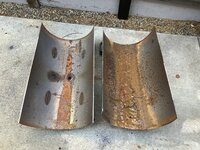
It's that last image that scares me. Deep erosion in a line right along the bottom is the sort of thing that will cause a tank to unzip and explode. Just search for "exploded air compressor" on google images, and 90% of them will look like this was the cause.
Yep. I was in a scuba shop decades ago when a tank with nearly 3000psi let go. Luckily I was far enough away to be uninjured. Other folks got hurt very badly. I couldn’t hear for many days. But, it taught me to never be near things when servicing or filling that have high pressure. That tank that I posted above was in a separate room from my shop with a cage around it bolted down…overkill I know…but I had my lucky explosion day already!

I was surprised it had that much ****…
 

Showkey

"MEMBER EMERITUS"
Joined
Aug 9, 2014
Messages
8,638
Location
Wausau WI
The internet stories pop up every so often.
Interesting to know what the actual frequency rate is for catastrophic compressor tank failure ?
1 in 1,000,000, 1 in 10,000,000, 1 in 100,000 ??

I personally owned one tank that developed pin hole leaks in the bottom and the tank was taken out of service.
 
To avoid these ads, REGISTER NOW!

Showkey

"MEMBER EMERITUS"
Joined
Aug 9, 2014
Messages
8,638
Location
Wausau WI
There are 100’s hours of reading on the internet on the merits and problems with tank treatments to prevent rust:


PoorUB

Well-known member
Joined
Mar 29, 2021
Messages
11,655
Location
Fargo, ND
I can't imagine any method to treat the inside of a rusty tank working out. Seems like it would add more problems that it would cure. How are you going to paint the inside of a tank? Pour it in and roll it around? You can run some acid through it and try clean it first, but I have my doubts it would be effective.

I have pulled the large plugs and pressure washed the inside of a tank, but that was difficult to get the whole inside blasted.
 

Mooky

Well-known member
Joined
Jul 6, 2014
Messages
257
Location
PA
You tested it at the correct pressure: 1.5 times design pressure (Section VIII of the Boiler & Pressure Vessel code states minimum 1.3 X MAWP). If you have the dimension of the the tank, and the thickness readings, PM me & I can run the Fitness For Service Calculations.

As for the hammer test, that was commonly used before the ultrasonic meters became small enough to take in the field. A blunt pointed tip (think welding chipping hammer) was used. Typically used on refinery piping back when I started.

Mooky
NBIC, API 570 Inspector
AWS CWI
Retired
 

oldmachinenut

Well-known member
Joined
Apr 3, 2009
Messages
2,526
Location
Missing, presumed dead in central Pa.
Make sure you have full pressure in it :)
This is how I did my 80 gallon vertical tank. I removed all the plugs, pressure washed the inside then looked it over well with a inspection camera. I sealed it up, pressurized it to 160psi.
I had it on a refrigerator truck/dolly laying on it’s side so I could wail on the bottom with a
ball-pein hammer to check for thin spots. At one point I even sat on it like Slim Pickens did with the hydrogen bomb in the movie “Dr. Strangelove” . It passed the test and no bus loads of nuns were harmed it is pressurized every day with no leaks.
 

cvairwerks

Well-known member
Joined
Aug 12, 2016
Messages
7,228
Location
Within hearing distance of Texas Motor Speedway
All of our pressure rated piping, tubing and accumulators have a thickness loss limit of 10% of original wall thickness. ***** to have to replace a bunch of hydraulic tubing because some dumbA nicked a swaged line. On the aircraft we run pressures from a few psig to almost 7000 psig, depending on service.

Doesn’t take a lot of material loss to hit that 10% on some stuff.
 

rlitman

Well-known member
Joined
Oct 18, 2010
Messages
24,624
Location
Long Island
This is how I did my 80 gallon vertical tank....At one point I even sat on it like Slim Pickens did with the hydrogen bomb in the movie “Dr. Strangelove” ...
So, not relevant to this thread, but I'll recount my Dr. Strangelove moment.

I bought my 80 gallon vertical compressor on CL, and needed to get it up into my garage loft. It was already disassembled, so I could transport the tank in my station wagon horizontally without needing to tip the pump, and I had used my HF hoist to lift the pump and motor up to the loft, so it was time to lift the tank. I strapped up the tank around the middle while it was standing up on the floor, picked it with the hoist at the balance point, using the hoist to help me lower it to horizontal, and now I could lift it up to the loft level.

The HF hoist had no trouble lifting the tank, and my trolley easily carried both over the loft edge. Now, sitting just inches above the loft floor, the damned hoist gearbox locked up, and I couldn't lower it! Bouncing on top of the tank to get it to move low enough for me to unhook it had me seriously tempted to go and grab a hat.
 

LS6 Tommy

Well-known member
Joined
Dec 27, 2013
Messages
26,162
Location
Northern NJ
The OP "hydro tested" it to 300 PSI. i.e. he way overpressurized it.

It did not "pass a hydro". There is a BIG difference there. Go call up the company that put the ASME stamp on that tank and see what their real hydro test entails. Hydro testing of cylinders is not a home undertaking.
X2. I'm no Safety Nazi, but "I _______ tested it myself" posts always make me cringe just a teeeeny bit.

Tommy
 

welder4956

Well-known member
Joined
Apr 8, 2010
Messages
3,072
Location
Birmingham, AL USA
I have a 150 gallon vertical air receiver, 1993 year of manufacture. There is some rust scale inside, I can hear it when I roll the tank.
The data plate says 200 PSI max. It also says the shell is .181 thick and the heads (end domes) are .149. I hydro tested it to 300 PSI with no issues.
Then I checked the bottom with an ultrasonic thickness gauge. Around the drain fitting I found it to be the thinnest, in a couple spots it measured .124,
but mostly I saw .134-.138.

I'm thinking it should be fit for 125 PSI MAX service........
What do you guys think?
If original head thickness was 0.149" and the lowest thickness measurement was 0.124", then 0.124÷0.149 is 83%. 83% of the original 200 psi MAWP is 166 psi max for the derated pressure.
 

pcmeiners

Well-known member
Joined
Aug 13, 2009
Messages
7,917
Location
In the only town in Pennsylvania, Bloomsburg.
How thin.... all depends how much you want to win a Darwin award and how much insurance you have.

As to corrosion prevention, rig a 1/2 threaded cylindrical boat zinc off a tee connected to your tank drain port, one zinc should last a couple decades. Coating the tank interior will not work.
 

mike93lx

ALLIANCE MEMBER
Joined
Dec 9, 2013
Messages
37,641
Location
Richmond, VA
All your "hydro test" did was waste time and potentially damage the tank, IMO

If you want a real answer have it done right. If you just want reassurance on a decision you have already made, I'd say you got enough here..
 
Last edited:

niget2002

Well-known member
Joined
Oct 2, 2012
Messages
11,144
Location
Josephine, TX
The internet stories pop up every so often.
Interesting to know what the actual frequency rate is for catastrophic compressor tank failure ?
1 in 1,000,000, 1 in 10,000,000, 1 in 100,000 ??

I personally owned one tank that developed pin hole leaks in the bottom and the tank was taken out of service.
My experience is even more sketchy than that.

First air compressor I owned was given to me by my dad. It developed a pin hole leak in the bottom. I lifted up the air compressor and saw two metal screws screwed into the bottom. I called and asked my dad what the deal was. He said, 'Oh. that tank has sprung a leak before. Just drill out the rust spot, put some JB weld on a screw and run it up in there to seal it back up.' Not knowing any better, I did.

That tank was over 30 years old when I got it because my grandfather bought it at a garage sale and gave it to my dad before I was born.

I had no idea that was dangerous until after coming to this site a few years after plugging it. There's no telling how long that tank was running with the other two screws plugging the bottom of the tank.

I've since replaced the air compressor for a larger, more capable one.
 

racecougar

Well-known member
Joined
Jan 26, 2021
Messages
5,135
Location
Missouri
First air compressor I owned was given to me by my dad. It developed a pin hole leak in the bottom. I lifted up the air compressor and saw two metal screws screwed into the bottom. I called and asked my dad what the deal was. He said, 'Oh. that tank has sprung a leak before. Just drill out the rust spot, put some JB weld on a screw and run it up in there to seal it back up.' Not knowing any better, I did.
Holy cr@p!!! 😲
 
Joined
May 14, 2018
Messages
7
Location
Tinley Park, IL
A handheld UT thickness meter isn't going to have the resolution to properly measure a small area wall loss like the pinhole you'd be worried about, and the angle of the sound wave won't work for measuring wall loss. In a pipeline application you'd use a phased array UT set up specifically for corrosion mapping, but those run a bit more than $85 buy-in.

Realistically, you're probably well within safe operating pressures at 75% of the rated pressure. Stick a borescope in there and if it isn't crazily rusty you should be ok.
 

workerbee

Member
Joined
Sep 1, 2020
Messages
14
Location
West Texas
The OP "hydro tested" it to 300 PSI. i.e. he way overpressurized it.

It did not "pass a hydro". There is a BIG difference there. Go call up the company that put the ASME stamp on that tank and see what their real hydro test entails. Hydro testing of cylinders is not a home undertaking.
I have hydro tested professionally for years including for companies that had ASME stamps. You can absolutely do it at home and it is exactly the same. Is this guy doing it properly and safely? Who knows without going over his setup and procedure. I will say though that I would not recommend someone doing it for the first time on their own without understanding what they are doing. I have seen them go badly. And by the way 300 psi is the exact pressure you would use for a 200 psi rated tank. 1.5x is standard for pressure piping.
 

John in OH

Well-known member
Joined
Jun 2, 2007
Messages
2,444
Location
SE Ohio & Eastern Virginia
I will go along with the crowd and say that if you hydrotested a 200 psi tank to 300 psi then it "should" be good for 125-150psi.

That being said, there is another consideration. It isn't quite as significant issue on a vertical tank as it would be on a horizontal tank, but the pit depth isn't necessarily the only consideration. Along with thickness you need to consider pit "alignment". Usually, if you have one pit, you will have more. IF the pits align, say in a relatively straight line along the bottom of the tank, the tank is more susceptible to failure ... think about tearing paper along a perforated line.
 
OP
D

dkmc

Well-known member
Joined
Jan 20, 2008
Messages
950
Location
NYS--Upstate in the corn fields
Wow, thanks for all the replies. I never get email notifications on responses to my threads and just now happened to check back.
It's interesting the wide range of responses to the question. I'm baffled why some think a hydrostatic test can't be done by other than "professionals". Unless there's some Vodo involved I'm not aware of.

Next questions:
Who makes the best Pizza?
What car is better Chevy or Ford?
:rocketwho
 

rlitman

Well-known member
Joined
Oct 18, 2010
Messages
24,624
Location
Long Island
... I'm baffled why some think a hydrostatic test can't be done by other than "professionals". Unless there's some Vodo involved I'm not aware of.

Next questions:
Who makes the best Pizza?
What car is better Chevy or Ford?
:rocketwho
No voodoo. But that are your test criteria? Simply not leaking at a test pressure is hardly sufficient, since your test may have caused permanent damage now that makes a future failure more likely. i.e. you must know if you have stressed the steel beyond its elastic range, because once the steel begins to yield, you are in trouble.

For high pressure cylinders, volume is monitored during hydrostatic testing. The expanding pressurized cylinder must return back to within an acceptable range, ideally it's initial volume when depressurized. The good news is that's way overkill for your purposes.

In your case, the test could be raising it to a test pressure and monitoring any loss of pressure over a time period that could indicate material creep, followed by a depressurization and a repeat test. You could improve that by measuring the tank circumference along the major and minor axes before and after your testing, though now that you've potentially deformed it, that's a bit late.

Still, while I wouldn't say your tank passed a hydro test, I'd likely just put it into service. I'm a lot more comfortable with vertical tanks than horizontal, and if it doesn't have pinhole leaks, it's probably fine. The other thread about restoring an antique riveted tank has me WAY more concerned.

What's more important is that your safety valve works. Be sure that you can get it to vent by pulling the ring at say 30 PSI (wear hearing protection), and that **** isn't being blown through it. I'll bet that most compressor tank failures are caused by a stuck electrical contact leading to the sudden discovery that the safety valve is shot.

also:
New York Pizza*, and
It's a Jeep thing, you wouldn't understand. ;)

*I have had FANTASTIC pizza outside of New York, so it isn't the water or some special loyalty to the area that I espouse, but it sure can be hard to find good pizza elsewhere. OTOH, so long as you stay out of a chain store, most pizza here will be at least acceptable, whereas outside of New York, most pizza is, well, ****.
 
To avoid these ads, REGISTER NOW!
Top Bottom