To avoid these ads, REGISTER NOW!

cast iron oil cans

Joe Huld

Well-known member
Joined
Sep 21, 2017
Messages
308
Location
South Pasadena Ca.
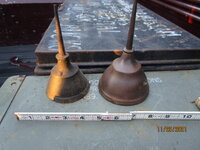
Does anyone collect or own any cast iron oil cans? Attached are pictures of the two I have. Both of these have flexible brass bottoms soldered to the cast body and steel spouts. Any thoughts on why anyone would make one of cast iron rather than steel or brass.
 

Attachments

  • IMG_4622.JPG
    IMG_4622.JPG
    315.1 KB · Views: 148
  • IMG_4623.JPG
    IMG_4623.JPG
    359.7 KB · Views: 142
  • IMG_4624.JPG
    IMG_4624.JPG
    332.4 KB · Views: 131
To avoid these ads, REGISTER NOW!

crguy

Well-known member
Joined
Jan 24, 2016
Messages
2,659
Location
SW Washington
Does anyone collect or own any cast iron oil cans? Attached are pictures of the two I have. Both of these have flexible brass bottoms soldered to the cast body and steel spouts. Any thoughts on why anyone would make one of cast iron rather than steel or brass.
I had one for a while. It was marked on the brass plate in the bottom, but I don't recall what it said. Also don't know the reasoning for using cast iron.
 

2oolhound

Well-known member
Joined
Dec 18, 2010
Messages
5,918
Location
BC Canada
Those are rare and unusual. You should post photos in the OILER Thread

I don't think anyone had posted and cast oilers there before and there are some serious collectors there.

The only reason I can think of is they would be heavy and therefor very stable on the shelf and not prone to being tipped over.
 

tube_guy

Well-known member
Joined
Jan 21, 2009
Messages
749
Tooling costs maybe? If you have a foundry it's cheap and easy to make a casting like that.
The tooling for a stretch-formed container is likely more expensive than a wood or plastic pattern for a sand casting. But the labor required to produce the sand casting is so much higher that the more expensive tooling for stretch-forming would pay for itself in just a few thousand containers.

I'd guess it's more about people's perception of quality. When you walk into a store and there are cast iron oilers sitting next to sheet metal oilers, some people will buy the cast iron oiler because it's heavier and nicer. Years ago, a lot of people actually thought like this and the company that made the cast iron oilers probably wanted to take advantage of that when selling their products. Although they couldn't have been very successful with that approach because they certainly aren't very common.
 

mogandave

Well-known member
Joined
Nov 4, 2021
Messages
3,052
Location
Bangkok
The tooling for a stretch-formed container is likely more expensive than a wood or plastic pattern for a sand casting. But the labor required to produce the sand casting is so much higher that the more expensive tooling for stretch-forming would pay for itself in just a few thousand containers.
Correct, so if someone wanted just a few hundred, the casting would make sense. I think there were foundries everywhere, and once you have a crucible full of molten iron, pouring more parts has little additional cost beyond the material itself.

Figuring in the cost of labor at that time compared to the cost of steel, it becomes even more attractive.

It could also jut be that they predate widespread use of stamping. As I understand it, stamping has always been pretty capital intense, and manufacturing was much more localized.

I'd guess it's more about people's perception of quality. When you walk into a store and there are cast iron oilers sitting next to sheet metal oilers, some people will buy the cast iron oiler because it's heavier and nicer. Years ago, a lot of people actually thought like this and the company that made the cast iron oilers probably wanted to take advantage of that when selling their products. Although they couldn't have been very successful with that approach because they certainly aren't very common.

Indeed
 

MShaw

Well-known member
Joined
Mar 2, 2015
Messages
1,014
Location
York, Pa.
I believe that pre dating production stamping was the reason. In a book on the Model T Ford there is the story of Ford soliciting quotes for a machine to stamp oil pans at the production of 60 per hour. The representative said "surely you mean 60 per day, this is a more realistic rate." Ford replied " no the rate is correct and you will pass the prototype machine doing it on your way out."
 

tube_guy

Well-known member
Joined
Jan 21, 2009
Messages
749
Correct, so if someone wanted just a few hundred, the casting would make sense. I think there were foundries everywhere, and once you have a crucible full of molten iron, pouring more parts has little additional cost beyond the material itself.

Figuring in the cost of labor at that time compared to the cost of steel, it becomes even more attractive.

It could also jut be that they predate widespread use of stamping. As I understand it, stamping has always been pretty capital intense, and manufacturing was much more localized.


Indeed

It doesn't matter how many foundries there are out there or if the iron is already melted and sitting in a crucible, the production of a sand mold, the trimming of the casting, and the finishing of the casting are all very labor intensive compared with production of a stretch formed part. The threads in the casting for the spout have to be machined, and I'd imagine machining is also required at the bottom, where the stamped pump section is attached.

That's why Henry Ford replaced castings and forgings with stamped parts in many of his early automobiles. He couldn't meet demand with the additional labor that the castings and forgings required.

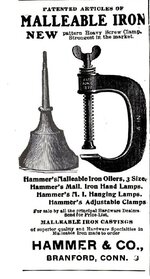
You're probably right in that they're just old and pre-date common stamping processes. Here's an advertisement from 1888 for Malleable iron oilers produced in Connecticut. That would predate common stamping processes by a few years.Iron oilers ad.jpg.
 
OP
J

Joe Huld

Well-known member
Joined
Sep 21, 2017
Messages
308
Location
South Pasadena Ca.
It doesn't matter how many foundries there are out there or if the iron is already melted and sitting in a crucible, the production of a sand mold, the trimming of the casting, and the finishing of the casting are all very labor intensive compared with production of a stretch formed part. The threads in the casting for the spout have to be machined, and I'd imagine machining is also required at the bottom, where the stamped pump section is attached.

That's why Henry Ford replaced castings and forgings with stamped parts in many of his early automobiles. He couldn't meet demand with the additional labor that the castings and forgings required.

You're probably right in that they're just old and pre-date common stamping processes. Here's an advertisement from 1888 for Malleable iron oilers produced in Connecticut. That would predate common stamping processes by a few years.Iron oilers ad.jpg.
I think you are absolutely correct, considering the difficulty of producing the thin walled malleable casting, all the extra machining required, and the hand work of soldering the brass diaphragm I don't think a cast iron oiler could be produced cheaper than a stamped steel can. There has to be some reason other than cost for using cast iron. The can in the ad you posted was produced by Hammer and company using US patent 305305 which actually pertained to the two piece bottom which required a thicker body. The patent application states that the two piece bottom reduces the strain the soldered joint. Neither of my two cans have any markings and the larger has a lot of solder on the bottom suggesting it may have been repaired, and also that that one or both may have been made by someone other than Hammer and Co. I am attaching pictures of both cans and their bottoms, and just to liven up this discussion another similarly shaped steel can. The third one is made of steel, has a welded seam, no markings of any kind, and a machined spout. The seam suggests that it might have been a shop project.
 

Attachments

  • IMG_4682.JPG
    IMG_4682.JPG
    296.8 KB · Views: 52
  • IMG_4683.JPG
    IMG_4683.JPG
    340.5 KB · Views: 45
  • IMG_4684.JPG
    IMG_4684.JPG
    292.3 KB · Views: 41
  • IMG_4685.JPG
    IMG_4685.JPG
    266.8 KB · Views: 45
To avoid these ads, REGISTER NOW!
OP
J

Joe Huld

Well-known member
Joined
Sep 21, 2017
Messages
308
Location
South Pasadena Ca.
Those are rare and unusual. You should post photos in the OILER Thread

I don't think anyone had posted and cast oilers there before and there are some serious collectors there.

The only reason I can think of is they would be heavy and therefor very stable on the shelf and not prone to being tipped over.
Will post them there along with a steel can with a similar look but much different construction. BTW like the Dodge Power wagon, I once owned one but I'm older now, so I have a more civilized and easier to drive 4x4, a 53 Willys pick up
 

1982fxr

Well-known member
Joined
Jan 7, 2012
Messages
10,012
Location
Phoenix
Could it be they were for cold environments so you could heat the oil to keep it moving and the casting would retain heat longer?
 

four.cycle

Well-known member
Joined
Oct 19, 2015
Messages
29,257
Location
Tacoma, Washington
completely off-topic here:

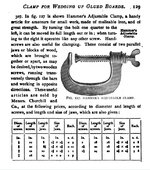
RE: tubeguy's post #10 showing Hammer & Co., Branford, CT oil can and C-clamp:

That led me down a rather intriguing rabbit hole over the course of the last hour or so, which led to "Malleable Iron Fittings Co." (also of Branford, CT.)

I am now wondering if "Malleable Iron Fittings Co." and/or "Hammer & Co." might be the parties responsible for the ubiquitous "Malleable Iron" C-clamps found in the second-hand market.
I found a patent date of June 18 1872, but I can't pin it down to a patent number. (I still haven't quite figured out how to enter a date into the USPTO search window.)

Help?
 
OP
J

Joe Huld

Well-known member
Joined
Sep 21, 2017
Messages
308
Location
South Pasadena Ca.
completely off-topic here:

RE: tubeguy's post #10 showing Hammer & Co., Branford, CT oil can and C-clamp:

That led me down a rather intriguing rabbit hole over the course of the last hour or so, which led to "Malleable Iron Fittings Co." (also of Branford, CT.)

I am now wondering if "Malleable Iron Fittings Co." and/or "Hammer & Co." might be the parties responsible for the ubiquitous "Malleable Iron" C-clamps found in the second-hand market.
I found a patent date of June 18 1872, but I can't pin it down to a patent number. (I still haven't quite figured out how to enter a date into the USPTO search window.)

Help?
I used to use a lot of c clamps as welding clamps and have had a lot of them marked "Malleable" with and without a manufacturers name. I think in most cases "Malleable" simply refers to the malleable iron material. Malleable iron was made by holding the cast object at a high heat for a long time to burn off some of the excess carbon, it worked very for thin cross sections but not so well for thicker ones.
I haven't figured out how to enter a patent date either. I found the patent number on the Hammer oil can the hard way: first verified that the date fell on Tuesday and then went to the patent office gazette for that date and looked through patent by patent. In the 1870-80s 200-300 patents were issued per day so it is a task.
 

four.cycle

Well-known member
Joined
Oct 19, 2015
Messages
29,257
Location
Tacoma, Washington
Hammer / Hammer & Co., Branford, CT / malleable iron clamps / patent ? Jun 18 1872 / (see also Malleable Iron Fittings Co.) / https://archives.lib.uconn.edu/islandora/object/20002:860134073 /

Malleable Iron Fittings / Malleable Iron Fittings Co., Branford, CT / cast & alligator wrench /

If we can take at face value the patent DATE on the C-clamp shown in the engravings used in early "Hammer" advertisements, it appears that the applicable patent is 128064 Jun 18 1872 James H. Phillips for an "Improvement in Clamps".
I am awaiting confirmation that I have ascertained the correct and applicable patent number, and will hopefully have an answer in the near future.
 

Attachments

  • 1890 Hammer & Co. clamp (patent Jun 18 1872).jpg
    1890 Hammer & Co. clamp (patent Jun 18 1872).jpg
    179.6 KB · Views: 26
  • 1906 Iron Age Vol Hammer & Co. ad.jpg
    1906 Iron Age Vol Hammer & Co. ad.jpg
    223.4 KB · Views: 45

crguy

Well-known member
Joined
Jan 24, 2016
Messages
2,659
Location
SW Washington
I used to use a lot of c clamps as welding clamps and have had a lot of them marked "Malleable" with and without a manufacturers name. I think in most cases "Malleable" simply refers to the malleable iron material. Malleable iron was made by holding the cast object at a high heat for a long time to burn off some of the excess carbon, it worked very for thin cross sections but not so well for thicker ones.
I haven't figured out how to enter a patent date either. I found the patent number on the Hammer oil can the hard way: first verified that the date fell on Tuesday and then went to the patent office gazette for that date and looked through patent by patent. In the 1870-80s 200-300 patents were issued per day so it is a task.
Correct. The term "Malleable iron" wasn't a Hammer exclusive. It was used by a number of manufacturers.
 

choonks13

Member
Joined
Mar 31, 2019
Messages
16
Location
NJ
Hammer / Hammer & Co., Branford, CT / malleable iron clamps / patent ? Jun 18 1872 / (see also Malleable Iron Fittings Co.) / https://archives.lib.uconn.edu/islandora/object/20002:860134073 /

Malleable Iron Fittings / Malleable Iron Fittings Co., Branford, CT / cast & alligator wrench /

If we can take at face value the patent DATE on the C-clamp shown in the engravings used in early "Hammer" advertisements, it appears that the applicable patent is 128064 Jun 18 1872 James H. Phillips for an "Improvement in Clamps".
I am awaiting confirmation that I have ascertained the correct and applicable patent number, and will hopefully have an answer in the near future.
Did you ever find a patent number for the Hammer & Co. C clamp? The 128064 James Phillips patent I saw was for a clamping table. I have one of these clamps but the patent date was to worn to read. Anyway your post helped me identify what company made the clamp. Thanks Paul Choonks13
 
To avoid these ads, REGISTER NOW!
Top Bottom