To avoid these ads, REGISTER NOW!

Generator powering house from shop?

fitter30

Well-known member
Joined
Jun 23, 2019
Messages
2,981
Location
Peace Valley,mo
Have a 6500 watt peak generator converted to lp. Have a outside plug like post 24 with a 6' factory made cord. 500 gallon lp tank for the generator, cook stove and emergency heat cast iron stove. Run a fridge, window ac 5k btu, lights ,well pump, water heater and microwave not at the same time. Window ac is for a bedroom in summer kept in a closet. Lp never goes bad living 15 miles to closest gas station with a 1/4 mile driveway in the ozarks. Generator kept in the garage on a dyi cart with pneumatic tires rolls easy.

IMG_20220130_152828.jpg
 
To avoid these ads, REGISTER NOW!

rsanter

Well-known member
Joined
Dec 22, 2007
Messages
18,517
Location
visalia ca
The best way to do it is to set up a priority sub panel next to the main panel. The priority sub panel would have just the circuits that you would want/need powered from the generator.

Then when you flip the interlock you will disconnect the sub panel from the main panel and you will be safe. This is better than having to remember to turn off certain circuits and such
 

My Old Tools

Well-known member
Joined
Jun 4, 2014
Messages
5,438
Location
Hamrick Lake, TX
Just curious what actually will happen if someone fed their main with a generator and didn’t have a disconnect during an outage, and the power came back on? I see everyone saying you need an interlock, but I know there are dumb people out there just cutting 2 extension cords and splicing so there are male ends to connect a generator.
In my case, the generator will kick its breaker immediately if you forget to disconnect from the grid.
 

dave*99

Well-known member
Joined
May 5, 2009
Messages
4,268
Location
Coastal NJ
The best way to do it is to set up a priority sub panel next to the main panel. The priority sub panel would have just the circuits that you would want/need powered from the generator.

Then when you flip the interlock you will disconnect the sub panel from the main panel and you will be safe. This is better than having to remember to turn off certain circuits and such
It really depends on your needs (load). My interlock is in the main panel and my generator can therefore be connected to all circuits. I have Natural Gas heating, cooking and water heating. All lighting is LED. So the only thing I switch off is the central AC breakers. Some of the priority sub panels only have a limited number of circuits. Newer houses tend to have many many circuits. I probably have 12 lighting circuits alone spread across 2 panels that are some distance from each other. And with LED lighting I with them all powered.
 

Innovate1

Well-known member
Joined
Jul 28, 2014
Messages
4,289
Location
Illinois near St. Louis, Missouri
Even if this were code compliant, which I don't think it is, I don't see the point. The whole idea with the interlock is so you can turn on what you want without a separate transfer panel limiting you. So you are essentially saying you want to have the AC breaker in a separate panel so you don't turn it on, instead of just not turning it on.
What they mentioned is certainly code compliant anywhere they allow main breaker interlocks. (my understanding is some areas don't allow any form of breaker interlocks and require a true DPDT transfer switch although more areas may be allowing interlocks. St. Louis County didn't allow them a few years ago but I see the big box stores now carry the interlock kits). The point is to prevent power from being fed upstream. Putting it on a subpanel does that. And it's as good as many of the generator panels in that they aren't big enough to be used for all the house circuits.

I put my interlock on a sub panel about 18 years ago and it passed inspection (and it was pretty thorough). Main breaker interlocks were hard to find as they were just coming out. But after adding a detached garage with heat and water to the main panel I am thinking I should move the interlock to the main panel. But it still doesn't cover the whole house - I have a 325 A meter base and two 200A panels - fairly common around here. I got lucky in that all the essential stuff I want to power is in one 200A panel.

Main panel interlock is more flexible but subpanel is fine too if that's what someone wants to do.
 

dave*99

Well-known member
Joined
May 5, 2009
Messages
4,268
Location
Coastal NJ
Rules vary from location to location. There are new products and greater acceptance now than before.

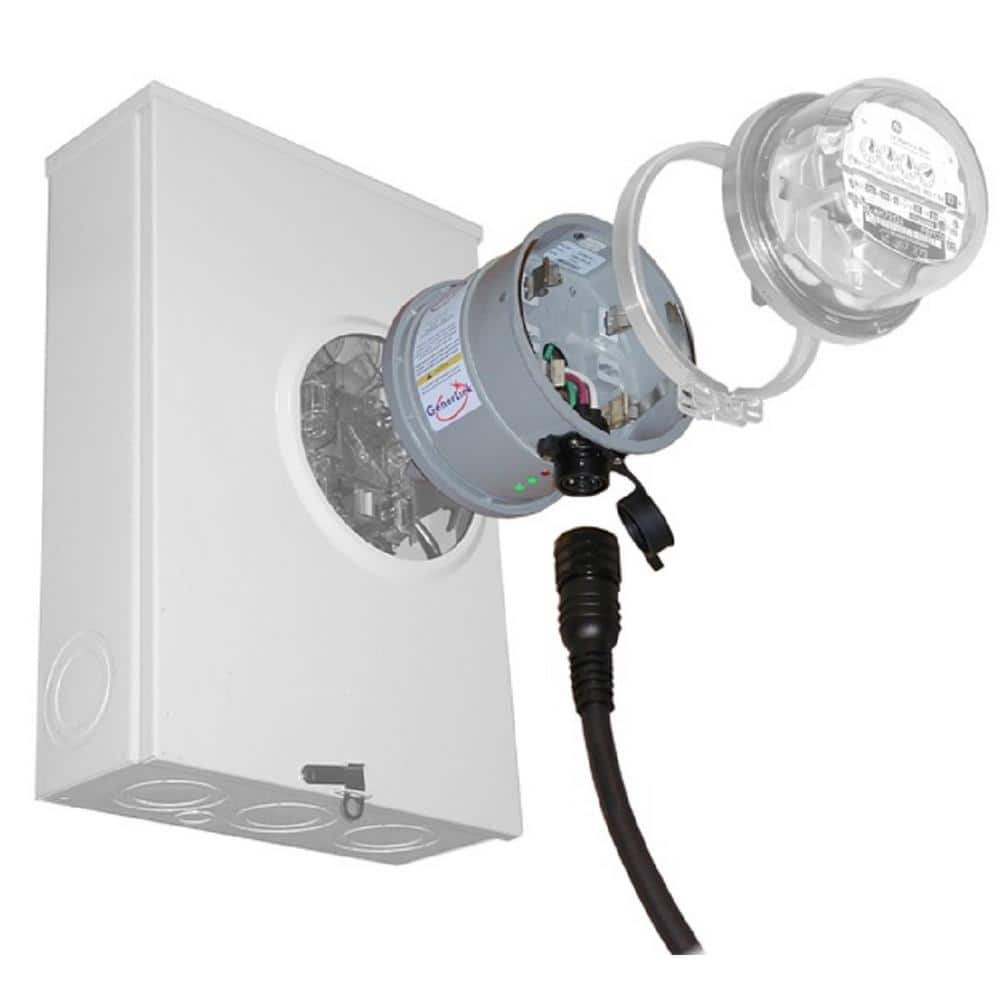
Here is an example:
In some locations a meter base generator inlet is not allowed. In other locations, you can buy it from your power company.


1644245758674.png
This device isolates your house from the POCO power. The installation manual has some useful info if you are new to the topic.
 

89MustangGX

Well-known member
Joined
Feb 24, 2008
Messages
1,023
Location
Stanwood, WA
Rules vary from location to location. There are new products and greater acceptance now than before.

Here is an example:
In some locations a meter base generator inlet is not allowed. In other locations, you can buy it from your power company.


1644245758674.png
This device isolates your house from the POCO power. The installation manual has some useful info if you are new to the topic.
That's pretty neat. Seems like a great solution actually, talk about easy install. I didn't look at it yet, but would be great if it even had an indicator to tell you when POCO power is restored too.
 

MongoTA

Well-known member
Joined
Mar 10, 2018
Messages
1,004
Location
CT
@MushCreek

I'm a bit late to this discussion, my apologies if reviving a couple week dead thread is bad forum etiquette.
With that written?

It sounds like I have a similar generator, a Honda eu6500. I've had it for several years. For our power outages I needed something simple that can be EASILY operated by my wife if I'm not home. This is about as simple as I could get:

APC UTS10BL Transfer Switch

Price has gone up since I bought, and they do have a smaller (less $$) version. It's a generator transfer panel that load sheds, so it's self-regulating with regards to load control. When you install it, you program/prioritize the various circuits. Example, if my well pump kicks on, and if that load will overload the generator which might cause the generator to kick off and the whole house to go dark, I can program (for example) the panel to load to shed my fridge/freezer circuit. Because I don't want my fridge/freezer to short-cycle, I program that circuit so if it DOES shed, it stays off for say 5 minutes. Then when it does repower, I can program the fridge/freezer circuit to not be shed for 10 minutes minimum.

Sounds more complicated than it is. Essentially, you prioritize circuits. This circuit over that. Minimum ON times for when they are powered and minimum OFF times if something has to be shed.

Without a doubt there are other ways to do this. Again, I needed simple and easy for my wife, as she has zero interest in flipping breakers.

When our power goes out, all she has to do is turn the key and power up the generator.

When the grid power comes back up, the generator continues to power the house for 30 seconds. If the grid power is stable, the panel allows the grid to power the house. She then goes outside and turns off the generator.

The panel does have the ability to auto-start the generator if the grid goes down. I don't have that enabled as I don't want the gas-powered generator to run if the house is empty.

My generator stays outside the house under a small shelter that protects it from weather but that affords it access to free air. I have a maybe 30' cable that connects the generator to an outlet I installed on the side of the house. Installation of all that, the panel, and then programming the panel took me about half a day.

The only negative I can write about the panel is that each circuit inside the panel is protected with a fast-blow fuse. An occasional power surge, usually when the grid comes on/off, can cause one of those fuses to blow. I've had this set-up for maybe 10 years and it things usually run smoothly. But I've had maybe 3 fuses blow over those years. Pretty easy to replace, my wife even did one once, I talked her through it over the phone.

You can get creative with the wiring. House is somewhat large but with the eu6500 and the UPC panel I can power most every convenience:
1) 220v circuit powers my well pump so we have water.
2) Oil burner so we have radiant floor heat and domestic hot water.
3) Powder room downstairs as well as master bath and kid's bath upstairs are powered.
4) All first floor rooms in the house are powered (My office, my wife's office, living room, basic kitchen circuits).
5) Microwave
6) Fridge and freezer
7) Kitchen outlets and gas (propane) cooktop
8) Master bedroom is powered.
9) Attic is powered (home theater and game room).

Significant things that are not powered:
1) Electric wall oven
2) Whole house central air conditioning
3) Electric clothes dryer
4) Kid's bedrooms. We are empty nesters. But with a flip of a switch I can depower the attic game room and power the kid's bedrooms.
5) My basement workshop.

Anyhow, just another idea.
 

dave*99

Well-known member
Joined
May 5, 2009
Messages
4,268
Location
Coastal NJ
That's pretty neat. Seems like a great solution actually, talk about easy install. I didn't look at it yet, but would be great if it even had an indicator to tell you when POCO power is restored too.
It has an indicator that tells you when the POCO power is restored.
 

Chumly

Well-known member
Joined
Dec 10, 2021
Messages
124
Location
Alpine, CA
Perspective and thoughts, I'm trying to grasp this too:

I passed code in California with a generator feed plug meant for a suicide line hook up in 2015 or so. Everyone signed off on it, including SDG&E, basically telling me "you better know how this works". As a an ex-lineman in another state (sing the song with me), we also had so many checks before you touch the line and you cut a lot of back-feeding out of the equation. Not all, but most. We physically cut the line forward of the problem area, fixed that, then fixed our cut...and that was the sketch part. I ain't saying I'd lick an 120V outlet, but I've been hit a lot and I'm only mildly stupid now.

That being said, doing it right is a great, and highly suggested idea. Now how can he do this from the shop and not be right by the house with said generator? They're out in the weather and catching hell unless you built a little coop around it. Thought we had a one chicken coop (seriously) then I figured out it's for a generator. Can you simply add something to the sub-box to send a signal to trip the transfer switch at the house to go to work?

CJ7VFR states the manual method which I'd chose doing this. I'd like an Auto sensing setup that when zero voltage is fed to the mains, it opens or switches to the transfer and sends to a sub-box you have pre-setup to just run what you can. Generac is my only source of info and their quote for a whole-house generator had that auto transfer and start option so I'm sure it can be done simply. Until then, Manual seems like the thing. Basically a knife switch, if this then that...not both and zero back-feed to the line.

We're off grid all the freaking time so it is a real question out here. If the wind blows they shut it off. If the moon is out, they shut it off. Did you look at me? Shut it off. Right now we're doing the suicide plug until the smart meter beeps and says we can go back.

Oh, and gas generators are about to be banned and electric cars a mandate in this state a couple years later.
 

Chumly

Well-known member
Joined
Dec 10, 2021
Messages
124
Location
Alpine, CA
while posting I just read MongoTA's APC $600 fix, you da man! Thank you so much.

Seems so simple since we had load-shedding transfer stuff in the Navy probably designed in the 50's. I'm looking into that APC right now and see if there's a way for the OP to get something like that working from the shop where he wants to run the generator from.
 

wyliesdiesels

Well-known member
Joined
Aug 14, 2012
Messages
20,021
Location
Modesto, CA
Perspective and thoughts, I'm trying to grasp this too:

I passed code in California with a generator feed plug meant for a suicide line hook up in 2015 or so. Everyone signed off on it, including SDG&E, basically telling me "you better know how this works". As a an ex-lineman in another state (sing the song with me), we also had so many checks before you touch the line and you cut a lot of back-feeding out of the equation. Not all, but most. We physically cut the line forward of the problem area, fixed that, then fixed our cut...and that was the sketch part. I ain't saying I'd lick an 120V outlet, but I've been hit a lot and I'm only mildly stupid now.

That being said, doing it right is a great, and highly suggested idea. Now how can he do this from the shop and not be right by the house with said generator? They're out in the weather and catching hell unless you built a little coop around it. Thought we had a one chicken coop (seriously) then I figured out it's for a generator. Can you simply add something to the sub-box to send a signal to trip the transfer switch at the house to go to work?

CJ7VFR states the manual method which I'd chose doing this. I'd like an Auto sensing setup that when zero voltage is fed to the mains, it opens or switches to the transfer and sends to a sub-box you have pre-setup to just run what you can. Generac is my only source of info and their quote for a whole-house generator had that auto transfer and start option so I'm sure it can be done simply. Until then, Manual seems like the thing. Basically a knife switch, if this then that...not both and zero back-feed to the line.

We're off grid all the freaking time so it is a real question out here. If the wind blows they shut it off. If the moon is out, they shut it off. Did you look at me? Shut it off. Right now we're doing the suicide plug until the smart meter beeps and says we can go back.

Oh, and gas generators are about to be banned and electric cars a mandate in this state a couple years later.
cant add it to the subpanel but what youre describing is an auto transfer switch
 
To avoid these ads, REGISTER NOW!

Chumly

Well-known member
Joined
Dec 10, 2021
Messages
124
Location
Alpine, CA
Thanks Wyliesdisels, I was quickly pointed to that APC that did kind of what I think I would want, but I seemed to have hijacked the OP's desires to have a generator not connected to the main breaker box, which only leads back to
1) Suicide plug in the garage and breaker play up at the mains (we're all not suggesting these plugs openly).
2)Moving the Main Breaker box to where he wants the generator to run (Huge money for little gain)
3)Longer cord and build a little shack for the generator.

[Edit upon re-reading] Still seems like back-feeding power from the garage sub up to the home's main unless the garage/shop has it's own power line drop; Then everything goes to heck. I like under the deck if you can protect it from weather and figure out how to re-fuel it easily. Couple 1-by slats to the joists giving some plywood "roof" and angle...it's a roof for a start of a housing. I just can't get down and re-fuel a 5500W unit under the porch without something like these:

 
Last edited:

Ole Slewfoot

Well-known member
Joined
Feb 22, 2016
Messages
5,098
Location
Freedom, CA
Just curious what actually will happen if someone fed their main with a generator and didn’t have a disconnect during an outage, and the power came back on? I see everyone saying you need an interlock, but I know there are dumb people out there just cutting 2 extension cords and splicing so there are male ends to connect a generator.
My neighbor took a stab at that one.
The transformer atop the nearest pole turned into lightning.
20 minutes later ( I was about 15 minutes from town) a bucket truck with searchlight shining into the trees showed up.
They billed her for a transformer, and her generator needed replacement.
 

Chumly

Well-known member
Joined
Dec 10, 2021
Messages
124
Location
Alpine, CA
I'd get a lawyer for blowing a local transformer with a common generator.

The harm is the thought of why the power is out. In most of the US the power is out because a power line is down and is actively on the ground for the public to access or their are others working on that line. The other, now, is it's shut off to stop fires during high winds.

The second is a rant so let's focus on the first: If a power line is down, the grid controller must actively send out calls to cut power to that branch and that's when you get a power outage to your home in a wide area (don't touch downed power lines stuff) while workers get on site to keep public safe, who mostly aren't right by the line that fell occurs. The crew arrives, communicates back the location of the fault, and grid op turns on un-affected circuits...power back to those on the branch, not the circuit. This is when there's a meeting of how to attack the problem and the plan to move forward on the repairs.

It's accepted, like firearms, that all lines are hot at all times and are treated accordingly. There's many procedures in place and send-to-ground is one they'll use, but you firing up a generator and back-feeding to a grid on a broken line linemen are touching has that risk that someone could get shocked by not having some actual protocol in place. There's too many local grids to say it's a universally accepted safety protocol that you could actually harm a life by firing up a generator and feeding them 120V/20A with a little Honda 2200. Half an Amp will kill ya is the saying, right? 50,000volts? Give it to me...blow my fuse.

The local transformer blowing up thing is common...it's dirty and old. Bakersfield was like a fireworks show after a rain following a drought. That's their problem. No one is blowing up a local transformer with a common generator.

Bury the lines...
 
Last edited:

dcg9381

Well-known member
Joined
Jun 20, 2018
Messages
11,767
Location
Austin, TX
Rules vary from location to location. There are new products and greater acceptance now than before.

Here is an example:
In some locations a meter base generator inlet is not allowed. In other locations, you can buy it from your power company.


1644245758674.png
This device isolates your house from the POCO power. The installation manual has some useful info if you are new to the topic.

Wow.. That's cool.. Never even seen that.. It'd make it much simplier.
 

AP514

Well-known member
Joined
Jan 23, 2014
Messages
768
Location
Pearland, Tx
I am curious about just what the generator can handle. It's supposedly 6500 watts. Theoretically, that should run my water heater. The HVAC units are only 10 amps, or about 2400 watts. The last time we lost power, we cycled between keeping the fridge and freezer cold, and typical tasks like making coffee in the morning. I didn't have a hook-up for 240V., so I didn't try the water heater. We'll really only need the HVAC if we lose power in the dead of winter, like an ice storm. No A/C is an inconvenience, but we could survive it.
What HVAC units are those ? window units ?
My 2.5ton unit only uses 10Amps while running.. but start-up is a whole other Ballgame.....
 

dave*99

Well-known member
Joined
May 5, 2009
Messages
4,268
Location
Coastal NJ
Man that Generlink 30AMP is VERY PRICEY....$650
As a piece of hardware yes, but for those that call an electrician to install a transfer switch and inlet with permit….. vs the POCO installs this in 30 seconds…. YMMV

I installed an interlock switch in my main with an inlet. When my neighbor wanted to know how HE could hook up HIS generator to his house I showed him the Generlink.
 
To avoid these ads, REGISTER NOW!
Top Bottom