

You are using an out of date browser. It may not display this or other websites correctly.
You should upgrade or use an alternative browser.
You should upgrade or use an alternative browser.
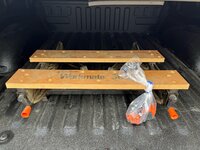
Tool score!
- Thread starter Rewind97
- Start date


PelicanPines
ALLIANCE MEMBER
Nice score ... $50 ... you have a lot of **** in you. 
Ricky Joe
Well-known member
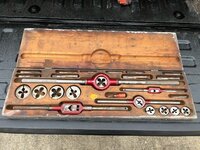
Greenfield Tap and Die, Greenfield, Massachusetts. High quality, good score!
RTM
Well-known member
GTD is Greenfield Tap & Die, Argh RJ beat me to it by seconds
RoninB4
Well-known member
Be a bit wary using any of the taps/dies. They are good quality but age and use may very well have dulled them. Fine for cleaning up existing threads but cutting new threads demands sharp cutting edges that may now be dull and break off when using. Use cutting fluid/oil when threading. I've used many of GT&D taps/dies over the years and liked them. Nice find.
RoninB4
Well-known member
Any way to tell the age of the set?
You're touching on one of the three things I do when purchasing used tooling, age and history of the tool. First off, metal does not reveal much info for date of origin but does show the history of duty, wood wears it's age and pedigree with pride. You have to look for the clues in less obvious places.
Begin by examining the outer surface of the top/lid. Does it have a faded logo on it? Makers of industrial tooling used to have their logo/brand name on the outside. Some do/did on the inside as well. Product pride meant a whole lot more years ago than it does now. Makers wanted you to remember their product by a glance when you pulled it out and put it away. Quality tooling is like that. Now it almost seems as if they don't want you to remember how poorly something performed in hopes you'll forget the name and buy another (but I digress......) If there's no logo remaining then you next look at the fitment of what's in the container. Do the products appear to properly fit the cut-outs well or has the case been re-purposed from a different maker?
Next, examine the type of wood used for the case itself. Does it look like Pine, Poplar, Boxwood, or some nameless variety of white-wood? Decades ago (showing my age here...) companies that made a top quality product often charge top dollar for it too. That price demanded a good looking, durable case appropriate for the contents. Industrial hand tools often had cases made from maple. Measuring instruments had cases from mahogany (Brown & Sharpe for example). Very fine instrument cases were often made of cherry (for a different reason), often had a "French Fitted" case with a velveteen material to protect the instrument (Lufkin dial indicators for example) that might be covered in a leatherette type of material (Gerstner tool chests, Lufkin and Federal indicators). Quality of packaging/storing was important and you would know at a glance there was something special inside. Distinctive colors/materials were also used to associate a brand, still are for lots of things.
The inside of a "fitted" case can also be a clue to age. Open cell foam is used to keep things from rolling around in the case and protect surfaces from banging into each other. Open cell foam started replacing the velveteen material because it was cheaper, a bean counter type decision. It works ok but it does deteriorate after a few decades into crumbly particles. I have a couple of originals for micrometers (inside, depth, etc.) that were a crumbly mess after 25 years. If it still looks ok and is solid then it's been made in this century.
As injection/blow molding became cheaper many makers started going with the cheaper plastic cases, that started in the mid 1970's. The imported tooling still used wood for a case as molded cases were more expensive for a product they weren't sure if it was going to be around for very long, still do for a lot of the cheap Chinese stuff. You can tell a Chinese made wooden case almost blindfolded by sharp corners, inexpensive type of wood, cheap lacquer finish, and cheaply made hinges. Before it sounds like I'm knocking imported tooling let me say that I own tooling/instruments from all over the world. I still have a Polish made micrometer I bought in 1979 that I trust. I also have a newer made threading die made in Wisconsin that was **** from day one.
As for your set (finally) I haven't seen a tap/die set in an original wooden box for decades. IF original, it might have been made in the late 1960's or 70's. It could also be a home/shop made box to hold/protect the contents instead of rolling around loose in the toolbox. I've re-purposed several cases from different makers and also made several cases from wood for my own tooling that came with no case or a crappy plastic one. Wooden cases get the shyte beat out of them, particularly in a rough shop environment. If the user(s) paid for it or were conscientious workers then it might be OEM. I try to be careful with mine as it's part of the history of the tool and maybe the next owner will be curious enough to want to know the history as well. Examine the case, clean it up with gentle cleaning products (no sanding) and a light coat of BLO (beeswax optional) rubbed in well will make it look good. A light coating of oil on the steel components will help prevent further rusting. Post up your findings, I'm curious about it too.
My apologies if I've bored anyone with TMI, I'll go sit down in the back row now.
Last edited:
Iridium rand
Well-known member
- Joined
- Sep 23, 2021
- Messages
- 218
Greenfield is the oldest in the business in the US at least, the military literally made a fortification around their factory in WW2 because there wasn’t anyone else they could source taps and dies from on a large enough scale
Hello I am new to this site, but definitely not to toolmaking. But I have question for you and I hope you can help. I’m curious about dating my Gerstner toolbox… wait, that didn’t come out right! LOLYou're touching on one of the three things I do when purchasing used tooling, age and history of the tool. First off, metal does not reveal much info for date of origin but does show the history of duty, wood wears it's age and pedigree with pride. You have to look for the clues in less obvious places.
Begin by examining the outer surface of the top/lid. Does it have a faded logo on it? Makers of industrial tooling used to have their logo/brand name on the outside. Some do/did on the inside as well. Product pride meant a whole lot more years ago than it does now. Makers wanted you to remember their product by a glance when you pulled it out and put it away. Quality tooling is like that. Now it almost seems as if they don't want you to remember how poorly something performed in hopes you'll forget the name and buy another (but I digress......) If there's no logo remaining then you next look at the fitment of what's in the container. Do the products appear to properly fit the cut-outs well or has the case been re-purposed from a different maker?
Next, examine the type of wood used for the case itself. Does it look like Pine, Poplar, Boxwood, or some nameless variety of white-wood? Decades ago (showing my age here...) companies that made a top quality product often charge top dollar for it too. That price demanded a good looking, durable case appropriate for the contents. Industrial hand tools often had cases made from maple. Measuring instruments had cases from mahogany (Brown & Sharpe for example). Very fine instrument cases were often made of cherry (for a different reason), often had a "French Fitted" case with a velveteen material to protect the instrument (Lufkin dial indicators for example) that might be covered in a leatherette type of material (Gerstner tool chests, Lufkin and Federal indicators). Quality of packaging/storing was important and you would know at a glance there was something special inside. Distinctive colors/materials were also used to associate a brand, still are for lots of things.
The inside of a "fitted" case can also be a clue to age. Open cell foam is used to keep things from rolling around in the case and protect surfaces from banging into each other. Open cell foam started replacing the velveteen material because it was cheaper, a bean counter type decision. It works ok but it does deteriorate after a few decades into crumbly particles. I have a couple of originals for micrometers (inside, depth, etc.) that were a crumbly mess after 25 years. If it still looks ok and is solid then it's been made in this century.
As injection/blow molding became cheaper many makers started going with the cheaper plastic cases, that started in the mid 1970's. The imported tooling still used wood for a case as molded cases were more expensive for a product they weren't sure if it was going to be around for very long, still do for a lot of the cheap Chinese stuff. You can tell a Chinese made wooden case almost blindfolded by sharp corners, inexpensive type of wood, cheap lacquer finish, and cheaply made hinges. Before it sounds like I'm knocking imported tooling let me say that I own tooling/instruments from all over the world. I still have a Polish made micrometer I bought in 1979 that I trust. I also have a newer made threading die made in Wisconsin that was **** from day one.
As for your set (finally) I haven't seen a tap/die set in an original wooden box for decades. IF original, it might have been made in the late 1960's or 70's. It could also be a home/shop made box to hold/protect the contents instead of rolling around loose in the toolbox. I've re-purposed several cases from different makers and also made several cases from wood for my own tooling that came with no case or a crappy plastic one. Wooden cases get the shyte beat out of them, particularly in a rough shop environment. If the user(s) paid for it or were conscientious workers then it might be OEM. I try to be careful with mine as it's part of the history of the tool and maybe the next owner will be curious enough to want to know the history as well. Examine the case, clean it up with gentle cleaning products (no sanding) and a light coat of BLO (beeswax optional) rubbed in well will make it look good. A light coating of oil on the steel components will help prevent further rusting. Post up your findings, I'm curious about it too.
My apologies if I've bored anyone with TMI, I'll go sit down in the back row now.
But seriously, I have heard of all kinds of different details and/or features that the box may, or may not have. My question is this I was told that if the name stenciled in has curved upper and lower lines, it is post 1960 if they are curved up on top and down on the bottom then it is 1959 or older. The reason I’m asking is because I just saw this on eBay. It is an old Model 42. And I was told they stopped making these in the late 1940’s. I’m going to try to add some pictures but I’m not really from the “computer generation” LOL But thanks in advance for your help,
Best regards,
Frank
Attachments

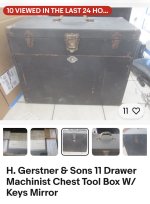

I apologize, I can’t believe I didn’t even ask you the question. What is the rule on dating the box by this method. Because I’m pretty sure that this box is from the WWII days? Thanks againYou're touching on one of the three things I do when purchasing used tooling, age and history of the tool. First off, metal does not reveal much info for date of origin but does show the history of duty, wood wears it's age and pedigree with pride. You have to look for the clues in less obvious places.
Begin by examining the outer surface of the top/lid. Does it have a faded logo on it? Makers of industrial tooling used to have their logo/brand name on the outside. Some do/did on the inside as well. Product pride meant a whole lot more years ago than it does now. Makers wanted you to remember their product by a glance when you pulled it out and put it away. Quality tooling is like that. Now it almost seems as if they don't want you to remember how poorly something performed in hopes you'll forget the name and buy another (but I digress......) If there's no logo remaining then you next look at the fitment of what's in the container. Do the products appear to properly fit the cut-outs well or has the case been re-purposed from a different maker?
Next, examine the type of wood used for the case itself. Does it look like Pine, Poplar, Boxwood, or some nameless variety of white-wood? Decades ago (showing my age here...) companies that made a top quality product often charge top dollar for it too. That price demanded a good looking, durable case appropriate for the contents. Industrial hand tools often had cases made from maple. Measuring instruments had cases from mahogany (Brown & Sharpe for example). Very fine instrument cases were often made of cherry (for a different reason), often had a "French Fitted" case with a velveteen material to protect the instrument (Lufkin dial indicators for example) that might be covered in a leatherette type of material (Gerstner tool chests, Lufkin and Federal indicators). Quality of packaging/storing was important and you would know at a glance there was something special inside. Distinctive colors/materials were also used to associate a brand, still are for lots of things.
The inside of a "fitted" case can also be a clue to age. Open cell foam is used to keep things from rolling around in the case and protect surfaces from banging into each other. Open cell foam started replacing the velveteen material because it was cheaper, a bean counter type decision. It works ok but it does deteriorate after a few decades into crumbly particles. I have a couple of originals for micrometers (inside, depth, etc.) that were a crumbly mess after 25 years. If it still looks ok and is solid then it's been made in this century.
As injection/blow molding became cheaper many makers started going with the cheaper plastic cases, that started in the mid 1970's. The imported tooling still used wood for a case as molded cases were more expensive for a product they weren't sure if it was going to be around for very long, still do for a lot of the cheap Chinese stuff. You can tell a Chinese made wooden case almost blindfolded by sharp corners, inexpensive type of wood, cheap lacquer finish, and cheaply made hinges. Before it sounds like I'm knocking imported tooling let me say that I own tooling/instruments from all over the world. I still have a Polish made micrometer I bought in 1979 that I trust. I also have a newer made threading die made in Wisconsin that was **** from day one.
As for your set (finally) I haven't seen a tap/die set in an original wooden box for decades. IF original, it might have been made in the late 1960's or 70's. It could also be a home/shop made box to hold/protect the contents instead of rolling around loose in the toolbox. I've re-purposed several cases from different makers and also made several cases from wood for my own tooling that came with no case or a crappy plastic one. Wooden cases get the shyte beat out of them, particularly in a rough shop environment. If the user(s) paid for it or were conscientious workers then it might be OEM. I try to be careful with mine as it's part of the history of the tool and maybe the next owner will be curious enough to want to know the history as well. Examine the case, clean it up with gentle cleaning products (no sanding) and a light coat of BLO (beeswax optional) rubbed in well will make it look good. A light coating of oil on the steel components will help prevent further rusting. Post up your findings, I'm curious about it too.
My apologies if I've bored anyone with TMI, I'll go sit down in the back row now.
Frank
four.cycle
Well-known member
Hello @FJT and welcome to the site.
Keep this link handy
and this one too
HERE is the big "tool box" thread. You would do better to post your photos and ask your questions there, as some members just don't look at every thread and only follow certain discussion threads.
Sorry, I don't know anything about Gerstner.
Gerstner / H. Gerstner & Sons, 20 Gerstner Way, Dayton, OH 45402 / https://gerstnerusa.com/ / est. 1906 / tool storage systems /
Keep this link handy
and this one too
HERE is the big "tool box" thread. You would do better to post your photos and ask your questions there, as some members just don't look at every thread and only follow certain discussion threads.
Sorry, I don't know anything about Gerstner.
Gerstner / H. Gerstner & Sons, 20 Gerstner Way, Dayton, OH 45402 / https://gerstnerusa.com/ / est. 1906 / tool storage systems /
RTM
Well-known member
Also, on top of what four.cycle said, look for the guide to wooden toolboxesI apologize, I can’t believe I didn’t even ask you the question. What is the rule on dating the box by this method. Because I’m pretty sure that this box is from the WWII days? Thanks again
Frank

'The' Guide for Wooden Machinist Tool Chests
'The' Guide for 20th Century Wooden Machinist Tool Chests This site was originally a Google Old Style, launched in Sept. of 2014. It used to be for the Pre-1960 Machinist Tool Chests and Cases. Google Sites had stipulated that it be converted to their New Site format prior to 9/1/2021. On July 18th
 sites.google.com
Author is a member here, it’s a great resource.
RoninB4
Well-known member
-Well hey there Frank. Dating your Gerstner? We don't kink shame here.....very much. Welcome from the foothills of Appalachia, pull up a chair and join the conversations.I’m curious about dating my Gerstner toolbox… wait, that didn’t come out right! LOL
RoninB4
Well-known member
-I'll apologize for not knowing a lot about Gerstner, they were almost always out of my budget range and the bulk of my extra(?) cash went to measuring instruments instead of the really nice boxes from Gerstner. Once I did come across a deal on the large machinist boxes, top, middle, and roll around bottom, for $700 new and I decided to pass. I changed jobs quite a lot back then and didn't think the wood boxes would hold up to frequent moving. Wood chests were really supposed to arrive at your job and only leave when you retired.What is the rule on dating the box by this method. Because I’m pretty sure that this box is from the WWII days? Thanks again
-What I do recall about Gerstner is whether the "and sons" as well as "Dayton" were printed. Older ones yes, modern ones no. What's in the photos is clearly of an older vintage. Some of the more knowledgeable members here can provide more info than I can. Searching the internet you'll also find websites that go into greater detail with Gerstner history. Wish I could be more help on that, glad you found yhou way here.
Last edited:
Thanks for taking the time to respond. All these older things are the same… they are all different! So many variables. It’s like trying to figure out what year that old Harley is by looking at the speedometer. Now you can actually get pretty close and then you look at the screws on the primary cover are the at 3&9 oclock or 12 &6 oclock lol!! But anyway thanks again.
I feel right at home already! I’m not going anywhere for a while (I hope not anyway)-Well hey there Frank. Dating your Gerstner? We don't kink shame here.....very much. Welcome from the foothills of Appalachia, pull up a chair and join the conversations.
CGarage
Well-known member
Call Gerstner, they will be able to help you.
There is a lovely woman there who really knows the production history and can help date it.
There is a lovely woman there who really knows the production history and can help date it.
Thank you, I appreciate all the help. It’s anc amazing. This is probably going to sound strange but. I didn’t think I would get anywhere near the level of response that I received. I was really expecting a response like: ya that’s right, or something else brief, but similar. So, here goes the long version; (I apologize in advance loI) I can kinda date them … a little. Actually the box in the pictures is not mine. I just happen to know for sure that, the one in the picture is from the war years, maybe as late as 49, but that’s just a maybe. So definitely no later. Because they couldn’t get good white oak during WWII due to rationing. So they used a different (cheaper) wood and covered them with the leatherette that you can see in the pictures. Where it gets confusing to me is that, I was told if the stencil of name on the inside of the bottom of the box, has a curved up top line and a curved down bottom line; then it is post 1960. Which obviously this box is not, and if they are straight it is pre 1940, which could still be true. I’ve never seen one that I was sure of the date  . I am really trying to date the one that I own. To the best of my knowledge they stopped making the one I own in 1959. But it has the curved lines which were not supposed to start until after 1960 which obviously is incorrect. So you can see my confusion. I hope this doesn’t keep anybody awake at night!
Thanks for all your help. I’ve been a toolmaker for over 40 years so if there’s any questions or advice I can offer, I would be happy to help. Thanks again to everyone, and Merry Christmas.
. I am really trying to date the one that I own. To the best of my knowledge they stopped making the one I own in 1959. But it has the curved lines which were not supposed to start until after 1960 which obviously is incorrect. So you can see my confusion. I hope this doesn’t keep anybody awake at night! Thanks for all your help. I’ve been a toolmaker for over 40 years so if there’s any questions or advice I can offer, I would be happy to help. Thanks again to everyone, and Merry Christmas.
RoninB4
Well-known member
-Me too, that almost feels like an AA meeting where I stand up and say "I'm a recovering toolmaker"Thanks for all your help. I’ve been a toolmaker
-We're about the same vintage and have likely chewed on some of the same grit. As a long time metal hacker you're probably aware of the multitude of differences in the boxes due to being able to order different woods and IIRC one could even pay a little extra for limited availability in more expensive grades of wood as listed in older catalogs. I've seen examples of tiger/flame/birds-eye maple, highly figured oak, walnut, and cherry that were distinctly different than the more common plain vanilla examples. Determining the date by font may not account for early prototype stamps or change-over but it should be close. I hadn't considered the leatherette explanation, thank you for that.for over 40 years
-Rather off-topic that might interest you: Determining vintage/authenticity in old(er) things can be rough, especially in art and/or antiques. I once worked with a Russian immigrant with a crew in Russia that fabricated maker stamps, forgeries, and fakes for valuable antique items. He told/showed me how to make silver appear to be gold with a boiled egg and an onion, it worked when I tried it at home. An adage sometimes heard is "If you've seen 10 (insert maker name) then you've seen 11 forgeries/fakes.