I just thought of another major use of wire I use - hanging parts of stuff I rebuild so I can spay paint them. I have a wide reaching magnolia tree where I hang stuff to paint in warm weather. I keep lengths of wire there always so it's quick to tie and paint parts. I also have a grid under an awning which had about 20 wires always hanging there for when I need to paint small parts.
Here is a fabrication use of wire where I added an overhang onto a headache rack for a pickup. I have a tiny shop so no room for a fabrication table. Instead I have trailer hitch extension slots built into the 20" deep work bench to support long projects.
Here you see the cab arms tacked on to the headache rack. Welding distorts so if you can't fix components down to a large fab table you need to come up with options.
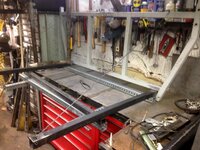
^ I have square unistrut in the trailer hitch pockets and long unistrut supporting the cab arms I'm welding to the headache rack. Tie wire is added diagonally to pull the cab arms square after they were lightly tacked to the headache rack.
In this shot you can see that attaching the wire doesn't have to look pretty, it will tighten up and hold after you twist the wire. The wire takes a lot of force. The wire was doubled up and then brought back down to the start and twisted to the other end to form a kind of giant loop. A square can be seen in the far corner to indicate when the cab arms are pulled square.

Here you see a bolt inserted between the 2 double strands of wire. It is used to twist the 2 strands together to shrink their length thereby sucking the cab arm upward until it is square to the headache rack. Any rod, screw driver etc. will do this job.
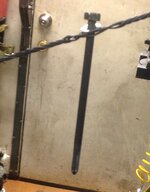
It is square now.

Here you can see the diagonal wire used to pull the cab arm sideways to square it that way.

After the wire pulls everything square by twisting it, I tack hard tubing in place of the wire and then finish welding the cab arms to the headache rack. Adding rigid tubing allows me to handle the assembly, turn it over etc in a safer manor than the twisted wire would allow by itself. The twisted wire allows for very gradual controlled adjustments before tacking in place in multiple places.

Here is the finished project. It's just what the client wanted. It looks and is completely square from every angle.


