To avoid these ads, REGISTER NOW!

DMM & amp-probes for parasite draw

emoze

Member
Joined
Oct 31, 2017
Messages
22
OK - i have looked at a few other threads i find on these subjects here - am looking for an amp-clamp-probe that is reliable for low mV=mA parasite draw diagnostics &/or volt-drop diagnostics on newer cars where it's problematic to disconnect the battery for direct measurements & difficult to probe micro fuses in nearly inaccessible places whilst simultaneously watching a meter

i have tried both an Innova 3347 and a eis-695 with my older Fluke 88 and the readings bounce erratically - i dunno if it is the Fluke or the probes ??? The Fluke will zero & hold zero before i plug in any leads, but then gets erratic when leads are plugged in; worse when the probe is plugged in. The 2 probes above will sometimes temporarily zero, but won't hold zero, and after being attached for readout will "reset" to some higher minimum reading - like reading 5mV then jumping to say 18 if a circuit is activated , then never going back to 5 after the circuit is off (or fuse pulled) , but if i then remove the probe, reset to zero & reattach, it again reads 5 -- so it's impossible to know if there is a continuing draw that persists on the circuit

one post on another thread simply says these probes are unreliable at low output ranges - is so why do so many folks use 'em?

i posted related DMM question here #58 - https://www.garagejournal.com/forum/threads/best-budget-dmm.464320/page-2#post-9538158

?? ideas & recommendations??
 
To avoid these ads, REGISTER NOW!

kbeefy

Well-known member
Joined
Sep 14, 2013
Messages
3,453
Location
Harington, Eastern Washington
I've used several amp clamps that attach to a multimeter for the same thing and never had very good luck with them.
I'd imagine a dedicated tool would be a better choice, but I've never had access to one that would measure mA.

My current one is a Mac, but I much prefer hooking a fuse buddy inline.
 

dogdog

Well-known member
Joined
Nov 15, 2011
Messages
12,711
There are plenty of videos and articles on how to check parasitic draws from checking voltage drop across fuses. Just look up and print out that fuse resistance chart.

Me... I trust inline amp checks more than amp clamp probe. There are two different sensors on those amp clamp probes for AC and DC... just make sure your probe is capable of AC and DC. Sorry don't have a brand recommendiation. But I do have a large 200AMP capable Shunt from Ebay.
 

Buckaroo5

Well-known member
Joined
Oct 18, 2012
Messages
824
Location
Central Ohio
This little rig makes it easier to use your DMM in line to measure parasitic draw. This video is a MAC Tools version but Lisle makes it (#64970). A little over $20 on Amazon.
 

charbar

Well-known member
Joined
Feb 6, 2021
Messages
1,995
Location
Midwest
Are you sure your meter isn't holding the max value for some reason?


I've never liked an amp clamp for parasitic load testing, even on a graphing multimeter. DMM inline is still my go to.
 

richfinn

Well-known member
Joined
Jan 29, 2011
Messages
4,814
Location
Leeds, Yorkshire, England

I wouldn't bother with a current clamp for this task, the resolution and constant drift will just frustrate you (unless you spend a lot of money!!!)

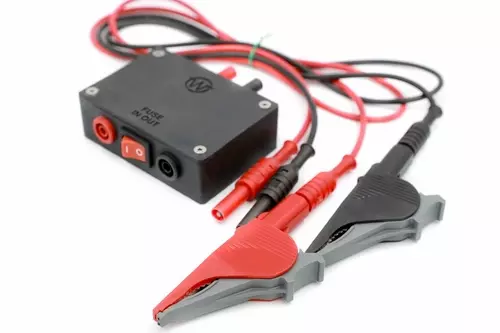
Maybe look into something like this


take the amp drain measurement with your Fluke Meter set to amps (and then safely remove your meter without disturbing the test) and next step use your Fluke again set to mV range to find the "hot fuses" (record the positions and mV drop) and then find the culprit using this handy calculator to convert mV to amps


These test probes facilitate single handed vehicle fuse testing in very awkward locations

 
Last edited:

WWheeler

Well-known member
Joined
Jun 23, 2015
Messages
4,105
Location
Middleofnowhere USA
Learn to use power probe's table for calculating parasitic draw by measuring voltage drop across fuses is the best way. WAAAAY better than an amp clamp. Lots of videos showing this from the likes of Eric O @ South Main Auto., Ivan @ Pine Hollow Diagnostics, Humble Mechanic, etc.


Easiest way is to use a thermal imaging camera though unless the draw is super super tiny you can usually see it right off the bat.
 
Last edited:

WWheeler

Well-known member
Joined
Jun 23, 2015
Messages
4,105
Location
Middleofnowhere USA
Usually I'm looking for 20-50mA, I haven't had any luck with the thermal (Seek) camera.
:unsure:

A normal amount of draw for most cars is between 50-milliamp to 85-milliamp. Lots of newer cars do this right off the lot. That won't drain your battery unless you're leaving it for weeks at a time.

Edit: If you're looking that small you can find what fused circuit it's on by measuring voltage drop across the fuses. It doesn't take long once you've gotten the car's modules to go to sleep.
 

xjfish

Well-known member
Joined
Feb 22, 2014
Messages
1,293
This little rig makes it easier to use your DMM in line to measure parasitic draw. This video is a MAC Tools version but Lisle makes it (#64970). A little over $20 on Amazon.
...
This is my go to for an actual draw diag. I bought one from Matco years ago. A person could make one fairly easy if wanted but this is cleaner. Also protects your expensive internal meter fuses. An amp clamp can often be used for a quick test to see if a draw actually exists without disconnecting battery.
 
To avoid these ads, REGISTER NOW!
OP
E

emoze

Member
Joined
Oct 31, 2017
Messages
22

I wouldn't bother with a current clamp for this task, the resolution and constant drift will just frustrate you (unless you spend a lot of money!!!)

Maybe look into something like this


take the amp drain measurement with your Fluke Meter set to amps (and then safely remove your meter without disturbing the test) and next step use your Fluke again set to mV range to find the "hot fuses" (record the positions and mV drop) and then find the culprit using this handy calculator to convert mV to amps


These test probes facilitate single handed vehicle fuse testing in very awkward locations

Thanks - great alternative tool ideas !

- it's a major hassle trying to do volt drop on a micro-fuse panel up on the side of left kick panel whilst laying on shoulder with flashlite in teeth - i have got a fuse buddy & some "extensions" but it is still a hassle
 
OP
E

emoze

Member
Joined
Oct 31, 2017
Messages
22
Learn to use power probe's table for calculating parasitic draw by measuring voltage drop across fuses is the best way. WAAAAY better than an amp clamp. Lots of videos showing this from the likes of Eric O @ South Main Auto., Ivan @ Pine Hollow Diagnostics, Humble Mechanic, etc.


Easiest way is to use a thermal imaging camera though unless the draw is super super tiny you can usually see it right off the bat.
thanks - had not seen the South Main video before - good stuff to keep in the bookmarks toolbox
 
OP
E

emoze

Member
Joined
Oct 31, 2017
Messages
22
consensus seems to be that amp-clamps are about worthless! (unless maybe very expensive ones )

here is an interesting idea from u-tube comments section

"Amp clamps are often not very accurate. They usually measure rounded to 1/10th of an amp at best. A trick I learned a long time ago to increase the amp clamps sensitivity tenfold is to take a 14 ga wire and loop it 10 times. Connect each end in series to the circuit being tested and install the amp clamp through the loop created. This increases the magnetic field in the circuit 10 times. The amp clamp reading now reads 10 times the actual circuit amperage. Move the decimal point one spot to the left and voila, a 10x increase of amp clamp sensitivity achieved. 1/10th sensitivity is now 1/100th."

of course that still requires breaking the circuit & going in series
 
Last edited:

theoldwizard1

Well-known member
Joined
Feb 22, 2011
Messages
43,166
Location
SE MI
consensus seems to be that amp-clamps are about worthless! (unless maybe very expensive ones )
Well, I would not go that far !

The problem with measuring amperage (current) is you need to start big and the work your way down. If the first measuring meter is not big enough (the load is higher than you think) you can damage the meter. Clamp meters, on the battery positive or negative cable, "get you in the ballpark".

Once you are their, voltage drop across a fuse is the best way to go. Don't worry about charts to figure he exact current. If the voltage drop more than a couple of millivolts, there is your problem.
 
Last edited:

Fedwrench

ALLIANCE MEMBER
Joined
Dec 9, 2007
Messages
14,954
Location
Valley of the sun
I like the Lisle tool because it protects the more expensive DMM fuses just like the old Vantages had a replaceable fuse on the back. I honestly have never gotten an amp clamp to succeed with measuring parasitic draw but, maybe I'm doing it wrong. :dunno:
 

Tools4Me

Well-known member
Joined
Jun 22, 2021
Messages
546
I don't have any experience using your particular amp clamps, but I do have some thoughts. I just looked at your Fluke 88 manual and I think the issue you are having with clamp probes could easily be the range your meter measures in. Fluke meters in general are more designed for industry and higher voltage tasks. What you are wanting to do with an amp clamp would be done more easily with a multimeter geared more towards electronics work. Your 88 Fluke's lowest mV range (for reading amp clamp results) is 600.0mV, which is just too high. Your Innova 3347 clamp has a setting for 10mV/1A which means that 30mA of actual current flow would show up on your multimeter as 0.3mV. That means any low value you measure using an amp clamp is going to be completely lost in the error and slight fluctuations of your meter when at the lowest range setting.

You really need a meter capable of measuring at least to the second digit after the decimal point for the mV function. That will also help tremendously when using your multimeter to measure mV voltage drop across a fuse, because the difference between 0.08mV and 0.14mV across a fuse can often represent a 30-50mA difference in current flow through the fuse. A Fluke 88 is just not the right tool for the type of work you are trying to do. A multimeter with something like a 60.00mV range would be much better, and any readings would also be much more stable if the amp clamp itself is able to to the job required. I think the cheapest Fluke multimeter that has a mV range that low is the $650+ 287/289 series, so that's why I'm saying you would be better off looking towards electronics multimeters for performing that sort of task. You can find electronics type multimeters with a low range mV setting for less than $100.

Secondly, lower current DC amp clamps are very sensitive to general magnetism and interference in the surrounding air. Mine will fluctuate all over the place just moving the clamp around without any wire in the jaws at all. To get a decent reading, the clamp needs to be put in the exact position it will be in when taking a reading and zeroed out at that location to remove all stray stuff in the air from affecting the results. After the clamp has been zeroed out in the exact position you want to take the reading in, move things around as little as possible while moving the wire you want to measure into the jaws of the amp clamp to take the reading.

Lastly, anyone using the fuse voltage drop method to measure current flow needs to be using OEM or established brand name fuses like Littelfuse or Bussmann. Cheap fuses like the ones found in the $10 fuse assortments sold at HF, local auto parts stores, and all over Amazon are poorly designed often often won't even burn open until the fuse's current rating has been vastly exceeded. They also have voltage drop to current curves that are way off from published charts, so any readings you take will often be meaningless or very misleading. Any error will also be in the direction of underreporting the actual current flow, so using the voltage drop method on generic fuses can cause you to miss parasitic draw issues completely even if you are using sensitive and accurate measuring instruments.
 
OP
E

emoze

Member
Joined
Oct 31, 2017
Messages
22
Your 88 Fluke's lowest mV range (for reading amp clamp results) is 600.0mV, which is just too high. Your Innova 3347 clamp has a setting for 10mV/1A which means that 30mA of actual current flow would show up on your multimeter as 0.3mV. That means any low value you measure using an amp clamp is going to be completely lost in the error and slight fluctuations of your meter when at the lowest range setting.

You really need a meter capable of measuring at least to the second digit after the decimal point for the mV function. ... you would be better off looking towards electronics multimeters for performing that sort of task. You can find electronics type multimeters with a low range mV setting for less than $100.
terrific advice & knowledge !!!(y)


sure enuf - if i touch the leads on mV per another post-er - the fluctuations go away - when i use the 88 in series i read 22mA draw on my current parasite gremlin issue, but using the clamp gets me anywhere from 1.8-5.3 mV reading (before conversion) which is not confidence building - i just want to avoid having to disconnect batteries for parasite diagnostics

S0 - ?? anybody got a recommendation for a new meter that can do this?
 
Last edited:
OP
E

emoze

Member
Joined
Oct 31, 2017
Messages
22
thanks to all for the education - i have been studying the accuracy-vs-range-vs-resolution issue - i am admittedly a novice on this topic

Maybe an ANSWER - the newer 88V has a HiRes 4-1/2 digit mode on almost all scales vs my old 88 which is HiRes for ohms only (but still the maybe problematic 600mV range) - guess it's time to upgrade (tough to spend $500 for something i will rarely use, ..... so it goes)

Also noted - the Innova 3347 clamp has 1mv/A & 10mV/A ranges (similar to that UT210e), versus my AES 695 which has 10mV/A & 100mV/A ranges
 
Last edited:

Showkey

"MEMBER EMERITUS"
Joined
Aug 9, 2014
Messages
8,638
Location
Wausau WI
Do not over think parasitic draw. Especially if your trying determine a draw exists.
Finding the exact cause of a draw can require more careful measurement and special techniques.

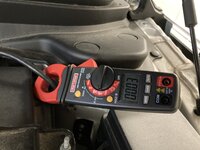
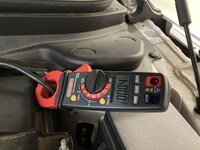
A simple DC clamp on amp meter can be the tool of choice. The pictures below show a Craftsman meter that cost $60 back in the day.
Normal draw will be 20 to 80 ma. ( .015 to .080 ma)
Bounce on the meter can be dash LED red light flashing, CANBUS signals, cell communications in modern car or just meter drift.

Key off, doors closed, hood switch closed measure draw might be estimated:
10 seconds lights on …….10.00 amps
20seconds lights turn off……..4.0 amps
90 seconds some CANBUS shuts down .125 amps. 125 ma
possible seconds to minutes later………. .030 to .040 amp. 30-40 ma

The .03 amps measure could actually be .030 to .039 the third digit is not important as the draw standard is .020 to .080 amps. So the bounce to .04 means the meter is seeing between .030 to .049 but more likely .035 to .045 amps ( 35-45 ma)
Yes, there are meters that will read to the third digit in amps ( .001) or 1ma. Is it absolutely required to measure vehicle draw …..no

615DF1D2-F759-4942-B323-98F89F48EC13.jpegD650E0BD-A2E7-43AE-885E-1FE6A7DA10C2.jpeg

It is not necessarily to measure every last milliamp.
Common key off draw issues:
after market alarms and remote start
stereo and Audio amps
Bluetooth and satellite device sticking on
CANBUS not sleeping….. often a CAN module is active, a signal switch is stuck, often door lock or input switch etc
Wiring issues especially damage or corrosion/water intrusion at connectors
relay stuck on like AC Clutch. ( several amps).

Often scan tool able to see body modules and switch/signal inputs is needed.

High draw several amps light builds or device stuck on.
125-500 ma draw module stuck on . One common item 125 ma was the bluetooth module.

under 200ma will take several days of non use to run the battery down. A +/- 200 ma draw might not show as problem in daily driver and only show when parked several days. Several amps might not last over night.

As mentioned there several dozen Youtube videos on the topic.
 
Last edited:
OP
E

emoze

Member
Joined
Oct 31, 2017
Messages
22
Finding the exact cause of a draw can require more careful measurement and special techniques.

A simple DC clamp on amp meter can be the tool of choice.
pretty good summary of the processes involved;

i have ordered a self-contained Uni-T 210E pro similar to your old craftsman just as an experiment to see if it will provide usable quick results reasonably close to direct in-series measurements with my Fluke; .(if it turns out to be useful, i'll certainly update this thread about that)

oops - was not my intent to divert the original meter-clamps question to a general discussion of diagnostics; i was just looking for expertise on the reliability of meters-with-clamps, and again thank all the post-ers here for the clarifications & tips ... (y) *

'yep, had excessive draw draining NEW battery to under 2.4V (= no start) in 24-30hrs which was intolerable on a car that used to sit for many days & still start fine

i was well beyond the general diagnostics; the excessive draw is/was specifically on the B-Can circuit which has multiple multiplexer components on a single fuse; i needed to narrow it to ONE bad-actor component & was hoping a clamp would help & speed up the diagnostics; am now hoping the tedious Honda DTC process will narrow it down., (no meter required for that)

*.... as above, i have no confidence in the variable & wildly unstable results using either of the 2 clamps with my Fluke ;

... i originally tho't (per u-tube) it would be nice to not have to disconnect a lot of wires &/or pull off a lot of panels to trace problems, but trying the clamps has been a trying experience at best,

( i wont say it was a waste of time cuz i learned some useful things from y'all ) (on the flip, i can't say that either clamp was a good investment, nor will be used much, if at all)
 
To avoid these ads, REGISTER NOW!
Top Bottom