To avoid these ads, REGISTER NOW!

New water heater blowing out taps

Rod N

Well-known member
Joined
Jul 21, 2011
Messages
835
Location
Keswick, Ontario
I get a new water heater and hirer a guy to install it as it's gas and the pipes need to be moved.

After he leaves, I notice the kitchen faucet has almost no pressure on the hot side. He comes back and we discover it's the tap. Pfister (who came up with this name? LOL) is sending me a new cartridge.

A couple of days later I have to move a couple of laundry taps so I need to shut the water off again. When I turn the taps in the bath tub the pressure is so strong it blows out the screens. I try the shower and it blows out too. Now shower pressure is much reduced.

I've never seen this. Have the water heater tanks changed?
 
To avoid these ads, REGISTER NOW!

Bucko

Well-known member
Joined
Aug 23, 2021
Messages
679
Did you run all the faucets after opening up the system. The air trapped in the line can come out pretty violently.
 

fitter30

Well-known member
Joined
Jun 23, 2019
Messages
2,992
Location
Peace Valley,mo
Was a expansion tank installed? System have a pressure reducing valve? If a outdoor faucet install after the prv can pick up a female hose to gauge 0 to 100lb gauge to measure system pressure. If the system has ex tank it can be set up properly.
 

pattenp

Well-known member
Joined
Jun 4, 2008
Messages
10,175
Location
Virginia - USA
You didn't bleed out the air slowly. Air compresses, water doesn't. If you just open facets fully it can be a very violent pressure release. Once all air is released the water pressure should return to normal.
 
OP
R

Rod N

Well-known member
Joined
Jul 21, 2011
Messages
835
Location
Keswick, Ontario
You didn't bleed out the air slowly. Air compresses, water doesn't. If you just open facets fully it can be a very violent pressure release. Once all air is released the water pressure should return to normal.
Thank you. Funny how I never had this problem before.
 

engineer2

Well-known member
Joined
Dec 13, 2009
Messages
11,820
Location
Chicago burbs
I open an upstairs bathroom faucet or two to drain the system and leave faucets open when turning the water back on. I may also open other faucets to let air out. That way if there is a leak, the system won't be at full pressure.
 
Last edited:

finn

Well-known member
Joined
Mar 27, 2005
Messages
16,326
Location
The UP, God's country
If you turned on the water heater without bleeding it first, the element or burner likely overheated what water managed to get into the tank. That low volume of water boiled creating steam. That in combination with the compressible air, created a bad situation.
 

tdkkart

Well-known member
Joined
Jun 17, 2006
Messages
6,887
Location
Eastern Iowa
It's supposed to, and normally is, such a simple system, right up until somebody gets lazy and doesn't
refill/bleed the system properly. The installer should have left it turned off until the entire system was full of water and every last faucet was bled before turning on the heater.
 

kbuhagiar

Well-known member
Joined
Dec 27, 2005
Messages
1,755
Location
Escondido, CA
Yep, not surprised though. I've been working on our water system for the last few days and no matter how many faucets I leave open when I turn the water back on I still get the occasional 'burping' for a couple of days after.
 
To avoid these ads, REGISTER NOW!

Jackfre

Well-known member
Joined
Dec 26, 2010
Messages
4,411
Location
N CA
Always bleed pressure off slowly. Fixture by fixture from close to far away. I think I would put an X-tank on the system. Did the relief valve trip?
 

jhelrey

Well-known member
Joined
Sep 15, 2010
Messages
7,254
Location
MN
Tank is fine. Sounds like you have air in the system. Will take a number of days to fully get out.
 

Wheelingit

Well-known member
Joined
Jul 28, 2020
Messages
330
Location
Maryland USA
Open every faucet hot and cold in the house for a minute or two. Problem should be solved. Begin at the bottom and work your way up. And flush every toilet after the faucets.
 

MongoTA

Well-known member
Joined
Mar 10, 2018
Messages
1,015
Location
CT
Where would I find that?
Typically at the point where your water service enters your house there will be a pressure regulating valve and a pressure gauge. The PRV will reduce the water supply pressure from the street to something in the 40-60psi house pressure. If you have a well, the pressure regulator is a part of the switch that sends power to the well pump, signalling it to pump water. It, as well as the pressure gauge, are typically plumbed where the well supply enters the foundation, at the base of the large well pressure tank.

Your plumber shouldn't have fiddled with any of that.

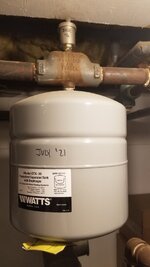
What sometimes does happen (happened to me last summer) is that the bladder or diaphragm in my boiler expansion tank failed. The boiler expansion tank has a bladder across the middle of it, it divided the expansion tank into two halves, with water on one side and an air charge on the other. With all of the taps closed your domestic hot water is a "closed system", so as the water temp in the pipes goes up in temperature, its volume wants to increase, and that excess volume causes the diaphragm in the boiler's expansion tank to flex. If the water had no place to expand as its temperature went up then the pressure within the pipes would have to increase.
The expansion tank allows the volume to increase and decrease as the temperature fluctuates, allowing the pressure within the pipes to stay in a fairly steady and comfortable range.

In my case, we noticed a small puddle of water in the basement and traced it back to the boiler. Pressure valve on the front of the boiler read around 30psi. Its typical range is 12-15psi. The pressure relief valve on the boiler lets go at around 25psi. So I figured that my small boiler expansion tank was no longer allowing for expansion, that the diaphragm within had failed. I 'flicked' the bottom of the tank with my finger and heard a dull thud. I flicked the top of the tank and heard the same dull thud. Typically the top of the tank, filled with water, will 'thud' and the bottom of the tank, filled with air, will 'ping'.

I replaced my expansion tank (post-mortem, it had indeed failed) as well as a few other valves on the boiler; the presure relief valve and the water admittance valve. Replaced the air purge valve as well. The air purge valve should be at a the high point in the plumbing, usually above the expansion tank, but not always. It allows air bubbles within the system to escape to atmosphere. On a difficulty scale they were all easy to do, but took me about 45 minutes. I had to break a solder joint in the copper tubing coming out of the boiler's pressure relief valve. There wasn't enough clearance to simply unthread the valve and the "L" shaped copper drain assembly coming out of the temp/pressure relief valve.

If your boiler expansion tank failed, causing the water pressure within the hot water system to increase, there is a chance that the increased pressure could have contributed the failure of your hot water tank. Or not.

Photo shows the boiler expansion tank and above it, the gold cylinder which is the air purge valve. Closeup of the sticker on the boiler expansion tank shows the water and air sides, separated by the diaphragm/bladder.

As far as everything else being wacky, he could have simply stirred up sediment in the system. That if the system wasn't properly flushed, that sediment (or even excess gobs of solder or flux from the plumbing repairs) could be in your plumbing, causing issues with the aeration screens in the faucets and shower heads and/or the cartridges in your faucet and shower valves.

Good luck with it.
 

Attachments

  • 20220427_135627(0).jpg
    20220427_135627(0).jpg
    145.1 KB · Views: 3
  • 20220427_135720.jpg
    20220427_135720.jpg
    105.5 KB · Views: 3
To avoid these ads, REGISTER NOW!
Top Bottom