Typically at the point where your water service enters your house there will be a pressure regulating valve and a pressure gauge. The PRV will reduce the water supply pressure from the street to something in the 40-60psi house pressure. If you have a well, the pressure regulator is a part of the switch that sends power to the well pump, signalling it to pump water. It, as well as the pressure gauge, are typically plumbed where the well supply enters the foundation, at the base of the large well pressure tank.
Your plumber shouldn't have fiddled with any of that.
What sometimes does happen (happened to me last summer) is that the bladder or diaphragm in my boiler expansion tank failed. The boiler expansion tank has a bladder across the middle of it, it divided the expansion tank into two halves, with water on one side and an air charge on the other. With all of the taps closed your domestic hot water is a "closed system", so as the water temp in the pipes goes up in temperature, its volume wants to increase, and that excess volume causes the diaphragm in the boiler's expansion tank to flex. If the water had no place to expand as its temperature went up then the pressure within the pipes would have to increase.
The expansion tank allows the volume to increase and decrease as the temperature fluctuates, allowing the pressure within the pipes to stay in a fairly steady and comfortable range.
In my case, we noticed a small puddle of water in the basement and traced it back to the boiler. Pressure valve on the front of the boiler read around 30psi. Its typical range is 12-15psi. The pressure relief valve on the boiler lets go at around 25psi. So I figured that my small boiler expansion tank was no longer allowing for expansion, that the diaphragm within had failed. I 'flicked' the bottom of the tank with my finger and heard a dull thud. I flicked the top of the tank and heard the same dull thud. Typically the top of the tank, filled with water, will 'thud' and the bottom of the tank, filled with air, will 'ping'.
I replaced my expansion tank (post-mortem, it had indeed failed) as well as a few other valves on the boiler; the presure relief valve and the water admittance valve. Replaced the air purge valve as well. The air purge valve should be at a the high point in the plumbing, usually above the expansion tank, but not always. It allows air bubbles within the system to escape to atmosphere. On a difficulty scale they were all easy to do, but took me about 45 minutes. I had to break a solder joint in the copper tubing coming out of the boiler's pressure relief valve. There wasn't enough clearance to simply unthread the valve and the "L" shaped copper drain assembly coming out of the temp/pressure relief valve.
If your boiler expansion tank failed, causing the water pressure within the hot water system to increase, there is a chance that the increased pressure could have contributed the failure of your hot water tank. Or not.
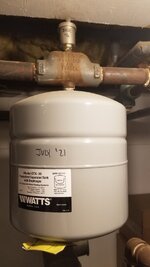
Photo shows the boiler expansion tank and above it, the gold cylinder which is the air purge valve. Closeup of the sticker on the boiler expansion tank shows the water and air sides, separated by the diaphragm/bladder.
As far as everything else being wacky, he could have simply stirred up sediment in the system. That if the system wasn't properly flushed, that sediment (or even excess gobs of solder or flux from the plumbing repairs) could be in your plumbing, causing issues with the aeration screens in the faucets and shower heads and/or the cartridges in your faucet and shower valves.
Good luck with it.