billconner
Well-known member
amen! probably not true but sure feels like it.people are getting dumber

amen! probably not true but sure feels like it.people are getting dumber
I found Intertek and CSA-US, but no UL. My range might be UL, but the wife was making cookies so I didn't bother looking.I'm pretty sure every appliance in my home bears the seal of a NRTL, and maintained in a "list" by them, probably tested to a standard written under the auspices of UL. I'm a member of one UL standards technical panel (ANSI/UL 2344-2012 (R2022) - American National Standard for Material Lifts).
Of course none of these are law until a legislative body votes them to be.
I've been in business enough years to know everybody has friends,no conspiracy theory...and there are many other conspiracies.
Sad, that you think corruption is the norm and turn a blind eye to it.I've been in business enough years to know everybody has friends,no conspiracy theory.
Some people just have bigger friends in higher places is all. Hahaha
So you're telling us that you made the decision. Just because you participated does not mean you made the decision.Having been a participant in the process for a long time, not really. I can point to sections of the UBC and LSC that I wrote to get words for and shepparded through the process. I can also point to similar sections by manufactures and contractors and other special interests. Anyone can participate, submitting proposals and comments, speaking in hearings, and holding membership or seats on committees that ultimately vote on changes. It's really a kind of wonderful, democratic process.
What a slap in the face for all the people who do this kind of work. My former SIL was on an industry specific group that wrote pipeline related regs and stuff.Input that involves money changing hands behind closed doors has a lot to do with writing codes.
Have you EVER participated in the process.The biggest reason is more profit than from the last code cycle. You can believe whatever you want, but there actually are some of us on here that deal with this **** day in and day out and have so for a number of years. (28 in my case). We have seen the evolution of the GFCI and the AFCI, and things might be getting a little safer because people are getting dumber, but they are getting more expensive exponentially compared to the lives that are supposedly saved. They can't hammer us with everything at once, that would be too obvious. But add them in a little at a time, here and there, and before too long, they are everywhere. Why did they wait until 2020 to require GFCI protection for 250 volt rated receptacles in the same places that 120 volt GFCI's are required, along with air conditioners? The answer is money, more of it to be specific.
To sit on a code committee takes a lot of time and money, most people who have a interest in to sit on one, have neither the time nor the money to do so, so most are sponsored by manufacturers or organizations that does have the money to send people to act in their interest, AFCI's added in the 1999 NEC are a good example of skullduggery, they lied as to what they could do, and to this day have made the customers & users the beta test, most tripping in early models was due to the GFCI function then in in them, although at a higher level then the 6 ma in GFCIs, for those and other reasons I still call AFCI's "snake oil". I would have been cool with requiring GFCI's on most residential 120V circuits, as they are reliable & fairly cheap. I have not said dishwasher GFCI's are a bad idea, merely that it was crooked as to how they were included.Manufacturers have friends in many places.
No, I did not cast all the committee votes. But I earned the committee's respect and trust, am in fact much more knowledgeable and experienced in the particular subject, and presented well researched proposals. Representing the interests of not for profits probably makes it easier. And I learned a lot from watching the brighter, more highly paid, and better speaking industry representatives who do the same thing.So you're telling us that you made the decision. Just because you participated does not mean you made the decision.
Thank you for bringing that up as it is a important part of the conversation.BTW, the code making process is not government. No elected representatives. Participation is voluntary. Some in fact do it as a part of their employment. I'm purely voluntary.
Have you EVER participated in the process.
Obviously, the answer to my question is no because the CMP has nothing to do with government.I used to rant about government until I got involved. Now my opinion is 100% changed.
This thread has nothing to do with pipelines and the safety aspects of pipelines. It has to do with the fact that the electrical code keeps adding GFCI receptacles in places that they have never been required. Every three years, more are added in the name of "safety".What a slap in the face for all the people who do this kind of work. My former SIL was on an industry specific group that wrote pipeline related regs and stuff.
I don't have the names of any specific people, but a quick Google search would probably yield results. How about companies instead of organizations. Siemens, Square D, Eaton, GE to name a few. This has nothing to do with corruption. It has everything to do with bottom line profit. There is no whistle to blow, nothing can be done except follow the rules. And do work without a permit.You really astound me that you don't blow the whistle on all there CORRUPT people. Please post the names and organizations.
I really doubt anyone cares who you worked for, and it also has nothing to do with this topic.I worked for a company and we dealt with a company that had a crooked buyer. One call to the owner and the buyer was gone. the playing field was leveled.
Ummm this topic has absolutely nothing to do with government. The codes are not written by government agencies bodies or elected reps. If you think they are, then you clearly dont know what youre talking about.Have you EVER participated in the process.
I used to rant about government until I got involved. Now my opinion is 100% changed.
What I was referring to is all the people who say that there is nothing but corruption and acquiescing to the profit motives of the companies.Ummm this topic has absolutely nothing to do with government. The codes are not written by government agencies bodies or elected reps. If you think they are, then you clearly dont know what youre talking about.
But If you do know that they arent written by government agencies bodies or reps, then why muddy the waters with this comment? It serves no purpose here other than to add confusion to the discussion.
It has to do with the integrity of process of setting standards and the comment about my SIL is relevant to the character of the people.This thread has nothing to do with pipelines and the safety aspects of pipelines. It has to do with the fact that the electrical code keeps adding GFCI receptacles in places that they have never been required. Every three years, more are added in the name of "safety".
I don't have the names of any specific people, but a quick Google search would probably yield results. How about companies instead of organizations. Siemens, Square D, Eaton, GE to name a few. This has nothing to do with corruption. It has everything to do with bottom line profit. There is no whistle to blow, nothing can be done except follow the rules. And do work without a permit.
Whatever it was your SIL did for the pipeline still has nothing to do with GFCI's, unless the pipeline people are on the electrical code making panel.It has to do with the integrity of process of setting standards and the comment about my SIL is relevant to the character of the people.
You seem to know a lot. Why don't you post the minutes from the meetings that prove they are actually all about safety. And you are the one spouting off about corruption.You have made libelous comments about these companies. You really should be specific in your allegations. Please post the minutes from the meeting where they are adding location for devices. I want to see where there is corruption. I suspect there will be reams of technical data and reliablility figures.
What is quasi governmental? The NFPA is NOT a government agency.... youre just muddying the waters inferring it isWhat I was referring to is all the people who say that there is nothing but corruption and acquiescing to the profit motives of the companies.
They have never done anything other than ***** and slander the people who do the work.
These bodies are quasi governmental. Specific regulatory functions have been delegated to these bodies. Look up the function and role relating to quasi governmental.
This thread has degenerated into what I call bar talk. When you don't understand the process you quickly get a comfortable explanation and got with it. In this case is that it's all money related.
Another example is everybody know how to run their employers business better. If you have actually done it the phrase "it is much easier to sign the back of the paycheck than the front".
Goodbye.I am out of this thread. I cannot stand the assumption that there is a great conspiracy to only make money for the companies.

You do realize there is also a functional difference here regarding how much of the wiring system is protected? With AFCI breakers, all of the wiring is protected, but with AFCI devices, the cable between the panel and the first device is unprotected. With GFCIs it's not as big a risk, but for arc fault protection, there is some chance that a problem (e.g. an errant nail or a chewing rodent) occurs in that first length of cable and there would be no protection.AND, If this safety **** wasn't about money, Leviton wouldn't have started making panels. The story I got in code class was that there was an argument about AFCI's, whether they should be a breaker or wiring device (new construction, I know there are AFCI receptacles.). The breaker manufacturers won out, so the device manufacturers were missing out on a **** ton of money. That is why Leviton started making panels. I haven't seen one, and I wouldn't use one, but they are available. I don't know if anyone else is making panels at this time, but I'm sure it's coming.
Same here for new or renovation. We will provide one receptacle for the DW and another for the disposer, usually each on a separate circuit. Some disposers are on air-switches and some on wall switches. I suppose a wall switch would serve as a disconnect if it were hardwired, but for consistency we still install a receptacle.New construction guy here.
We are required to have the dishwasher on a gfi.
We are required to have an accessible disconnect for the dishwasher that does not require tools (ie can’t unscrew toe kick panel, unscrew junction box housing, etc).
The solution in my neck of the woods is to provide a gfi outlet in the base cabinet of the sink then use corded plug on the dishwasher.
We been doing it this way now 5-6 years?
I totally, completely, 100% understand that even though I don't agree with anything AFCI related. The whole point of that part of my post was to show why device manufacturers, Leviton specifically, got into manufacturing panels. They got into making panels to get in on the scam that is AFCI protection in order to maximize profit. The code changes are all about profit disguised as safety. I thought that was pretty well laid out in the rest of the post.You do realize there is also a functional difference here regarding how much of the wiring system is protected? With AFCI breakers, all of the wiring is protected, but with AFCI devices, the cable between the panel and the first device is unprotected. With GFCIs it's not as big a risk, but for arc fault protection, there is some chance that a problem (e.g. an errant nail or a chewing rodent) occurs in that first length of cable and there would be no protection.
If the dishwasher is on its own breaker, does that count as easy to disconnect? My dishwasher is in my kitchen island so it is hardwired through the floor to the basement (as with the drain), but on its own switch. My new dishwasher has a junction box.New construction guy here.
We are required to have the dishwasher on a gfi.
We are required to have an accessible disconnect for the dishwasher that does not require tools (ie can’t unscrew toe kick panel, unscrew junction box housing, etc).
The solution in my neck of the woods is to provide a gfi outlet in the base cabinet of the sink then use corded plug on the dishwasher.
We been doing it this way now 5-6 years?
Unless the panel is within site of the dishwasher, no, but the switch may be sufficientIf the dishwasher is on its own breaker, does that count as easy to disconnect? My dishwasher is in my kitchen island so it is hardwired through the floor to the basement (as with the drain), but on its own switch. My new dishwasher has a junction box.
It needs to be fitted with a breaker lock out in order to be considered a disconnect, so LOTO can be done when servicing, LOTO = Lock Out Tag Out, the chance of a service tech doing LOTO in a residence is slim to none, but still needs to be in place. Every breaker MFG makes them but some makes are easier to find then others.If the dishwasher is on its own breaker, does that count as easy to disconnect? My dishwasher is in my kitchen island so it is hardwired through the floor to the basement (as with the drain), but on its own switch. My new dishwasher has a junction box.
Thanks for replying. Doesn't turning off the breaker switch count as doing that? I don't understand what happens with LOTO that is different from shutting off the power.It needs to be fitted with a breaker lock out in order to be considered a disconnect, so LOTO can be done when servicing, LOTO = Lock Out Tag Out, the chance of a service tech doing LOTO in a residence is slim to none, but still needs to be in place. Every breaker MFG makes them but some makes are easier to find then others.
It is a lock out... You can prevent it from being turned on again by another person. Flipping a switch does not do thatThanks for replying. Doesn't turning off the breaker switch count as doing that? I don't understand what happens with LOTO that is different from shutting off the power.
As Mike says it LOCKS.Thanks for replying. Doesn't turning off the breaker switch count as doing that? I don't understand what happens with LOTO that is different from shutting off the power.

Ok folks, this is a timely thread for me as I am waiting on a delivery of a new dishwasher to replace our approximately 10 year old one. It currently is hard wired and after reading this thread I think I’d like to add a plug and a receptical.
What specifically do you all recommend?
For a box?
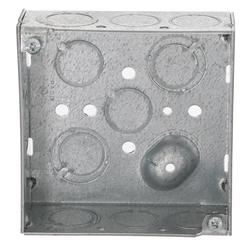
 www.menards.com
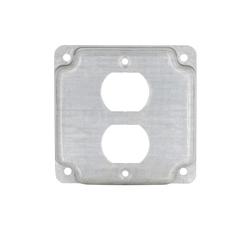 www.menards.com
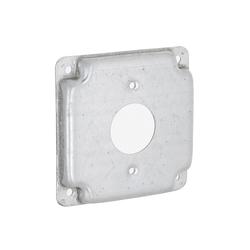 www.menards.com
For an outlet?
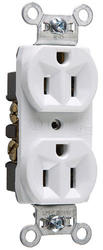 www.menards.com
 www.menards.com
Above is what I would recommend and use for myself. If being code compliant is at the top of the list you will need thisLinks and photos would really be appreciated!
Nah, a handy box and an aliexpress gfci is plenty.and thisRACO 4" Galvanized Steel Square Electrical Box
The RACO® four-inch two-gang Galvanized Steel Square New Work Box is 1-1/2 inches deep. It features 1/2- and 3/4-inch knockouts for a variety of wiring applications. It's recognized by contractors for its versatility in commercial and residential applications.
or thisRACO 1-Gang Galvanized Steel 1/2" Raised 4" Square Electrical Box Cover
The RACO 4" Square Exposed Work Cover has one duplex receptacle opening. Includes two nuts to use with your device screws to mount device.
RACO 1-Gang Galvanized Steel 1/2" Raised 4" Square Electrical Box Cover
The RACO 4" Square Exposed Work Cover has a 1.406-inch diameter receptacle opening. Includes screws to mount device to cover.
Legrand® Pass & Seymour® 15-Amp White Commercial-Grade Duplex Outlet
These sturdy receptacles offer excellent value. They deliver rugged, lasting construction that hold up in a high-use commercial environment, while still maintaining the look of a traditional outlet. They are also ideal in residential applications where the outlets are regularly being used, such...
or this
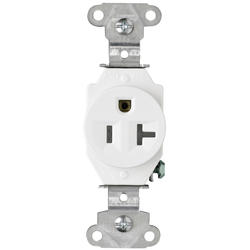
Legrand® Pass & Seymour White 20-Amp Heavy-Duty Side Wire Single Outlet
These sturdy receptacles offer excellent value. They deliver rugged, lasting construction that hold up in a high-use commercial environment. This outlet is ideal for use where a second outlet would not be needed, such as behind an appliance like a refrigerator. All 20 amp straight blade outlets...
Above is what I would recommend and use for myself. If being code compliant is at the top of the list you will need this
and this