To avoid these ads, REGISTER NOW!

Garage Mezzanine (Concrete question)

Saintbacon

Member
Joined
Jun 6, 2022
Messages
15
Hi there. First time poster, but I've seen a lot of good advice and was hoping to get some too.
I'm new to construction, so I'll be using simple terms to the best of my abilities.

I'm building a 30'x40' garage and would like to plan the foundation to be able to support a mezzanine. It'll be for light storage plus a space for an office. There will be a maximum of 2 or 3 people up there at any given time. I'd like to plan to be able to put a mezz over the entire floor of the garage.

My question is this:
What considerations would I have to make in my garage floor to support such a structure?


Details:
  • Garage Size: 30x40
  • Foundation Footer: 12" thick concrete walls that are 48" deep and 12" above ground (5ft total).
  • Garage floor: 4" thick with 1/2" rebar grid pattern.
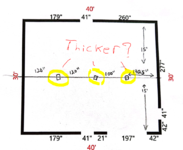
  • Mezzanine is to be free standing and supported primarily on the foundation walls. I plan to put some columns in the dead center of the building (Making a 15' span width wise) and 10' apart.
  • Would I need to pour thicker concrete in the middle of the building in order to support the load? I was thinking 2' squares that go 12" deep instead of the normal 4" concrete.
Garage Mez Question.PNG
Any advice would be appreciated. Rough sketch attached. Thanks so much!
 
To avoid these ads, REGISTER NOW!

gsmith22

Well-known member
Joined
Jul 14, 2015
Messages
337
Location
Central NJ
the columns will need their own foundation - spread footings. the columns can't just bear on the concrete slab as it is too thin and not able to distribute the load to the soil without cracking. mezz will require a minimum uniform live load per building code (can't remember offhand buts its probably like 50psf for an office type space but light storage is more maybe 100psf?) plus weight of structure plus weight of whatever you will try to hang off the underside of the mezz (you know you will :)). take tributary area of mezz loading to each post and design your foundations below the posts for that load. install foundations prior to slab pour. even if you don't construct the mezz right away, the foundations will be under there waiting for it. you could try to incorporate the footings into the slab in one pour but that might be questionable for several reasons such as if the shallow soil competent for load support. it will probablay also use more concrete to do something monolithic but it would certainly be faster than exacavting and casting footings and then seperately casting slab. I would personally never construct less than a 3'x3' spread footing regardless of column load. The smaller you make the footing size, the more localized soil prep/bearing issues can affect the performance.
 

mcbane

Well-known member
Joined
Jul 23, 2017
Messages
794
Location
California
Unless you plan to store some really heavy stuff on the mezz level, the simplest design that offers the most flexibility is to go with a thicker slab. At 1200 sq-ft, each additional inch of slab thickness is less than 4 yards of concrete. Find out what your point loads will be and then have an engineer calc the slab for flexural strength and punching shear using a healthy factor of safety. When you finally get around to building that mezzanine, you are free to change your mind re: exactly where those columns go.

Just how I would approach it - I dont like difficult excavation work, having to pour concrete on two separate days, and having column pedestals that protrude through the slab.
 

firebirdparts

Well-known member
Joined
Jun 8, 2016
Messages
10,631
Location
Kingsport, TN
I agree with gsmith. You'll need little spread footers. The weight on that mezz is really not much, but we design as if it were.
 
OP
S

Saintbacon

Member
Joined
Jun 6, 2022
Messages
15
Thanks for all the replies, folks!

Seems like I definitely need some extra concrete where I plan to support the mezzanine.

I'm going to go over it with my Concrete person, but I think I might have a 3' wide strip down the center of the garage floor that goes down about 12" (instead of the normal 4") to make sure there's plenty of strength. Does anybody anticipate an issue with that?

I do like the idea of having spread footers, but I think this idea actually provides for a little more flexibility when I go to place the mezz later.

I could also just make the whole garage floor thicker, but I think this would be a more economical (and possibly stronger) way of attacking the issue.


Thanks in advance!
 

jack stand

Well-known member
Joined
Feb 29, 2012
Messages
3,338
Location
Lakes Region Maine
For your described use, you probably don't need to do anything, maybe a few extra bars across that dimension. Talk with your guy and a grade beam across at 6" (thickened slab) would not be much of an expense and would be plenty.

Welcome to the garage, and bring us along with your build on a thread, with pictures of course. 😆👍
 

theoldwizard1

Well-known member
Joined
Feb 22, 2011
Messages
43,191
Location
SE MI
Rebar is a waste of money in a garage floor unless you plan on parking heavy equipment there. If you are, you need a 6" floor. If you are concerned about cracks, add wire mesh.

You need a bigger/deeper footer for those posts. Same as the foundation for the walls. Here is where you need rebar.
 

theoldwizard1

Well-known member
Joined
Feb 22, 2011
Messages
43,191
Location
SE MI
Mezzanine is to be free standing and supported primarily on the foundation walls. I plan to put some columns in the dead center of the building (Making a 15' span width wise) and 10' apart.
Attachment to the walls is CRITICAL, especially if that space will hold people ! Make sure the design is approved by an engineer!
 
OP
S

Saintbacon

Member
Joined
Jun 6, 2022
Messages
15
Rebar is a waste of money in a garage floor unless you plan on parking heavy equipment there. If you are, you need a 6" floor. If you are concerned about cracks, add wire mesh.

You need a bigger/deeper footer for those posts. Same as the foundation for the walls. Here is where you need rebar.
You're saying there should be another 4 foot deep wall under the center of my garage to hold a mezzanine?
 
OP
S

Saintbacon

Member
Joined
Jun 6, 2022
Messages
15
What a range of replies! Anywhere from "you don't need to do anything" all the way to needing equal depth footers (4 feet deep).

I definitely appreciate any further replies and will provide an update once I hear back from my concrete guy. (Likely tomorrow)
 
OP
S

Saintbacon

Member
Joined
Jun 6, 2022
Messages
15
I expect your concrete guy will advise you to thicken the slab a few inches for a couple feet around where the posts will land because quite frankly, anything more is ridiculous.
Music to my ears (eyes) LLWillysfan. I'm really hoping that is the case, and I appreciate the fact that your signature seems to have a lot to do with Concrete. More to come once I consult with my guy!
 
OP
S

Saintbacon

Member
Joined
Jun 6, 2022
Messages
15
Footer/foundation under the posts.
Well you might be right, Wizard...though I hope it doesn't have to go that deep under my columns in the center of the building. Of course the main footer for the building will be 4ft deep with the Mezz properly fastened to it.

I also appreciate the answer might be different regionally. Considering that LLWillysfan is in Maine, and my project is in Rhode Island, I hope that his knowledge of local practices is more accurate for New England.
 

vrinner

Well-known member
Joined
Aug 29, 2006
Messages
1,078
Location
Placentia, CA
Here is my reply to another post showing the picture of the center footing for a post for my mezzanine. Every corner or my building had some pretty big footings.

Seems like mezzanine talk is all the rage lately. :ROFLMAO:


Toomanytools?

Well-known member
Joined
Nov 4, 2010
Messages
855
Location
Washington
"I'd like to plan to be able to put a mezz over the entire floor of the garage."
This isn't a mezzanine anymore it seems more like a second floor. Get with the builder or who is drawing up plans might need to beef up exterior posts to hold the floor, and post footings.
 
OP
S

Saintbacon

Member
Joined
Jun 6, 2022
Messages
15
"I'd like to plan to be able to put a mezz over the entire floor of the garage."
This isn't a mezzanine anymore it seems more like a second floor. Get with the builder or who is drawing up plans might need to beef up exterior posts to hold the floor, and post footings.
You're right - it's basically an entire 2nd floor. I thought the word to describe it would be Mezzanine because it's not really going to be touching the metal building itself, just sharing a foundation.

However, I just looked it up, and the technical difference is that a mezzanine only covers 25% or less of the total area. My bad, thanks for calling that out.

I'm fairly confident that the 12" thick and 4' deep walls will easily be able to hold both the (relatively light) metal building and "2nd floor" sections without trouble. My house is sitting on the same type of foundation and is much heavier than the building + 2nd floor. However, I will double check that with my builders as well. Thanks for ensuring I double check that consideration.
 
OP
S

Saintbacon

Member
Joined
Jun 6, 2022
Messages
15
Here is my reply to another post showing the picture of the center footing for a post for my mezzanine. Every corner or my building had some pretty big footings.

Seems like mezzanine talk is all the rage lately. :ROFLMAO:

Awesome post Vrinner. I'm likely going to be doing something similar to that so long as it's legal. Love the details here.
 

wssix99

Well-known member
Joined
Mar 2, 2011
Messages
5,161
Location
Chicago, IL
Seems like I definitely need some extra concrete where I plan to support the mezzanine.

I'm going to go over it with my Concrete person, but I think I might have a 3' wide strip down the center of the garage floor that goes down about 12" (instead of the normal 4") to make sure there's plenty of strength. Does anybody anticipate an issue with that?

You aren't describing a "mezzanine." At the point, you are covering the entire area of your building, you are adding another floor. It would be interesting to know what you expect the differences are and how you would use them differently.

Will you have enough head space for a real floor on top of your garage space? If not and if you are going to put several people up there to work and if you are looking to be legal, this should be a bigger concern for you than your structural question. You could have larger fire/code issues.

Structurally speaking, adding concrete and/or rebar don't necessarily do much for you. You can park a heavy truck on a concrete slab and be fine. As long as you spread the loads out with a proper base plate/attachment, the concrete pad will be fine. The problem with your design is that you are contemplating attaching a floor to structural walls and then supporting the middle of them on top of a floating slab. Through the course of the year, the slab will heave and your "mezannine" will move. (This movement could do other structural damange to your floor/building and, at least, I expect you will find the tilting floors annoying.) This is why you need bonafide footers in the middle of the room where you would put columns. Footers take the concrete down to the frost line and they stay put - no heaving.

There are other threads here with similar builds, but all I have seen have architects and engineers behind the plans. I think you will definitely save a lot of time, money, and grief if you were to employ a local architect or engineer to help you with this plan.
 

billconner

Well-known member
Joined
Jul 20, 2021
Messages
6,970
Location
Thousand Islands NYS
Regarding depth under columns, are you heating the building? And if so, you're probably insulating under slab and slab edges?

I'm (finally) about to apply for permit and have a similar condition - smaller, 1 column. I'm not heating so doing a footing and pier to below frost, and planning for pier to be independent - isolated from - floor. I want floor to float and not be restrained by footings. Planning to prove concrete doesn't have to crack. :)
 
To avoid these ads, REGISTER NOW!

billconner

Well-known member
Joined
Jul 20, 2021
Messages
6,970
Location
Thousand Islands NYS
PS

1. I'd sure try for just one column or at least only two. Should be easy with an LVL.

2. And "office" is habital space, and cannot have only egress through garage, and probably needs to be separated with a layer of 5/8" gwb.
 
OP
S

Saintbacon

Member
Joined
Jun 6, 2022
Messages
15
You aren't describing a "mezzanine." At the point, you are covering the entire area of your building, you are adding another floor. It would be interesting to know what you expect the differences are and how you would use them differently.

Will you have enough head space for a real floor on top of your garage space? If not and if you are going to put several people up there to work and if you are looking to be legal, this should be a bigger concern for you than your structural question. You could have larger fire/code issues.

Structurally speaking, adding concrete and/or rebar don't necessarily do much for you. You can park a heavy truck on a concrete slab and be fine. As long as you spread the loads out with a proper base plate/attachment, the concrete pad will be fine. The problem with your design is that you are contemplating attaching a floor to structural walls and then supporting the middle of them on top of a floating slab. Through the course of the year, the slab will heave and your "mezannine" will move. (This movement could do other structural damange to your floor/building and, at least, I expect you will find the tilting floors annoying.) This is why you need bonafide footers in the middle of the room where you would put columns. Footers take the concrete down to the frost line and they stay put - no heaving.

There are other threads here with similar builds, but all I have seen have architects and engineers behind the plans. I think you will definitely save a lot of time, money, and grief if you were to employ a local architect or engineer to help you with this plan.
Hi there.
Yeah somebody called me out earlier in this thread on the whole "That isn't a mezzanine" thing. Turns out something covering the entire floor would technically be a 2nd floor. News to me! I'm likely not going to be covering the entire thing, but because of the nature of concrete, I am going to try to aim for the maximum possible expansion that I MIGHT want.

1)Head space: Yup. plenty of head space.
2)Extra concrete wouldn't do anything: How big would you consider a "Proper" base plate to be for an application like this? (Guesses are fine).
3) Frost Heave: It sounds like you're saying that the garage floor is going to frost heave even without any type of mezzanine (or 2nd floor) on top. There are lots of garages in the area built like this, and I don't see any significant heaving going on. Wouldn't the thermal mass of the building prevent frost from developing this deep? I'm planning on doing some work in the building and thus it will be typically heated. Also, I'm wondering if adjustable lally columns might help to take up any differences imposed by frost on the garage floor.
4) Legal: This is a residential structure. As I get closer to possibly building a 2nd floor or mezzanine, I plan to get the plans made and approved. This is going to be a secondary structure put up later. I just want to make sure my concrete will hold the thing up as I'm going to be pouring soon.

Thanks!
 
OP
S

Saintbacon

Member
Joined
Jun 6, 2022
Messages
15
Regarding depth under columns, are you heating the building? And if so, you're probably insulating under slab and slab edges?

I'm (finally) about to apply for permit and have a similar condition - smaller, 1 column. I'm not heating so doing a footing and pier to below frost, and planning for pier to be independent - isolated from - floor. I want floor to float and not be restrained by footings. Planning to prove concrete doesn't have to crack. :)

I'm not certain, but insulating underneath the slab sounds like it would be worthwhile. It's doubtful that I will be heating the entire building for the entire winter. More likely the "shop" half. I'll look into it - thanks for the tip!
 
OP
S

Saintbacon

Member
Joined
Jun 6, 2022
Messages
15
PS

1. I'd sure try for just one column or at least only two. Should be easy with an LVL.

2. And "office" is habital space, and cannot have only egress through garage, and probably needs to be separated with a layer of 5/8" gwb.
I'll definitely look into the spans I can achieve with LVL Lumber. That would reduce the amount of columns I'd need. Thanks!

So to be legal, I'd have to attach some stairs to the outside of the building. Got it.
What's GWB? I assume it's some kind of subflooring that's fireproof? Google says it's the George Washington Bridge...so probably not that.

Thanks!
 

billconner

Well-known member
Joined
Jul 20, 2021
Messages
6,970
Location
Thousand Islands NYS
Saintbacon, just to help me, is this an accessory structure on property with a dwelling - like your house and this is your garage and not a commercial building?
 
OP
S

Saintbacon

Member
Joined
Jun 6, 2022
Messages
15
Saintbacon, just to help me, is this an accessory structure on property with a dwelling - like your house and this is your garage and not a commercial building?
Yes Exactly. It's going to be a garage/workshop. Nothing commercial about it.

I used the phrase "office" because I'd like to be able to set up an area for chilling up there. Maybe a couch and a TV. Not for people to be working. I figured it was just easier to describe as "office space" but I see I might've made a misstep there. Was just trying to keep it brief.
 

billconner

Well-known member
Joined
Jul 20, 2021
Messages
6,970
Location
Thousand Islands NYS
I don't know what you can do in your jurisdiction but using it as a lounge makes it habital space and requires egress not through the garage. Pure storage, mechanical equipment, a few other uses, and it's not habital.

I don't know how often this is overlooked, by either owners or building officials.
 

Mikeske

Well-known member
Joined
Apr 28, 2017
Messages
2,131
Location
Washington State
I am of the thinking to add a bit extra strength to the center and actual side yard f building. Oh sure you intend for the 2nd floor to be lightly loaded now but in the future who knows how about in the future a different owner might overload it beyond what you intend for now.
 

jkuro

Well-known member
Joined
Apr 28, 2009
Messages
552
Why not just build it right the first time, as a two story structure.
 

billconner

Well-known member
Joined
Jul 20, 2021
Messages
6,970
Location
Thousand Islands NYS
What is the basic construction? pole barn, steel, stick frame?

Stick frame, tji second floor (no columns), trussed roof. Pretty simple construction using basic house building.
 

Renegade1LI

Well-known member
Joined
Mar 11, 2018
Messages
4,965
Location
long island ny
Did you have an architect design this? They would be your best source to know what is required, if you are building a mezzanine that size I would also look to a design professional. What you're building is more than a storage area & adding habitable space adds a bunch of safety considerations, for what you're going to spend, spend a few bucks more for a good design.
 

wssix99

Well-known member
Joined
Mar 2, 2011
Messages
5,161
Location
Chicago, IL
2)Extra concrete wouldn't do anything: How big would you consider a "Proper" base plate to be for an application like this? (Guesses are fine).
This requires math - engineer math. I wouldn't trust this kind of math from the internet. (No matter if I or anyone else did it.) If someone gives it to you for free, they aren't an engineer and/or don't know what they are doing. (Or don't value what they are doing.)


3) Frost Heave: It sounds like you're saying that the garage floor is going to frost heave even without any type of mezzanine (or 2nd floor) on top.
Indeed. Guaranteed.

There are lots of garages in the area built like this, and I don't see any significant heaving going on.
When built properly, the floor floats independently and the structural parts stay put. Mine does that. Here is my floor plan. Grey diamonds are the footings for steel columns holding up a two story concrete wall on top. (They are footings and don't move.) The rest of the floor is free to float up and down and is isolated from the footings with proper expansion joints. The dashed lines are control joints and is where the cracking happens, radiating from the penetrations/footers, etc. (In controlled places, away from my lift posts, where the cracks are problematic.)

full


Wouldn't the thermal mass of the building prevent frost from developing this deep? I'm planning on doing some work in the building and thus it will be typically heated. Also, I'm wondering if adjustable lally columns might help to take up any differences imposed by frost on the garage floor.
The heave happens too fast for a human to keep up with lally columns.

The dirt outside your building is a massive heat sink and will **** heat away. Likewise, it takes a long time and a lot of heat to get your slab up to temperature. So much so, I don't think you'll ever see a payback by insulating your slab if you are only going to periodically heat the space. (Insulation doesn't hold on to heat, it only slows the escape.)

If you were going to heat the space 24/7, you'd get a payback eventually by insulating the floor and foundation walls. Even then and even if one keeps the dirt heated all the way to the frost line, one still plans for the floor to heave. There's some differential heating/cooling by the garage doors and we don't want to set things up for disaster if the heater ever goes out. (As a general rule of thumb, you don't want to have the heater as single point of failure for keeping the structure sound.)


4) Legal: This is a residential structure. As I get closer to possibly building a 2nd floor or mezzanine, I plan to get the plans made and approved. This is going to be a secondary structure put up later. I just want to make sure my concrete will hold the thing up as I'm going to be pouring soon.

If you want to avoid the time and cost of hiring professionals to help and to build proper footings/foundations, you can avoid a lot of complexity and pain by NOT attaching the structure to your walls. Just put the whole thing on posts, even along the walls. Build it like an outdoor deck. This way, the entire structure will heave with the floor and all will be happy. You can use your local deck building guides to help you plan the joists and structure to have confidence it's sound. (The downside is more posts and posts against the walls.)

To do the math: Take the PSF you are desiging the structure/deck to. Draw lines equal distances between all the posts and then calculate the area around each post to figure out how many pounds it is holding up. Divide that by the surface area of the post. The PSI the post imparts on the slab is what matters. You can add posts or make them bigger (6X6 instead of 4X4) to lower your psi.

For reference, a concrete truck imparts 120 psi on the pavement. I'd be comfortable with that on a 4" slab.

The pressure on the ground below decreaces roughly with the square of the depth. So 120 psi on a 4" slab woud put 120/(4X4) = 7.5 psi on the ground.

If you end up with loads higher than the psi you are targeting, then you can increace the slab thickness until you get an equivalent ground pressure that makes you feel comfortable. So, if I had 190 psi, then I could go to a 5" slab - 190/(5X5) = 7.6 psi and be in just about the same situation as the concrete truck sitting on my 4" slab.

I'll definitely look into the spans I can achieve with LVL Lumber. That would reduce the amount of columns I'd need. Thanks!
This strategy will send you in the direction of definitely needing footers that can take the higher loading. (And an engineer to design them.)

So to be legal, I'd have to attach some stairs to the outside of the building. Got it.
It's worth checking your local building codes. There could be lots of other requirements. In a space like this, egress should be a major concern in your design. Fires happen in garages all the time. You don't want to be in a space where you get trapped in a corner and can't get out. Staris help, egress windows are great. Fireman's pole, whatever.
 

sticktime

Well-known member
Joined
Oct 28, 2011
Messages
80
Location
VA
My 40x14 mezzanine has two posts, two 3x3' 12" thickend slab at the post locations My mezzanine was designed to store gun safes and weight equipment
 

billconner

Well-known member
Joined
Jul 20, 2021
Messages
6,970
Location
Thousand Islands NYS
You could look at a FPSF (frost protected shallow foundation) for unheated buildings for the whole thing. In my area with 48" frost line it means a 2" foam layer minimum 10" below grade and extending 4' outside of exterior wall. Less digging and concrete, a lot of foam - now around $3 per sf. here. You can do stem walls and instead of 4' out, go 4' down.
 
OP
S

Saintbacon

Member
Joined
Jun 6, 2022
Messages
15
Wow thanks for all the replies, folks. Definitely gave me a lot to think about. Super helpful forum!

I did wind up talking to my concrete guy and he says there's really no way to do it legally while having it rest in any way upon the slab itself. No amount of additional concrete will really conform legally (For reasons mentioned earlier. Frost heave, potential cracking, etc. )
I'd need to use footings of some sort that go 48" down.

He recommended that I could just use 16" sonotubes 48" down to get the job done. Considering it would add almost nothing to my total building cost, I'm likely going to go that route.

I'll definitely be using some of the advice from this discussion when I go to build the actual 2nd floor or Mezzanine...But at least whatever I decide, there will be a legal and solid base to build it on.
 

mcbane

Well-known member
Joined
Jul 23, 2017
Messages
794
Location
California
You could look at a FPSF (frost protected shallow foundation) for unheated buildings for the whole thing. In my area with 48" frost line it means a 2" foam layer minimum 10" below grade and extending 4' outside of exterior wall. Less digging and concrete, a lot of foam - now around $3 per sf. here. You can do stem walls and instead of 4' out, go 4' down.
Exactly. Rather than trying to isolate footings from a slab that is heaving and dropping like a yoyo, prevent the heave in the first place. I used 2" foam outside my frost walls and the soil under the slab in my unheated building never drops below 40 degrees.
 
OP
S

Saintbacon

Member
Joined
Jun 6, 2022
Messages
15
Exactly. Rather than trying to isolate footings from a slab that is heaving and dropping like a yoyo, prevent the heave in the first place. I used 2" foam outside my frost walls and the soil under the slab in my unheated building never drops below 40 degrees.
Interesting. When I spoke to my building inspector they never mentioned it. Just that it had to go down 48" and that was that. Might just not be an option for my small town.
 

billconner

Well-known member
Joined
Jul 20, 2021
Messages
6,970
Location
Thousand Islands NYS
Interesting. When I spoke to my building inspector they never mentioned it. Just that it had to go down 48" and that was that. Might just not be an option for my small town.
It's allowed per IRC, but don't know where you are or what code they adopt. IRC seems to be most widely adopted model code, but always exceptions and it is sometimes amended.

Under IRC, you can do it without an architect or engineer for heated buildings, but not expressly for unheated buildings. (heated = minimum monthly mean of 64 F.) But the leap to FPSF for unheated is not far.

I agree with your concrete guy if not FPSF - footers below frost to meet code.

I found ASCE 32 standard most useful in understanding FPSF. There's an older version free on line. HUD also has a decent guide. And IRC is of course good for heated.

(just Google fpdf HUD or fpsh asce)
 

mcbane

Well-known member
Joined
Jul 23, 2017
Messages
794
Location
California
Interesting. When I spoke to my building inspector they never mentioned it. Just that it had to go down 48" and that was that. Might just not be an option for my small town.
You should ask the building dept whether the 48" requirement applies to interior column bases when you have an insulated frost wall. The problem with a design that promotes frost heave under a slab is that the soil under the slab, inside a building, cant be counted on to freeze all at once. So the perimeter portions likely freeze first and heave first, and unless you have a super flexible slab you may be encountering a bit of extra cracking.
 
To avoid these ads, REGISTER NOW!
Top Bottom