2)Extra concrete wouldn't do anything: How big would you consider a "Proper" base plate to be for an application like this? (Guesses are fine).
This requires math - engineer math. I wouldn't trust this kind of math from the internet. (No matter if I or anyone else did it.) If someone gives it to you for free, they aren't an engineer and/or don't know what they are doing. (Or don't value what they are doing.)
3) Frost Heave: It sounds like you're saying that the garage floor is going to frost heave even without any type of mezzanine (or 2nd floor) on top.
Indeed. Guaranteed.
There are lots of garages in the area built like this, and I don't see any significant heaving going on.
When built properly, the floor floats independently and the structural parts stay put. Mine does that. Here is my floor plan. Grey diamonds are the footings for steel columns holding up a two story concrete wall on top. (They are footings and don't move.) The rest of the floor is free to float up and down and is isolated from the footings with proper expansion joints. The dashed lines are control joints and is where the cracking happens, radiating from the penetrations/footers, etc. (In controlled places, away from my lift posts, where the cracks are problematic.)
Wouldn't the thermal mass of the building prevent frost from developing this deep? I'm planning on doing some work in the building and thus it will be typically heated. Also, I'm wondering if adjustable lally columns might help to take up any differences imposed by frost on the garage floor.
The heave happens too fast for a human to keep up with lally columns.
The dirt outside your building is a massive heat sink and will **** heat away. Likewise, it takes a long time and a lot of heat to get your slab up to temperature. So much so, I don't think you'll ever see a payback by insulating your slab if you are only going to periodically heat the space. (Insulation doesn't hold on to heat, it only slows the escape.)
If you were going to heat the space 24/7, you'd get a payback eventually by insulating the floor and foundation walls. Even then and even if one keeps the dirt heated all the way to the frost line, one still plans for the floor to heave. There's some differential heating/cooling by the garage doors and we don't want to set things up for disaster if the heater ever goes out. (As a general rule of thumb, you don't want to have the heater as single point of failure for keeping the structure sound.)
4) Legal: This is a residential structure. As I get closer to possibly building a 2nd floor or mezzanine, I plan to get the plans made and approved. This is going to be a secondary structure put up later. I just want to make sure my concrete will hold the thing up as I'm going to be pouring soon.
If you want to avoid the time and cost of hiring professionals to help and to build proper footings/foundations, you can avoid a lot of complexity and pain by NOT attaching the structure to your walls. Just put the whole thing on posts, even along the walls. Build it like an outdoor deck. This way, the entire structure will heave with the floor and all will be happy. You can use your local deck building guides to help you plan the joists and structure to have confidence it's sound. (The downside is more posts and posts against the walls.)
To do the math: Take the PSF you are desiging the structure/deck to. Draw lines equal distances between all the posts and then calculate the area around each post to figure out how many pounds it is holding up. Divide that by the surface area of the post. The PSI the post imparts on the slab is what matters. You can add posts or make them bigger (6X6 instead of 4X4) to lower your psi.
For reference, a concrete truck imparts 120 psi on the pavement. I'd be comfortable with that on a 4" slab.
The pressure on the ground below decreaces roughly with the square of the depth. So 120 psi on a 4" slab woud put 120/(4X4) = 7.5 psi on the ground.
If you end up with loads higher than the psi you are targeting, then you can increace the slab thickness until you get an equivalent ground pressure that makes you feel comfortable. So, if I had 190 psi, then I could go to a 5" slab - 190/(5X5) = 7.6 psi and be in just about the same situation as the concrete truck sitting on my 4" slab.
I'll definitely look into the spans I can achieve with LVL Lumber. That would reduce the amount of columns I'd need. Thanks!
This strategy will send you in the direction of definitely needing footers that can take the higher loading. (And an engineer to design them.)
So to be legal, I'd have to attach some stairs to the outside of the building. Got it.
It's worth checking your local building codes. There could be lots of other requirements. In a space like this, egress should be a major concern in your design. Fires happen in garages all the time. You don't want to be in a space where you get trapped in a corner and can't get out. Staris help, egress windows are great. Fireman's pole, whatever.


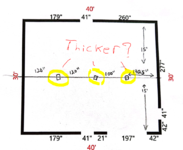
 ). take tributary area of mezz loading to each post and design your foundations below the posts for that load. install foundations prior to slab pour. even if you don't construct the mezz right away, the foundations will be under there waiting for it. you could try to incorporate the footings into the slab in one pour but that might be questionable for several reasons such as if the shallow soil competent for load support. it will probablay also use more concrete to do something monolithic but it would certainly be faster than exacavting and casting footings and then seperately casting slab. I would personally never construct less than a 3'x3' spread footing regardless of column load. The smaller you make the footing size, the more localized soil prep/bearing issues can affect the performance.


