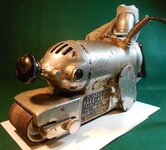
To avoid these ads, REGISTER NOW!

How about a classic Porter-Cable thread?

JHuston

Well-known member
Joined
Feb 21, 2016
Messages
301
Location
Canton, Ohio
Hi folks,
I don't post here very often, since my shop is in my basement and my attempt at a garage revamp thread fizzled ( both the thread and the revamp, if I'm honest), but I like to stop by and appraise the furniture every so often. You know, admire Gregor's latest project/post, crib organizational ideas from Drivesitfar's shop thread, that sort of thing. I really enjoy the posts in this forum, since it's related to what I do.

I've been a power tool repairman for about twenty years, specializing in Porter-Cable/Rockwell tools. I've been collecting the various products of that company for most of my adult life, focusing almost solely on pre-Rockwell era tools and machines. My shop houses forty stationary machines and one hundred and seventy handheld power tools, virtually all of them made by Porter-Cable or the legion of cousins Germain that they accumulated over the years. This list includes Syracuse Sander, Hutchinson Manufacturing, Mulliner-Enlund Tool, Unit Electric, and others.

50976993613_7315df031c_z.jpg


52016623763_7f40beccdd_z.jpg


26434753626_6c7c2e1042_z.jpg

I know that there are other P.C. fans on here; let's see your stuff!

-James Huston
 
To avoid these ads, REGISTER NOW!
OP
J

JHuston

Well-known member
Joined
Feb 21, 2016
Messages
301
Location
Canton, Ohio
Jay, the Mark 26 riding mower is long on style, but it's also a pretty decent lawn mowing machine. I also have the Mark 1 suburban tractor; it's mainly used for snow plowing, a task it excels at with its aggie tires and low, low gearing.

As requested,

50542289571_80231a3760_z.jpg

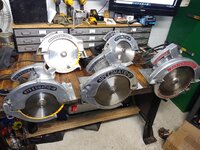
Here's a shot of the biggest circular saws in the shop. Front row, left to right: K-10, c. 1939, BK-12, c. 1942, 512, c. 1959.
Back row, L-R: 510, c. 1965, BK-10, c. 1947

And on the stationary side of things, my trio of band saws,

51864577028_84ff8fd425_z.jpg

Left to right: 20" Syracuse Sander BS band saw, c. 1918, Porter-Cable 20" BS band saw ( same basic machine, built after Syracuse Sander was purchased in 1922), c. 1930, Hutchinson "Speed Marvel" 16" band saw, c. 1925

One more saw, this time a before and after,

27946664508_164db16f23_z.jpg

32085971677_f37942b66f_z.jpg
K-88 circular saw with factory modifications, c. 1940.

This K-88 8" circular saw was ordered from the factory with an extended arbor ( this saw can run a full 1" dado stack) and steel base. The stock base is duralumin, this appears to be stamped from cold-rolled steel. While special order saws with extended arbors aren't uncommon, no other saw has come to light with an arbor this long or a base made from steel. It's possible that this saw is one of a kind. It was a bit of a heap when I got it ( in a group of K-series saws), but it's back in good health and back to work.

-James Huston
 

don long

Well-known member
Joined
Mar 31, 2012
Messages
8,856
Location
southern california
JHuston
Because of one of your earlier posts in another thread I have started collecting the porter-cable belt sanders and other power hand tools
Thank you. I haven't had time to polish any of them yet but I'm sure it will happen
 

bl00

Well-known member
Joined
Oct 6, 2006
Messages
1,014
Location
Chantilly, Virginia
Here are all (both) of my P-C tools. The shaper works great, but could really use a paintjob. Pic 2 is shaper accessories. Pic3 is a belt sander.
 

Attachments

  • shaper.jpg
    shaper.jpg
    322.9 KB · Views: 31
  • shaper tools.jpg
    shaper tools.jpg
    341.8 KB · Views: 35
  • pc sander.jpg
    pc sander.jpg
    346 KB · Views: 34

Jayman17

Well-known member
Joined
Feb 6, 2017
Messages
3,816
Location
Seattle, Wa
James, that Syracuse Sander bandsaw is really interesting I can’t recall seeing a bandsaw with a round table. That’s a nice collection of BS you have.

Jay
 

Lesserstore

Well-known member
Joined
Mar 18, 2020
Messages
866
Location
Texas
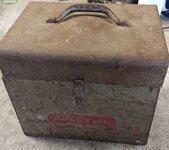
My dad won this late 60s early 70s Rockwell-PC 315 circular saw at an auction for a dollar. The case is from an earlier saw I believe. I really like how it adjusts for depth, keeping it parallel instead of just pivoting the saw up. I'm impressed by the quality, much better than my Craftsmans from the same era.
 

Attachments

  • 20220612_200346.jpg
    20220612_200346.jpg
    551.5 KB · Views: 30
  • 20220612_200412.jpg
    20220612_200412.jpg
    347.4 KB · Views: 19
  • 20220612_200420.jpg
    20220612_200420.jpg
    300.4 KB · Views: 20
  • 20220612_200636.jpg
    20220612_200636.jpg
    418.1 KB · Views: 20
  • 20220612_200653.jpg
    20220612_200653.jpg
    285.6 KB · Views: 26
OP
J

JHuston

Well-known member
Joined
Feb 21, 2016
Messages
301
Location
Canton, Ohio
I know Mr. Huston from OWWM.org. Ya'll are in for a treat.

Kind words! I hope my fellow members enjoy the thread, and add their own examples.
JHuston
Because of one of your earlier posts in another thread I have started collecting the porter-cable belt sanders and other power hand tools
Thank you. I haven't had time to polish any of them yet but I'm sure it will happen
I'm looking forward to seeing a Don Long restoration on a vintage Porter-Cable tool; I was describing your garage and its treasures to a friend, and I told him that I thought your work in taking pieces of Americana and bringing them to a state of perfection that they never would have had new qualified as Art ( with a capital A), specifically modern art. It takes a lot more skill and vision to turn a grease gun into a polished example of pure aesthetics than it does to paint a really big soup can!
James, that Syracuse Sander bandsaw is really interesting I can’t recall seeing a bandsaw with a round table. That’s a nice collection of BS you have.

Jay
It's really a shame that the BS band saw wasn't a bigger success, because it's a great saw to use- quiet, smooth, and very solid. The round table makes arranging a fence impractical, but it looks sooo cool.
My dad won this late 60s early 70s Rockwell-PC 315 circular saw at an auction for a dollar. The case is from an earlier saw I believe. I really like how it adjusts for depth, keeping it parallel instead of just pivoting the saw up. I'm impressed by the quality, much better than my Craftsmans from the same era.
Your 315 is a little bit older than you think. The dual-badged era was only from 1961-64, and the 315 was introduced in April of 1964. It was an incredibly popular saw; I've rebuilt nearly a hundred of them at this point, and seen a lot more than that out in the wild.
The case does appear older, as the original 315 case has a front hinged flap that makes it easier to remove the saw.

bl00, I also have a Porter-Cable AS_7 shaper, although mine is still undergoing repairs to the feed mechanism and toolhead,

51864577328_c5ea681d3d_z.jpg

I'm champing at the bit to get it running, because shapers are vastly underrated in a small shop.

-James Huston
 

freudianfloyd

Well-known member
Joined
Feb 12, 2015
Messages
3,432
Location
Nowhere
I don't own any vintage Porter Cable, but I remember as a boy, my dad who owns a construction company, took me to our local lumber yard, and he was looking to get a new reciprocating saw. He was always a Milwaukee Sawz-all guy, but I tried with all my hearts content to get him to buy a Tiger Saw.

I dont know what it was about them, but they always stuck with me and made me a Porter Cable fan. I run across them every once in a while at yardsales, but have never bought one as they are a bit outdated.

I do however use a P.C. drill and impact, multi-tool, and a few other tools and love all of them, even though the newer stuff does not have the reputation of the old stuff.

Heck, I even named my boy Porter.
 
OP
J

JHuston

Well-known member
Joined
Feb 21, 2016
Messages
301
Location
Canton, Ohio
The Tiger saw and the Sawzall have always been viewed as the Ford versus Chevy of power tools, but they're really apples and oranges. The Sawzall had no provision for oscillation in those days, being intended for the plumbing and electrical trades from the word go. While this led to a cleaner cut in thin meatal, it was a handicap when doing demo work, as the gullets of the blade would promptly fill with dust and bog down the cutting action. The Tiger saw had another advantage over and above the "wood" and "metal" settings- it had a significantly longer stroke ( again, the Milwaukee had a short stroke by design, since it helped with making a more accurate cut). These factors combined made the Tiger saw the most popular reciprocating saw for the homebuilder/contractor.

As far as being outdated, I wouldn't necessarily agree. The era I prefer is the earliest double insulated versions ( best combination of modern features and vintage build quality), but my sole Tiger saw is the original base model, the 677, and I've used the absolute stuffing out of it.
The model I've repaired the most was the ubiquitous 737. I have an example that was scrapped out for leaking grease. Turns out that it had a hole the size of a silver dollar broken out of the gear housing. I cleaned it up and kept it for the purpose of showing how a wobble plate- design reciprocating saw works.

-James Huston
 
OP
J

JHuston

Well-known member
Joined
Feb 21, 2016
Messages
301
Location
Canton, Ohio
Here's yet another long-term project,

51987202228_e6a51feb55.jpg

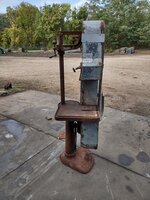
It's a B-6W wet belt grinder, built during WW2 ( the war finish tag is missing, but the ghost and drivescrew holes remain) and issued to Drydock, San Diego Naval Repair Base if the Naval station tool number tag is any indication. It started out as a rusted heap,

51573183179_83f7cf6054.jpg

but I've slowly been returning it to life. The water jacket is in awful shape, so I'm going to have to do some body work,

51641158312_fc1b98e094.jpg

but the rest of the grinder is in much better shape now, being only a belt and motor pulley away from functionality.

-James Huston
 

Cruzan80

Well-known member
Joined
Jul 22, 2015
Messages
4,302
Location
Denver, CO
When I first saw the title of this thread, I was laughing to myself. "Why do we need one of these, when someone on OWWM has gone thru so much work over there?". Imagine my (less-)surprised face when I opened it, saw the username and pics, and realized it was the same person...

The only suggestion I would make is to store some of your bigger documentation threads (I know you have done drills, sanders, etc) either on multiple forums or, even better, an offline copy with pictures. Just in case a site ends up self-destructiong, having server issues, or another Photobucket diaster. Would hate to see so much research get lost.
 
OP
J

JHuston

Well-known member
Joined
Feb 21, 2016
Messages
301
Location
Canton, Ohio
When I first saw the title of this thread, I was laughing to myself. "Why do we need one of these, when someone on OWWM has gone thru so much work over there?". Imagine my (less-)surprised face when I opened it, saw the username and pics, and realized it was the same person...

The only suggestion I would make is to store some of your bigger documentation threads (I know you have done drills, sanders, etc) either on multiple forums or, even better, an offline copy with pictures. Just in case a site ends up self-destructiong, having server issues, or another Photobucket diaster. Would hate to see so much research get lost.
I've actually started doing just that; I have a website ( that is still very much under construction ),

I'm hoping to eventually have the lion's share of my posts there, as well as links to some youtube videos.
-James Huston
 

freudianfloyd

Well-known member
Joined
Feb 12, 2015
Messages
3,432
Location
Nowhere
The Tiger saw and the Sawzall have always been viewed as the Ford versus Chevy of power tools, but they're really apples and oranges. The Sawzall had no provision for oscillation in those days, being intended for the plumbing and electrical trades from the word go. While this led to a cleaner cut in thin meatal, it was a handicap when doing demo work, as the gullets of the blade would promptly fill with dust and bog down the cutting action. The Tiger saw had another advantage over and above the "wood" and "metal" settings- it had a significantly longer stroke ( again, the Milwaukee had a short stroke by design, since it helped with making a more accurate cut). These factors combined made the Tiger saw the most popular reciprocating saw for the homebuilder/contractor.

As far as being outdated, I wouldn't necessarily agree. The era I prefer is the earliest double insulated versions ( best combination of modern features and vintage build quality), but my sole Tiger saw is the original base model, the 677, and I've used the absolute stuffing out of it.
The model I've repaired the most was the ubiquitous 737. I have an example that was scrapped out for leaking grease. Turns out that it had a hole the size of a silver dollar broken out of the gear housing. I cleaned it up and kept it for the purpose of showing how a wobble plate- design reciprocating saw works.

-James Huston
I'm not disagreeing that the tiger saw is a formidable saw that could still hold its own. I just meant the switch to battery powered kind of put a damper on plug in reciprocating saws and Tiger Saws never made the switch as far as I know.

By the way, one other BIG advantage the Tiger saw had over the Milwaukee is a quick change for the blade. The old Milwaukees required a hex key and those screws always seemed to get stripped out. Now they all have some form of quick change feature.
 
OP
J

JHuston

Well-known member
Joined
Feb 21, 2016
Messages
301
Location
Canton, Ohio
There was a 19.2 volt tiger saw, but the cost and amount of power it took to drive a tiger saw mechanism doomed it to obscurity.
- James Huston
 
OP
J

JHuston

Well-known member
Joined
Feb 21, 2016
Messages
301
Location
Canton, Ohio
Nearly every repair or restoration I do involves my lathe, Millicent.

52146380408_0eb6be5407.jpg

This is a Mulliner-Enlund 14" engine lathe, made sometime between late 1917 and early 1919, when Mulliner was purchased by Porter-Cable. P.C. already made a couple models of lathe, but they were second operation machines, not really suited for general purpose turning. This machine changed that, offering greater versatility and capacity ( this example is the 6' bed model). There is some connection to Hendey lathes, as several components are Wendell Norton designs used first by Hendey on their conehead series of lathes.

The Mulliner is a wonderful lathe to use, capable of surprising accuracy in the hands of a sympathetic machinist.
-James Huston
 
To avoid these ads, REGISTER NOW!
OP
J

JHuston

Well-known member
Joined
Feb 21, 2016
Messages
301
Location
Canton, Ohio
I like Porter cable reciprocating saws but I am not familiar with the larger woodworking line of Porter cable.
The tiger saw vied with the Milwaukee sawzall for decades, but they're really designed for different tasks; the original Sawzalls had a relatively short stroke and no oscillation, making for cleaner cuts in metal, whereas the Tiger saw had a longer stroke and could oscillate for demo work. The earliest Porter-Cable reciprocating saws, the Ruff-Neck and Multi-saw, were actually worm drive saws, but the performance was dismal despite the fairly high reciprocating speed.

As for the stationary machines, they were heavy into abrasive finishing; I'll post some photos.

-James Huston
 
OP
J

JHuston

Well-known member
Joined
Feb 21, 2016
Messages
301
Location
Canton, Ohio
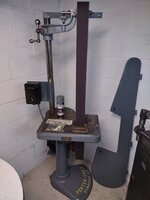
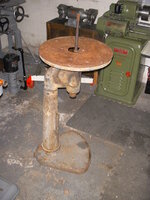
Porter-Cable made a large variety of stationary abrasive machines, from spindle sanders for patternmakers to industrial belt grinders with automated feed systems. Here are a few of the ones in my shop.

18596908654_a9ff9cbedb_z.jpg

The earliest design was this D-1 disc sander, invented around 1916 by R.L. Carter. Carter was most famous for inventing the router, but he had a number of stationary machines to his credit, the most successful being the Syracuse Sander models. Carter sold this business to Porter-Cable in 1922, and the D-1 was made until the stationary machine line was sold off around 1950. A 15" machine, the D-1 was extremely popular and is still commonly found.

Then there's the D-1's litter mate, the S-1 oscillating spindle sander,

10259725085_60af1329d7_z.jpg

Which came to the shop in awful shape, but made a full recovery,

16736193779_cf208a5377_z.jpg

This is also a Carter design. The original version seen here had a solid spindle and used wooden drums, but later types would have rubber drums and exchangeable spindles. My S-1 was little more than the five main castings when I got it; two of the castings were broken.

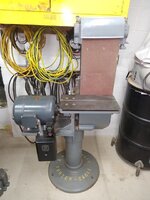
Rounding out the trinity of P.C. sanders in the early '30s was the massive B-3.

50720437328_3c090900ea_z.jpg

A 10" x 54" belt sander, the B-3 is usually equipped with a 3hp motor. The B-3 isn't a Carter design, but rather the descendant of a sander known as the B-1. This sander was a poorly thought out, fragile design, and Porter-Cable wasted precious little time on it, redesigning it almost immediately into the B-2, which was similar in layout to the b-3 but quite a bit smaller. The B-3 first appeared around 1925 and ( after the sanders were sold off ) would go on to be built by Engelburg Huller, who would make a version of it into the 1970s.

James Huston
 

Hoorn

Well-known member
Joined
May 19, 2020
Messages
1,140
Location
Glendora, CA
Extremely impressive. Its very clear the amount of effort you've invested in hunting and tracking down leads, combing sales sites, finding and refurbishing these grand tools over many years. Thank you for sharing and inspiring.
 
OP
J

JHuston

Well-known member
Joined
Feb 21, 2016
Messages
301
Location
Canton, Ohio
Thank you for the pictures and commentary.
I'm glad people are enjoying them!
J
Your collection of Porter cable equipment is SOOO Impressive. Makes me want to see more of it.
Coming from you, that is a mighty big compliment! In honor of the Big Party garage, I wanted to post some photos of tools that you might particularly enjoy.
, such as this B-10 belt sander from the late '30s.

49311956198_829bdb4429_z.jpg
A sander rarely encountered today, the B-10 was the first Porter-Cable "dustless" sander. Unfortunately, this was its downfall, as the armature fan was also pressed into service as the dust impeller. Due to the impeller housing, the fan was too far away from the motor, and airflow was badly restricted, causing overheating issues. All the same, the B-10 was produced from 1931 to 1942, mainly because there wasn't an alternative ( until the much more successful BB-10 came along during the war ).
This sander was rescued by a friend who intercepted it on the way to a scrapyard. The sander had sat somewhere damp for many, many years, seizing every single fastener and bearing, and partially dissolving the front of the frame.

Don't worry, I fixed it.

49334296448_996f398336_z.jpg

There was a lot of welding involved, and I spent more time than I care to admit freeing the various screws. The sander actually didn't have a ton of miles on it, which is probably why it survived long enough to wind up here in tool Valhalla.

Another looker is this c.1949 UC router that I call Ragnar Roundtooth because of the helmet-like upper cap,

51904844767_053af5244b_z.jpg

This is my favorite router, and it has handled every job I've thrown at it with ease. Porter-Cable bought Unit Electric in 1948 and produced the two router designs, the UC and its smaller sibling, the UB, for only four years, but the Unit routers would influence all later designs until Stanley Bostich discontinued all Porter-Cable routers earlier this year.

Then there's the 1000 finishing sander.

51872620469_3a331bcd1e_z.jpg

Also another company's brainwave, Sterling Sander was brought into the fold in 1949. Of the three models of sander made by Sterling, the 1000 is the golden child, being a finishing sander meant for almost constant use. Equipped with replaceable dust filters, quick-change sanding pads, and a fully enclosed drive running in an oil bath, the 1000 could survive a direct nuclear strike and was understandably really, really expensive ( 142.00 in 1951, or about 1,500 bucks today ). Once again, this design would inform all later sander layouts, making this the great-granddaddy of the legendary Rockwell 505 1/2 sheet sander.


Beautiful machines and outstanding work to resuscitate them. Porter cable as a builder of high-quality machines seems all but forgotten.

Tom B.

It's upsetting to me how fast they were forgotten. There were a number of great power tool manufacturers, but few had anywhere near the influence on how work was done that Porter-Cable had.
Extremely impressive. Its very clear the amount of effort you've invested in hunting and tracking down leads, combing sales sites, finding and refurbishing these grand tools over many years. Thank you for sharing and inspiring.

It's been nearly two decades in the making, but I've had a lot of help from people all over the country that didn't want to see a badly damaged machine die. I'm not much for pristine examples; I like the basket cases, the lost causes, the "why bother?" tools and machines.

One of my favorite finds was handed to me. Long story short, I lusted after a B-5 for years, but never had the money or the timing to land one. I watched the average price rise for years, then one day, I was contacted by another collector who had several of them. He said that he had one that was a heap, but he offered to give it to me free of charge if I promised to try my best to save it.

8263403206_20a9d0ebf6_m.jpg

The B-5 was in dreadful shape. For starters, the sander had been run with a major tracking issue for so long that the belt had abraded the frame nearly in half. This was "fixed" by drilling holes and bolting in an angle iron bracket, then welding the cut shut, melting the tag partly. The sander was driven along, dying on its feet, by generations of orangutans until the gears stripped. This put the sander out of commission, but not before the armature and field coil were burnt to a crisp.
They also broke the front handle, the fiends.

Still, it was a B-5 sander, my B-5 sander. This sander was the bedrock upon which Porter-Cable built their power tool empire, and it was the first portable belt sander ever made. This example was the "type two", having the maple rear handle ( the original had both handles made of aluminum, not the greatest idea in the days before grounded outlets). It was a piece of history, and it deserved better than to sit on a shelf as a derelict.

I learned to weld aluminum repairing the frame. I put money aside until I could afford to have the motor rewound, then scraped up the funds to have a new gear cut. I made several parts from scratch, such as the rear roller and bracket ( since the motor is offset, the B-5 is poorly balanced- the bracket helps counteract that ). I found a match to the factory paint, and adapted the sander to modern bearings ( both the original magneto bearings and the bores they fit in were toast, so an update was in order). It took six months of work to bring the sander back to life.
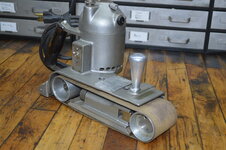
50947177633_15d06f9bb8_z.jpg

It was worth every minute.

I don't use the B-5 on every job; I reserve it for my finest work only. But it's a pleasure to see the sander in its rightful place on the bench nearly one hundred years after it left the factory.

-James Huston
 

don long

Well-known member
Joined
Mar 31, 2012
Messages
8,856
Location
southern california
James
Thank you for the new shots. I'm in love with that 1000 sander. it looks more like a speaker from the drive in.
How long have you been collecting these beautiful old tools?
I'm in awe of your ability to put life back in these abused tools.
 
OP
J

JHuston

Well-known member
Joined
Feb 21, 2016
Messages
301
Location
Canton, Ohio
Don, I've never thought of the 1000 that way, but that's pretty accurate. I started around 2003 or so with this 115 circular saw,

49674513756_03dc2defa2.jpg

I started out as a small engine tech, but the person at our shop that handled the power tools had a problem with showing up for work regularly, so I got voluntold to do that, too. I found the 115 in pieces at the bottom of a used parts box, rebuilt it, and was hooked.
-James Huston
 
OP
J

JHuston

Well-known member
Joined
Feb 21, 2016
Messages
301
Location
Canton, Ohio
genog, that 537 was made between 1959-1962. In its day, it was the second-largest router Porter-Cable offered, and was popular, if pricy. The 350/690 platform was more commonly seen after 1962 because it was cheaper, but the 537 continued as one of the flagship routers until well into the '90s. Cases were never offered for the larger routers, so many an enterprising carpenter built his own, if only to keep all the bits and accessories in one place. Beautiful example of an unbeatable router you have there.
-James Huston
 

genog

Well-known member
Joined
Sep 4, 2021
Messages
2,015
Location
Silicon Valley
Thanks James
I have three 690's and plan to put this ole boy back to work
But only for light duty

I enjoy your pics and restorations
Please keep them coming
 

Milton Shaw

Well-known member
Joined
Feb 11, 2011
Messages
4,845
Porter Cable are/were tool innovators when they were independent before they were bought out. I have several that were made a few years and then discontinued but they are unique in function. I have seen a hedge trimmer that had a chain saw action with straight teeth instead of regular chain saw teeth, no vibration and cut like crazy. I have a pocket tool jig that uses a router type bit for the recess and then use a hand drill to drill the screw hole. Very handy and does a better pocket than a Kreg jig as the hole is parallel to the board edge, not at such an angle it goes out of the board if too long. They made the first drum sander with oscillating drum that was portable. Numerous other tools that were short time of production but many are still being made. They were a great tool company based in Jackson TN, time will tell if they still are.
 
OP
J

JHuston

Well-known member
Joined
Feb 21, 2016
Messages
301
Location
Canton, Ohio
Milton, innovators is right; Porter-Cable introduced the first belt sander, the first helical geared ( sidewinder) circular saw, the first portable band saw, and one of the earliest cordless tool lines, the "big Ten" system of the early '60s.

The hedge shear was likely a 103 or 103r, but there was an earlier model known as the HT that is immediately recognizable by the wooden top handle. All used the same linked tooth design, and were very fast cutting. There was also a more conventional model, the 130, that used a reciprocating design.

-James Huston
 

four.cycle

Well-known member
Joined
Oct 19, 2015
Messages
29,225
Location
Tacoma, Washington
Porter_Cable_B10_Dustless_Take-About_Sander_1938_01.jpg
1938 Porter Cable B10 Dustless Take-About Sander
Porter_Cable_B10_Dustless_Take-About_Sander_1938_02.jpg
Porter_Cable_B10_Dustless_Take-About_Sander_1938_01.jpg
1938 Porter Cable B10 Dustless Take-About Sander
Porter_Cable_B10_Dustless_Take-About_Sander_1938_03.jpg
Porter_Cable_B10_Dustless_Take-About_Sander_1938_01.jpg
1938 Porter Cable B10 Dustless Take-About Sander
Porter_Cable_B10_Dustless_Take-About_Sander_1938_04.jpg
Porter_Cable_B10_Dustless_Take-About_Sander_1938_01.jpg
1938 Porter Cable B10 Dustless Take-About Sander

Yes, it works just fine.

Instruction sheets and parts list is around here somewhere too.
 

Attachments

  • Porter_Cable_letter_050592.jpg
    Porter_Cable_letter_050592.jpg
    231 KB · Views: 13
  • Porter-Cable B-10 belt sander BOX.jpg
    Porter-Cable B-10 belt sander BOX.jpg
    230.4 KB · Views: 17

Milton Shaw

Well-known member
Joined
Feb 11, 2011
Messages
4,845
Milton, innovators is right; Porter-Cable introduced the first belt sander, the first helical geared ( sidewinder) circular saw, the first portable band saw, and one of the earliest cordless tool lines, the "big Ten" system of the early '60s.

The hedge shear was likely a 103 or 103r, but there was an earlier model known as the HT that is immediately recognizable by the wooden top handle. All used the same linked tooth design, and were very fast cutting. There was also a more conventional model, the 130, that used a reciprocating design.

-James Huston
The one I used had a wooden top handle, but that has been over 50 years ago, so memory is not good other than it worked like crazy.
 
OP
J

JHuston

Well-known member
Joined
Feb 21, 2016
Messages
301
Location
Canton, Ohio
Four.cycle, that's an amazingly preserved example of a B-10! One interesting note is the presence of that black band right behind the front windshield; not all B-10's have that feature, and I'm not sure of the significance. It could be that it's a baffle intended to improve what airflow the B-10 has to work with, or it could be a means of installing a slightly longer armature and field coil ( Porter-Cable used motors made by other companies in those days, including GE, Westinghouse, Robbins and Myers, and Dumore ).

Milton, does this look familiar?

52204226328_88bd2124c5_c.jpg

It's a HT hedgeshear made around 1940 or so. A clever design that really only needed streamlined to become the more commonly encountered 103 series.

-James Huston
 

four.cycle

Well-known member
Joined
Oct 19, 2015
Messages
29,225
Location
Tacoma, Washington
JHuston- it's still in use here. I've done nothing to "preserve" it. It's just as it was when I bought it in 1992 from the children of the original owner.
 

Milton Shaw

Well-known member
Joined
Feb 11, 2011
Messages
4,845
Four.cycle, that's an amazingly preserved example of a B-10! One interesting note is the presence of that black band right behind the front windshield; not all B-10's have that feature, and I'm not sure of the significance. It could be that it's a baffle intended to improve what airflow the B-10 has to work with, or it could be a means of installing a slightly longer armature and field coil ( Porter-Cable used motors made by other companies in those days, including GE, Westinghouse, Robbins and Myers, and Dumore ).

Milton, does this look familiar?

52204226328_88bd2124c5_c.jpg

It's a HT hedgeshear made around 1940 or so. A clever design that really only needed streamlined to become the more commonly encountered 103 series.

-James Huston
Its been over 55 years, I just don't remember it any more than it was a chain instead of a vibrating bar.
 
OP
J

JHuston

Well-known member
Joined
Feb 21, 2016
Messages
301
Location
Canton, Ohio
JHuston- it's still in use here. I've done nothing to "preserve" it. It's just as it was when I bought it in 1992 from the children of the original owner.
I was thinking of the fellow who made the case, and it's new home where it's appreciated- vintage tools were made to be used, alright. Considering that sander is at least eighty- two years old, it's in beautiful shape.
- James Huston
 
To avoid these ads, REGISTER NOW!
Top Bottom