Thank you for the pictures and commentary.
I'm glad people are enjoying them!
J
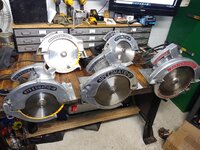
Your collection of Porter cable equipment is SOOO Impressive. Makes me want to see more of it.
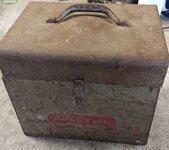
Coming from you, that is a mighty big compliment! In honor of the Big Party garage, I wanted to post some photos of tools that you might particularly enjoy.
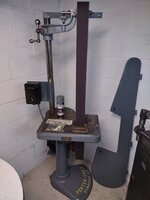
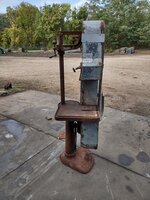
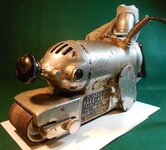
, such as this B-10 belt sander from the late '30s.

A sander rarely encountered today, the B-10 was the first Porter-Cable "dustless" sander. Unfortunately, this was its downfall, as the armature fan was also pressed into service as the dust impeller. Due to the impeller housing, the fan was too far away from the motor, and airflow was badly restricted, causing overheating issues. All the same, the B-10 was produced from 1931 to 1942, mainly because there wasn't an alternative ( until the much more successful BB-10 came along during the war ).
This sander was rescued by a friend who intercepted it on the way to a scrapyard. The sander had sat somewhere damp for many, many years, seizing every single fastener and bearing, and partially dissolving the front of the frame.
Don't worry, I fixed it.

There was a lot of welding involved, and I spent more time than I care to admit freeing the various screws. The sander actually didn't have a ton of miles on it, which is probably why it survived long enough to wind up here in tool Valhalla.
Another looker is this c.1949 UC router that I call Ragnar Roundtooth because of the helmet-like upper cap,

This is my favorite router, and it has handled every job I've thrown at it with ease. Porter-Cable bought Unit Electric in 1948 and produced the two router designs, the UC and its smaller sibling, the UB, for only four years, but the Unit routers would influence all later designs until Stanley Bostich discontinued all Porter-Cable routers earlier this year.
Then there's the 1000 finishing sander.

Also another company's brainwave, Sterling Sander was brought into the fold in 1949. Of the three models of sander made by Sterling, the 1000 is the golden child, being a finishing sander meant for almost constant use. Equipped with replaceable dust filters, quick-change sanding pads, and a fully enclosed drive running in an oil bath, the 1000 could survive a direct nuclear strike and was understandably really, really expensive ( 142.00 in 1951, or about 1,500 bucks today ). Once again, this design would inform all later sander layouts, making this the great-granddaddy of the legendary Rockwell 505 1/2 sheet sander.
Beautiful machines and outstanding work to resuscitate them. Porter cable as a builder of high-quality machines seems all but forgotten.
Tom B.
It's upsetting to me how fast they were forgotten. There were a number of great power tool manufacturers, but few had anywhere near the influence on how work was done that Porter-Cable had.
Extremely impressive. Its very clear the amount of effort you've invested in hunting and tracking down leads, combing sales sites, finding and refurbishing these grand tools over many years. Thank you for sharing and inspiring.
It's been nearly two decades in the making, but I've had a lot of help from people all over the country that didn't want to see a badly damaged machine die. I'm not much for pristine examples; I like the basket cases, the lost causes, the "why bother?" tools and machines.
One of my favorite finds was handed to me. Long story short, I lusted after a B-5 for years, but never had the money or the timing to land one. I watched the average price rise for years, then one day, I was contacted by another collector who had several of them. He said that he had one that was a heap, but he offered to give it to me free of charge if I promised to try my best to save it.

The B-5 was in dreadful shape. For starters, the sander had been run with a major tracking issue for so long that the belt had abraded the frame nearly in half. This was "fixed" by drilling holes and bolting in an angle iron bracket, then welding the cut shut, melting the tag partly. The sander was driven along, dying on its feet, by generations of orangutans until the gears stripped. This put the sander out of commission, but not before the armature and field coil were burnt to a crisp.
They also broke the front handle, the fiends.
Still, it was a B-5 sander, my B-5 sander. This sander was the bedrock upon which Porter-Cable built their power tool empire, and it was the first portable belt sander ever made. This example was the "type two", having the maple rear handle ( the original had both handles made of aluminum, not the greatest idea in the days before grounded outlets). It was a piece of history, and it deserved better than to sit on a shelf as a derelict.
I learned to weld aluminum repairing the frame. I put money aside until I could afford to have the motor rewound, then scraped up the funds to have a new gear cut. I made several parts from scratch, such as the rear roller and bracket ( since the motor is offset, the B-5 is poorly balanced- the bracket helps counteract that ). I found a match to the factory paint, and adapted the sander to modern bearings ( both the original magneto bearings and the bores they fit in were toast, so an update was in order). It took six months of work to bring the sander back to life.
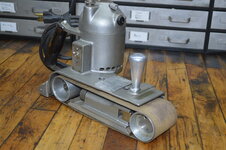
It was worth every minute.
I don't use the B-5 on every job; I reserve it for my finest work only. But it's a pleasure to see the sander in its rightful place on the bench nearly one hundred years after it left the factory.
-James Huston