To avoid these ads, REGISTER NOW!

Cutting stainless machine screws to length

rslaback

Well-known member
Joined
Jul 24, 2010
Messages
4,078
Location
Westcentral Wisconsin
I have an application where I need to cut some 10-32 screws to a shorter length. Ordinarily for standard steel or brass hardware I use the shear on my wire stripper to make a nice clean cut. However, I'm using stainless and the stainless is just a bit tougher and while the stripper will make the shear with an assist from a larger pliers for leverage it cannot be good for it.

Does a tool exist like the shear portion on a wire stripper that is designed for a tougher material and more force?
 
To avoid these ads, REGISTER NOW!

RTM

Well-known member
Joined
May 13, 2019
Messages
13,202
Location
SF Bay Area
I've seen a couple, but they aren't cheap

Here is an outside the box idea


Somewhere recently I saw a giant wire stripper type cutter, can't find it now.

EDIT might have been this

Then there is this thread.

I usually run a nut on, and use my dremel, but I'm not usually doing a bunch, and am not paid by the hour or job, or paid.
 
Last edited:

nadogail

Well-known member
Joined
Jan 23, 2009
Messages
31,982
Location
Coronado, CA
Cutting 10-32 Stainless Screws by hand is not for sissies, I have used the shear in my wire stripper & crimper it messed up both the tool and I believe my hands.

My advice; Buy the screws you need rather than try to make them.
 

rel406

Active member
Joined
Jun 8, 2022
Messages
26
I've seen a couple, but they aren't cheap

Here is an outside the box idea


Somewhere recently I saw a giant wire stripper type cutter, can't find it now.

EDIT might have been this

Then there is this thread.

I usually run a nut on, and use my dremel, but I'm not usually doing a bunch, and am not paid by the hour or job, or paid.
The same here- just use my dremel. I now run 2 nuts on first. I had one time where taking off 1 nut didn't clean up the threads quite enough, and I had a pain getting it re-threaded! Now I really take my time back-and-forth taking the nut off
 

JradM

Well-known member
Joined
Sep 4, 2019
Messages
1,819
Location
Alberta
Any of the decent-quality mini bolt cutters would do it - but you might want to thread a nut or die on before you slice incase the very end of the threads get mushed up. Cut-off wheel or grinder might give a slightly cleaner result, but a pair of Knipex Cobolts will be faster.

The Wiha bicuts could probably handle it too.
 

GeoBruin

Well-known member
Joined
May 5, 2018
Messages
3,744
Any of the decent-quality mini bolt cutters would do it - but you might want to thread a nut or die on before you slice incase the very end of the threads get mushed up. Cut-off wheel or grinder might give a slightly cleaner result, but a pair of Knipex Cobolts will be faster.

The Wiha bicuts could probably handle it too.
Mini bolt cutters and then dress them up on the belt grinder.
 

RoninB4

Well-known member
Joined
Jul 22, 2020
Messages
3,573
Location
Under My House
If you had a lathe (even a small one) you'd have mentioned it so the Dremel thing would work ok for small batches. Putting a nut on beforehand to avoid the thread burr/deformation is standard stuff but this often isn't enough. The cut will deform the thread or leave a dead square lead-in which often makes using the fastener difficult to get started in the hole. I'll do the nut thing but also put a chamfer (.025 for 10-32) on the end after cutting a fastener to length by chucking the head in a hand drill and touching the cut end on the grinder, while spinning the fastener, for just a moment. Most quality fasteners have a lead-in chamfer on them as part of the manufacturing process, same goes for a tapped hole having a C'sink for lead-in purposes. Makes it easier to start the thread with far less chance of cross-threading. Sure it's one extra step but it's a small one and well worth the effort. It's also a standard machining practice to do this on ALL internal/external threads.
 

JradM

Well-known member
Joined
Sep 4, 2019
Messages
1,819
Location
Alberta
If you had a lathe (even a small one) you'd have mentioned it so the Dremel thing would work ok for small batches. Putting a nut on beforehand to avoid the thread burr/deformation is standard stuff but this often isn't enough. The cut will deform the thread or leave a dead square lead-in which often makes using the fastener difficult to get started in the hole. I'll do the nut thing but also put a chamfer (.025 for 10-32) on the end after cutting a fastener to length by chucking the head in a hand drill and touching the cut end on the grinder, while spinning the fastener, for just a moment. Most quality fasteners have a lead-in chamfer on them as part of the manufacturing process, same goes for a tapped hole having a C'sink for lead-in purposes. Makes it easier to start the thread with far less chance of cross-threading. Sure it's one extra step but it's a small one and well worth the effort. It's also a standard machining practice to do this on ALL internal/external threads.
That's a good point. If I were doing this myself I would use mini bolt cutters and thread a nut on first - but after the cut, I would chamfer the end with my bench grinder before unscrewing the nut.

I don't know what tools the OP is working with though.

I wouldn't choose to use a cut-off wheel or just grind them down unless that was my only good choice. They get too hot - and you can still be left with messed up threads at the end.
 

RoninB4

Well-known member
Joined
Jul 22, 2020
Messages
3,573
Location
Under My House
I wouldn't choose to use a cut-off wheel or just grind them down unless that was my only good choice. They get too hot - and you can still be left with messed up threads at the end.
When working with stamping dies or injection molds there's "customized" thread lengths that just have to happen. The fasteners are almost exclusively socket head (SHCS) and are case hardened. Not much choice but to use an abrasive to cut-to-length cuz you sure aren't going to shear anything larger than electrical panel fasteners by hand.

They sure do get hot, container of water/coolant is required. If they're 1/2" or larger I'll spin the chamfer in the lathe. Not a pleasant thing to do shortening fasteners but it's regular thing that happens all the time.
 

sparky 1971

Well-known member
Joined
Oct 9, 2018
Messages
7,974
Location
Central Iowa
The best advice given has been to put a nut on before cutting with a ... (fill in the blank). I cut four (3) stainless 8-32's once with stripper shears. Each time, the handles of the strippers bent, and by the time I got to the fourth, the handles were touching and the screw wasn't cut. I can't imagine what a 10-32 or 10-24 would do.

These are the type of stripper I was using, not some phony Chinese junk.31qUAHaYrwL._AC_SY1000_.jpg
 

ToolPolisher

Well-known member
Joined
Jan 21, 2017
Messages
195
If I have to cut down a bolt or screw I use a Dremel as mentioned previously but I cut all the way around the fastener, not just straight through. Since starting to do it that way, not a single messed up thread. Just make sure you're cutting square to the fastener and not letting the threads guide your blade.
 

darkzero

Well-known member
Joined
Oct 20, 2011
Messages
3,327
Location
SoCal
Don't know how long your screws are, how much you need to shorten them, & how many you need to do. When I need to shorten not that much & just a few screws I use these. Just strips of aluminum with tapped holes, imperial on one end, metric on the other, hit em on the belt sander.

I just make em out of aluminum now cause I consider them sacraficial, quicker to make than using steel. Last batch I made I made a couple out of C-channel to try.

20200623_171555.jpg20200623_170709.jpg
 

RoninB4

Well-known member
Joined
Jul 22, 2020
Messages
3,573
Location
Under My House
Don't know how long your screws are, how much you need to shorten them, & how many you need to do. When I need to shorten not that much & just a few screws I use these. Just strips of aluminum with tapped holes, imperial on one end, metric on the other, hit em on the belt sander.

I just make em out of aluminum now cause I consider them sacraficial, quicker to make than using steel. Last batch I made I made a couple out of C-channel to try.
Lot of work but if you frequently have to shorten fasteners this type of jig works real well. Stamping dies often use a type of hollow set screw that needs to lock on shallow tapped holes where the height and flat face was important. Standard practice was to tap multiple holes in a 1/4" plate, set on the surface grinder chuck, run the hollow set screws (Unfied's) in to just touch the chuck, then grind all to a targeted height. No burning fingers, consistent height, flat face. Photo of Unified below, usually larger than 1" in diameter.
1660913849591.png
 
To avoid these ads, REGISTER NOW!

dcoleman88

Active member
Joined
Jul 22, 2019
Messages
44
Location
TN
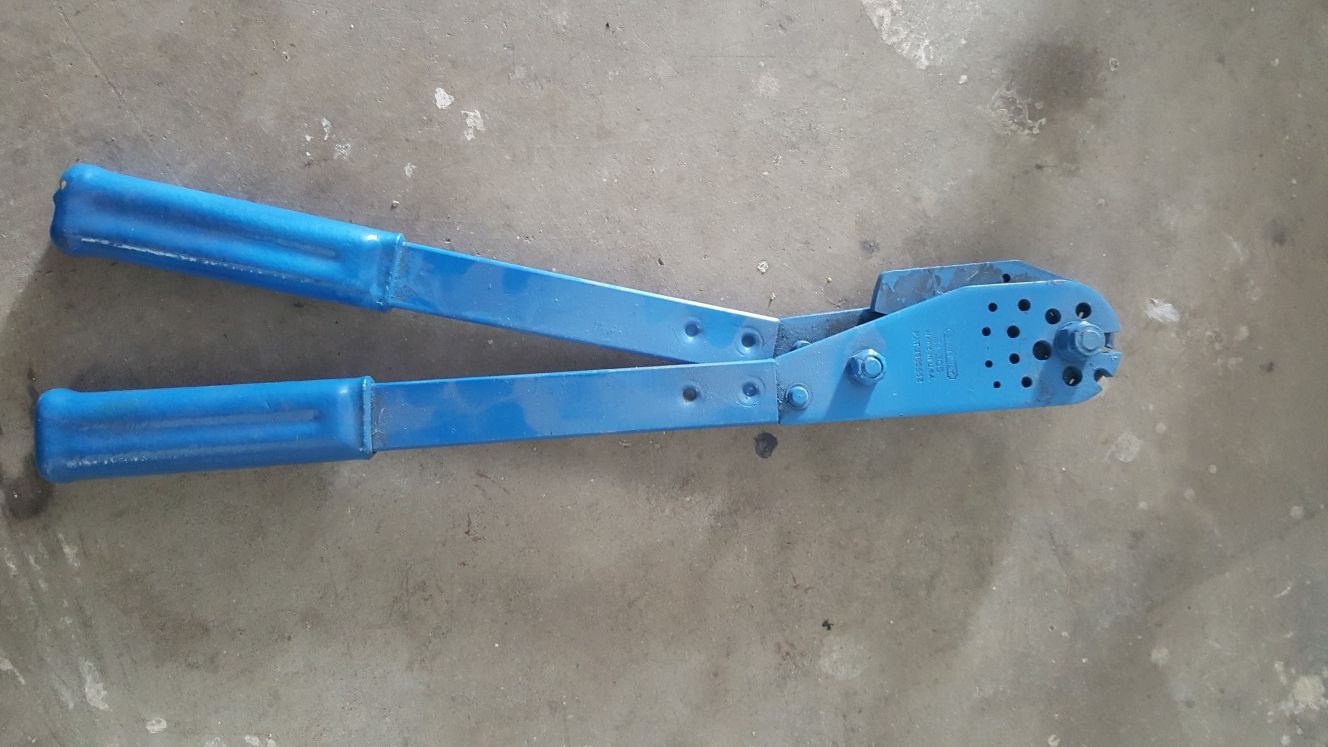
Stanley 84-205, handy when doing multiple fasteners. Sounds like just what you need.
 

tamaraw

Well-known member
Joined
Jun 6, 2022
Messages
843
If you have a bunch, I would probably run them through a bandsaw with a jig for the correct length. Otherwise a vice and a small cut-off wheel or even hacksaw will work. Or you could throw them in the chuck of a rotary tool and hold that against a hacksaw blade in a vice.
 

zendriver

Well-known member
Joined
Dec 10, 2014
Messages
29,975
Location
Indiana
A nut and a HF 3" cutoff tool, is what I use.

Leave the cut end ragged or fancy it up - doesn't matter.
 

dr_clyde

Well-known member
Joined
Jan 7, 2009
Messages
6,451
Location
Holland, MI
I use a rod shear most of the time, but they're kinda pricey new. Makes a pretty nice, clean cut with minimal futzing around, but you sometimes need to soften the lead in on the belt sander or deburr wheel.

One or two screws a small pneumatic cutoff wheel and touch up on the belt sander.
 

steel 35

Well-known member
Joined
Feb 20, 2011
Messages
2,105
Location
Between the PNW and the Emerald Triangle
all Sizes get nut’s, little ones go to the portaband stand , larger ones go to the lathe and are cut with a mounted dremel while spinning, and they are pretty again.
Work, just the same for the softer stuff.
yes I destroyed one cutter it failed the test and I liked it.
 

Mandres

Well-known member
Joined
Jun 22, 2006
Messages
1,157
10-32 screws are pretty cheap and available everywhere. It might make more sense to buy the right size than spend the time to cut them down?
 

dr_clyde

Well-known member
Joined
Jan 7, 2009
Messages
6,451
Location
Holland, MI
10-32 screws are pretty cheap and available everywhere. It might make more sense to buy the right size than spend the time to cut them down?
Yeah that obviously the way to go, this thread is assuming you are stuck with modifying a fastener for whatever reason.

I’m not gonna stop what I’m doing and go get two screws if I don’t have any, but can cut some down. If I have time, I’ll order a box of the right ones.
 

welder4956

Well-known member
Joined
Apr 8, 2010
Messages
3,072
Location
Birmingham, AL USA
I have an application where I need to cut some 10-32 screws to a shorter length. Ordinarily for standard steel or brass hardware I use the shear on my wire stripper to make a nice clean cut. However, I'm using stainless and the stainless is just a bit tougher and while the stripper will make the shear with an assist from a larger pliers for leverage it cannot be good for it.

Does a tool exist like the shear portion on a wire stripper that is designed for a tougher material and more force?
I use a Dremel cutoff wheel or cutoff wheel on a grinder, then dress the end with a file. The cut quality is as good or better than the sheared ends from a wire stripper. It helps to put the nut on before cutting, then remove it after cutting to align the threads. You could also get a thread chamfer tool to use with a drill that fits machine screw sizes. Something like this: https://www.amazon.com/dp/B07LF5JM6S/?tag=atomicindus08-20
 
OP
R

rslaback

Well-known member
Joined
Jul 24, 2010
Messages
4,078
Location
Westcentral Wisconsin
I should've known better than to post a thread without full context...

My hobby is to fix stuff that other people deem unrepairable or unworthy of repair. My family also does a fair amount of camping. As those two things overlap I find myself scavenging a lot of folding camping chairs that have been discarded. The chairs point of failure is usually the corner connectors. I measure and 3d model the design and then 3d print replacements.

Where the shortened fasteners come in is that these are usually held in place by a rivet for a pivot pin. To duplicate that smooth shank and evenly distributed load I use stainless machine screws sizing the unthreaded shank to the rivet length and leaving just enough thread to install a nylon nut to retain it.

I don't buy the right length fastener because to my knowledge it doesn't exist.

20220820_124324.jpg

20220820_124342.jpg
 

tarbellb

Well-known member
Joined
Apr 17, 2011
Messages
5,760
Location
Oregon
I would cut all these fasteners AFTER installed... for a perfectly flush fit

Cut off wheel or even a hacksaw
 

F-22

Well-known member
Joined
Jan 23, 2022
Messages
1,830
And it doesn't take much heat to melt the PLA that the part is made of
Does that hold it well? It must be a lot weaker than the original (probably ABS) part...

I'd definitely go with PETG for something structural like that. I'd also likely try to "support" the screw on both ends as that makes something like this way stronger (instead of a bending torque/moment on the plastic from the screw, it would mostly stay under compressive forces if the screw is supported on both ends).
 
OP
R

rslaback

Well-known member
Joined
Jul 24, 2010
Messages
4,078
Location
Westcentral Wisconsin
Does that hold it well? It must be a lot weaker than the original (probably ABS) part...

I'd definitely go with PETG for something structural like that. I'd also likely try to "support" the screw on both ends as that makes something like this way stronger (instead of a bending torque/moment on the plastic from the screw, it would mostly stay under compressive forces if the screw is supported on both ends).
Best I can tell the original parts are hdpe. The pla does fine and seems to have less tearing issues than the hdpe.
 

HenryAZ

MEMBER EMERITUS
Joined
Sep 18, 2012
Messages
1,054
Location
South Congress AZ
I buy all of my machine screws/bolts long (from McMaster-Carr), then cut them to length as needed. For stainless up to about M6, a hacksaw is quick enough. For larger, my PortaBand on a SWAG stand. To finish them off, a quick spin against a stationary belt sander at 45º leaves a nice bevel. I have never had a nut fail to thread on a screw done like this. In the case where I cannot get the screw to a sander, I use this Shaviv external chamfer bit, turned by hand or slowly in a drill.

I also use a thread file to clean up factory threads, needed more and more as quality goes down these days. The thread file comes in handy many other places, too.
 
To avoid these ads, REGISTER NOW!
Top Bottom