To avoid these ads, REGISTER NOW!

Learning more about anti seize products

908Jim

Well-known member
Joined
Aug 1, 2013
Messages
556
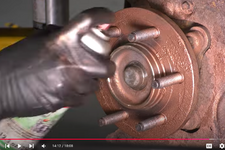
Not to add fuel to this fire, but some vehicle manufacturers do explicitly tell you to put anti-seize on the wheel hub to wheel centerbore interface.

Here is an example.
20220911_202353.jpg

Castrol Optimoly TA is just silver anti-seize. Cleaning and lubricating the wheel hub is necessary and not doing so can lead to an improperly mounted wheel. At least according to Porsche, a company devoted to engineering.

They also reference cleaning and using anti-seize on the area of the hub that centers the rotor.

20220911_202855.jpg

The area I circled comes from the factory with anti-seize applied to it. This area is a precision fit with the rotor. The five points center the rotor on the hub.

Anti-seize should never be applied to the hub face, rotor face or wheel face. I'm not sure if this is what your quoted post is saying, or if you are telling people not to grease the wheel hub to wheel centerbore. I know other manufacturers make similar suggestions in their service manuals, I am just most familiar with Porsches.

Porsche also recommends using anti-seize on their silver wheel bolts used from about 1997-2012. Around 12-13 they switched to a black coating on wheel bolts and anti-seize became a major no no at that point. The only time I'd ever recommend anti-seize on wheel bolts or lug nuts is when the manufacturer specifically calls for it in their service information.

I just checked my Audi Factory Manual for the B8 chassis and it says to lubricate wheel studs with Optimoly. One thing I found interesting is the image below in the "Wheel and Tire Guide General Information" section, where they are suggesting applying corrosion protection in the centering area. They refer to a "wax spray"


1662981631204.png

Also interesting to note, is an a VW Touran Manual I pulled up online it says:

"Always make sure that only the centering seat - arrow - is waxed and not the wheel contact surfaces. As a consequence, the brakes would become contaminated while driving and thereby result in poor braking."

Which leads me to wonder if this is the real reason they say not to use grease on the interface surface. Regardless, safest bet is to follow the specific instructions outlined in your vehicles manual.
 
To avoid these ads, REGISTER NOW!

cannuck

Well-known member
Joined
Nov 30, 2021
Messages
4,631
Location
Rural SK
Not to add fuel to this fire, but some vehicle manufacturers do explicitly tell you to put anti-seize on the wheel hub to wheel centerbore interface.


Anti-seize should never be applied to the hub face, rotor face or wheel face. I'm not sure if this is what your quoted post is saying, or if you are telling people not to grease the wheel hub to wheel centerbore. I know other manufacturers make similar suggestions in their service manuals, I am just most familiar with Porsches.

Porsche also recommends using anti-seize on their silver wheel bolts used from about 1997-2012. Around 12-13 they switched to a black coating on wheel bolts and anti-seize became a major no no at that point. The only time I'd ever recommend anti-seize on wheel bolts or lug nuts is when the manufacturer specifically calls for it in their service information.
You are providing exactly the information this thread needs. Note that they are careful to mention "should never be applied to the hub face, rotor face or wheel face". THESE are the surfaces that provide the friction that carries the loads from the hub to the wheel. Where they DO want anti-seize is the centering ring that does NOT carry any load once the wheel is tightened, but the first place of all to corrode and jam the wheel in place.

Also, what several of us have been trying to convey is few manufacturers are clear at specifying when, where and how to use anti-seize or other lubricating compounds.

Your post eloquently demonstrates exactly what I have been trying to explain. Thanks for posting this.
 

slowtwitch73

Well-known member
Joined
Apr 18, 2019
Messages
5,876
Location
Hellgate
I just checked my Audi Factory Manual for the B8 chassis and it says to lubricate wheel studs with Optimoly. One thing I found interesting is the image below in the "Wheel and Tire Guide General Information" section, where they are suggesting applying corrosion protection in the centering area. They refer to a "wax spray"


"Always make sure that only the centering seat - arrow - is waxed and not the wheel contact surfaces. As a consequence, the brakes would become contaminated while driving and thereby result in poor braking."

Which leads me to wonder if this is the real reason they say not to use grease on the interface surface. Regardless, safest bet is to follow the specific instructions outlined in your vehicles manual.
I just changed a flat on my Tundra and the wheel was frozen on.. aluminum to cast iron. I can see why they recommend doing that. Luckily a guy drove by with a sledge in his truck.
 

Uofime

Well-known member
Joined
Jan 11, 2021
Messages
173
Location
Charleston SC
I would not count on any specific value for reduction of friction, especially when the range your assuming is 300% wide!!!! F1 cars use drive pins, the bigass nut just holds the wheel in place. Pretty much EVERYTHING else relies on clamping friction provided by the wheel fasteners.
Guarantee the center lock nut which is either titanium or aluminum and is slathered in anti sieze. Likely the drive pins too. The pins are likely hardened steel and the receivers In the wheel again aluminum or titanium.
 

oldwino

ALLIANCE MEMBER
Joined
Nov 16, 2009
Messages
1,917
Location
Sonoma County California (wine country)
I used to like to dip a pencil in the never-seize and then apply a little bit inside a finger of a certain co-worker's work gloves...
Between taking his gloves off to scratch his nose/rub his face, and a couple restroom trips, he provided a LOT of entertainment. He never figured it out.
Dang, I thought that was what Dykem was for
 

cannuck

Well-known member
Joined
Nov 30, 2021
Messages
4,631
Location
Rural SK
Guarantee the center lock nut which is either titanium or aluminum and is slathered in anti sieze. Likely the drive pins too. The pins are likely hardened steel and the receivers In the wheel again aluminum or titanium.
A bit mean to have to point out: entertainment props are only based on some of the elements of transportation devices, not actually one and the same. Those wheels do not remain in place long enough for corrosion to become an issue. Whatever they DO, though, you can rest assured it is a thoroughly engineered joint and process, not something built on assumptions and old wives tales.
 

2oolhound

Well-known member
Joined
Dec 18, 2010
Messages
5,918
Location
BC Canada
A testament to torque and road stresses on wheels.

I recently took a 300 mile road trip in my tundra. I had changed my wheels from the steel rimmed winter treads back to my original aluminum rims with the summer tread tires in May using a torque wrench and no dressing anywhere. On the return trip I took the back roads which are hard packed gravel for the 1st 70 miles. After 40 miles of gravel the road got really bad with serious pot holes. At at least one point the suspension bottomed out. I slowed to a crawl for much of the final 30 miles of gravel. As soon as I hit pavement I noticed a bad pulsating wobble. The road was super narrow and windy with no shoulder to pull over on so I adjusted my mirrors down to at least look at the back wheels. The drivers rear was wobbling really badly. I made it to a wide shoulder and found all 5 nuts were almost ready to fall off the studs. Lucky for me I hadn't lost any and lucky for me to make it to the pavement because on the bad gravel I couldn't feel anything. Had there been 10 more miles of gravel things could have gotten really bad.

When I think about it now I know all 4 wheels had the correct torque and I brought the tire pressure up to specs just before leaving to head back on the gravel. I'm thinking that wheel received loads over and above normal loads that the manufacturer based their torque settings and wheel component materials on.

This thread is an interesting one. Check your wheel nuts regularly as well as tire pressure and follow manufacturer's specs.
 

PBCampbell

Well-known member
Joined
Feb 2, 2009
Messages
871
Location
WV
There is some old advice about rechecking lug nut torque after removing/reinstalling wheels within some small amount of mileage . There is also some old advice about excercising clicker type torque wrenches that don't see regular use. That applies to the common coil spring type, not so much the beam type. 2oolhound's experience seems extreme but maybe the extreme road surface conditions exacerbated the situation.
 

cannuck

Well-known member
Joined
Nov 30, 2021
Messages
4,631
Location
Rural SK
I have started installing plastic wheel nut torque indicator flags on trailers, and possibly start on trucks. Managed to find a manufacturer that will sell me boxes of 100 for about $0.50 Cdn (loonies are .7 real greenbacks). Won't stop them from loosening but an easy way to draw attention and get verification on daily inspection.
 

billford

Well-known member
Joined
Dec 26, 2016
Messages
81
I use anti seize on exhaust studs, nuts and anything that screws into the exhaust, like o2 sensor, nox sensors, fittings, etc...
Also use it on wheel hubs.

I only use the motorcraft brand, as they only have 1 type of the product, never had a problem with it.

Motorcraft Anti Sieze
 

brtsvg

Well-known member
Joined
Aug 13, 2011
Messages
131
There is some old advice about rechecking lug nut torque after removing/reinstalling wheels within some small amount of mileage .

Yes this is "standard practice: when torquing aluminum rims on wheel studs protruding from a steel hub.
 

dffay

Well-known member
Joined
Jul 9, 2015
Messages
434
I’ve wondered if using anti-seize for its anti-galling feature would nullify the use of Nylock nut where it’s slip feature works against the nylon lock in the Nylock.

But then I tend to ponder imponderables all the time.....
 
To avoid these ads, REGISTER NOW!

Plombob

Well-known member
Joined
Oct 19, 2008
Messages
4,129
Location
Tennessee
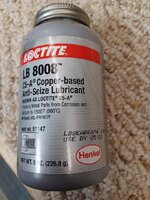
Bought an 8 oz. bottle of Loctite LB 8008, aka C5-A at Habitat for a few bucks. Thought I'd have enough anti-seize to last 15 lifetimes. Then I noticed it has an EXPIRATION DATE! "Use by 05/23".

WTF! How does this stuff "expire"? What will happen if I continue to use it after that date? Parts will stick together?Loctite.jpg
 
Last edited:

richfinn

Well-known member
Joined
Jan 29, 2011
Messages
4,814
Location
Leeds, Yorkshire, England
I hate that horrible sh*t!!!

It's used way too liberally by people who shouldn't be meddling with vehicles.

If the factory doesn’t apply it, you don't need it!!!
 

Jim greengo

Well-known member
Joined
Sep 3, 2018
Messages
7,415
Location
Behind my house
Blue Loctite is probably the best solution. It seals the threads from corrosion and as the name implies locks the bolt until you want it to come out. That's usually a fight but with modern impacts you always win and the bolt doesn't gall up or rust. Anti-Seize does have it's place, like for example between the brake disc and the hub where two metal parts can rust to each other making removal difficult/impossible. I don't use it on fasteners I use Blue Loctite.
Blue loc tite usually isnt too bad ,red stuff is a differant story in my experiance.
 

cannuck

Well-known member
Joined
Nov 30, 2021
Messages
4,631
Location
Rural SK
In my world it is the last line of defense from customers and their engineers who didn't understand to order silicon bronze nuts to go with SS bolts. We carry it onto every job to be able to re-use the stainless-on-stainless stuff that is still not broken. (for those not aware, stainless steel nuts will seize on stainless bolts about 1 in every 10 and can only be removed by breaking the bolt). Customers who give a damn will pay us to put correct nuts in place but since that is literally thousands of bux, most just have us put on the paste.
 
Last edited:

tamaraw

Well-known member
Joined
Jun 6, 2022
Messages
842
I have started installing plastic wheel nut torque indicator flags on trailers, and possibly start on trucks. Managed to find a manufacturer that will sell me boxes of 100 for about $0.50 Cdn (loonies are .7 real greenbacks). Won't stop them from loosening but an easy way to draw attention and get verification on daily inspection.
King County Metro put them on all of the public buses here about 10 years ago. Seems like a very cheap and simple, yet effective "preflight" when you have 4-6 wheels with 10 lugs each.
 

M6erfan

Well-known member
Joined
Dec 6, 2014
Messages
10,170
Location
'Merica!
Blue Loctite is probably the best solution. It seals the threads from corrosion and as the name implies locks the bolt until you want it to come out. That's usually a fight but with modern impacts you always win and the bolt doesn't gall up or rust. Anti-Seize does have it's place, like for example between the brake disc and the hub where two metal parts can rust to each other making removal difficult/impossible. I don't use it on fasteners I use Blue Loctite.

Blue loc tite usually isnt too bad ,red stuff is a differant story in my experiance.

I use the low strength purple stuff; Loctite 222 as a general purpose thread sealant.
 

bill75075

New member
Joined
Dec 18, 2024
Messages
1
I personally keep all of them on hand for different things and because it’s interesting to me lol. I have each one at home but I’m out of the nickel. I typically use copper for exhaust and spark plugs, silver for the wheel to rotor and rotor to hub and lug nuts. Also CV axle shafts going into the hub and other things too. Nickel don’t really have a special use for it just wanted it because I collect it. I use it on plugs for sure. Once you have dealt with seized plugs then you will do it. I also use just a very very light amount on lug studs and I usually coat the hub to rotor surface and occasionally will use a little bit on the wheel to rotor surface too. At work all we have is the Permatex anti seize lubricant that’s all it says on the jar. We do stock the Motorcraft nickel anti seize for the Ford techs to use on those spark plugs that break. I know a bunch of old timers who use anti seize on battery terminals personally that seems like something that would burn the car to the ground since it’s conductive lol. Actually had a guy from Interstate Batteries tell me to use it on terminals too when he delivered a battery to me after I told him I forgot to get a installation kit. After reading online because I had never heard of doing that it appears it’s a lot more common than most people think.
"I know a bunch of old timers who use anti seize on battery terminals personally that seems like something that would burn the car to the ground since it’s conductive lol."

This actually makes a lot of sense - what would burn the car to the ground would be having a bad connection, since those are the ones that heat up. If you have a good connection (which the conductive anti-seize would help with), you'd have reduced resistance, so no heat build-up and no fire. You WANT conductive.
 

cannuck

Well-known member
Joined
Nov 30, 2021
Messages
4,631
Location
Rural SK
King County Metro put them on all of the public buses here about 10 years ago. Seems like a very cheap and simple, yet effective "preflight" when you have 4-6 wheels with 10 lugs each.
When I am hauling a B train there are 160 lug nuts to check! You want to believe it helps.
 

lund

Well-known member
Joined
Nov 2, 2019
Messages
769
Location
Michigan
I'm not a big fan either... I have a jar that's at least 20 years old and will be around when I'm not lol.
It depends where you live. I am in the Michigan rust belt and keep cars a long time. Anti-seize is a life saver. I use it on most everything exterior that I take apart (not usually in internal engine parts though) and it makes subsequent work way easier. The only big minus is it tends to get over most everything.

I use both the regular (silver) and copper versions (high heat, say on exhaust manifolds or brake components). I never noticed any issues using copper on Aluminum. Even if it is sub-optimal, I doubt very much that it makes much difference. There are test videos online where they confirm that anti-seize products work somewhat better than grease, wax, etc. It is simple, fast, and cheap and also makes future work much easier in the rust belt. So why not. The only downside I see is the mess. But I try to consistently wear old clothes that I do not mind getting damaged when doing car work.
 
Last edited:
To avoid these ads, REGISTER NOW!
Top Bottom