
For every one who's worked with peaveys and cant hooks in their past do you get a little sick looking at the new fangled ones they sell now-a-days? They're made of pipe and steel all welded together and painted bright red and blue. They don't have smooth flowing lines like the old ones that can be squeezed in between logs in a deck to get the one you want. I just can't stand looking at them. I decided to refit some old hardware I've had around since when I built log houses in the 70's. I turned down a length of a yew wood limb I had on my 10" atlas lathe. (Messy but it cuts like butter in the metal lathe).

Back in those days I always wanted to make a cant hook but use an aluminum baseball bat for a handle. I figured it might even float for B&B crews, saw millers and loggers working near the salt chuck so I've been keeping my eyes open for one and was gifted a beat up one some kids must have been hitting rocks with. Good enough for me (Free!).
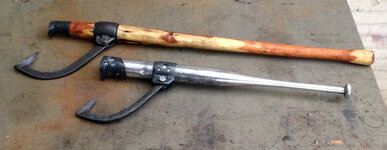
The top one I made the tip and the yew wood handle for, the rest of it was parts I had.
The baseball bat one I made the tip and the clamp for the hook. I milled some steel pieces for the lugs where the hook swings between and then hits a high shoulder to stop it from closing up so you can't grab a log. Those lugs were then welded into some pipe collars that I drilled holes in for looks and to keep the weight down. I haven't tested it to see if it floats but that will be a bonus if it does.
Here is the tip set up to weld the teeth onto the pipe for the aluminum one.

Here is this set up clamped together for welding:

Here it is stuck together with weld:

Here is the hook clamp that has the 2 machined lugs welded to the pipe:

This shot shows the raised lug that stops the hook from closing against the tip. The lugs were milled on my mill drill. The good ole original ones were forged entirely by a blacksmith but I'm not that talented (yet) :

This is the tip for the yew wood one. It is a piece of pipe that was bashed onto a tapered cone to give it the taper needed for the handle. It was heated red hot then the bent up top was dipped in water to cool it so I could hammer on it without flattening it so the bottom end would expand over the cone. Once I had the taper deep enough I cut the top off and used the bottom. The piece on the right side is the old broken one.

Here's the tip with some teeth welded on:

Cant hooks cant wait to do some log work!
Back in those days I always wanted to make a cant hook but use an aluminum baseball bat for a handle. I figured it might even float for B&B crews, saw millers and loggers working near the salt chuck so I've been keeping my eyes open for one and was gifted a beat up one some kids must have been hitting rocks with. Good enough for me (Free!).
The top one I made the tip and the yew wood handle for, the rest of it was parts I had.
The baseball bat one I made the tip and the clamp for the hook. I milled some steel pieces for the lugs where the hook swings between and then hits a high shoulder to stop it from closing up so you can't grab a log. Those lugs were then welded into some pipe collars that I drilled holes in for looks and to keep the weight down. I haven't tested it to see if it floats but that will be a bonus if it does.
Here is the tip set up to weld the teeth onto the pipe for the aluminum one.
Here is this set up clamped together for welding:
Here it is stuck together with weld:
Here is the hook clamp that has the 2 machined lugs welded to the pipe:
This shot shows the raised lug that stops the hook from closing against the tip. The lugs were milled on my mill drill. The good ole original ones were forged entirely by a blacksmith but I'm not that talented (yet) :
This is the tip for the yew wood one. It is a piece of pipe that was bashed onto a tapered cone to give it the taper needed for the handle. It was heated red hot then the bent up top was dipped in water to cool it so I could hammer on it without flattening it so the bottom end would expand over the cone. Once I had the taper deep enough I cut the top off and used the bottom. The piece on the right side is the old broken one.
Here's the tip with some teeth welded on:
Cant hooks cant wait to do some log work!
Attachments

Last edited:


