Ton ton
Well-known member
You should have both. Remember the garage journal rule. That way if you break the ratchet, you have a backup plan.


My dad hardly knows what a breaker bar is, LOL. I grew up using a 3/4" ratchet. I did buy a 3/4" drive breaker since I joined garage journal.By father would kill me if I ever did that to a ratchet.

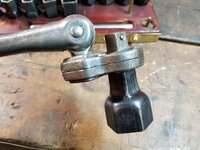
My 30+ year old MAC has the drive stud square, not angled as shownQuestion for you guys who have modern "breaker bars"... Do any still come with the drive stud hinged on an angle like this?
Why did they do that?Question for you guys who have modern "breaker bars"... Do any still come with the drive stud hinged on an angle like this?
I have a 1/4 Facom mini breaker bar with the anvil on an angle. Don't think I've seen a new one in a long time.Question for you guys who have modern "breaker bars"... Do any still come with the drive stud hinged on an angle like this?
I'm not sure. I have a theory. It would allow the handle to be at oblique angles, perhaps providing better access when needed. Those are Snap-on M-10 (9/32-inch drive), NS-10 (1/2-inch drive), and L-10 (3/4-inch drive) hinge handles from WWII, incidentally.Why did they do that?
Thanks! That's good to know. The only other hinge handle I have seen with that 45* design approach is this one!I have a 1/4 Facom mini breaker bar with the anvil on an angle. Don't think I've seen a new one in a long time.



It’s more than the money. A broken tool always hurts productivity. You have to waste time finding an alternative tool, doing the warranty submission (even if it’s a tool truck involved, it takes time), and there’s always the risk of injury.If your talking tool truck warranty/replace if it breaks then I’m using the ratchet no question. If I have to pay for new tool when it breaks then I’m using a breaker bar cause it’s less money to replace.
My 1/2 breaker bar is a little bit beefier handle then my 18 inch 1/2 ratchet. It has less flex. I use both to break stuff loose, benefit of the 18 is that you can still use it afterward to keep working rather than swap out. 24 inch ratchet would be annoying once you've broken a fastner loose. I wouldn't ever see the need for a 24 inch ratchet, at least in tight places.
This.I think you *need* a breaker bar, where a 24" ratchet is a little bit of a luxury.
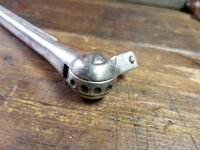
That socket set looks amazing man! I wonder what those drilled holes are for in the break anvil? Very well made looking breaker bar.I'm not sure. I have a theory. It would allow the handle to be at oblique angles, perhaps providing better access when needed. Those are Snap-on M-10 (9/32-inch drive), NS-10 (1/2-inch drive), and L-10 (3/4-inch drive) hinge handles from WWII, incidentally.
Thanks! That's good to know. The only other hinge handle I have seen with that 45* design approach is this one!
Which is really old. It belongs to this antique socket set from c. 1909.
There's a detent ball under the pivot that locks it in one of those positions.I wonder what those drilled holes are for in the break anvil?
Thanks. It is. Love the ball on the end, too, which is very comfortable control.That socket set looks amazing man!...[ ]...
Very well made looking breaker bar.
The reason is that the original patent, held, I believe, by Plomb, had the drive squared up. They aggressively guarded their design and pursued legally infringements of their patent. Other manufacturers used the offset drive head to skirt the issue. After the patent expired, there weren’t many manufacturers who held on to the circumventing design. Or so I’ve read somewhere at some time, years ago when I first started paying attention to tools as collectibles.Why did they do that?
You're conflating the orientation of the drive stud with how the entire head is attached to the shank, RJ. The patent you're referring to (1,380,643 / June 7, 1921) was not held by Plomb. Granted to a guy named Eagle, who licensed it to Plomb and others, it claimed as novel a hinge handle with the shank forked and the head pinned inside the fork. P&C had been making hinge handles for years before that with the head forked and pinned on the outside of the shank. When they started making them the other way around, Eagle sued P&C for infringement in 1930. Eagle lost. Worse, the court (9th Circuit, 74 F.2d 918, 920) determined that his patent was invalidly awarded by the USPTO! Even if he had not lost, that patent would've expired in 1938. Snap-on and nobody else was bound by that in WWII. Also, note that not all Snap-on hinge handles were made with the drive stud twisted 45*. I don't know if they were special order or if it was just during WWII. I never looked into it that far. But I have always been curious about it, and took this opportunity to ask.The reason is that the original patent, held, I believe, by Plomb, had the drive squared up.

Those old ones were so unique, functionally and cosmetically.Question for you guys...
(Thanks for bearing with me. This will be my last interruption, AJHD.)
I really do appreciate reading about older hand tools.I know the thread had more of an AVP approach, and the OP came around to the mini-survey conclusion of having both in the end, how about Breaker and Ratchet, instead? Believe it or not, those M.I.T. Eames bros had a very early ratchet adaptor, too!
(Thanks for bearing with me. This will be my last interruption, AJHD.)
Fixed it for ya. If you're gonna be on GJ, ya gotta do it right.You should have multiple versions o f both. Remember the garage journal rule. That way if you break the ratchet, you have a backup plan.
Give me a welder: I can make a ratchet a breaker bar!Breaker bars are good for exactly that. They don't 'fall back' beyond where you put them. I use a long 1/2" breaker bar for high torque needs like 30mm Land Cruiser torsion bar suspension, 3/4 ton lug nuts, Honda crank bolts, etc. You *can* make a breaker bar a ratchet (SO S67/S77/S77A on eBay - I paid $35) but to the best of my knowledge you cannot make a ratchet a breaker bar. I don't want to buy a whole load of 3/4" sockets, so this is my 'ultimate' 1/2" solution save air and fire.
I had one of these in 3/4 drive. HF flavor.Give me a welder: I can make a ratchet a breaker bar!

Glad to hear that it wasn’t pot metal!I had one of these in 3/4 drive. HF flavor.
The internals were!Glad to hear that it wasn’t pot metal!