To avoid these ads, REGISTER NOW!

Breaker bar vs. Ratchet

To avoid these ads, REGISTER NOW!

VolvoRyan

Well-known member
Joined
Dec 29, 2019
Messages
1,339
Location
Kentuckiana, USA
I have both. Both Snap-On, though the ratchet is the locking-flex head. Breaker bar can get into tighter spaces. That matters. Breaker bars are also much cheaper than the ratchet. As mentioned, you can "work" a stuck fastener more easily with a breaker bar.

On the other hand, the Snap On ratchet handle is thicker than the breaker bar's. That makes the ratchet less bendy. Snap-On will also sell you replacement guts for the ratchet for the princely sum of $10. Cheap enough to have on hand... so you get a mulligan if you do something stupid. The ratchet is every bit as "strong" as the breaker bar.

24" ratchets are great for leverage (duh), but also "ergonomics": Much easier on the back to turn an engine over with a 24" handle instead of bending over to do it with a 17". I've found a number of TTY fasteners... that got rusty, and there was enough un-threaded fastener to absorb the blows from an impact wrench. Ratchet worked well here.

I think you *need* a breaker bar, where a 24" ratchet is a little bit of a luxury.

-Ryan
 
Last edited:

richfinn

Well-known member
Joined
Jan 29, 2011
Messages
4,817
Location
Leeds, Yorkshire, England
I have a couple of breaker bars in 3/4" and 1/2" which I tend to use on tight lug nuts/hub nuts if an impact won't shift them.

I really like my 3/8" Snap-On breaker bar and short Ko-ken extra sockets or 12 point sockets for working on the front end of engines in front wheel drive cars

I like how compact a breaker bar can be sometimes compared to a ratchet for certain tasks

I use my long 1/2" ratchet for barring engines over with the crank pulley bolt and loosening cylinder head /suspension bolts mostly.

If I'm using an extension bar I always pick a ratchet

You need a selection of both if you work on European cars
 

Zewnten

Well-known member
Joined
Jun 11, 2017
Messages
1,830
Going heavy equipment you need the breaker bar to back up your impact. One socket on the gun the other; deep or shallow on the bar. I have 30" matco sheared the anvil off, ratchet internals were fine. I also have the old SK's longest 1/2 breaker bars. Both for clearance issues otherwise I use 3/4 dr when I need that much torque. You're going to need a 36" 3/4 dr breaker bar and ratchet before you need really long 1/2 dr stuff.
 

Private Lugnutz

Well-known member
Joined
Mar 30, 2012
Messages
30,623
Location
The Authentic Jersey Shore
Why did they do that?
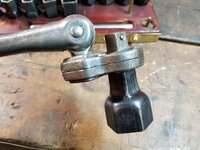
I'm not sure. I have a theory. It would allow the handle to be at oblique angles, perhaps providing better access when needed. Those are Snap-on M-10 (9/32-inch drive), NS-10 (1/2-inch drive), and L-10 (3/4-inch drive) hinge handles from WWII, incidentally.
I have a 1/4 Facom mini breaker bar with the anvil on an angle. Don't think I've seen a new one in a long time.
Thanks! That's good to know. The only other hinge handle I have seen with that 45* design approach is this one!

Eames 3.1.jpg

Eames 3.4.jpgEames 3.5.jpgEames 3.6.jpg

Which is really old. It belongs to this antique socket set from c. 1909.

Eames 1.2.jpg
 

Attachments

  • Eames 1.1.jpg
    Eames 1.1.jpg
    174.4 KB · Views: 14

finn

Well-known member
Joined
Mar 27, 2005
Messages
16,297
Location
The UP, God's country
If your talking tool truck warranty/replace if it breaks then I’m using the ratchet no question. If I have to pay for new tool when it breaks then I’m using a breaker bar cause it’s less money to replace.
It’s more than the money. A broken tool always hurts productivity. You have to waste time finding an alternative tool, doing the warranty submission (even if it’s a tool truck involved, it takes time), and there’s always the risk of injury.

It seems that a breaker bar is less likely to fail, and if it does fail, it will be less dramatic. Plus, it’s cheaper to replace.
 
Last edited:

sparky 1971

Well-known member
Joined
Oct 9, 2018
Messages
7,975
Location
Central Iowa
I have both in multiple sizes. 8", 16", and 30" SK and a 24" Proto breaker bars in 1/2" drive. For 1/2" flex head ratchets, 15" and 18" SK, 18" and 24" Gearwrench, and a 26" Mac. I really only use the 30" SK breaker bar and the 15" SK ratchet though. I'm old school enough and have busted my hands open enough times from a ratchet failing (years ago) that if something doesn't want to move, I'm using a breaker bar.
 

RedneckWelder

Well-known member
Joined
Nov 12, 2013
Messages
5,705
Location
The Ghetto Kingdom of Methlandia
My 1/2 breaker bar is a little bit beefier handle then my 18 inch 1/2 ratchet. It has less flex. I use both to break stuff loose, benefit of the 18 is that you can still use it afterward to keep working rather than swap out. 24 inch ratchet would be annoying once you've broken a fastner loose. I wouldn't ever see the need for a 24 inch ratchet, at least in tight places.

24” flex head ratchet can reach **** you cannot with a shorter ratchet

i have a 36” Snap On breaker bar, a 24” gearwrench flex head ratchet, and a 17” Snap On flex head ratchet, each has its place and each has filled roles the others can‘t or can’t do easily.
 

teagueo

Well-known member
Joined
Mar 7, 2017
Messages
464
I'm not sure. I have a theory. It would allow the handle to be at oblique angles, perhaps providing better access when needed. Those are Snap-on M-10 (9/32-inch drive), NS-10 (1/2-inch drive), and L-10 (3/4-inch drive) hinge handles from WWII, incidentally.

Thanks! That's good to know. The only other hinge handle I have seen with that 45* design approach is this one!

Eames 3.1.jpg

Eames 3.4.jpgEames 3.5.jpgEames 3.6.jpg

Which is really old. It belongs to this antique socket set from c. 1909.

Eames 1.2.jpg
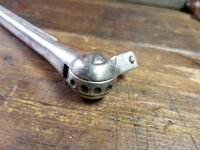
That socket set looks amazing man! I wonder what those drilled holes are for in the break anvil? Very well made looking breaker bar.
 
OP
A

AJHD

Well-known member
Joined
Jan 4, 2020
Messages
3,035
Location
AZ
2 pages of responses and I've determined the general consensus is this...

#1. Have both.
#2. Personal preference.
 
To avoid these ads, REGISTER NOW!

Private Lugnutz

Well-known member
Joined
Mar 30, 2012
Messages
30,623
Location
The Authentic Jersey Shore
I wonder what those drilled holes are for in the break anvil?
There's a detent ball under the pivot that locks it in one of those positions.
That socket set looks amazing man!...[ ]...
Very well made looking breaker bar.
Thanks. It is. Love the ball on the end, too, which is very comfortable control.
 

Walkers

Well-known member
Joined
May 17, 2021
Messages
3,912
Location
Cave Creek Az
If you feel that you are far exceeding the strength of the ratchet, and there is a chance of breakage, switch to the breaker bar. You may still have a broken tool until the snappy man comes back by, but at least you won’t be spinning off nuts with a breaker bar for a week.
 

Ricky Joe

Well-known member
Joined
Sep 15, 2013
Messages
2,452
Location
Roanoke, Va.
Why did they do that?
The reason is that the original patent, held, I believe, by Plomb, had the drive squared up. They aggressively guarded their design and pursued legally infringements of their patent. Other manufacturers used the offset drive head to skirt the issue. After the patent expired, there weren’t many manufacturers who held on to the circumventing design. Or so I’ve read somewhere at some time, years ago when I first started paying attention to tools as collectibles.
 

Private Lugnutz

Well-known member
Joined
Mar 30, 2012
Messages
30,623
Location
The Authentic Jersey Shore
The reason is that the original patent, held, I believe, by Plomb, had the drive squared up.
You're conflating the orientation of the drive stud with how the entire head is attached to the shank, RJ. The patent you're referring to (1,380,643 / June 7, 1921) was not held by Plomb. Granted to a guy named Eagle, who licensed it to Plomb and others, it claimed as novel a hinge handle with the shank forked and the head pinned inside the fork. P&C had been making hinge handles for years before that with the head forked and pinned on the outside of the shank. When they started making them the other way around, Eagle sued P&C for infringement in 1930. Eagle lost. Worse, the court (9th Circuit, 74 F.2d 918, 920) determined that his patent was invalidly awarded by the USPTO! Even if he had not lost, that patent would've expired in 1938. Snap-on and nobody else was bound by that in WWII. Also, note that not all Snap-on hinge handles were made with the drive stud twisted 45*. I don't know if they were special order or if it was just during WWII. I never looked into it that far. But I have always been curious about it, and took this opportunity to ask.

Lastly, not to take anything away from Mr. Eagle, but note that my Eames hinge handle, designed in 1909, in the pressed steel socket era, by a pair of brothers after they graduated from M.I.T., (and after their business failed, one of them went back and became a tenured profess of mechanical engineering there!), preceded Eagle by a dozen years, and preceded Snap-on's wartime production by decades. Turning the stud 45* was clearly done then, and decades later, for reasons that had nothing to do with the frivolous Eagle lawsuit or Plomb.
 

demarpaint

Well-known member
Joined
Sep 17, 2010
Messages
1,237
Location
Long Island
IMO it's best to have both. No point in breaking a ratchet when a breaker bar is needed, and I see no point in testing a ratchet to see how strong it is. Warranty or not I'd rather not bust a tool using it for something it wasn't designed to do.
 

Private Lugnutz

Well-known member
Joined
Mar 30, 2012
Messages
30,623
Location
The Authentic Jersey Shore
I know the thread had more of an AVP approach, and the OP came around to the mini-survey conclusion of having both in the end, how about Breaker and Ratchet, instead? Believe it or not, those M.I.T. Eames bros had a very early ratchet adaptor, too! :)

(Thanks for bearing with me. This will be my last interruption, AJHD.)
 

Attachments

  • Eames Adapter 1.1.jpg
    Eames Adapter 1.1.jpg
    719.8 KB · Views: 14
  • Eames Adapter 1.2.jpg
    Eames Adapter 1.2.jpg
    980.8 KB · Views: 16
  • Eames Adapter 1.5.jpg
    Eames Adapter 1.5.jpg
    544.9 KB · Views: 14
  • Eames Adapter 1.3.jpg
    Eames Adapter 1.3.jpg
    531.8 KB · Views: 13
  • Eames Adapter 1.7.jpg
    Eames Adapter 1.7.jpg
    448.6 KB · Views: 10

KnurledNut

Well-known member
Joined
Jan 28, 2011
Messages
8,165
Location
n/a
Question for you guys...
Those old ones were so unique, functionally and cosmetically.
These days, style is replaced by chrome. Blah.
I have one with the 45°, maybe an SO.
My old Cornwell has a female sq. in the handle and drilled (and ball detented!) for a cross bar.
Probably my favorite.

Since we are on the topic, ill use an old Herbrand ratchet adaptor on my bar sometimes.
Smoothest one ever.
 

65k10

Well-known member
Joined
Jul 25, 2016
Messages
619
Location
somewhere
Although I rarely use breaker bars these days, they still have their applications as others have said. Backing impacts, odd access situations, or for working a fastener back and forth.

In 1/2 drive, I've pretty much switched to the 24"-ish long ratchets with my current favorite being Matco's offerings. It's faster than a breaker bar and having more options for positioning the handle in relation to the socket makes a number of things that would be difficult or not possible with a breaker bar are now doable. Yes, there is a risk of breaking the mechanism, but it seems like they are strong enough and the benefits outweigh having to spend the $10 once in a while for a rebuild kit.

While I do use long 1/2 ratchets for real stuck fasteners, usually I'll opt for 3/4 if possible. For me the 24" long 1/2 ratchets really shine for situations where in the past I would have used a 17" long 1/2 ratchet, but was almost out of leverage. The longer ratchet offers more control when breaking loose tight fasteners. It's also nice in confined areas where my body is in a position where I cannot apply much force with my arms and the longer handle makes up for that. Point being, the longer 1/2 ratchets have uses beyond being able to brute force fasteners on or off and make many things easier.
 

Ton ton

Well-known member
Joined
Oct 16, 2019
Messages
4,592
Location
Page County,VA
I know the thread had more of an AVP approach, and the OP came around to the mini-survey conclusion of having both in the end, how about Breaker and Ratchet, instead? Believe it or not, those M.I.T. Eames bros had a very early ratchet adaptor, too! :)

(Thanks for bearing with me. This will be my last interruption, AJHD.)
I really do appreciate reading about older hand tools.
 

mrjaw14

Well-known member
Joined
May 22, 2012
Messages
1,958
Location
Nashville, TN
Just today I used both at the same time. Needed to remove a 1 1/8 head bolt with a nylock nut that was 150 ft lbs. bolt head was trying to spin as I was loosening the nut. Used the breaker bar on the head of the bolt and a 24” snap on flex head ratchet.
 

MJK

Well-known member
Joined
May 21, 2018
Messages
732
Location
Tucson, AZ
Breaker bars are good for exactly that. They don't 'fall back' beyond where you put them. I use a long 1/2" breaker bar for high torque needs like 30mm Land Cruiser torsion bar suspension, 3/4 ton lug nuts, Honda crank bolts, etc. You *can* make a breaker bar a ratchet (SO S67/S77/S77A on eBay - I paid $35) but to the best of my knowledge you cannot make a ratchet a breaker bar. I don't want to buy a whole load of 3/4" sockets, so this is my 'ultimate' 1/2" solution save air and fire.
 

Black300zx

Well-known member
Joined
Apr 8, 2019
Messages
782
Location
Elkton, Md
For me:
  • If I need to toss a cheater pipe on it, I'll grab my breaker bar instead of my ratchet since if it breaks, I'll miss it less (and it's cheaper)
  • If I need to hold the nut still on a nut/bolt joint (or a honda crank bolt tool, or similar) I'll usually use a breaker bar since I don't need to worry about the ratchet reversing to the wrong direction
 

Ricky Joe

Well-known member
Joined
Sep 15, 2013
Messages
2,452
Location
Roanoke, Va.
Breaker bars are good for exactly that. They don't 'fall back' beyond where you put them. I use a long 1/2" breaker bar for high torque needs like 30mm Land Cruiser torsion bar suspension, 3/4 ton lug nuts, Honda crank bolts, etc. You *can* make a breaker bar a ratchet (SO S67/S77/S77A on eBay - I paid $35) but to the best of my knowledge you cannot make a ratchet a breaker bar. I don't want to buy a whole load of 3/4" sockets, so this is my 'ultimate' 1/2" solution save air and fire.
Give me a welder: I can make a ratchet a breaker bar!
 
  • Haha
Reactions: MJK
To avoid these ads, REGISTER NOW!
Top Bottom