To avoid these ads, REGISTER NOW!

Above 1200 Sq/FT Restored 1930's Auto Shop

Wokspaces above 1200 squarefeet.

scooterbum46

Well-known member
Joined
Jan 29, 2014
Messages
859
Location
South Central Michigan / ex Gulf Coast Florida
Hi there Gerry, not exactly sure what Windjammer equipped Honda 750 you're referring to. The Honda's I owned back then were 350's, 450's and a CX500. All had Windjammers on them so maybe one of them is what you meant. The local Honda shop in Champaign was only about 10 miles away from Philo and I knew it well. It was located on south Neil Street. I don't think Rantoul, which was 16 miles from Champaign, ever had a Honda dealership.

I distinctly remember Craig Vetter's early fairing efforts in the late 1960's. He lived in an older 2 story house with a nice big porch on West Springfield Ave in Champaign. We drove by there all the time and I always was on the lookout for his bikes that at that time had full, fiberglass fairings. Sometimes they were parked on the porch of the house. I'd never seen anything like that for street use. They were beautiful! Eventually he developed the Windjammer 1/2 fairing and stopped his full fairing efforts. I purchased what must have been among his first Windjammers that I installed on a new 1971 Honda 450. That was my only mode of transportation for a couple of years, even in the winter! The fairing was made of fiberglass and I had it painted to color match the bike. He soon dropped the use of fiberglass and used a kind of ABS plastic material to construct his Windjammer II's and III's.

For more on Craig and his fairing's, here's a couple of links:

https://craigvetter.com/pages/Vetter_Fairings/1966-Oct 13-anniversary.html

https://ironandair.com/windjammer-fairing/


Thomas
Thomas - in some of your early posts about the restoration of the garage, there was a Honda with a Windjammer fairing, IIRC in one of the sheds.

I wish my friend (**** Hintz) was still with us, he passed away a few years ago. He had moved back to the Lansing area, worked the same place I did (he was a computer programmer). He also kept one foot in the Rantoul area, he had married a lady from there who didn't want to move to Michigan. He was also a pilot, and the last few years got involved in vintage motorcycle racing .. Good guy - miss him.

Thanks for the answer, I thought you might know something about the shop and Mr. Vetter..

PS - I ran my '64 Corvair at Stanton in '65 - ran against a flatbed truck that was blowing straw off the back. That was when you had to wait if there was a plane landing..

Gerry
 
To avoid these ads, REGISTER NOW!
OP
B

BB767

Well-known member
Joined
Dec 24, 2009
Messages
3,724
Location
Philo, IL
Oh THAT 750 Honda! Yeah, that wasn't mine, that one belonged to John Johnson and I found it in a small steel storage shed. He picked it up at some point and I have no idea what became of it. That was a long time ago now, nearly 16 years ago that he took it away.

Thomas
 

Boosted1

Well-known member
Joined
Nov 25, 2007
Messages
1,680
Location
Georgetown, KY
Very nice indeed TR6SR650. The quintessential 1960's British bike. Lots of chrome to polish there and I don't see any leaks under it! Good for you. Somehow I also think there's another Triumph lurking around your place.

Now for something completely different, here's is a follow up to the original mailbox post...

106Circa1950-1sm copy.jpg
...that Mr. Johnson made for his house. This picture is circa early 1950's, that's the rear of the shop in the background on the left. Note the pipe extending from the back of the box. Even though I never used the mailbox, I didn't remove it until 2016 with the start of construction of the new house.

106Circa05Part2sm copy.jpg

It has been standing on the very crest of the hill in front of the family home for decades. This picture was taken in the fall of 2005, just prior to my closing on the property. Look to the far left of the picture and you can just make out the white of the old family home through the trees and brush. Hard to see here, but in the first picture, the pipe extending from the rear of the box was cut off years before I bought the property. Needless to say, the post and hanger were of extremely heavy duty construction and the post went into the ground about 40" (101 cm). It was removed without any damage to it and I give it away to be used once more.

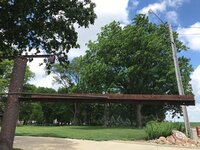
I got a call last month to help install the post finally in its new location about 40 miles from the shop. At my suggestion, it was powder coated for durability.

IMG_3495.jpg

The new owner wanted it to be easily visible, thus the bright yellow color.

IMG_3492.jpg

The fasteners used are all stainless steel and a new mailbox was used. The old, original box has been retained and I'm told will be used as an accent piece in their garden. With the post now powder coated, it should survive for many decades more. So another successful repurposing of items from the property. There is more coming.

Thanks for your continuing comments and interest. That's what keeps me going here!

Thomas
Of course it was powder coated! Looks great. Maybe cap the ends of top post to prevent wasp nests from gathering.
 

scooterbum46

Well-known member
Joined
Jan 29, 2014
Messages
859
Location
South Central Michigan / ex Gulf Coast Florida
Oh THAT 750 Honda! Yeah, that wasn't mine, that one belonged to John Johnson and I found it in a small steel storage shed. He picked it up at some point and I have no idea what became of it. That was a long time ago now, nearly 16 years ago that he took it away.

Thomas
Thomas: I forget for me it was a few months ago that I read about it, while for you it was 16 years. I'm not sure what I had for lunch..
Amazing story about Craig Vetter. I had one of his fairings on a 1970 Honda SB350. It was a full fairing like the ones in this picture

9CI: Had a '78 Suzuki Gs 1000C with a full Vetter setup including lowers, bags, trunk, Vetter sound (with a CB/FM and even Hippo Hands.

It looked pretty much like this one. (Pic borrowed from FB Vetter Users group)

VETTER.JPG
 

onething

Well-known member
Joined
Jan 23, 2011
Messages
438
Location
TEXAS
I've never seen a mailbox mounted under a pipe like that. All of ours have a flat plate attached to the top of the vertical pipe. Is there a reason for doing it that way?
 

bulletpruf

Well-known member
Joined
Nov 28, 2013
Messages
11,005
Location
San Antonio
I've never seen a mailbox mounted under a pipe like that. All of ours have a flat plate attached to the top of the vertical pipe. Is there a reason for doing it that way?

Well, I don't want to answer for Thomas, but I suspect the mailbox is mounted that way because that's how Mr. Johnson (the prior owner of Thomas's property) had it mounted. Just wouldn't make a lot of sense -- at least not to me -- to re-use the mailbox post to honor Mr. Johnson and then change the configuration.
 
OP
B

BB767

Well-known member
Joined
Dec 24, 2009
Messages
3,724
Location
Philo, IL
Good evening everyone, busy times so sorry for the delayed reply. I agree that I had never seen a mailbox suspended like Mr Johnson's either. The exact reason he did it is unfortunately lost to history. For whatever reason, it seemed to work. His original mailbox set up survived over 65 years in great condition until I removed it. Now that it's been powder coated and equipped with a new box, I see no reason what it can't survive equally as long.

The now, present owner of the mailbox post knew Mr. Johnson and wanted to keep it just as it was. Makes sense to me; why change something that was clearly a successful design.

Nothing terribly new or exciting around the "ranch". Earlier this year I did kind of "volunteer" to help a retired University of Illinois professor repair old clocks. He's been doing it for more than 50 years in his spare time and is an amazing wealth of knowledge on the subject. He wanted to pass on his expertise on the subject and got me hooked on it. For a little under a year, we've repaired dozens and dozens of clocks together. The oldest being a very large, stately Grandfather clock made in 1805. Lots of fun and certainly a challenge but it does take up a lot of my spare time.

I trust everyone in our gang here are safe and well. I'm looking forward to what the new year will bring. Take care.

Thomas
 

scooterbum46

Well-known member
Joined
Jan 29, 2014
Messages
859
Location
South Central Michigan / ex Gulf Coast Florida
Good evening everyone, busy times so sorry for the delayed reply. I agree that I had never seen a mailbox suspended like Mr Johnson's either. The exact reason he did it is unfortunately lost to history. For whatever reason, it seemed to work. His original mailbox set up survived over 65 years in great condition until I removed it. Now that it's been powder coated and equipped with a new box, I see no reason what it can't survive equally as long.

The now, present owner of the mailbox post knew Mr. Johnson and wanted to keep it just as it was. Makes sense to me; why change something that was clearly a successful design.

Nothing terribly new or exciting around the "ranch". Earlier this year I did kind of "volunteer" to help a retired University of Illinois professor repair old clocks. He's been doing it for more than 50 years in his spare time and is an amazing wealth of knowledge on the subject. He wanted to pass on his expertise on the subject and got me hooked on it. For a little under a year, we've repaired dozens and dozens of clocks together. The oldest being a very large, stately Grandfather clock made in 1805. Lots of fun and certainly a challenge but it does take up a lot of my spare time.

I trust everyone in our gang here are safe and well. I'm looking forward to what the new year will bring. Take care.

Thomas
Thomas:
I wish I lived closer to the Center of The Universe, I've got a Ridgeway Schoolhouse clock I'd consult with you on, it's getting fussy after 40 some years, now down to a week between windings and less when it's cold out. Clock caregivers are getting few and far between..

Gerry
 

zanyad

ALLIANCE MEMBER
Joined
Apr 26, 2018
Messages
2,779
Location
NE Ohio
Good evening everyone <snip>
Nothing terribly new or exciting around the "ranch". Earlier this year I did kind of "volunteer" to help a retired University of Illinois professor repair old clocks. He's been doing it for more than 50 years in his spare time and is an amazing wealth of knowledge on the subject. He wanted to pass on his expertise on the subject and got me hooked on it. For a little under a year, we've repaired dozens and dozens of clocks together. The oldest being a very large, stately Grandfather clock made in 1805. Lots of fun and certainly a challenge but it does take up a lot of my spare time.

I trust everyone in our gang here are safe and well. I'm looking forward to what the new year will bring. Take care.

Thomas
Thomas:
I wish I lived closer to the Center of The Universe, I've got a Ridgeway Schoolhouse clock I'd consult with you on, it's getting fussy after 40 some years, now down to a week between windings and less when it's cold out. Clock caregivers are getting few and far between..

Gerry
Same-same. I have a Black Forest cuckoo clock I received as a graduation gift that the clock repair place said wasn't worth repairing as it'd cost about the same as a new one. o_O
 

bulletpruf

Well-known member
Joined
Nov 28, 2013
Messages
11,005
Location
San Antonio
Nothing terribly new or exciting around the "ranch". Earlier this year I did kind of "volunteer" to help a retired University of Illinois professor repair old clocks. He's been doing it for more than 50 years in his spare time and is an amazing wealth of knowledge on the subject. He wanted to pass on his expertise on the subject and got me hooked on it. For a little under a year, we've repaired dozens and dozens of clocks together. The oldest being a very large, stately Grandfather clock made in 1805. Lots of fun and certainly a challenge but it does take up a lot of my spare time.

Thomas - care to share any details and pictures of your clock repair work?

Scott
 

TR6SR650

Well-known member
Joined
Dec 13, 2012
Messages
65
Thomas, Pam and I would like to wish you and Chris a Merry Christmas and a Happy New Year.
Calvin.
 
OP
B

BB767

Well-known member
Joined
Dec 24, 2009
Messages
3,724
Location
Philo, IL
Gerry, I'm familiar Ridgeway clocks of that era. Typically at that age, 30-40 years, they are worn out, literary. We've found they are not cost effective to have them rebuilt since replacement movements are available and normally recommend to buy a replacement, internal movement. The issue is primarily the bushings not any of the gears. That's likely what is slowing it down. I would guess most if not all the bushing will need replacement and possibly the mainspring replaced. Cleaning and oiling it will keep it going only for so long and the accuracy will constantly decline.

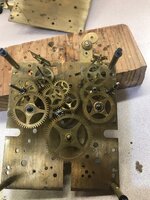
For clocks that do not have replacement movements and/or the owner has sentimental reasons to keep the clock, a complete refurbishment can be done. Here is a GUSTAV BECKER mantle clock that I am refurbishing at the moment. This clock was made in 1850, the first year of production for this model.

IMG_3746.jpg

The face has been removed in the above picture.

IMG_3749.jpg

IMG_3753.jpg

IMG_3748.jpg

I extensively photograph the movement before disassembly.

IMG_3784.jpgIMG_3804.jpg

This clock is serial #3625 of a production run of over 4 million in 76 years, making it a somewhat rare clock. We had they very same model GUSTAV BECKER in the shop earlier this month that was made in 1926, the last year of production. In the intervening years, they had made virtually no changes to it at all.

I'll do a complete disassembly, replace bushings as needed, ultrasonically clean and inspect everything, evaluate the springs, reassemble, oil it (we use Mobile 1 dispensed from a syringe) and make adjustments as needed.

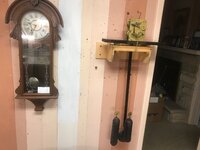
For larger clocks...

IMG_2986.jpg

...we do house calls. Here I'm standing on the 3rd step of a stepladder to access the movement of this stately grandfather clock. If necessary, where possible we will remove the movement...

IMG_2198.jpg


... and take it to the shop for more extensive work.

IMG_2548.jpgIMG_3660.jpg

All great fun, challenging and rewarding. It just takes too much of my free time!! The first day of winter and holiday season are upon us. As always, my thanks for your interest and support in our corner of the world. Take care everyone, stay safe.

Thomas
 
To avoid these ads, REGISTER NOW!

rmalkow2

Well-known member
Joined
Jun 26, 2009
Messages
4,087
Location
Brighton, MI
Clock restoration seems like an interesting skill/hobby but one I cold never have the patience for but, appreciate those who have it. Good luck with restoring time and hope you and Chris have a very Merry Christmas and Happy New Year.
 

wasfast

Well-known member
Joined
Apr 10, 2014
Messages
874
Location
San Diego CA
Those mechanical clocks are just so interesting to see if you appreciate and know a little about mechanical things. Very cool.
 

scooterbum46

Well-known member
Joined
Jan 29, 2014
Messages
859
Location
South Central Michigan / ex Gulf Coast Florida
Thomas - Thank you for your response and the information about the Ridgeway. Since it is still keeping perfect time, just not running as long, I think I'll just keep winding it and see how long it lasts. Again great information, thanks for sharing.

Gerry
 
Last edited:
OP
B

BB767

Well-known member
Joined
Dec 24, 2009
Messages
3,724
Location
Philo, IL
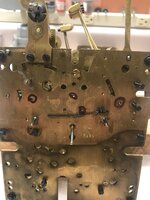
Gerry if it runs and is accurate by all means keep it going. It's when they will only run a couple of days and then stop is where you'll have an issue. Depending on how clean an environment it's been kept in and the frequency of oiling will determine how long the bushings will last. If a clock has an issue, one of the first things we check is the condition of the bushings. If they are generally in good shape, sometimes only cleaning and oiling is necessary. Generally speaking, clocks only need oiling once every 5 years or so. Only oil the bushings and shafts, never, never any of the gears. They are designed to run dry.

IMG_3794.jpg

The GUSTAV BECKER clock I'm servicing right now is 172 years old and it still had all of it's original bushings. As part of the servicing, I had to replace 5 of the bushings. The 4 circled here and one on the other plate. So as you can see, depending on the quality of the movement and care, clocks can live a long, useful life. GUSTAV BECKER clocks are some of the highest quality made.

IMG_3822.jpg

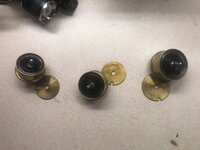
Another issue can be with the mainsprings. This can be especially true if a clock sits for long periods of time fully wound up but not running, the spring will take a "set" and not have as much power as they did originally. Here I have removed the covers from the mainspring barrels in preparation for the spring removal from their barrels. We remove the main springs and prior to ultrasonic cleaning them, stretch them out fully to help restore energy back in them. * A note of CAUTION here: these springs have a tremendous amount of energy stored in them when they are wound up. Before their removal it's imperative that the spring is let down prior to its remove. If stretching, cleaning and oiling a spring doesn't fix the issue, a replacement can generally be found.

IMG_3824.jpg

Something else I forgot to mention...

IMG_3823.jpg

... when the clock is serviced, as many as can be done, the shafts are chucked in a lathe and the pivots are then carefully polished. When done properly, there is an awful lot of work involved in doing a complete clock service. Patience is definitely a requirement. Enjoy your clock Gerry.

Thomas
 

Boosted1

Well-known member
Joined
Nov 25, 2007
Messages
1,680
Location
Georgetown, KY
I enjoy reading your post about the clock service. We were recently gifted a Howard Millar grand father clock. It's nice to see the inter workings and how service is done.
 

Old Man Roger

Well-known member
Joined
Apr 6, 2017
Messages
17,634
Location
Palm Coast Florida
I couldn’t even figure out how to synchronize the chimes on my grandfather clock.lol

After a move, for instance, it would chime 3 times at 1 o’clock. Coincidentally, a guy who was buying something I was selling on offerup, asked me if I wanted to sell the clock. I told him I would love to, but my girl would have me drawn and quartered..lol Anyway, he actually knew exactly how to synchronize it.

I was initially filled with confidence, because before touching the brass, he pulled out a pair of white linen gloves from his back pocket, and said, this is what I do.

Soon after though, I thought I‘d made a fatal mistake letting him touch the clock. The first thing he did was break, what I thought, were two cardinal rules. Not only did he move the hour hand, he moved it counter clockwise :Twitch:

Been chiming perfectly ever since.:thumbup:
 

scooterbum46

Well-known member
Joined
Jan 29, 2014
Messages
859
Location
South Central Michigan / ex Gulf Coast Florida
Gerry if it runs and is accurate by all means keep it going. It's when they will only run a couple of days and then stop is where you'll have an issue. Depending on how clean an environment it's been kept in and the frequency of oiling will determine how long the bushings will last. If a clock has an issue, one of the first things we check is the condition of the bushings. If they are generally in good shape, sometimes only cleaning and oiling is necessary. Generally speaking, clocks only need oiling once every 5 years or so. Only oil the bushings and shafts, never, never any of the gears. They are designed to run dry.


Thomas - apparently it's had a good life, I've always been shy about any maintenance until recently, my plan was to take it back to the shop where it came from. That plan is now no-op, the clock guy has retired.

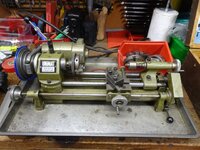
Thought you'd get a chuckle from these pictures - the machine shop in a carton.. My dad (a tool maker) bought it from one of my friends in about 1980, I've had it about 28 years now. It came with just about every option in the catalog.. The South Bend book is from my 1962 SHop class.

.DSC04885 (Small).JPGDSC04886 (Small).JPG
 

Fishwacker

Active member
Joined
Dec 1, 2007
Messages
32
Location
El Cajon, CA
Here's a more detailed look at the process of creating the new signs, outside of the shop.

IMG_1740(1).jpg

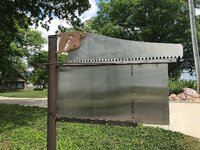
Originally there were 3 separate sign panels, 2 rectangle and on top, one in the shape of a handsaw. I removed the bottom panel a few years back. I had decided that was too much signage for what I was doing out there. I only kept the center panel seen above and the handsaw on top. Those 2 signs in turn were then removed...

IMG_0301(1).jpg

...leaving just the post and supporting brackets. Since I was going to reuse the post and supporting brackets, those items were wire brushed and I painted them with rust converter. The rust converter dried to a nice black finish so that's all I did to them. The old, rectangular center panel was replaced with a slightly larger panel that was made of stainless steel for durability.

The old, upper SAWS FILED sign was an actual handsaw that the handle had rotted away decades ago. I decided to fabricate a larger saw to provide more surface area for the letters. Also I decided to make it out of aluminum so it wouldn't rust away like the old one did.

To begin, I needed a handsaw to get the correct shape.


IMG_0512.jpg

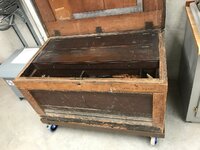
As you might remember, I have my great, great grandfathers old tool box. Among other tools inside the tool box....


IMG_0513.jpg

...is a selection of various handsaws.

IMG_0515.jpg

I selected a large saw...

IMG_0514.jpg

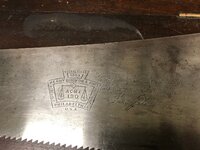
...with a fancy handle. This saw was manufactured by...

IMG_0517.jpg


IMG_0519.jpg

...by Henry Disston & Sons. I was able to date the manufacture of this saw to 1888. I suspect my great, great, grandfather bought it new. Disston saw works at one time, was the largest saw maker in the world. More interesting reading about Disston can be found here: https://www.workshopoftheworld.com/tacony/disston.html

The saw was placed on an aluminum sheet and outlined on the sheet. The outline was increased in size to create a larger saw.

SawFab.jpg

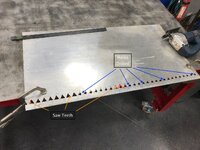
Oversized, exaggerated "teeth" were created to make them more visible from the street and to emphasize that this was a "handsaw". Once the teeth were drawn, a hole was drilled by each tooth that was large enough for a jig saw blade to be inserted to cut out each tooth. Completed teeth are seen on the left, above.

IMG_0290.jpg

The cut lines were small and faint so I wore a head lamp to better light them up while I cut them and I always try to protect my hearing and wear safety glasses. (Hey I'm really getting bald aren't I?!!) :eek: Good thing Chris has a fondness for this older, balding man!


IMG_0298.jpg

It was cumbersome and repetitive but patience wins the day. The space on the bottom of the teeth is where the saw will be supported by a bracket on the sign post. That's why I couldn't cut the teeth to a sharp point. It'll make sense when you see it mounted.

img268.jpg

Next I had to make the handle. The Disston saw handle was outlined on a piece of paper that was used as a pattern. I then scanned the shape into my computer and increased the size of the outline using my computer until it was scaled to approximate the size of the saw body.

I used redwood for the handle because of it's resistance to decay from moisture. I have a small stash of redwood that I got from my father and found a small board about 1 1/4" (3.2 cm) thick.


IMG_1406.jpg

The pattern was cut out and the shape was traced onto the board.

IMG_0306.jpg

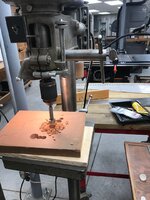
I first drilled out the bulk of the finger cutouts with a Fostner bit. Then using a jig saw, I cut the remaining waste out as well as the outline of the handle. Using the table saw with the blade raised, I was able to cut a slot into the handle for the the body of the saw to slide into. The edges were eased over using a wood rasp and various grades of sandpaper.

IMG_0308.jpg

The handle was then test fitted and mounted on the post. I used polished stainless steel acorn nuts to secure the handle to the saw body.

IMG_0318.jpg

With this closeup you can see why that material was left on the bottom of the teeth to provide a place to secure the bottom of the saw. I did extend the end 2 teeth to a sharp point to trick the eye into thinking they were all sharp. All the fastening hardware is stainless steel.

IMG_0336.jpg

With a good test fit, the redwood was sealed to promote longevity.


IMG_1407.jpg


I used this product, One Time, which I was not familiar with until last summer. Most polyurethane and other finishes break down fairly quickly when used outside, but this one promises to be better. After all it uses "NEW 21st Century Advanced Technology"! We'll see. Full disclosure, I paid full retail price and have no financial connection or benefit from this company.

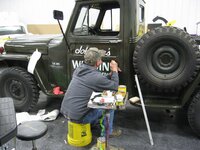
With the saw and rectangular panel ready for lettering paint, they were taken to my sign painter, Dave Anderson.


IMG_7119.jpg

He's local and the same gentleman who lettered Gus, the shop truck about 10 years ago.

IMG_0402.jpg

He's one of the last sign painters who still hand letters signs.

IMG_0326.jpg

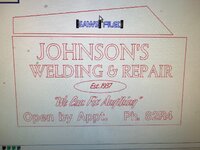
This is the design we finally came up with. Since I didn't want folks to think it was an actual repair shop open for business, that's why it's only open by appointment. Note the shop phone number, 82R4.


IMG_0327_copy.jpg

That's the correct phone number for the shop...

IMG_9211(3).jpg

...from the 1930's, 40's and early 50's. This is a pad of blank shop invoices from that time period. It was a party line back then and so the R4 indicated if it rang 4 times, the call was for the shop.

IMG_0409.jpg

With the signs completed they were installed out front. As a final detail...

IMG_0674(1).jpg

...once they were installed, the screw heads of the mounting hardware were all painted black so your eye isn't drawn to them. Note how the saw seems to float and balance on the top supporting bracket.

So as you've seen, there is more than you'd think to the creation and implementation of these signs. I've been thinking about how I was going to do this for several years and I am more than satisfied with the end result. With any luck they should be there for decades.

Hope you found this interesting and for those who have been following this thread for several years, that you like it as well. Come see it in person next June. I've got more coming this way, please check back. Thanks everyone.

Thomas
Hey Tom,
It's been way too many years since I last checked on you and your phenomenal adventure, but I haven't forgotten you. I just want to say hello and congratulate you on all your successes. The sign is an awesome tribute to Mr. Johnson along with all the other great things you and your crew have accomplished. Very well done indeed.
 

TR6SR650

Well-known member
Joined
Dec 13, 2012
Messages
65
"Where patience is a virtue", like skill can be learned, but patience comes first. I find it amazing how fast time flies when I stay busy.

Nice to hear from you again.
Calvin
 

stillp

Well-known member
Joined
May 5, 2015
Messages
428
Location
Midlands, UK
Thomas - apparently it's had a good life, I've always been shy about any maintenance until recently, my plan was to take it back to the shop where it came from. That plan is now no-op, the clock guy has retired.

Thought you'd get a chuckle from these pictures - the machine shop in a carton.. My dad (a tool maker) bought it from one of my friends in about 1980, I've had it about 28 years now. It came with just about every option in the catalog.. The South Bend book is from my 1962 SHop class.

.DSC04885 (Small).JPGDSC04886 (Small).JPG
I had one of those Unimats (just the lathe) a long time ago but sadly I sold it. For £10 I think!
Pete
 
OP
B

BB767

Well-known member
Joined
Dec 24, 2009
Messages
3,724
Location
Philo, IL
Hi everyone, I'm not ignoring you, promise! I've been following along here everyday. Busy around here but I'll get an update going shortly. Doing BMW bike work...

IMG_4059.jpg

...if that's considered automotive. Also acquired my own Unimat lathe, I'd been using a friends up to now. It's a nice one...

IMG_4132.jpg
...I've been looking for over a year now. Details to follow on all of the above plus other material, standby. Thanks!

Thomas
 

budro35

Member
Joined
Dec 2, 2012
Messages
23
Great hearing from you Thomas! I’ve followed you from day one and curious minds wonder a bit when things are too quiet! I cannot wait for the updates to see what you and Chris have been doing!
 

IMCA38

Well-known member
Joined
Sep 21, 2007
Messages
999
Location
Bennet, NE
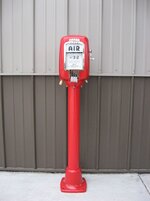
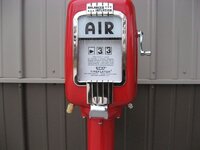
Hello there Mickm. Nice air meter you have there! :thumbup: Depending on what has been done to it in the past, don't be surprised if you don't have to do a whole lot to it. These ECO units are amazingly tough and well built. Your's look like the same vintage as...

IMG_3174.jpg

...the one I'm going to install outside the barn, seen here.

IMG_3176.jpg

It's the same year, 1953, as my wall mount model 97 only this one is model 98 pedestal unit just as yours appears to be. I needed a pedestal unit since the wall is not as substantial as the old shop block wall and these air meters are heavy!

Hook yours up to an air source and try it out, you might be surprised that it works just great as is, you never know. Once they are calibrated they are surprisingly accurate. My wall unit is within 1/2 pound of the selected pressure time after time. I probably don't even need an air gauge anymore but I still check the first tire for accuracy but the other three I don't anymore. You'll find it's mighty handy to have around the shop.

Thanks for dropping us a note. Let us know how it works out.

Thomas
Recently was browsing an online sale and came across something I’d seen before!
Brought a very impressive price as well!


Poor Ron

Well-known member
Joined
Jul 1, 2011
Messages
69
Location
Michigan
Hey Thomas; We tried to go to US-131 today. Since it was raining, we went to the Gilmore instead.
If they reschedule FAST I will see you there, or Stanton later on.
 
To avoid these ads, REGISTER NOW!
Top Bottom