To avoid these ads, REGISTER NOW!

Sagging garage that was "fixed" already by a flipper: is it secure?

mholmes

Member
Joined
Nov 9, 2022
Messages
9
Hello all,

Question that is often covered but I may have a spin on the usual situation thanks to some "flippers" who touched our home before purchasing.

Thankfully - the flip itself was very light, so we haven't had to redo too many things... but take a look at this garage.

Note: I am aware it is a crusty old garage, I am not in the position to rebuild it or just build a new one. The flippers also only worked on the house for about 3 weeks total, simple in/out paint of the house, threw a new kitchen in (it appears they literally did) and "secured" the garage.

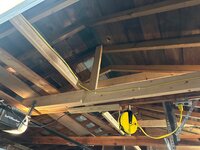
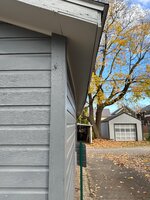
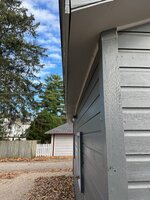
Issue: Garage roof sagging, side walls bowing... however, the flipper reinforced BUT apparently did NOT attempt to straighten anything. They just added some support to stop movement.

Question: Do any of you think this is safe/sufficient to stop the collapse of the garage as we use it for our car. Or if its sketchy, should I remove what they put up, attempt the straighten and THEN re-secure it?

I had wanted to replace the garage windows, fix wood siding and just overall garage cleanup... house is really nice, garage...not so much.

Pics below (don't mind the crooked chimney - there was an 1950's gas furnace I removed and that pipe is disconnected)

Thank you!
 

Attachments

  • IMG_0314.jpg
    IMG_0314.jpg
    498.4 KB · Views: 460
  • IMG_0315.jpg
    IMG_0315.jpg
    467 KB · Views: 452
  • IMG_0316.jpg
    IMG_0316.jpg
    385.2 KB · Views: 452
  • IMG_0317.jpg
    IMG_0317.jpg
    713.3 KB · Views: 451
  • IMG_0318.jpg
    IMG_0318.jpg
    683.5 KB · Views: 440
  • IMG_0319.jpg
    IMG_0319.jpg
    989.7 KB · Views: 457
To avoid these ads, REGISTER NOW!
OP
M

mholmes

Member
Joined
Nov 9, 2022
Messages
9
Did the flipper use an engineer or pull a permit/have an inspection? I'd be leery.
Flipper..... no way he had any permits for anything. We had our home inspection - Honestly we weren't very concerned with the garage itself, ironically its a little dumpy thing and the older person who passed away (before flipper was involved) just had a new garage opener/door installed.

So it's basically a pile, with a nice door and this "secured" bit of construction done and I've been unsure what the heck to do with it
 

driftpin

Well-known member
Joined
Dec 22, 2016
Messages
11,266
Location
Miami-Dade/Broward Co. Florida
Either involve a knowledgeable friend, or get a competent contractor to come give you a bid on taking care of the issues. The ridge looks like it reflects the settlement of the building over many years. I don't know that mid-Nov. is the best time to be exposing things on the outside. Re-shingling for instance. You need to be prepared for whatever you find, so springtime is a better time to remove shingles, and possibly face re-sheathing after doing whatever structural repairs are necessary. I'd look at the type, number, and placement of the fasteners on those bottom chords they installed, and the added vertical members. I'd say the roof is probably better than if it wasn't done, but hiring a structural person to investigate things and to produce a plan for repairs is what needs to be done, especially going forward, and having inspections.

It's always a good idea to put below your avatar where you are because readers may know local resources which could help you.
 
Last edited:

Garcky

Well-known member
Joined
Sep 10, 2022
Messages
3,434
Location
Twin Cities Metro Area, Minnesota
I've seen worse. But there's not really enough information to predict how that building will fare in the future. That would require an inspection and some measurements to determine what's going on with it. Still, I've seen garages in much worse shape that have stood for a decade or two. I'd recommend getting someone competent to look at it closely and give you a professional evaluation of it.
 
OP
M

mholmes

Member
Joined
Nov 9, 2022
Messages
9
I've seen worse. But there's not really enough information to predict how that building will fare in the future. That would require an inspection and some measurements to determine what's going on with it. Still, I've seen garages in much worse shape that have stood for a decade or two. I'd recommend getting someone competent to look at it closely and give you a professional evaluation of it.
Good to know, thank you for the input. I'd rather be safe than sorry
 
OP
M

mholmes

Member
Joined
Nov 9, 2022
Messages
9
From the pics you shared- the answer is No!
And I certainly wouldn’t remove anything that is there unless you really know what you’re doing.
Thanks!
I was just getting a game plan for spring work I want to plan out... started looked more closely at the garage and thought I'd start with some opinions. Glad I asked...and no way I'm not touching anything that is up there currently. I don't have enough knowledge/skill to prevent injury to damage
 

rlmartinson

Well-known member
Joined
Aug 22, 2012
Messages
99
Location
Lee, NH
My opinion is that was not done correctly, but is probably secure. I mean it stood before they "fixed" it. With some knowledge, it could be fixed on the cheap.
My old neighbor fixed his garage that probably should have been tore down. Slowly jack up the center, add new cross ties, and reinforce anything that needs it. Of course you need to safely remove the latest "fix" before you can jack up the center.
 

Wolley

Well-known member
Joined
Jun 24, 2022
Messages
420
Location
Maine
How's the sills look? I'd take out all the new stuff and start over. Hopefully they screwed that new stuff in so it will be easy to take out
 
OP
M

mholmes

Member
Joined
Nov 9, 2022
Messages
9
How's the sills look? I'd take out all the new stuff and start over. Hopefully they screwed that new stuff in so it will be easy to take out
I'll need to inspect the sills, new stuff appears to be nailed...I'm assuming they grabbed a nail gun and just did the job quite quickly to be done and sell it.

-Thankfully we did buy when interest rates were at their lowest, so in the big picture I cannot really complain about it. More just get to have the fun to redo things that could have and should have been done with a little more time and properly.
 
OP
M

mholmes

Member
Joined
Nov 9, 2022
Messages
9
I'm with K'ledgeBldr. Probably would of stood another decade or two with no work done to it. Should not be hard in good weather to straighten it out and reinforce anything that really needs it.
Thanks - I'll start my planning for the Spring, I'll have a good chunk of work to do in the backyard anyway.
I'll bring in a contractor or at least experienced person for their input to make sure its safe and go from there.
 

Zeke

Well-known member
Joined
Aug 13, 2009
Messages
17,176
Location
Long Beach CA, the sewer by the sea.
My experience with bowed/sagging ridges is that they resist being lifted. It takes a long time to erase their memory. If you don't need the center floor space you can set some posts under the ridge and try to move it. More on that if you decide to try it.

As you gain any lift release the collar ties and anything else that you are working against. I have a sagging beam and have had a brace under it for 5 years. Whenever I go to raise it a bit I find no less resistance than from a couple of months ago. The end plan was to put an engineered I-beam joist under the beam and raise it from one end while resting in a new pocket built at the other end.

It's a lot of work with no guaranties so that's why it has not been done.
 

Hank11

Well-known member
Joined
Aug 19, 2019
Messages
1,152
Location
Tennessee
Its fixable, but not great right now. As others have written, one thing to consider is that its been standing for many years before it was "repaired". So I doubt it will collapse over this weekend. ;)

I'd start with pulling the walls plumb by chaining across and pulling with a come along. Once each stud is pulled plumb, sister a new one right beside it. Nail and glue. Once the walls are good, what Zeke wrote above is probably close to right but I think you can jack it and make it lots better. And its probably worth getting an engineer or a very experienced framer to look at this before you start.

If you doubt your ability to do this, hire that experienced framer you find who seems to have good sense.
 
To avoid these ads, REGISTER NOW!
OP
M

mholmes

Member
Joined
Nov 9, 2022
Messages
9
Its fixable, but not great right now. As others have written, one thing to consider is that its been standing for many years before it was "repaired". So I doubt it will collapse over this weekend. ;)

I'd start with pulling the walls plumb by chaining across and pulling with a come along. Once each stud is pulled plumb, sister a new one right beside it. Nail and glue. Once the walls are good, what Zeke wrote above is probably close to right but I think you can jack it and make it lots better. And its probably worth getting an engineer or a very experienced framer to look at this before you start.

If you doubt your ability to do this, hire that experienced framer you find who seems to have good sense.
Thank you for your input and explaining. At least I feel its not moving more now....sure as heck isn't pretty but its standing. I'll find someone - I have some friends who are in the biz but are they experienced framers, I'll find out. I'd be comfortable helping/watching this process done but I don't feel like killing myself or doing something wrong and it collapse the garage.
I like the idea of reinforcing the stud walls as well once they are plumb.
 

yeldogt

Well-known member
Joined
Jan 2, 2012
Messages
18,184
When was the houses built ?

I did a bunch of bungalows in NJ back in the late 80's and 90's -- all built before WWI (around 1910). Standardized lumber was not really a thing until after WWI. I remember seeing different lumber sizes in houses on the same block built at the same time-- the garages were all built like that. No ridge beam and typically two lower rafter ties. The rafter ties are important .... you want to make sure they are locked into the roof rafters. looks like they added collar ties up above.

The fix is involved -- strong ridge beam and new collar ties ... mixed with a lot of luck
 
OP
M

mholmes

Member
Joined
Nov 9, 2022
Messages
9
When was the houses built ?

I did a bunch of bungalows in NJ back in the late 80's and 90's -- all built before WWI (around 1910). Standardized lumber was not really a thing until after WWI. I remember seeing different lumber sizes in houses on the same block built at the same time-- the garages were all built like that. No ridge beam and typically two lower rafter ties. The rafter ties are important .... you want to make sure they are locked into the roof rafters. looks like they added collar ties up above.

The fix is involved -- strong ridge beam and new collar ties ... mixed with a lot of luck
The house was built in 1892, what closing documents I have show garage was around 1910 but no real clear proof if that was true or not other than based on construction style and I'm no expert.

This garage is not/will not ever be finished/insulated or heated... its just a place to park the car and some misc tools/bicycles. I didn't even notice until today that there is no ridge beam as opposed to others older detached garages :)
 
Last edited:

Zeke

Well-known member
Joined
Aug 13, 2009
Messages
17,176
Location
Long Beach CA, the sewer by the sea.
I actually hadn't noticed the lack of a ridge board. Good observation!

Certainly makes the concept of adding one easy. In fact, this gives me some new thoughts about my own sagging beam. It's below the rafters so easy to remove. Then I'm not fighting any memory in the old beam. Just need some temporary supports.

Pulling the sides in is also an excellent thought. Use all the forces available.
 

TimRich

Member
Joined
Sep 16, 2021
Messages
7
My recommendation is to not fix it the least expensive way. I have seen garages like this: I've refused to bid on a couple. The cost of correcting may be higher than you expect if you do it right. Assuming the wall foundation structure is suitable, if I were bidding I'd bid to re-sheath(remove current sheathing) and re-roof after remedy of the structural weakness including straightening the walls. If I were doing it on my own garage I'd likely do the same unless the height was suitable and pre-built stock trusses were available. The garages I've seen like this, however, are narrow and have a low wall that make trusses not always a good solution.
 

billconner

Well-known member
Joined
Jul 20, 2021
Messages
6,970
Location
Thousand Islands NYS
Nothing wrong with new sheathing but if going that direction, I'd demo it and start from scratch.

Dont know how long you'll live there but doubt any improvement to the garage, including replacing, would return much when selling it.
 

jkuro

Well-known member
Joined
Apr 28, 2009
Messages
552
In the spring jack and straighten the building. You will probably have to remove all the extra reinforcement placed by the flippers to do this. Once straight and plumb add ridge gussets: Then add collar and rafter ties.
 

Attachments

  • 1668180300564.png
    1668180300564.png
    291.6 KB · Views: 257
  • Gusseted-Trusses-1.jpg
    Gusseted-Trusses-1.jpg
    214 KB · Views: 269
Last edited:

Uncle murph

Well-known member
Joined
Jan 28, 2021
Messages
1,466
Location
Harford county
Hello all,

Question that is often covered but I may have a spin on the usual situation thanks to some "flippers" who touched our home before purchasing.

Thankfully - the flip itself was very light, so we haven't had to redo too many things... but take a look at this garage.

Note: I am aware it is a crusty old garage, I am not in the position to rebuild it or just build a new one. The flippers also only worked on the house for about 3 weeks total, simple in/out paint of the house, threw a new kitchen in (it appears they literally did) and "secured" the garage.

Issue: Garage roof sagging, side walls bowing... however, the flipper reinforced BUT apparently did NOT attempt to straighten anything. They just added some support to stop movement.

Question: Do any of you think this is safe/sufficient to stop the collapse of the garage as we use it for our car. Or if its sketchy, should I remove what they put up, attempt the straighten and THEN re-secure it?

I had wanted to replace the garage windows, fix wood siding and just overall garage cleanup... house is really nice, garage...not so much.

Pics below (don't mind the crooked chimney - there was an 1950's gas furnace I removed and that pipe is disconnected)

Thank you!
Were the flippers named Moe,Larry and Curly? It looks like their work.
 

nadogail

Well-known member
Joined
Jan 23, 2009
Messages
31,961
Location
Coronado, CA
Its fixable, but not great right now. As others have written, one thing to consider is that its been standing for many years before it was "repaired". So I doubt it will collapse over this weekend. ;)

I'd start with pulling the walls plumb by chaining across and pulling with a come along. Once each stud is pulled plumb, sister a new one right beside it. Nail and glue. Once the walls are good, what Zeke wrote above is probably close to right but I think you can jack it and make it lots better. And its probably worth getting an engineer or a very experienced framer to look at this before you start.

If you doubt your ability to do this, hire that experienced framer you find who seems to have good sense.
I have not seen your job; but I am imagining a steel pipe or beam on the outside of two opposing walls, with a turnbuckle drawing the walls towards each other.
 

kwb

Well-known member
Joined
May 1, 2009
Messages
1,771
Location
PNW
Here is my general strategy that I would take:
3 come-alongs tied into the top plate at 1/4, 1/2, and 3/4 of the length of the building.
Pull to snug.
Remove all the new lumber
Pull to plumb the walls ... probably even go past a bit. At this point the sag in the ridge should be a lot less.
Nail in new collar ties or bottom chord.

Release come-alongs and enjoy a frosty beverage.

The fun part may be that one side wants to move and the other doesn't. No reason to fret - just tie a kicker to the wall that got to vertical first anchor/wedge the base to the floor. The other wall should then start coming to vertical.

If the sag in the ridge isn't going away - a couple of posts to lift while the come-alongs are pulling should do the trick. I would then add a vertical member between ridge and bottom chord and have a defacto truss structure.

Time can help but as noted once a shape is into a piece of wood, getting it back out is going to take a long time. Myself in that building I would just brute force it and get the job done in a weekend +/-. It may not be perfect but it would be a lot better and with a real bottom chord in the roof structure a hell of a lot stronger with winter weather coming.
 

Firstram

Well-known member
Joined
May 16, 2017
Messages
1,391
Here is my general strategy that I would take:
3 come-alongs tied into the top plate at 1/4, 1/2, and 3/4 of the length of the building.
Pull to snug.
Remove all the new lumber
Pull to plumb the walls ... probably even go past a bit. At this point the sag in the ridge should be a lot less.
Nail in new collar ties or bottom chord.

Release come-alongs and enjoy a frosty beverage.

The fun part may be that one side wants to move and the other doesn't. No reason to fret - just tie a kicker to the wall that got to vertical first anchor/wedge the base to the floor. The other wall should then start coming to vertical.

If the sag in the ridge isn't going away - a couple of posts to lift while the come-alongs are pulling should do the trick. I would then add a vertical member between ridge and bottom chord and have a defacto truss structure.

Time can help but as noted once a shape is into a piece of wood, getting it back out is going to take a long time. Myself in that building I would just brute force it and get the job done in a weekend +/-. It may not be perfect but it would be a lot better and with a real bottom chord in the roof structure a hell of a lot stronger with winter weather coming.
This, easy weekend job!
 

yeldogt

Well-known member
Joined
Jan 2, 2012
Messages
18,184
The house was built in 1892, what closing documents I have show garage was around 1910 but no real clear proof if that was true or not other than based on construction style and I'm no expert.

This garage is not/will not ever be finished/insulated or heated... its just a place to park the car and some misc tools/bicycles. I didn't even notice until today that there is no ridge beam as opposed to others older detached garages :)
Remember the model T was born in 1908 ... if you wanted a car you needed a garage. Having a car in the winter was a lot of work because there was no anti freeze except basic alcohol formulas. Lots of garages got added prior to WWI. The history of the garage is very interesting and in some ways it's like heating and plumbing .. all very new at the turn of the 1900's. Building was the same .... I did a 1810 federal in Philadelphia (brick) ... all the wood is hand cut. I have done a couple places built just after the civil war and there were many lumber mills by that time -- but, the product is still very rough and not uniformly sized. The wood products by in the 1890's was much better ... but, if you think about someone building a garage in 1910 ... would a marginally built one from 1890 (twenty years) have started to fall apart?

We would not build a garage like that today ... but, years ago they were building a utility building and materials more costly than labor.

As others have said -- you need to lift the ridge and pull in the sides. Often a large timber or manufactured beam as a new ridge and then supports down to two or three new strong rafter ties .... sort of a mock truss. The two ends of the new ridge are easy to support. The problem is it has to be all pulled in and pushed up at the same time.
 

CraigStu

Well-known member
Joined
May 22, 2014
Messages
4,034
Location
Blacksburg, Va
I'd start working on it now. KWB has some specifics but I'd want the pulling to be done slowly. Come-alongs would work but you could also look into something more like a threaded rod. That way you could leave the rod in position permanently. If you can get this started in the next month or so you could slowly but surely tighten your rod or cable every 2 weeks until the spring. Also, if the nailing makes it too difficult to remove the new lumber, cut each piece as close to the end as you can. You may not be able to use every piece but a cut out 12footer will turn into a 10footer and still be used somewhere.
 

captain14

Well-known member
Joined
Dec 19, 2012
Messages
7,048
Location
Near College Park Maryland 20740
We’ve had a couple of members post their journeys repairing their garage repairs. I’m not sure if all the photos they posted have survived the photo bucket fiasco but the commentary will give you an idea on what they did.
I’m sure if you search GJ for others, they can be found.


Fergus has posted three threads about his garages as he moves on to the next project garage.
 
Last edited:

jbtvt

Well-known member
Joined
Apr 4, 2015
Messages
72
That seems like a lot of sag/spread considering you already have rafter ties every 3rd(?) rafter pair, and they appear to be original. I'd be concerned that they didn't use enough nails at the ends and the walls/rafters are starting to pull away from the rafter ties. As long as that isn't the case you should be fine for a while. I would recommend shelling out for a Tuf Tug brand comealong or two for the rebuild, considering you'll be standing inside and probably removing fasteners to help it pull together
 
To avoid these ads, REGISTER NOW!
Top Bottom