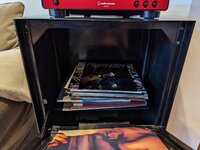
So practice and the race went well. I took the kids with me on Saturday night hoping to get them interested in their bikes again. I've learned a lot about patience this past year. Trying to
make them do things never works but bringing them to the race, handing them $20 to buy whatever they want from the concession and then telling them they can do whatever they want as long as they watch my race and cheer - it makes for a fun night for them. At the end of the evening Lucas said, "I want to ride my motorcycle again - can we do that next week?" Yeah, of course.
Long game. Oh, and I won my first race on the new bike that night. It was the heat race but a win is a win especially if you're pressured all race by Scott Rounds. So yeah, a good night.
There was a guy taking photos that night but I've not gotten any from him yet - hopefully I will and I can post those but...
This week, with the kids at moms, I had time to start work on the turntable. I reached out to Rick, my old boss at the hifi shop, and he sent me a kit that would update the turntable. The Linn LP-12 has been around in its basic form for 50 years and over that time it's been continuously refined and updated. That fact makes it either loved or hated in the goofy world of hifi. Loved because you can keep updating your turntable to get the benefits of new technology or hated because you think it's a scam to fleece you - why didn't they just make right the first time?
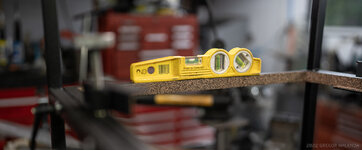
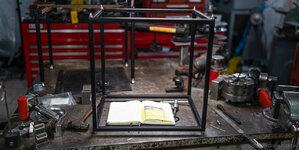
First step: level the jig.
In my mind the LP-12 is the Porsche 911 of the audio world. A good idea that has been continually refined as research/development and technology evolves. The reason the 911 didn't have fuel injection when it was first produced is because it didn't exist. Material sciences and computer technology have come a long way in the last 50 years.

Festool light coming in clutch.

I try to start with as much organization as I can: Festool screwdriver, Snap on wrenches etc.
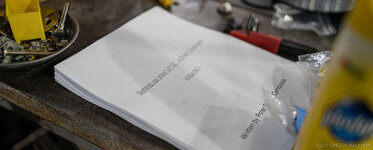
Despite having done this before I read all 90+ pages of set up manual found online. It's been a while after all. It was some nice light reading...
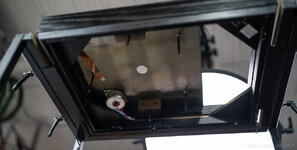
It didn't take long to strip the whole thing down to the base.
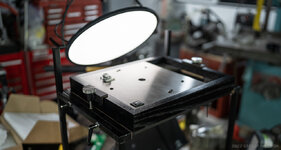
With the chassis stripped I went over the small scratches with a sharpie to fill them in and gave it a quick wipe down with some Pledge - you know, because that's what I do.

The new sub-chassis is CNC'd from aluminum (aerospace aluminum! - it's just a 7000 series) that's bonded to a steel frame - it's not rocket science but it's a stronger part but I had to drill out the armboard for the tonearm rest.

The whole upgrade is this simple bearing. Still a single point bearing but with changes in material science, hardness and friction technologies this is supposedly a big improvement. Plus a few bags of fasteners, grommets and springs.

The three springs that support the whole chassis/subchassis arrangement.
The Linn philosophy is that you start at the source. If you lose music in the beginning - the turntable, your speakers aren't going to magically find that again. They can only play what they get fed or as they say in computers: garbage in garbage out. It makes sense but hasn't always been a popular philosophy.
The bearing has
incredibly tight tolerances and so does the rest of the sub chassis. It's hard to imagine that this will make a big difference and yet small differences add up to big ones.

While the springs are supposed to be the same they never are so I measured how much force each applied to the scale for a 2mm press with the Mitutoyo height gauge. Is this overkill? Yes. Is it fun to use tools to solve a problem? Yes.
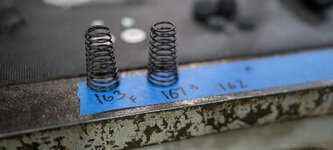
Depending on their strength they go different places in the chassis. This facilitates the ease of setup.

When I worked in the hifi shop I had zero mechanical ability and so this was my introduction to the concept of "tuning." Tuning, in this definition, is the mechanical refinement of parts to achieve a balance or an optimum result. At the time this seemed like a black art to me and much of the hifi world treated the idea of "tuning" a Linn to be a black art. Rick was one of the best at it.
It isn't a black art. It's a simple mechanical device with a pretty basic set up that needs some delicate attention but it isn't, much like everything in the world, rocket science.
The goal of tuning this turntable is to get the suspension to evenly bounce. That's it. An even bounce with a slow decay means that you've got it setup without any binding or external forces acting on it and thus it's pretty well isolated in the chassis. A simple design that has been perfectly refined. Just like the 911.


With the turntable parts installed it was time to put the tonearm back in but first the new cartridge is installed. Tiny wires required the binocular magnifying glasses.

I pulled out my Starrett Machinist Level as a joke but when I set it on the table I realized how incredibly sensitive it is and how much easier it is to use and so I actually ended up using it to fine tune the table to level - and you're leveling it because that's how the suspension is designed to be optimal. Which just makes sense - the springs are vertical and so you want a repeatable and consistent base. Level is universal.

It takes 24 drops of "special" Linn oil to lubricate the new bearing. Not sure what it is but obviously oil technology has come a long way in 50 years too.

So this is the whole thing - a single point bearing on the platter. Super low resistance but also zero runout. That's a hard thing to achieve and when you're trying to pick up micro vibrations you need as little slop in the system as possible. I
still have my doubts about this because the bearing looks pretty much the same on the spindle.
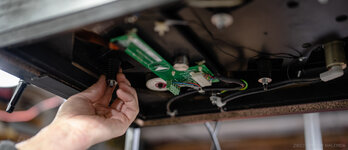
Here's the "black art" part of it - you spin the springs and their bushings until you get a perfect vertical bounce. It's not a black art though - it's just getting three springs to all be bind free and centered which, like jetting a carb or setting a motorcycle suspension, takes some patience because each twist effects the other springs. Twist, bounce, adjust, repeat.
It was surprisingly easy.
The turntable came to me pretty well set up but now I can see the difference in it being
perfectly set up. There's zero binding, zero drift or resonance and the decay lasts for a long time because there's zero forces interfering. I guess all those years of working on motorcycles had a side effect of making me more mechanically sensitive.

This is the very fancy alignment/protractor jig to make sure the tonearm and cartridge are aligned and square. I do not understand 70% of it and I suspect that 70% of it is to take up the space left after you use the two grid boxes.
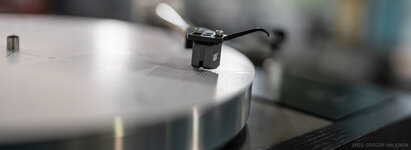
I had to pull out the binocular magnifiers again to see the alignment perfectly but, again, it didn't take much but some careful finesse.
All done but the listening!

Ween is another one of those bands that I love but missed on vinyl and it does not disappoint.
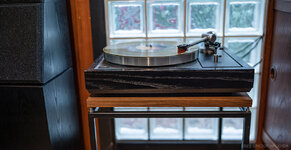
The sound now is tighter, cleaner and, and this is really a strange phenomenon that I can't explain but it's, much, much quieter in the background. Just overall better. I'm also super happy with the choice of the veneer for the turntable stand - it just helps tie things together. I'm going to do the same again when I build the stand for the gear.
The lamp came from ebay via Portugal and all I needed to do was rewire the plug. The bulb is a 240v 60w bulb but ends up being perfect on 120v as it's very,
very dim making only the softest glow.
Let's take a quick moment to reflect on the larger journey here.
Here's a photo from the real estate listing of the house - in 2010:

When I look at this photo I'm pretty speechless...

...and when I look at this photo I'm pretty speechless too - but for different reasons. When we bought this house I saw
this under all
that. Did I have
any idea how much work it was going to be? Not in the slightest.
When we moved in the living room was the room that no one ever sat in. It felt disconnected and lacked warmth - it wasn't cozy. Now it feels warm, inviting and comfortable. It feels like what this house was or should have been. It's filled with amazing music and light. Thank you for following along on this journey.
It makes me happy.
Gregor






























 .
.