To avoid these ads, REGISTER NOW!

Steel box mud rings and covers

Shovelhead

Well-known member
Joined
Dec 22, 2018
Messages
397
Location
DEEP EAST TEXAS
I’ve got 4S deep boxes set for a single receptacle and 3/4” mud rings.
Some are mounted on a common wall between shop and a room built inside the shop.
Since the T1-11 5/8” siding was already up before I started wiring I had to cut it so the receptacles on the shop side would be flush with the wall. The picture shows how I cut the wall to only expose the mud ring and not the 4” box.

Question is, are these steel mud rings designed to be screwed on the box and never have access to their screws?
If I were to cut out for the 4” box and use the single device mud ring, a standard cover plate wouldn’t cover it.

I do not like the looks of oversized cover plates.

Next question.
I have three 4S boxes dedicated for future 240v woodworking tools. I want to wire them for 120v right now.

Since I don’t know what 240v receptacle may wind up in these boxes, what 3/4” mud rings should I use that would allow me to swap from a single gang 120 receptacle to a 240 receptacle in the future?
I’m thinking I may need to make my wall cutouts the size of the box in order to change out the mud ring later on.
And that would require a big *** cover plate.

Is there a single round 120v receptacle I could use that would fit a 3/4” mud ring, and also fit a 240v receptacle?

Thanks1F6B6833-35E1-404C-A79F-66D6E6EE879B.jpeg0F753462-2BD4-4F54-97FB-487CB44C6F7D.jpeg
 
To avoid these ads, REGISTER NOW!

pbon

Well-known member
Joined
May 14, 2017
Messages
3,498
I am just a DIYer but don’t use mud rings. If I have a wall open that will be getting drywall, I set the box to where it will be flush with the drywall, whether that is 3/8 or 1/2 or 5/8.

If working on a wall with plaster or drywall in place, I try to find a stud and locate the outlet or switch on the stud. I like the heavy gray plastic boxes that have angled screws in them to allow you to set the depth of the box. I’ll use old work boxes if a stud is not an option. Sometimes I will use a metal switch box and thin screws if mounting to a wood baseboard or even plaster and lath (the cover will hide the screw heads). For any outlet that is going to be pulled on regularly (unnamed users other than me), I really try to mount it to a stud.

I have used plastic box extenders before, like when putting drywall over existing plaster or drywall. Maybe I will try mud rings one day when the opportunity arises — seems like a good way to turn a double box into a single opening so the box can serve as a junction without stuffing wires into it.
 

mcbane

Well-known member
Joined
Jul 23, 2017
Messages
794
Location
California
I’ve got 4S deep boxes set for a single receptacle and 3/4” mud rings.
Some are mounted on a common wall between shop and a room built inside the shop.
Since the T1-11 5/8” siding was already up before I started wiring I had to cut it so the receptacles on the shop side would be flush with the wall. The picture shows how I cut the wall to only expose the mud ring and not the 4” box.

Question is, are these steel mud rings designed to be screwed on the box and never have access to their screws?
If I were to cut out for the 4” box and use the single device mud ring, a standard cover plate wouldn’t cover it.

I do not like the looks of oversized cover plates.

Next question.
I have three 4S boxes dedicated for future 240v woodworking tools. I want to wire them for 120v right now.

Since I don’t know what 240v receptacle may wind up in these boxes, what 3/4” mud rings should I use that would allow me to swap from a single gang 120 receptacle to a 240 receptacle in the future?
I’m thinking I may need to make my wall cutouts the size of the box in order to change out the mud ring later on.
And that would require a big *** cover plate.

Is there a single round 120v receptacle I could use that would fit a 3/4” mud ring, and also fit a 240v receptacle?

Thanks1F6B6833-35E1-404C-A79F-66D6E6EE879B.jpeg0F753462-2BD4-4F54-97FB-487CB44C6F7D.jpeg
Once installed, the mud ring screws are kind of like the spot welds that hold the steel box together (which you typically wouldn't be grinding out and rewelding).
 
OP
S

Shovelhead

Well-known member
Joined
Dec 22, 2018
Messages
397
Location
DEEP EAST TEXAS
Once installed, the mud ring screws are kind of like the spot welds that hold the steel box together (which you typically wouldn't be grinding out and rewelding).

What I figured. The problem with how I have them now is someday replacing a receptacle. It's a ***** to stuff the wires in through that single gang mud ring and it's edges sharp as a cheap knife.

I found this but don't know if the physical size would be the same as a 240v. I know nothing about all the different NEMA this and that.
At Lowes last week and there wasn't a 3/4" single gang mud ring to be had. I imagine finding one with a round opening will be fun.

https://www.homedepot.com/p/Leviton...t-Single-Outlet-White-R52-T5015-0WS/202066674
 

yatg

Well-known member
Joined
Aug 16, 2019
Messages
2,836
Location
Southern Oregon
#2 - use a 2g mud ring and get the appropriate cover for your receptacle. The receptacle mounts on the box/ring, the plate mounts to the receptacle.

1673293714065.png
1673293764643.png
 

sparky 1971

Well-known member
Joined
Oct 9, 2018
Messages
7,994
Location
Central Iowa
I’ve got 4S deep boxes set for a single receptacle and 3/4” mud rings.
Some are mounted on a common wall between shop and a room built inside the shop.
Since the T1-11 5/8” siding was already up before I started wiring I had to cut it so the receptacles on the shop side would be flush with the wall. The picture shows how I cut the wall to only expose the mud ring and not the 4” box.
That's the way it's supposed to be

Question is, are these steel mud rings designed to be screwed on the box and never have access to their screws?
If I were to cut out for the 4” box and use the single device mud ring, a standard cover plate wouldn’t cover it.
Access to the box screws isn't necessary.


I do not like the looks of oversized cover plates.

Next question.
I have three 4S boxes dedicated for future 240v woodworking tools. I want to wire them for 120v right now.

Since I don’t know what 240v receptacle may wind up in these boxes, what 3/4” mud rings should I use that would allow me to swap from a single gang 120 receptacle to a 240 receptacle in the future?
I’m thinking I may need to make my wall cutouts the size of the box in order to change out the mud ring later on.
And that would require a big *** cover plate.
A 15 or 20 amp 240 volt single receptacle uses a single gang ring, the same as a 120 volt duplex or single receptacle. The singles will also use the same cover plate. If it's the boxes in the picture, you will be fine when it comes time to swap receptacles.
Is there a single round 120v receptacle I could use that would fit a 3/4” mud ring, and also fit a 240v receptacle?

Thanks1F6B6833-35E1-404C-A79F-66D6E6EE879B.jpeg0F753462-2BD4-4F54-97FB-487CB44C6F7D.jpeg
If the box in question is the one in the picture with the smurf pipe run to it, that looks like #10 which would be a 30 amp (6-30R). I've never done it, but those will fit in a single gang box, so you could put a single gang mud ring there. If you make it a 120 volt receptacle for now, you aren't supposed to re-identify one of those wires as a neutral, so to be up to snuff as far as the code goes, you should pull a white wire to it. I won't say what I would do because someone might get offended. You could also install a two gang mud ring and make a quad receptacle, even pull a neutral over to it and make it a MWBC and have two 120 circuits there for now.
 

Attachments

  • single plate 30-50.jpg
    single plate 30-50.jpg
    11 KB · Views: 25
Last edited:

sparky 1971

Well-known member
Joined
Oct 9, 2018
Messages
7,994
Location
Central Iowa
What I figured. The problem with how I have them now is someday replacing a receptacle. It's a ***** to stuff the wires in through that single gang mud ring and it's edges sharp as a cheap knife.

I found this but don't know if the physical size would be the same as a 240v. I know nothing about all the different NEMA this and that.
At Lowes last week and there wasn't a 3/4" single gang mud ring to be had. I imagine finding one with a round opening will be fun.

https://www.homedepot.com/p/Leviton...t-Single-Outlet-White-R52-T5015-0WS/202066674
That's a 15 amp 120 volt. It uses the same cover plate as a 20 amp 120 and a 15 and 20 amp 240 receptacle. You'll be ok using single gangs.
 
OP
S

Shovelhead

Well-known member
Joined
Dec 22, 2018
Messages
397
Location
DEEP EAST TEXAS
Appreciate it sparky.
So really I need to be darn certain a 6-30R will mount in a single gang mud ring prior to closing this wall, and covering up the mud ring mounting screws.

Yessir the box with the smurf has #10.
Unintentionally offending someone ain't never bothered me. I have a roll of white tape.
 

yatg

Well-known member
Joined
Aug 16, 2019
Messages
2,836
Location
Southern Oregon
Get a mudring with the slots (Raco). You might need to drill out the slot at the ends, and use an 8-32 nut on the receptacle screw threads. If you don't want to mess with that, put 2 120v receptacles there, leave one dead, and use a standard 2 gang receptacle plate. You will hate fishing around in the box through a single gang ring.


1673299623831.png
 
OP
S

Shovelhead

Well-known member
Joined
Dec 22, 2018
Messages
397
Location
DEEP EAST TEXAS
You can drill and tap the mud ring. I've had to do it a couple of times.

Well how does a 6-30R and cover plate typically mount in a 4S steel box? Are they all surface mount or what?
I know clothes dryers and ovens have in wall receptacles.
Tryin to figure out what makes my shop boxes any different. Other than the stinking mud rings.
 
To avoid these ads, REGISTER NOW!

sparky 1971

Well-known member
Joined
Oct 9, 2018
Messages
7,994
Location
Central Iowa
Well how does a 6-30R and cover plate typically mount in a 4S steel box? Are they all surface mount or what?
I know clothes dryers and ovens have in wall receptacles.
Tryin to figure out what makes my shop boxes any different. Other than the stinking mud rings.
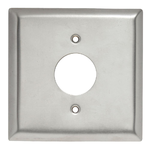
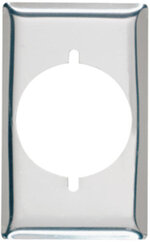
The larger 30 and 50 Amp receptacles have three sets of screws holes across the top and bottom. The center holes match up with a single gang, the outside sets match up to a two gang. The cover plate mounts to the receptacle through factory threaded 6/32 holes. Those line up with the notches at the top and bottom of the receptacle hole in the plate I posted. You could use a single gang mud ring and still use a two gang cover plate if you wanted.
 
OP
S

Shovelhead

Well-known member
Joined
Dec 22, 2018
Messages
397
Location
DEEP EAST TEXAS
Get a mudring with the slots (Raco). You might need to drill out the slot at the ends, and use an 8-32 nut on the receptacle screw threads. If you don't want to mess with that, put 2 120v receptacles there, leave one dead, and use a standard 2 gang receptacle plate. You will hate fishing around in the box through a single gang ring.


1673299623831.png

I was thinking that exact same thing about using two 120v receptacles, one being a dummy, for now.
I'd still like to see the proper mud ring for a 240v single receptacle(6-30R).
But. I bet you are 100% correct in saying I'd be fighting changing it out later through a single gang ring.
Thanks
 
OP
S

Shovelhead

Well-known member
Joined
Dec 22, 2018
Messages
397
Location
DEEP EAST TEXAS
The larger 30 and 50 Amp receptacles have three sets of screws holes across the top and bottom. The center holes match up with a single gang, the outside sets match up to a two gang. The cover plate mounts to the receptacle through factory threaded 6/32 holes. Those line up with the notches at the top and bottom of the receptacle hole in the plate I posted. You could use a single gang mud ring and still use a two gang cover plate if you wanted.
Ok, coming back to me a little now. Remembering 30A RV receptacles I've done in the past.
 

sparky 1971

Well-known member
Joined
Oct 9, 2018
Messages
7,994
Location
Central Iowa
I was thinking that exact same thing about using two 120v receptacles, one being a dummy, for now.
I'd still like to see the proper mud ring for a 240v single receptacle(6-30R).
But. I bet you are 100% correct in saying I'd be fighting changing it out later through a single gang ring.
Thanks
Why **** around making one a dummy? Make them both hot. If I knew it was going to be a 6-30, I would use a two gang. If it turned out that it's going to be a 20 Amp 240, just drill and tap the ringfor 6/32 screws 1/4" off center. The two gang plate will still cover the hole.
 

sparky 1971

Well-known member
Joined
Oct 9, 2018
Messages
7,994
Location
Central Iowa
I was thinking that exact same thing about using two 120v receptacles, one being a dummy, for now.
I'd still like to see the proper mud ring for a 240v single receptacle(6-30R).
But. I bet you are 100% correct in saying I'd be fighting changing it out later through a single gang ring.
Thanks
I just checked using a 6-50R which is the same physical size as a 6-30. It fits a single gang easily. You won't have an issue with stranded wire.
 
OP
S

Shovelhead

Well-known member
Joined
Dec 22, 2018
Messages
397
Location
DEEP EAST TEXAS
Why **** around making one a dummy? Make them both hot. If I knew it was going to be a 6-30, I would use a two gang. If it turned out that it's going to be a 20 Amp 240, just drill and tap the ringfor 6/32 screws 1/4" off center. The two gang plate will still cover the hole.
Hahaha.
Well, that particular box will have nothing but a table saw plugged in to it.
And, good point about "if I knew it was going to be a 6-30". I don't, and I may die before I ever own a 240v saw. And. In all likelyhood, will probably be 240v @ 20A, in which case I could have ran #12.

This place will be where I see my last sunset man, so I been trying to cover anything that the future may bring.
 

sparky 1971

Well-known member
Joined
Oct 9, 2018
Messages
7,994
Location
Central Iowa
Hahaha.
Well, that particular box will have nothing but a table saw plugged in to it.
And, good point about "if I knew it was going to be a 6-30". I don't, and I may die before I ever own a 240v saw. And. In all likelyhood, will probably be 240v @ 20A, in which case I could have ran #12.

This place will be where I see my last sunset man, so I been trying to cover anything that the future may bring.
I've seen a total of two home shop 240 volt table saws and they both needed a 20 Amp receptacle. Just use a single gang and if you need it to be a 6-30 in the future you'll still be ok.
 

yatg

Well-known member
Joined
Aug 16, 2019
Messages
2,836
Location
Southern Oregon
All the round receptacles, 6-30r, 14-30r, 14-50r, etc use the same hole pattern in the mounting plate and get screwed directly to the mud ring.
IMG_2851_800x600.jpg
 

pbon

Well-known member
Joined
May 14, 2017
Messages
3,498
If you think you may need a lower gauge wire later, could you use a square box now and run wire into it, with the other end in a junction box that will be accessible later? It is hard to plan for the unknown. I am fortunate to have an unfinished basement under my shop (I’d finish it but the floor is gravel and the ceiling is not 6’ tall).
 

sparky 1971

Well-known member
Joined
Oct 9, 2018
Messages
7,994
Location
Central Iowa
If you think you may need a lower gauge wire later, could you use a square box now and run wire into it, with the other end in a junction box that will be accessible later? It is hard to plan for the unknown. I am fortunate to have an unfinished basement under my shop (I’d finish it but the floor is gravel and the ceiling is not 6’ tall).
It will be fine with #10, even if a 15 Amp device is used.
 
To avoid these ads, REGISTER NOW!
Top Bottom