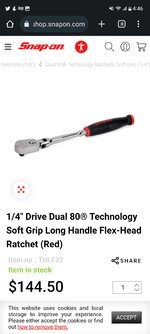
Not true, exact same mechanism. Only diff in the kits are the screws. The screws going through the body are supposed to be stronger, but don't know why SO doesn't do it for all of them.The THLL ones have a slightly different mechanism. There's an additional retaining clip under the cover plate and the repair kits are different.
Right - I don't know why I thought there was a circlip. I must be remembering another ratchet; maybe the 3/8 fhllf. But, the 1/4 kits are different as you mentioned.Not true, exact same mechanism. Only diff in the kits are the screws. The screws going through the body are supposed to be stronger, but don't know why SO doesn't do it for all of them.
Is it the longer handled ones that have screws through the body?The screws going through the body are supposed to be stronger, but don't know why SO doesn't do it for all of them.
it is done for those with longer handle so that extra torque is possible in theory. they suppose people don't use cheater pipes.Not true, exact same mechanism. Only diff in the kits are the screws. The screws going through the body are supposed to be stronger, but don't know why SO doesn't do it for all of them.
Yes. There's also the argument of possible striped threads and if it did happen, you'd only need to replace the plate, but the SO screws are quite long and I don't see that happening.Is it the longer handled ones that have screws through the body?
You're more likely to bend the handle on a 1/4" than to cause any damage to the head.it is done for those with longer handle so that extra torque is possible in theory. they suppose people don't use cheater pipes.
Maybe, want to find some test video to prove that?You're more likely to bend the handle on a 1/4" than to cause any damage to the head.
My long handle 1/4 snappy ratchet on its third rebuild kit begs to differ. Handle is still straight as an arrow, even after 3 broken square drives.You're more likely to bend the handle on a 1/4" than to cause any damage to the head.
I was referring to the plate design. I agree that the anvil is the weak point, but to say through screws make it a stronger design is moot. I'm saying you're more likely to bend the handle than to explode the ratchet head just because it didn't screw all the way through.My long handle 1/4 snappy ratchet on its third rebuild kit begs to differ. Handle is still straight as an arrow, even after 3 broken square drives.
Chris (ClientGraphics) does a lot of ratchet tests. Not SO specifically, but he does show some brands (Tekton) where the handle bends before the ratchet fails and Tekton doesn't have the through screw design.Maybe, want to find some test video to prove that?
I don't think it's an issue with loose screws. The screws have loctite from the factory.Was there an update/redesign based on people saying that the screws got loose?
We are only talking about snap on here. Those evidence is irrelevant. If you don’t think the decision is related to strength, what is your conclusion?Chris (ClientGraphics) does a lot of ratchet tests. Not SO specifically, but he does show some brands (Tekton) where the handle bends before the ratchet fails and Tekton doesn't have the through screw design.
It is relevant. The discussion is about whether or not a through screw design is stronger than screw to body. I'm saying it most likely doesn't matter because there are other failure points to consider, SO or not. What's your beef?We are only talking about snap on here. Those evidence is irrelevant. If you don’t think the decision is related to strength, what is your conclusion?
What’s tekton’s design? Unless it’s identical to SO, why is it informative? They might have different failure points.It is relevant. The discussion is about whether or not a through screw design is stronger than screw to body. I'm saying it most likely doesn't matter because there are other failure points to consider, SO or not. What's your beef?