To avoid these ads, REGISTER NOW!

Rebuilding a monarch 10ee lathe

OP
G

Grant Gunderson

Well-known member
Joined
May 17, 2013
Messages
2,319
Location
Bellingham, WA
Next o the list is getting the feed / feed screw shafts back on the machine.
IMG_0297.jpeg
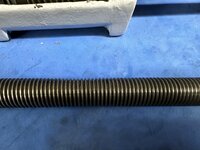
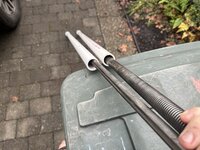
They were filthy. Caked full of old oil and scarf. First idea was to spray them down with brake cleaner. I quick abandoned that idea.
IMG_0303.jpeg
I decided best thing was to give them a soak in degreaser, so I dropped them into some PVS pipe, capped the ends and filled with degrease and left them for a few days to soak.
IMG_0566.jpeg
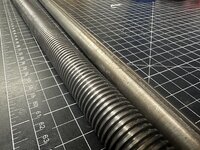
The degreaser soak was just the ticket! Saved me a ton of time brushing them and kept me from breathing brakes clean fumes, which my body reacts poorly too.
IMG_0569.jpeg
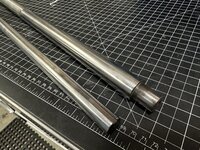
I then gave them a quick polishing on my Baldor buffer.
IMG_0572.jpeg
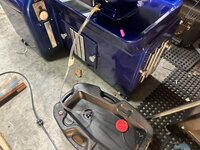
I originally planed on installing them with the apron on the lathe. I quickly realized that just wasn't possible. So it gave me a reason to test the drain valve I installed in the apron. That worked wonders and I had no mess from draining it!
IMG_0575.jpeg
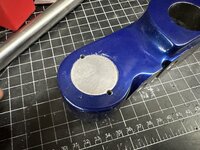
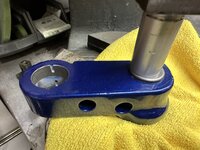
While the apron was draining, I started to work on prepping the feed rod plate. It uses two SKF 2202 ETN9 bearings.
IMG_0584.jpeg
These are a double row angular contact bearing. The originals where fully seized up.
IMG_0576.jpeg
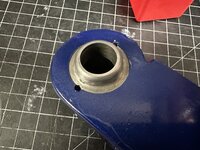
The inner bushing for the lead screw gets pressed in with the arbor press.
IMG_0577.jpeg
I then use a cupped bearing drift to press in the inner bushing for the feed rod.
IMG_0579.jpeg
 
To avoid these ads, REGISTER NOW!
OP
G

Grant Gunderson

Well-known member
Joined
May 17, 2013
Messages
2,319
Location
Bellingham, WA
IMG_0580.jpeg
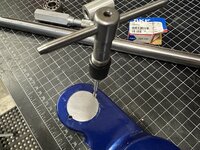
The feed rod inner bushing is locked in place by two 8-32 set screws. So I chased the holes with an 8-32 roll form tap
IMG_0582.jpeg
and then secured it with two 8-32 dog point set screws.
IMG_0586.jpeg
Using a bearing drift I then pressed the angular contact bearings into each of the bores from the outboard side.
IMG_0587.jpeg
It's surprising that there is no provision to lube these bearing in service. Adding a Zerk fitting may not have been a bad idea, but problem with that is no wear for the new grease to push the old out to. So I packed the area behind the Feed rod bearing with Super Lube grease then pressed in its dust cover.
IMG_0588.jpeg
I chased its holes and secured it with two more dog point 8-32 screws.
IMG_0590.jpeg
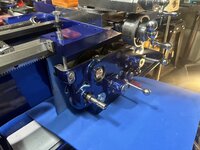
With the feed rod plate prepped, I then lowered the apron again using the bolt, nut and spacer technique. I placed some foam bellow and behind to protect the paint. I then discounted the oil line for the saddle and moved the apron back to the work bench.
IMG_0592.jpeg
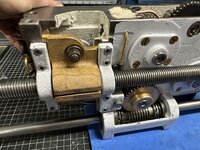
The feed rod needs to pass through these two bushings on the back of the apron and the worm gear with its internal key needs to slide into the keyway in the feed rod. That was surprisingly easy to do.
IMG_0611.jpeg
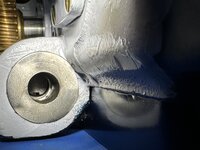
My lead screw has a significant amount of wear in one section. See above.
IMG_0613.jpeg
compared to the rest of the lead screw. It must have spent its entire previous life making a short thread section in the middle of the bed length. Taking with my Dad that sounds consistent with making the containers for fuel rods, which is what he thought many of these where used for. That brought up a pretty interesting conversation. Apparently he interviewed for his position at the Navy Nuclear Propulsion lab with Admiral Rickover. Apparently Rickover had a chain he had all applicants sit in that he had cut one leg short on to make the person being interviewed to feel uncomfortable. My dad stat down immediately noticed the chair had a lopsided leg, got up when to the book shelf in the office, grabbed a book and placed it under the chair leg. He ended up getting the job. He said he found out latter that Rickover used that as a test for all of his canidates.
IMG_0609.jpeg
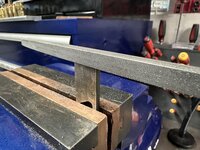
The problem with the wear section of the screw is where it's worn, the interlock key wont properly engage. After analyzing it, the problem is when I adjust the half nuts on the apron to work for all sections of the lead screw there is sections where the key is too long. So I filed it down just a hair, and that seemed to work perfectly.
 
OP
G

Grant Gunderson

Well-known member
Joined
May 17, 2013
Messages
2,319
Location
Bellingham, WA
IMG_0614.jpeg
I then set the bottom half nut to engage as much as possible at the thickest portion of the lead screw.
IMG_0615.jpeg
I then adjusted the top half nut.
IMG_0616.jpeg
Once I was happy with how it was set at the extremes of the lead screw, I then tested it at the most worn section. I'm quite happy with it now.
IMG_0617.jpeg
After I assembled the apron and initially filled it with way oil, I noticed the only leak was from the sight glass. The o-ring I had used behind the backer rolled on installation and was leaking.
IMG_0618.jpeg
I decided to revert back to the original cork replacements ones I made. I then installed them in the gear box and headstock as well.
IMG_0649.jpeg
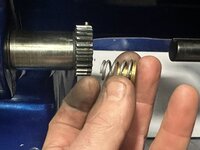
A friend then helped me reinstall the apron with the lead screw and feed rods installed. I could then connect the feed rod. It has a brass bushing that goes into the gear box end. It's supposed to have a spring behind it that I lost. Luckily I had a conical spring on hand that was a perfect fit, I just hope its got enough compression resistance!
IMG_0650.jpeg
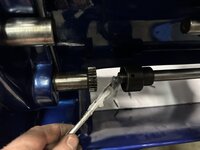
I blued up the stop collar and then slid it onto the feed rod.
IMG_0653.jpeg
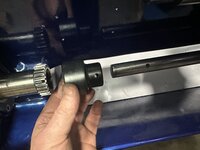
The feed rod clutch slides on next.
IMG_0655.jpeg
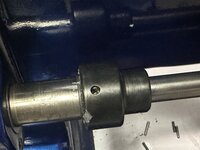
It gets secured with a #3 tapper pin.
IMG_0657.jpeg
 
Last edited:
OP
G

Grant Gunderson

Well-known member
Joined
May 17, 2013
Messages
2,319
Location
Bellingham, WA
IMG_0658.jpeg
I lubed the feed rod clutch with Super Lube.
IMG_0659.jpeg
and then slid it together.
IMG_0661.jpeg
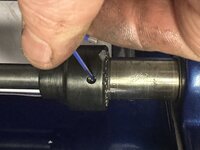
A 6-32 dog point set screw then gets inserted into the clutch.
IMG_0666.jpeg
I then set the feed rod stop collar for now, but will need to readjust its position once I have a chuck on the lathe.
IMG_0662.jpeg
I then slid the lead screw into the gear box collar and drove in its #3 tapper pin to secure it.
IMG_0668.jpeg
I can now install the Feed Rod Plate. I being by adding Tef-Gel to the bolt threads.
IMG_0670.jpeg
I slide the Feed Rod plate onto the two shafts, and then very loosely tighten then its mounting bolts.
IMG_0672.jpeg
I then drive in its large alignment pin.
IMG_0675.jpeg
I then place the retaining ring onto the lead screw.
IMG_0676.jpeg
and then pack the cavity full of Super Lube as there is no provision to lubricate this under normal operation. I can then tap in its dust cap.
 
OP
G

Grant Gunderson

Well-known member
Joined
May 17, 2013
Messages
2,319
Location
Bellingham, WA
IMG_0677.jpeg
I then tap in its dust cap and then fully tighten down the brackets two bolts.
IMG_0684.jpeg
I then use Ted-Gel to prep the spindle for its cam locks.
IMG_0685.jpeg
These small shouldered bushings are what hold the cams in place. They have bore on the backside that holds there springs in place.
IMG_0686.jpeg
The cams all have a notch that is in alignment with the mark on them.
IMG_0687.jpeg
The cams go into each of their bores, then I install the bushings that retain them.
IMG_0688.jpeg
and finally install the screws that retain the spring loaded bushings.
IMG_0680.jpeg
IMG_0682.jpeg
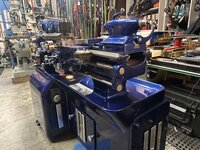
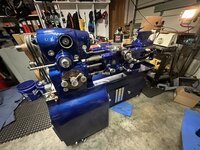
All of the major mechanical portions of the lathe are now done! I still need to paint the drive end covers, and some small parts, plus I need to take the various knobs, plaques, RPM bezel, etc in to get chromed when funds allow. Finally I'll need to finish sorting the power for it. Still more work to be done on the conversion to single phase. It's taken me 3 years (lots of big breaks for work and life events) and a hell of a lot of sweat and countless hours to get to this point. Quite frankly when I started I honestly didnt know if I could complete this project or if it was going to be over my head. I've had a hell of a lot of enjoyment out of working on it to get to this point and learned more than I ever imagined. More to come, but next on my list if a good cleaning of the shop as the lathe parts have taken up every inch of every horizontal space for the last 3 years.
 
OP
G

Grant Gunderson

Well-known member
Joined
May 17, 2013
Messages
2,319
Location
Bellingham, WA
Congratulations on getting it back together!
You definitely tackled a marathon of a project.

That blue paint really pops, and takes the entire machine to the next level (accurately reflecting all the amazing work on the internals as well).
Thanks! By far the most intensive and complicated project I've ever done. I feel doing full reservation of a classic car would have been simpler.

Has anyone had much luck with those DIY copper / nickle/ chrome platting kits? Given the quote I got locally for doing all of the small knobs/ etc. I think it may be my only viable option. I feel like they gave me a go away price not wanting to do it as they are booked out months.
 

Cruzan80

Well-known member
Joined
Jul 22, 2015
Messages
4,189
Location
Denver, CO
Can't wait to see this under power! If it were me, I would have already set up a 3ph motor to pull-start (and tap off of) just so I could see this thing turning and making chips (even if basic). Looks amazing!
 

dutchgray

Well-known member
Joined
Sep 28, 2014
Messages
6,465
Location
Dorset. England.
Nice work
I haven't been able to follow most of this as once there gets to be a certain number of pics per page it will no longer load for me (fairly slow Internet) and it's really pic heavy.

Really do need to get it running and try it out.
Do anything you can to keep the original workings, they were designed to have rapid acceleration and deceleration ability and to produce high torque at slow speeds.
Most replacement drives are not as capable as original fit.
 

tarmy

Well-known member
Joined
May 28, 2014
Messages
4,663
Location
Nor Cal
That thing turned out SPECTACULAR!

I have posted and been following since you got started. You have not only done a great job doing the work…but your documentation is outstanding. Way to take an old piece of machinery and make it something anybody would want.

YOU ****…and I know that you know how to take that!
 
OP
G

Grant Gunderson

Well-known member
Joined
May 17, 2013
Messages
2,319
Location
Bellingham, WA
Can't wait to see this under power! If it were me, I would have already set up a 3ph motor to pull-start (and tap off of) just so I could see this thing turning and making chips (even if basic). Looks amazing!
Thanks! Need to rebuild some garage cabinets, so it will fit the place I have in mind and then run power. Still debating doing the 220 conversion, VS, using another means to convert to 3 Phase... decisions to be made.
Nice work
I haven't been able to follow most of this as once there gets to be a certain number of pics per page it will no longer load for me (fairly slow Internet) and it's really pic heavy.

Really do need to get it running and try it out.
Do anything you can to keep the original workings, they were designed to have rapid acceleration and deceleration ability and to produce high torque at slow speeds.
Most replacement drives are not as capable as original fit.
Thanks!
Plan is to keep the original drives 100% in tact. I have done some testing on them, but more to do before Im ready to power it up.
That thing turned out SPECTACULAR!

I have posted and been following since you got started. You have not only done a great job doing the work…but your documentation is outstanding. Way to take an old piece of machinery and make it something anybody would want.

YOU ****…and I know that you know how to take that!
Thank you! I think I have a lot of seat equity into now!
 

fartymarty

Well-known member
Joined
Nov 9, 2012
Messages
1,348
Location
Fort Worth
Can't wait to see this under power! If it were me, I would have already set up a 3ph motor to pull-start (and tap off of) just so I could see this thing turning and making chips (even if basic). Looks amazing!

No way, it's a museum piece now. It just needs a slow rotating pedestal and a ceiling mounted ring of lights. :love:

I think I have a lot of seat equity into now!
I'm thinking we have the "seat" equity, and you have the "sweat" equity.

What a beautiful machine, and documenting it the way you have makes it as beautiful on the inside as the outside (not to mention the value $ added to it just because of the documentation). Again, thanks for sharing with us. (but yeah, you do ****. ;) )
 
OP
G

Grant Gunderson

Well-known member
Joined
May 17, 2013
Messages
2,319
Location
Bellingham, WA
No way, it's a museum piece now. It just needs a slow rotating pedestal and a ceiling mounted ring of lights. :love:


I'm thinking we have the "seat" equity, and you have the "sweat" equity.

What a beautiful machine, and documenting it the way you have makes it as beautiful on the inside as the outside (not to mention the value $ added to it just because of the documentation). Again, thanks for sharing with us. (but yeah, you do ****. ;) )
Haha. Thanks! Damn Typos!
 
To avoid these ads, REGISTER NOW!

SilverJimmy

Well-known member
Joined
Apr 14, 2012
Messages
1,628
Location
Prescott/Flagstaff, AZ
Here your chance to be a HERO just like Grant!
The price is so low if all you needed were a couple parts it would be worth it. So sad to see such wonders of American Craftsmanship be abused like this!
 

zanyad

ALLIANCE MEMBER
Joined
Apr 26, 2018
Messages
2,760
Location
NE Ohio
IMG_8114.jpeg

I’m making my lady friend one of my favorite fall meals, Tartiflet. I first had it in the Savoie region of Switzerland and France and ended up learning how to make it over there. It’s classic alpine mountain food and will be delicious with the Chantrelles.
...
It’s basically just potatoes, garlic, bacon chantrells, thyme, rosemary, tarragon and white wine with some really stinky French / Swiss cheese, white wine and crème French.
I’ll start in on the gear box tomorrow if all goes to plan.
Anything that starts out by rendering bacon fat is fine by me!
 
OP
G

Grant Gunderson

Well-known member
Joined
May 17, 2013
Messages
2,319
Location
Bellingham, WA
Anything that starts out by rendering bacon fat is fine by me!
Haha! It seems to make just about everything better!
Just finished reading this whole thread, wow just wow.
Your attention to detail, engineering, tools and the end result is fantastic.
I will never do a restoration like this but thanks to all the pictures & write up I went on the journey with you, thanks. This is a must read for anybody owning 10EE.
Thanks. I never thought I would find myself doing it either, but I quite enjoyed the process. I got a few more months until I'm done with work season, hopefully finished with the divorce, and its warm / nice enough to finish the painting, so I'll be back at it and working on the electronics then.
 

930dreamer

Super Moderator
Staff member
Joined
Oct 7, 2009
Messages
22,943
Location
Amarillo,TX and Stinnett,TX
Here's a 10ee in Waco TX for $1250;

I asked the seller about it but no response.
 

Attachments

  • 427321476_25268597696087757_4202137307803714512_n.jpg
    427321476_25268597696087757_4202137307803714512_n.jpg
    143.4 KB · Views: 44
  • 430751110_7317630144990415_817912922584022792_n.jpg
    430751110_7317630144990415_817912922584022792_n.jpg
    126.1 KB · Views: 42
  • 430738588_7659096437435187_6641798475066640132_n.jpg
    430738588_7659096437435187_6641798475066640132_n.jpg
    140.6 KB · Views: 38
Last edited:

fozzy

Well-known member
Joined
Apr 15, 2011
Messages
235
Location
Florida
I have no idea how I missed this thread all these years but I spent the last 5 days reading from start to finish. I'm just speechless, absolutely amazing restoration, and I'm incredibly impressed with the OP's willingness to roll up his sleeves and just dive into pulling such precision machinery down to its last bolt to give it centuries more usefulness, all the while winning awards in his primary occupation. So impressive because I can take anything apart- it is the second part that tends to give me issues.

Bumping in case anyone else has missed this amazing awesomeness. It is Grant's world, we just live in it.
 
To avoid these ads, REGISTER NOW!
Top Bottom