
You are using an out of date browser. It may not display this or other websites correctly.
You should upgrade or use an alternative browser.
You should upgrade or use an alternative browser.
Lets make an all vintage Snap-on tool picture thread!
- Thread starter chad s
- Start date

d42jeep
Well-known member
Yesterday’s estate sale finds. I thought that the crowsfoot would be an AN marked but it was Snap-on. I assume that indicates that Snap-on was the supplier of the AN crowsfoot military versions. The 1/2” deep socket looks to be early and the other two sockets are Par-X.
-Don

-Don
dtmcustoms
New member
Oldest snap-on tool i have in my collection is a 1920 -Course 9 tooth No. 6. First version ratchet adapter with pat. Pending stamped on it and in good condition
d42jeep
Well-known member
I did a comparison of the Snap-on crowsfoot to my AN marked military ones and despite the similarities in design, there are some differences. The date code looks to be 1961.Yesterday’s estate sale finds. I thought that the crowsfoot would be an AN marked but it was Snap-on. I assume that indicates that Snap-on was the supplier of the AN crowsfoot military versions. The 1/2” deep socket looks to be early and the other two sockets are Par-X.
-Don


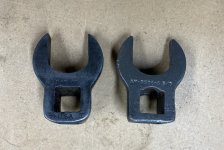


-Don
d42jeep
Well-known member
I cleaned up the early 1/2” drive 5/8” deep socket.
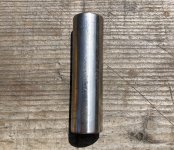 Here is a date code. Is that 1929?
It‘s 12 point.

-Don
Here is a date code. Is that 1929?It‘s 12 point.
-Don
Oldtuleguy
Well-known member
- Joined
- Nov 4, 2017
- Messages
- 10,458
Here's a sliding t extension with a lock pin, a1006 and a1003
Attachments


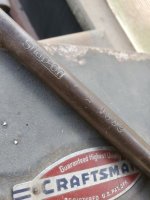
industrial, nice ones.Here's a sliding t extension with a lock pin, a1006 and a1003
Have you seen any without the different style detent ball? The little notches?there were at least two BP 9/32 drivers made. here is one. there was a earlier version with a different handle, but I do not think there is an example that still is intact, as they have disintegrated (there is a pic of one I had on the collectingsnapon site, but it has now disintegrated)

d42jeep
Well-known member
Here is my 9/32” drive Blue Point spinner in the early stage of disintegration. 
-Don
-Don
all the stubs I have, are notchedHave you seen any without the different style detent ball? The little notches?
oscarsnapkin
Well-known member
- Joined
- Feb 22, 2025
- Messages
- 477
So you can put a ratchet on the end of that? 3/4” drive?Here's a sliding t extension with a lock pin, a1006 and a1003
3baygarage
Well-known member
That is cool. Never seen that locking setup.Here's a sliding t extension with a lock pin, a1006 and a1003
3baygarage
Well-known member
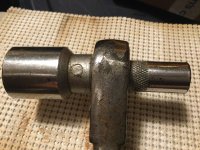
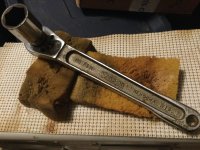
I’m not sure what to make of this scaffold ratchet. The hammer being part of the gear and not part of the head, never seen that way on a Snap-On.



Oldtuleguy
Well-known member
- Joined
- Nov 4, 2017
- Messages
- 10,458
No it's not broached for a ratchetSo you can put a ratchet on the end of that? 3/4” drive?
3baygarage
Well-known member
The more I look at that ratchet, the more It appears someone cobbled it together. The hammer tip looks an awful lot like the one on the Bog open gear, though the socket is different. When I get around to taking it apart, I’ll have to inspect the gear and see how it works so perfectly, almost like new, if it isn’t from Snap-On!
Redraptor
Well-known member


oscarsnapkin
Well-known member
- Joined
- Feb 22, 2025
- Messages
- 477
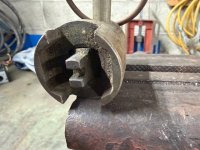
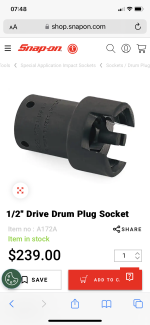
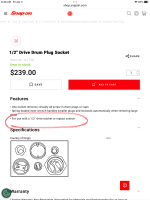
Very cool find. It is for opening drums/barrels. Here is the socket version.Found this tool in an old shop. Looks like something for shocks but not sure. Googling the Snap-on number doesn't give results.

oscarsnapkin
Well-known member
- Joined
- Feb 22, 2025
- Messages
- 477
Does the body have a hole for a ratchet? I’m wondering if that is just the socket I posted but with a hole drilled through it and a handle added by a previous owner? Look at where the handle goes through the body.Found this tool in an old shop. Looks like something for shocks but not sure. Googling the Snap-on number doesn't give results.
RTM
Well-known member
Does the body have a hole for a ratchet? I’m wondering if that is just the socket I posted but with a hole drilled through it and a handle added by a previous owner? Look at where the handle goes through the body.
Beerhippie
Well-known member
I have a cast-aluminum wrench that does the same thing. It cost $15.
oscarsnapkin
Well-known member
- Joined
- Feb 22, 2025
- Messages
- 477
I know the one from the catalog is a socket. I was asking about the one that the user posted that has a handle attached to it. I was wondering if it I simply a modified socket or if it was sold with the handle attached.
oscarsnapkin
Well-known member
- Joined
- Feb 22, 2025
- Messages
- 477
I know the one from the catalog is a socket. I was asking about the one that the user posted that has a handle attached to it. I was wondering if it I simply a modified socket or if it was sold with the handle attached.
RTM
Well-known member
Yup, little slow reading the references you quoted. Apologies.I know the one from the catalog is a socket. I was asking about the one that the user posted that has a handle attached to it. I was wondering if it I simply a modified socket or if it was sold with the handle attached.
TheRealZeus
Well-known member
Is “NS” the date code for the socket?
JustVicingIt
Well-known member
- Joined
- May 6, 2025
- Messages
- 179
Thrift store find today for $40.


d42jeep
Well-known member
I was happy to find this 1/2” drive 1944 dated K-4 speeder at this morning’s estate sale. 
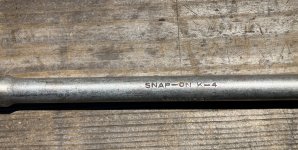
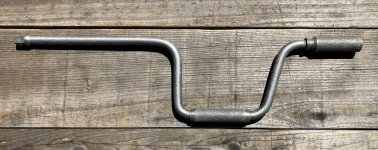
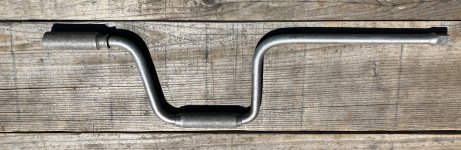
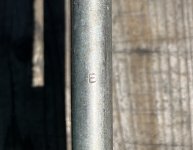
-Don
-Don
Redraptor
Well-known member
Yes. It has a 1/2" drive in the end. Strange and expensive tool for the intended purpose. Thanks for the response.Does the body have a hole for a ratchet? I’m wondering if that is just the socket I posted but with a hole drilled through it and a handle added by a previous owner? Look at where the handle goes through the body.
d42jeep
Well-known member
Two Snap-on finds at yesterday’s estate sale. I was particularly happy to find the 7mm combo as that one was missing from my user box. 

Added to the others in the metric rack.
The other tool was a 3/8” drive 8mm hex bit. I’m having trouble deciphering the date code. Any opinions?

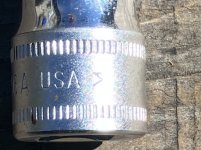
It turned out to be a duplicate so it will head to the summer home in a month or so.
-Don
Added to the others in the metric rack.
The other tool was a 3/8” drive 8mm hex bit. I’m having trouble deciphering the date code. Any opinions?
It turned out to be a duplicate so it will head to the summer home in a month or so.
-Don
Last edited:
oscarsnapkin
Well-known member
- Joined
- Feb 22, 2025
- Messages
- 477
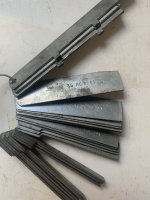
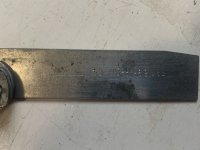
Just picked up this set of carburetor adjustment gauges. There doesn’t seem to be a date code on them. Anyone have a clue as to when they might have been made or if the ring they are attached to is original?

LNKMK8
Well-known member


Standard Power sockets P or PDH sometimes had the GM or Ford equivalent# stamped on them. Maybe they changed the SOP over the years. Is there a date code? ....or maybe I misunderstand the question completely.Wondering if anyone knew the story on this socket? Appears to be a standard 15/16" impact P-300-1/2 but has a GM and Ford number on it. Item number comes up as a regular socket in the catalogs.
LNKMK8
Well-known member
I couldn't find a date code.. same estate had a few other Snap-on pieces from the early 1940's
3baygarage
Well-known member
Pretty cool. Never seen one with the auto numbers.
Smokeshow69
Well-known member
Very cool story. I was just listening to a podcast yesterday that was talking about all the ww2 gliders in crates being scrapped postIn the years just after WWII, aluminum was used to make many things that later were made of other materials. The reason for this was that the aircraft production was geared up so high, and the war ended so fast, that there was a lot of unused aluminum sheet left over.
Pretty quickly after VJ Day, military aircraft started being scrapped in large numbers. I have a large farm shed that my grandfather had erected that used the timber frame from a WWII training camp truck shop. It is still covered with the corrugated aluminum roofing from 1953. Made of melted down B-17's and B-24's.
War for the value of the wood crates that folks used to build things around their houses/farms. As to your truck shop shed are you referring to Camp Adair?
d42jeep
Well-known member
I found this 14mm socket packed full of dirt and grease at this morning’s estate sale. Looks to have a date code of 1983. 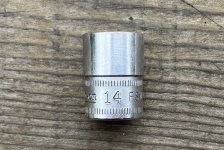
Cleaned up.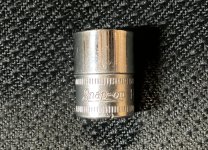


-Don
Cleaned up.
-Don


msharley
Well-known member
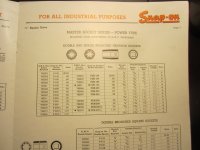
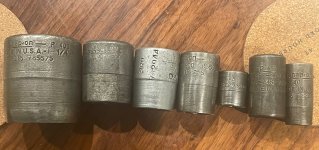
In my experience the actual numbers alone are quite a bit less unusual than being labeled ie. "Ford" or "G.M.C" before the numbers as in the OP's example. All these sockets I pulled are stamped with 3 unique ID numbers....not all visible in one pic but they do.yes, quite unusual to see all three model numbers. probably late 30s or to late 40s. power socket, pic is from a 48 industrial cat
Attachments
BlakeTheCarGuy
ALLIANCE MEMBER
One of our great forum members here didn’t leave a name or username sent me this vintage Snap-on 3/4 ratchet and a 3/8 T-Handle that says Snap-on Ferret on it. Not sure exactly what that means but it’s quite interesting. I love unexpected surprise packages lol. Someone from Ohio. I can definitely use this. I’ve often found myself grabbing 3/4 to work on dad’s semi truck. And the 3/8 T-Handle is super cool. I believe the T-Handle is dated 1955 and then the ratchet appears to be dated 1951.


